14.26
View the full transcript and gain access to JoVE Core videos
Q1: What are the two main pathways for converting nitriles to carboxylic acids?
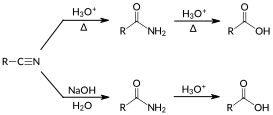
Nitriles undergo acid-catalyzed hydrolysis or base-catalyzed hydrolysis, both proceeding through nucleophilic acyl substitution. Acid-catalyzed hydrolysis uses hot acidic conditions, while base-catalyzed hydrolysis employs aqueous base. Both pathways convert nitriles to carboxylic acids via an amide intermediate, replacing the carbon-nitrogen triple bond with three carbon-oxygen bonds.
Q2: Why is an amide intermediate formed during nitrile hydrolysis?
During nitrile hydrolysis, the carbon-nitrogen triple bond is initially attacked by a nucleophile, forming an amide intermediate before further hydrolysis occurs. In acid-catalyzed conditions, protonation of the nitrile nitrogen makes the carbon more susceptible to water attack. This intermediate step is essential because the amide must then undergo a second hydrolysis to yield the final carboxylic acid product.
Q3: How does acid-catalyzed nitrile hydrolysis differ mechanistically from base-catalyzed hydrolysis?
Acid-catalyzed hydrolysis protonates the nitrile nitrogen first, activating the carbon for nucleophilic water attack. Base-catalyzed hydrolysis uses hydroxide ions as the nucleophile attacking the nitrile carbon directly. Both form amide intermediates, but acid-catalyzed conditions require heating with aqueous acid, while base-catalyzed conditions use aqueous base followed by acidification to yield free carboxylic acid.
Q4: What role does the tetrahedral intermediate play in nitrile hydrolysis?
The tetrahedral intermediate forms when water or hydroxide attacks the amide carbonyl carbon during the second hydrolysis step. This unstable intermediate collapses by eliminating ammonia or amide ion as a leaving group, reconstructing the carbonyl group. This collapse is crucial for converting the amide to the final carboxylic acid product.
Q5: Is nitrile hydrolysis reversible, and what does this mean for the reaction?
Nitrile hydrolysis is a reversible reaction where the carbon-nitrogen triple bond is replaced with three carbon-oxygen bonds to form a carboxylic acid. Reversibility means the reaction can proceed in both directions under appropriate conditions, though the forward reaction to carboxylic acid is typically favored under the hydrolysis conditions employed in synthesis.
Q6: What happens to the nitrogen atom during the conversion of nitriles to carboxylic acids?
During acid-catalyzed hydrolysis, the nitrile nitrogen is protonated and eventually converted to an ammonium ion as a byproduct. In base-catalyzed hydrolysis, the nitrogen is initially protonated by water, then eliminated as ammonia. In both pathways, the nitrogen leaves the molecule as the carbon-oxygen bonds form, allowing the carboxylic acid to be the primary organic product.
Q7: Why are hot acidic conditions necessary for acid-catalyzed nitrile hydrolysis?
Hot acidic conditions provide the protons needed to activate the nitrile nitrogen and protonate intermediates throughout the reaction mechanism. Heat increases molecular motion and reaction rate, facilitating both the initial nucleophilic attack by water and the subsequent hydrolysis of the amide intermediate. These conditions drive the reaction forward to completion, ensuring efficient conversion to carboxylic acid.