16.6
View the full transcript and gain access to JoVE Core videos
Q1: Why does 1,3-butadiene produce two different products when reacting with HBr?
1,3-butadiene has two equally reactive double bonds, so HBr can add to either one. The proton adds to a terminal carbon, forming a resonance-stabilized allylic carbocation intermediate. The bromide ion then attacks either carbon of this intermediate, yielding both 1,2- and 1,4-addition products as a mixture.
Q2: What is an allylic carbocation and why does it form in this reaction?
An allylic carbocation is a positively charged carbon adjacent to a double bond. In HBr addition to 1,3-butadiene, the proton attacks a terminal carbon to form this intermediate because it is resonance stabilized. This stabilization makes the allylic carbocation more favorable than a primary carbocation would be.
Q3: How do 1,2- and 1,4-addition products differ in structure?
In 1,2-addition, the bromide attacks the second carbon of the allylic intermediate, adding HBr across one double bond. In 1,4-addition, bromide attacks the fourth carbon, resulting in HBr addition across the conjugated system with a new double bond between carbons two and three.
Q4: How does temperature affect the ratio of 1,2- and 1,4-addition products?
Temperature controls product distribution in this reaction. At lower temperatures, the 1,2-adduct is favored, while higher temperatures favor the 1,4-adduct. This temperature dependence reflects the thermodynamic and kinetic control of the reaction pathway, where kinetic factors dominate at low temperature and thermodynamic factors at high temperature.
Q5: How does HBr addition to 1,3-butadiene differ from addition to a simple alkene?
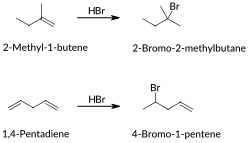
Simple alkenes undergo single electrophilic addition following Markovnikov's rule, yielding one product. Conjugated dienes like 1,3-butadiene have two reactive double bonds, so HBr addition produces a mixture of 1,2- and 1,4-adducts instead of a single product. The presence of two double bonds creates multiple reaction pathways.
Q6: What role does the nucleophilic attack step play in determining product identity?
After the allylic carbocation forms, the bromide ion nucleophilically attacks one of two carbons bearing positive charge. Attack at the second carbon gives the 1,2-product, while attack at the fourth carbon yields the 1,4-product. The position of nucleophilic attack determines which isomer forms.
Q7: Why is the allylic carbocation intermediate favored over other possible carbocations?
The allylic carbocation is resonance stabilized, meaning the positive charge is distributed across two carbons through pi-electron delocalization. This resonance stabilization makes it significantly more stable than a primary carbocation, so proton addition preferentially occurs at the terminal carbon to form this intermediate.
Explore Related Chapters