16.7
View the full transcript and gain access to JoVE Core videos
Q1: What is the mechanism of halogen addition to conjugated dienes?
When halogens like bromine react with conjugated dienes, one of the π bonds attacks the electrophilic center on the polarized halogen, displacing a halide ion and forming a halonium ion intermediate. The displaced halide ion then attacks the intermediate at one of two carbons, opening the ring and forming either a 1,2-adduct or 1,4-adduct product.
Q2: Why does bromide ion prefer attacking C2 over C1 in the bromonium ion intermediate?
Between C1 and C2, carbon 2 is the secondary carbon that can stabilize the positive charge better than C1. This makes C2 the preferred site for nucleophilic attack by the bromide ion, resulting in the formation of the 1,2-adduct as the major product at lower temperatures.
Q3: How does temperature affect the ratio of 1,2-adduct to 1,4-adduct products?
The 1,2-dihalide is favored at lower temperatures, while the 1,4-dihalide becomes dominant at higher temperatures. This temperature dependence reflects the difference in reaction kinetics and thermodynamics, where lower temperatures favor the kinetically controlled 1,2-product and higher temperatures favor the thermodynamically controlled 1,4-product.
Q4: What is the difference between 1,2-addition and 1,4-addition products?
In 1,2-addition, the halide ion attacks at C2, forming a product with the new bonds at adjacent carbons. In 1,4-addition, the halide ion attacks at C4, which moves the double bond to the adjacent position and displaces the bromonium ion at C2, creating a product with the new bonds separated by one carbon.
Q5: How does the halonium ion intermediate form in halogen addition to dienes?
A nucleophilic attack by one of the diene π bonds on the electrophilic center of the polarized halogen molecule forms the halonium ion intermediate. This cyclic intermediate contains a three-membered ring with the halogen and two carbons from the diene, setting up the subsequent nucleophilic attack by the displaced halide ion.
Q6: What determines whether a 1,2-dihalide or vicinal dihalide forms in halogen addition?
The formation of 1,2-dihalide or vicinal dihalide depends on where the displaced halide ion attacks the halonium ion intermediate. Attack at C2 gives the 1,2-product, while attack at C4 gives the 1,4-addition product. The reaction temperature controls which pathway is favored.
Q7: How does halogen addition to conjugated dienes differ from halogen addition to simple alkenes?
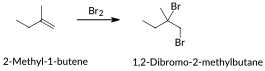
Electrophilic addition of halogens to simple alkenes produces only a 1,2-dihalide or vicinal dihalide. Conjugated dienes, however, form both 1,2-dihalide and 1,4-dihalide products because the conjugated system allows the halide ion to attack at two different carbons of the halonium intermediate.
Explore Related Chapters