This protocol describes an in vivo micro-PET imaging strategy combined with behavioral and molecular assays to dynamically evaluate the effects of electroacupuncture on β-amyloid deposition and cognitive function in an Alzheimer's disease mouse model.
Method Article
Imaging Strategies for Acupuncture Intervention in Alzheimer's Disease Model Mice
1Department of Traditional Chinese Medicine, General Hospital of the Chinese People's Liberation Army, 2Meizhou Hospital of Guangzhou University of Chinese Medicine (Meizhou Hospital of Traditional Chinese Medicine), 3School of Traditional Chinese Medicine, Capital Medical University, 4Department of Psychosomatic Medicine, Beijing Hospital of Traditional Chinese Medicine Affiliated to Capital Medical University
Opens in a new tab
In This Article
Summary
Loading...
$$\rightleftharpoonup{xx}$$
$$\longleftharp{xx}$$,
$$\longrightharp{xx}$$,
Abstract
Loading...
$$\rightleftharpoonup{xx}$$
$$\longleftharp{xx}$$,
$$\longrightharp{xx}$$,
Alzheimer's disease (AD) is a neurodegenerative disorder primarily characterized by progressive cognitive dysfunction. One of its typical pathological features is the formation of senile plaques in the brain due to the deposition of β-amyloid (Aβ) proteins. Acupuncture has demonstrated potential in clinical practice for improving cognitive function in AD patients. However, its dynamic effects on Aβ pathology require objective elucidation through modern technological approaches. Micro-positron emission tomography (micro-PET) provides a powerful tool for in vivo, non-invasive observation of Aβ deposition in the brains of AD model mice. In this protocol, we detail an imaging strategy utilizing [18F]AV-45 micro-PET to assess the effects of electroacupuncture intervention, complemented by Morris Water Maze behavioral testing and Western blot molecular analysis. The integrated approach enables the visualization and quantification of Aβ pathological progression in the brains of AD model mice. This provides objective and quantitative evidence to explore the regulatory effect of acupuncture on Aβ deposition. By integrating traditional Chinese medicine principles with modern molecular imaging and molecular biology technologies.
Introduction
Loading...
$$\rightleftharpoonup{xx}$$
$$\longleftharp{xx}$$,
$$\longrightharp{xx}$$,
In vivo monitoring of β-amyloid(Aβ) deposition in the brain is crucial for assessing the pathological progression of AD1. Following the clinical application of Aβ-targeted antibody therapies (e.g., Lecanemab), longitudinal and quantitative evaluation of cerebral Aβ load using PET has emerged as a gold standard for determining therapeutic efficacy2. While acupuncture has demonstrated potential in preclinical studies for modulating Aβ metabolism, traditional research approaches have largely relied on ex vivo analyses, lacking effective tools for the direct and objective assessment of its dynamic impact on Aβ deposition in living organisms. In recent years, advancements in molecular imaging technologies have created opportunities to address this gap. micro-PET has enabled the non-invasive, longitudinal observation of Aβ deposition in AD model mice1. More importantly, novel imaging strategies are evolving from single-target approaches towards multimodal paradigms. For instance, studies have confirmed that different structural subtypes of Aβ fibrils exhibit varying binding affinities to commonly used PET tracers, raising new demands for precise quantification3. Concurrently, emerging techniques such as neuroimmune imaging (e.g., TSPO PET) and assessments of blood-brain barrier function offer unprecedented perspectives for comprehensively elucidating the complex pathological mechanisms of AD and the multi-target effects of therapeutic interventions4.
Based on this foundation, this study aims to develop an advanced micro-PET imaging strategy utilizing the latest Aβ-specific probes to dynamically and quantitatively assess the impact of acupuncture intervention on Aβ deposition in the brains of AD model mice in vivo. The study will not only validate the therapeutic efficacy of acupuncture but also strive to provide direct evidence for its underlying mechanisms at the molecular imaging level.
Protocol
Loading...
$$\rightleftharpoonup{xx}$$
$$\longleftharp{xx}$$,
$$\longrightharp{xx}$$,
Conduct all experiments in accordance with the Guidelines for the Care and Use of Laboratory Animals issued by the National Institutes of Health. The study protocol was approved by the Experimental Animal Ethics Committee of Beijing University of Chinese Medicine (No.: bucm-4-2021102707-5421).
1. Experimental animals' preparation
- Obtain 6-month-old male APP/PS1 mice and age- and gender-matched C57BL/6 mice weighing 28.0 ± 2.0 g.
- House the mice in standard cages at a room temperature of 24 ± 2 °C with a humidity of 40%–60%.
NOTE: The animals were housed in standard cages at the Laboratory Animal Center of Beijing University of Chinese Medicine, Capital Medical University. - Keep the animals under a standard 12 h light/dark cycle (dark period: 8:00 PM to 8:00 AM)with free access to food and water. Change the bedding daily to ensure clean and dry housing conditions.
- Acclimate the animals to the laboratory environment for 7 days. Begin experiments on the eighth day following acclimation.
2. Animal grouping and interventions
- Randomly assign twenty 6-month-old male APP/PS1 mice to an Alzheimer's disease model group (AD group, n = 10) and an electroacupuncture group (EA group, n = 10). Assign ten age- and sex-matched C57BL/6N mice to a normal control group (N group, n = 10).
- Identify the three acupoints on the head for the intervention: GV20 (Baihui), GV26 (Shuigou), and GV29 (Yintang).
NOTE: The localization of acupoints is based on the "Animal Acupuncture Acupoint Atlas" formulated by the Experimental Acupuncture Research Society of the China Association of Acupuncture-Moxibustion. GV20 is situated at the midpoint between the tips of both ears; GV29 lies at the midpoint between the medial ends of the eyebrows; and GV26 is located below the nasal septum of the mouse, at the junction of the lower two-thirds and upper one-third of the midline of the lip cleft. The schematic diagram is shown in Figure 1. - Administer electroacupuncture stimulation to the EA group once daily for 20 min over 15 consecutive days.
- Restrain the mouse securely using identical custom-designed cloth restraint sleeves. Ensure the body is comfortably wrapped while the head remains fully exposed for accurate needle insertion and normal breathing.
- Prepare disposable sterile acupuncture needles (0.25 mm × 13 mm).
- Apply a quick pricking method (rapid insertion and immediate withdrawal without retention) to the GV26 (Shuigou) acupoint using the sterile acupuncture needle.
- Connect the handles of the needles at GV20 and GV29 to the output clips of an electronic electroacupuncture apparatus.
- Set the stimulation parameters on the apparatus to deliver a continuous sparse wave, with a frequency of 2 Hz, a constant voltage of 2 V, and a current intensity of 0.1 mA.
- Observe the mouse carefully and verify that the stimulation intensity induces a mild, rhythmic trembling of the mouse's head.
- Maintain mice in the N and AD groups under identical housing conditions without any intervention. Subject the N and AD groups to the same daily handling and restraint procedures as the EA group throughout the 15-day period to ensure consistency in experimental conditions.
3. The Morris water maze (MWM) test
NOTE: The behavioral framework (Morris Water Maze) builds upon our prior work5.
- Apparatus preparation
- Place a circular water tank (90 cm in diameter, 50 cm in depth) in the testing room. Fill the tank with water (22 ± 2 °C) to a depth of 30 cm.
- Add 0.5 kg of skimmed milk powder to the water to render it opaque. Virtually divide the tank into four equal quadrants (I, II, III, and IV).
- Position an escape platform (circular, 5 cm in diameter, 28 cm in height) in the center of quadrant I.
- Place distinct visual cues of different shapes on the inner wall of each quadrant to help the mouse learn and memorize the platform location.
- Mount a digital camera 2 m above the center of the tank on the ceiling and connect it to an image acquisition system6.
- Habituation
- Remove the platform from the tank on the day before the hidden platform test. Allow the mouse to swim freely in the tank for 90 s each in the morning and afternoon to acclimate to the experimental environment.
- Hidden platform test
- Conduct the hidden platform test over five consecutive days.
- Select starting points from the second, third, and fourth quadrants, respectively, ensuring each starting point is equidistant from the center of the tank.
- Place the mouse into the water, facing the tank wall. Allow the mouse 10 s to observe its surroundings after being placed into the water.
- Record the escape latency and swimming path if the mouse locates the hidden platform and remains on it for 5 s within a 60 s limit. Guide the mouse onto the platform manually if it fails to find the platform within 60 s.
- Allow the animal to remain on the platform for 10 s to observe and memorize the location, and record the escape latency as 60 s.
- Spatial probe test
- Remove the hidden platform from the tank following five consecutive days of hidden platform training.
- Place each mouse into the water from one of the starting points located in the second, third, or fourth quadrant. Allow the mouse to swim freely for 60 s. Record the swimming path and the time spent in the target quadrant (quadrant I).
- Return all mice to their home cages immediately between trials to minimize direct contact with the experimenter.
4. Western blot analysis
- Euthanize six mice per group 24 h after the completion of the 15-day intervention. Quickly dissect and isolate fresh hippocampal tissues on ice.
- Weigh the hippocampal tissues and place them into pre-chilled microcentrifuge tubes. Add cold RIPA lysis buffer supplemented with 1% protease inhibitor cocktail and 1% phosphatase inhibitor cocktail at a ratio of 10 µL buffer per 1 mg of tissue.
- Homogenize the tissues thoroughly using a mechanical tissue homogenizer on ice. Centrifuge the homogenates at 12,000 x g for 15 min at 4 °C to remove cellular debris. Carefully collect the supernatant and transfer it to a new, pre-chilled microcentrifuge tube.
- Mix the protein samples with 5× SDS loading buffer and boil the mixture at 95 °C for 10 min to fully denature the proteins. Load equal amounts of protein (20 µg) per well onto a 15% SDS-PAGE gel. Include a pre-stained protein molecular weight marker in one adjacent well.
- Run the stacking gel at a constant voltage of 80 V for 30 min, and then resolve the proteins in the separating gel at 120 V until the bromophenol blue dye front reaches the bottom of the gel.
- Transfer the separated proteins onto a 0.22 µm polyvinylidene fluoride (PVDF) membrane at a constant current of 250 mA for 90 min on ice. Block the PVDF membrane with 5% non-fat skim milk dissolved in Tris-buffered saline containing 0.1% Tween 20 (TBST) for 1 h at room temperature with gentle agitation on a shaker.
- Incubate the membrane with a primary antibody against Aβ (diluted [1:1000] in blocking buffer) and a primary antibody against GAPDH (diluted [1:5000] in blocking buffer) overnight at 4 °C on a horizontal shaker. Incubate the membrane with a horseradish peroxidase (HRP)-conjugated secondary antibody (diluted [1:2000] in blocking buffer) for 1 h at room temperature.
- Wash the membrane three times with TBST for 10 min each to remove unbound secondary antibodies.
- Apply an enhanced chemiluminescence (ECL) substrate to the membrane and capture the signal using a chemiluminescence imaging system.
- Quantify the protein band intensities using ImageJ software (version 1.53a). Normalize the grayscale values of the target bands to those of GAPDH, and calculate the relative expression levels of the proteins of interest.
5. [18F]AV-45 radiosynthesis
- Perform radiolabeling via nucleophilic substitution of 3.0 mg of the precursor compound with [18F]KF.
- Purify the product using high-performance liquid chromatography (HPLC) to achieve a radiochemical purity (RCP) greater than 95%.
- Dissolve the labeled compound in ethanol.
- Dilute the solution with 0.9% sodium chloride, and prepare the final product in 10% ethanol for subsequent use7.
6. In vivo PET imaging
- Select four mice randomly from each experimental group.
- Place the mouse on a circulating water heating pad (37 °C) or under a warming lamp for 5–10 min prior to the procedure to promote vasodilation of the tail veins.
- Secure the mouse in a suitable transparent cylindrical rodent restrainer, leaving the tail fully exposed. Disinfect the tail and further visualize the lateral tail veins by wiping the skin with a 70% ethanol swab.
- Draw the formulated[18F]AV-45 radiotracer into a 0.5 mL insulin syringe equipped with a needle. Prepare an injection volume of approximately 100–150 µL to achieve a target radioactivity dose of 3.0 MBq (radiochemical purity > 95%)2.
- Measure and record the initial radioactivity of the tracer-filled syringe using a dose calibrator.
- Insert the needle, bevel up, at a shallow angle (approximately 10°–20°) into the lateral tail vein. Wait 60 min after administration, then anesthetize the mouse by inhalation of 2% isoflurane.
- Position the mouse and acquire a 15-min three-dimensional static PET scan.
- Reconstruct the PET data using a three-dimensional ordered-subset expectation maximization (OSEM) algorithm.
- Process the reconstructed data with PMOD software (version 4.5).
- Co-register the data to a brain template suitable for small- to medium-sized mice within the PMOD fusion module. Allow the software to automatically delineate the regions of interest (ROIs) in the mouse brain.
- Calculate the standardized uptake values (SUVs). Obtain the standardized uptake value ratio (SUVR) by comparing the SUV of each ROI to that of the cerebellum8.
NOTE: The acceptable variability in the administered dose (2.0–3.8 MBq) accommodates daily radiotracer yield fluctuations and individual mouse body weights. Because subsequent quantifications rely on the standardized uptake value ratio (SUVR)—which normalizes the target region against a reference region (cerebellum)—absolute dose variations within this range do not compromise the comparative imaging outcomes. Micro-positron emission tomography (Micro-PET) is shown in Figure 2.
7. Statistical analysis
- Perform all statistical analyses using SPSS software (version 19.0).
- Present the data as mean ± standard deviation (SD).
- Apply one-way ANOVA to analyze the hidden platform test results.
- Analyze the data from the spatial probe test and PET imaging using repeated-measures ANOVA or one-way ANOVA, followed by LSD post-hoc tests for pairwise comparisons.
Results
Loading...
$$\rightleftharpoonup{xx}$$
$$\longleftharp{xx}$$,
$$\longrightharp{xx}$$,
Effect of electroacupuncture on cognitive function in APP/PS1 mice
To assess spatial learning ability, mice underwent training trials from day 1 to day 5. In the hidden platform test (Figure 3A,B), the escape latency of mice in all groups showed a decreasing trend over the training period. Compared with the N group, the AD group exhibited a significantly prolonged escape latency (p < 0.05), indicating pronounced learning and memory deficits in 6-month-old APP/PS1 mice. The escape latency in the AD group was significantly longer than that in both the N and EA groups (p < 0.01). Notably, on day 5, the escape latency in the EA group was significantly shorter than that in the AD group (p < 0.05) (Figure 3C). Following the 5‑day training period, spatial memory was evaluated using the spatial probe test. The ratio of time spent swimming in the target (platform) quadrant to the total swimming time was calculated; a higher ratio indicates better memory retention. The results showed that the swimming‑time ratio in the AD group was significantly lower than that in the N group (p < 0.01). In contrast, the EA group exhibited a significantly higher ratio compared with the AD group (p < 0.01). However, the ratio in the EA group remained lower than that in the N group (p < 0.05) (Figure 3D).
The number of platform crossings, which reflects the precision of spatial memory, was also analyzed. A greater number of crossings suggests better memory retention. The AD group displayed significantly fewer platform crossings than the N group (p < 0.05), whereas the EA group showed a significant increase compared with the AD group (p < 0.05). Nevertheless, the EA group still had fewer crossings than the N group (p < 0.05) (Figure 3E).
Effects of electroacupuncture on Aβ deposition in the hippocampus of APP/PS1 mice
Aβ deposition was evaluated using PET imaging, and the standardized uptake value ratio (SUVR) of the radiolabeled Aβ tracer was calculated in the hippocampus of APP/PS1 mice (Figure 4A). Micro‑PET scans revealed that both the N group and the EA group exhibited significantly lower SUVR values compared to the AD group (Figure 4B). Further quantitative analysis confirmed that the hippocampal SUVR and Aβ in the EA group were significantly higher than those in the N group(p < 0.05), while it remained significantly lower than that in the AD group following electroacupuncture intervention (p < 0.05) (Figure 4C).
Effects of electroacupuncture on Aβ protein expression
Following the behavioral and imaging assessments, Aβ protein expression in the hippocampus was evaluated via Western blot analysis (Figure 5A). Quantitative analysis revealed that the relative expression of Aβ in the AD group was significantly elevated compared to the N group (p < 0.05). The EA group exhibited a significant reduction in hippocampal Aβ expression compared to the AD group (p < 0.05). However, the expression levels in the EA group remained higher than those of the N group, indicating that while the intervention effectively attenuated Aβ accumulation, it did not completely clear the existing plaques (Figure 5B).
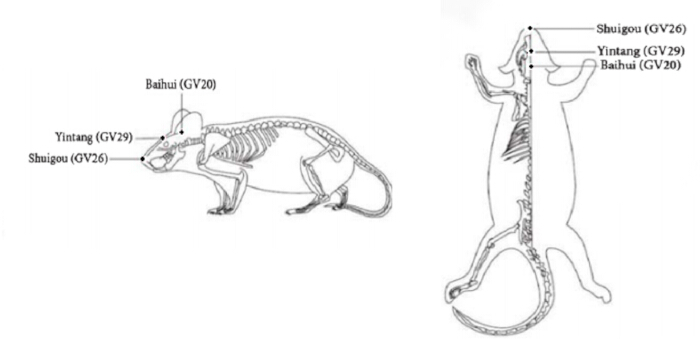
Figure 1: Schematic diagram showing the locations of the acupoints GV20 (Baihui), GV26 (Shuigou), and GV29 (Yintang) in mice. This figure has been reused with permission from Sun et al.5. Please click here to view a larger version of this figure.
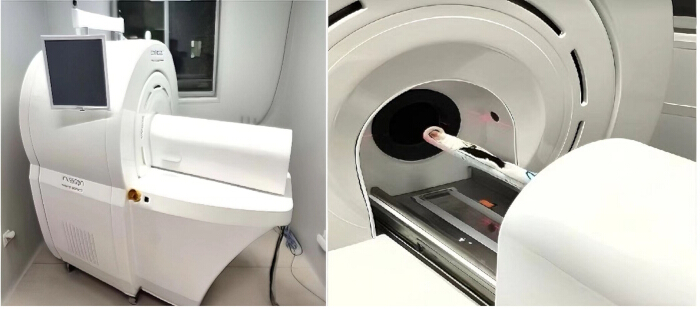
Figure 2: Micro-positron emission tomography (Micro-PET). The IRIS PET/CT (Inviscan) is a preclinical imaging system for mice and rats, featuring high sensitivity (>9%) and a spatial resolution of 1 mm with a 96 mm axial field of view. Please click here to view a larger version of this figure.
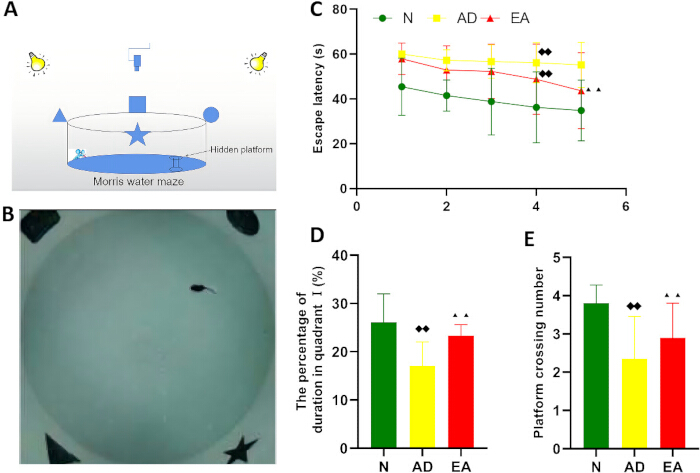
Figure 3: Effect of electroacupuncture on cognitive function. (A) MWM apparatus. (B) Mice were tested using the Morris water maze (MWM) apparatus. (C) Trends in escape latency during the hidden platform test. Compared to the N group, ◆◆p < 0.05; compared to the Alzheimer's disease (AD) group, ▲▲p < 0.05. (D) Proportion of swimming time in the first quadrant. Compared to the N group, ◆◆p < 0.05; compared to the AD group, ▲▲p < 0.05. (E) Number of platform crossings in the platform quadrant. Compared to the N group, ◆◆p < 0.05; compared to the AD group, ▲▲p < 0.05. This figure has been reused with permission from Sun et al.5. Please click here to view a larger version of this figure.
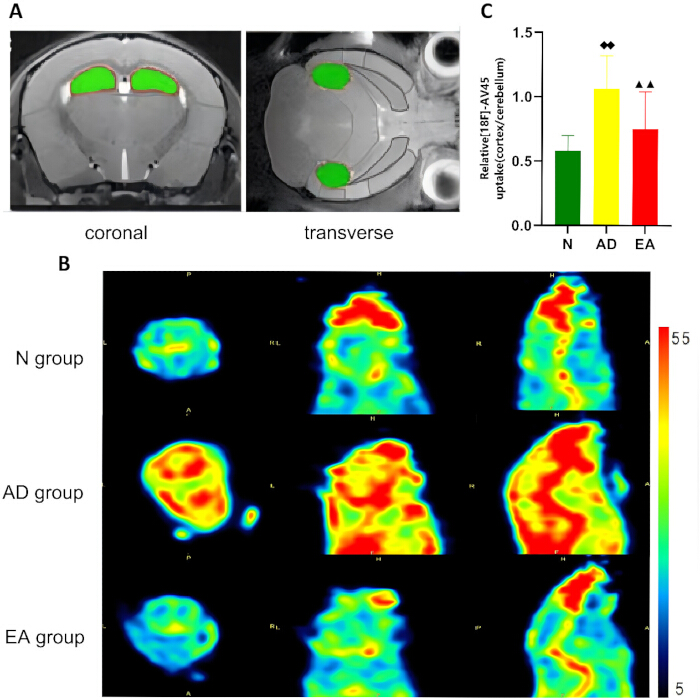
Figure 4: Effects of electroacupuncture on Aβ deposition. (A) The region of interest in the mouse hippocampus is displayed in green. (B) Micro-positron emission tomography images of Aβ in mice from each group. (C) Comparison of [18F]AV-45 standardized uptake value ratios (SUVR; target region/cerebellum) in the hippocampus of each group, quantified by micro-PET. Compared to the N group, ◆◆p < 0.05; compared to the Alzheimer's disease (AD) group,▲▲p < 0.05. This figure has been reused with permission from Sun et al.5. Please click here to view a larger version of this figure.
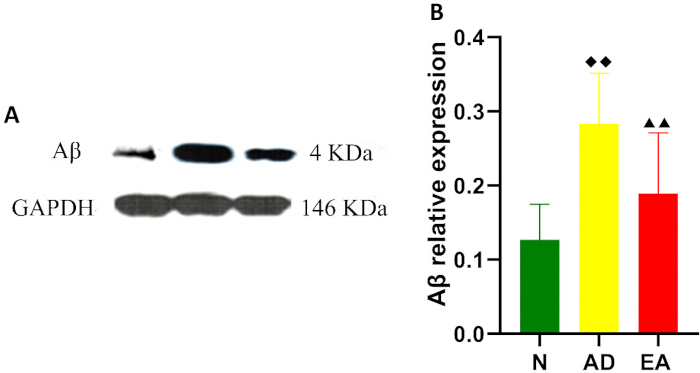
Figure 5: Effects of electroacupuncture on Aβ protein expression. (A) Representative Western blot bands showing the expression levels of Aβ (4 kDa) and GAPDH (146 kDa) as a loading control. The bands illustrate low Aβ expression in the N group, high expression in the AD group, and reduced expression in the EA group compared to the AD model. (B) Quantitative analysis of the relative expression of Aβ to GAPDH across the experimental groups. Compared to the N group, ◆◆p < 0.05; compared to the Alzheimer's disease (AD) group, ▲▲p < 0.05. This figure has been reused with permission from Sun et al.5. Please click here to view a larger version of this figure.
Discussion
Loading...
$$\rightleftharpoonup{xx}$$
$$\longleftharp{xx}$$,
$$\longrightharp{xx}$$,
Visualizing and quantifying A deposition in the hippocampus provides a pivotal window into the pathological progression of AD9. While multiple neuroimaging modalities exist, achieving high-resolution, quantitative, and cross-species translation remains a significant hurdle. For instance, near-infrared fluorescence imaging is frequently restricted by spatial resolution, and MRI—though capable of mapping structural alterations—often demands excessively high contrast agent doses to delineate amyloid plaques in vivo. By contrast, PET represents an optimal translational tool, allowing the dynamic assessment of neuroinflammation, glucose metabolism, and A accumulation in both animal models and clinical populations10,11. Molecular imaging via PET not only facilitates early diagnosis and precise pathological staging. but is also indispensable for monitoring the target engagement and efficacy of emerging AD therapeutics12. The advent of micro-PET technology in the preclinical arena has substantially expanded the utility of PET beyond clinical settings and non-human primate research. Characterized by superior spatial resolution and high sensitivity tailored to small fields of view, micro-PET enables researchers to track neurodegenerative progression in rodent models longitudinally13,14. Crucially, established quantitative metrics such as the SUVR-calculated relative to reference regions devoid of robust A pathology, such as the cerebellum, can be seamlessly translated from bench to bedside15. Historically, PET imaging utilizing specific tracers has exhibited high diagnostic sensitivity (up to 90%) and specificity (89%) for AD16,17. While [11C]PIB tracer revolutionized early amyloid visualization, its short half-life constrained its widespread deployment18. The subsequent development and 2012 FDA approval of [18F]AV-45 (Florbetapir) mitigated these limitations19, providing a longer half-life alongside excellent binding affinity and selectivity for Aβ. Consequently, [18F]AV-45 has become a staple for both clinical diagnostics and preclinical evaluations20.
Several critical steps and potential modifications must be considered when utilizing this protocol. First, rigorous control of the radiosynthesis parameters is essential; any deviation in the precursor amount or reaction temperature can severely compromise the radiochemical purity and yield of [18F]AV-45. Second, precise stereotaxic alignment during PET imaging is critical to avoid partial-volume effects, which can artificially skew SUVR calculations in small hippocampal regions of mice. For troubleshooting low signal-to-noise ratios in PET images, researchers should verify the specific activity of the injected tracer and ensure the isoflurane anesthesia depth remains stable, as respiratory motion can blur images.
This methodology has certain limitations. While the[18F]AV-45 micro-PET provides a macroscopic view of regional Aβ load, its spatial resolution does not permit the visualization of single, microscopic amyloid plaques. Furthermore, the 15-day electroacupuncture intervention implemented in this study demonstrated a significant attenuation of Aβ burden compared to untreated AD mice; however, given that complete clearance of established Aβ plaques typically requires months of sustained intervention, the current paradigm primarily reflects an early modulation of soluble Aβ dynamics or an arrest of progressive deposition rather than complete structural plaque clearance. Additionally, obtaining PET scans before and after the intervention within the same subject would provide a stronger longitudinal control, a strategy that should be adopted in future experimental designs.
In summary, the results of this study suggest that electroacupuncture (EA) intervention significantly mitigates Aβ accumulation and preserves spatial cognitive function in APP/PS1 mice. The mechanistic basis for this improvement may relate to the neuro-modulatory effects of stimulating Governor Vessel (Du Mai) acupoints21, which have been anatomically linked to fascial and neurovascular networks that promote cephalic blood flow and clearance pathways. By providing robust, quantifiable molecular imaging evidence, this protocol underscores the significance of integrating traditional therapeutic modalities with advanced neuroimaging. This methodological framework paves the way for deeper investigations into the therapeutic pathways of acupuncture in combating AD.
Disclosures
Loading...
$$\rightleftharpoonup{xx}$$
$$\longleftharp{xx}$$,
$$\longrightharp{xx}$$,
All authors have declared no potential conflicts of interest.
Acknowledgements
Loading...
$$\rightleftharpoonup{xx}$$
$$\longleftharp{xx}$$,
$$\longrightharp{xx}$$,
This research was supported by the National Natural Science Foundation of China (No. 82004482, 82274654, 82274644), Beijing Natural Science Foundation (No. 7252219), and the Innovation Cultivation Fund of the Sixth Medical Center of the PLA General Hospital (No. CXPY202405). We thank Biorender (biorender.com) for providing the graphical tools used in this study.
Materials
| Name | Company | Catalog Number | Comments |
|---|---|---|---|
| [18F]AV-45 | Radiopharmaceutical Laboratory of Beijing Normal University | —— | The most widely used tracer in the industry |
| 0.22 μm PVDF membrane | Beyotime | FFP71 | Efficient film transfer |
| 15% SDS-PAGE Gel | Beyotime | P0066 | Hinder the migration of small molecule proteins |
| 5× SDS loading buffer | Beyotime | P0015 | Ensure clear stripes and accurate separation. |
| 6-month-old male APP/PS1 mice | Cavenberg(Suzhou) Labotatory Animal Research Co.,Ltd. | SCXK (Su) 2018-0002 | Widely used for Alzheimer's disease research. |
| 6-month-old male C57BL/6 mice | Cavenberg(Suzhou) Labotatory Animal Research Co.,Ltd. | SCXK (Su) 2018-0002 | For the normal control group |
| Aβ antibody | proteintech | 25524-1-AP | Detecting A β monomer |
| Disposable sterile acupuncture needles | ZhongYan TaiHe Medicial Instrument Co.,Ltd | ZYTH2013030504 | Common acupuncture tools |
| ECL substrate | Thermo Fisher (Pierce) | 32106 (500 mL) | Detection of target proteins |
| Electroacupuncture (EA) apparatus | Beijing Huawei Industrial Development Co., Ltd. | HANSLH202 | Commonly used electroacupuncture equipment in China |
| GAPDH | proteintech | 23567-1-CB | Classic reference protein (1:5000) |
| HRP-conjugated secondary antibody | Thermo Fisher Scientific (Invitrogen) | 31430 (2mL) / C31430100 (100μL) | Detection of target proteins (1:2000) |
| ImageJ software | NIH | Version 1.53a | Analysis of strip grayscale values |
| Isoflurane | Centaur | 30135687 (250ml) | Safe and rapid anesthesia of mice |
| PET-CT | IRIS PET/CT imaging system | IRIS | High PET sensitivity and excellent quantitative performance |
| Phosphatase inhibitor cocktail | Beyotime | P0055B | Maintain the phosphorylation state of proteins |
| PMOD software | PMOD Technologies | Version 4.5 | Used for processing and analysis of PET image data |
| Pre-stained protein molecular weight marker | Thermo Fisher (Pierce) | 26619 (2×250µL) | Monitoring electrophoresis and membrane transfer |
| Protease inhibitor cocktail | Beyotime | P1046 | Broad spectrum inhibition of endogenous protease activity |
| RIPA lysis buffer | Beyotime | P0013C | Maintaining protein phosphorylation modification |
| Skimmed milk powder used in the Morris Water Maze apparatus | Yili | 6907992637815 | Make water opaque and hide underwater platforms |
| The Morris water maze system | Chengdu Taimeng Software Co., Ltd. | WMT-100S | Water maze equipment widely used in China |
References
Loading...
$$\rightleftharpoonup{xx}$$
$$\longleftharp{xx}$$,
$$\longrightharp{xx}$$,
- Chiotis, K., Wang, Y., La Joie, R., Rabinovici, G. D. The role of amyloid-β and tau PET in the new era of Alzheimer disease therapies. J Nucl Med. 67 (2), 175-185 (2026).
- Zhao, Q., et al. Unraveling Alzheimer's complexity with a distinct Aβ42 fibril type and specific AV-45 binding. Nat Chem Biol. 22 (3), 482-490 (2025).
- Machado, L. S., et al. Association between FDG- and TSPO-PET signals across human and animal studies investigating neurodegenerative conditions: a systematic review. Mol Psychiatry. 31 (1), 559-575 (2025).
- Yin, H., Lu, Z., Deng, Y., Tian, X., Gong, Q. Decoding blood-brain barrier dysfunction in Alzheimer's disease: innovations and challenges in multimodal MRI and PET imaging biomarkers. Ageing Res Rev. 114, 102952(2025).
- Sun, R. -Q., et al. Improvement of electroacupuncture on APP/PS1 transgenic mice in behavioral probably due to reducing deposition of Aβ in hippocampus. Anat Rec (Hoboken). 304 (11), 2521-2530 (2021).
- Lakatos, I., et al. AI-driven framework for enhanced and automated behavioral analysis in Morris water maze studies. Sensors (Basel). 25 (5), 1564(2025).
- Zha, Z., Ploessl, K., Choi, S. R., Alexoff, D., Kung, H. F. Preclinical evaluation of [18F]D3FSP, deuterated AV-45, for imaging of β-amyloid in the brain. Nucl Med Biol. 92, 97-106 (2020).
- Wong, D. F., et al. In vivo imaging of amyloid deposition in Alzheimer disease using the radioligand 18F-AV-45 (florbetapir [corrected] F 18). J Nucl Med. 51 (6), 913-920 (2010).
- Almeida, Z. L., Vaz, D. C., Brito, R. M. M. Morphological and molecular profiling of amyloid-β species in Alzheimer's pathogenesis. Mol Neurobiol. 62 (4), 4391-4419 (2024).
- Naganuma, F., et al. A novel near-infrared fluorescence probe THK-565 enables in vivo detection of amyloid deposits in Alzheimer's disease mouse model. Mol Imaging Biol. 25 (6), 1115-1124 (2023).
- Kim, E., et al. In vivo multi-parametric manganese-enhanced MRI for detecting amyloid plaques in rodent models of Alzheimer's disease. Sci Rep. 11 (1), 12419(2021).
- van Dyck, C. H., et al. Lecanemab in early Alzheimer's disease. N Engl J Med. 388 (1), 9-21 (2022).
- Masdeu, J. C., Pascual, B., Fujita, M. Imaging neuroinflammation in neurodegenerative disorders. J Nucl Med. 63 (Suppl 1), 45S-52S (2022).
- Zhan, Y., et al. Hybrid PET/MRI imaging of Alzheimer's disease based on 18F-AV-1451. J Vis Exp. (218), e67574(2025).
- Lopresti, B. J., et al. Simplified quantification of Pittsburgh compound B amyloid imaging PET studies: a comparative analysis. J Nucl Med. 46 (12), 1959-1972 (2005).
- Herschman, H. R. Micro-PET imaging and small animal models of disease. Curr Opin Immunol. 15 (4), 378-384 (2003).
- Patwardhan, M. B., McCrory, D. C., Matchar, D. B., Samsa, G. P., Rutschmann, O. T. Alzheimer disease: operating characteristics of PET–a meta-analysis. Radiology. 231 (1), 73-80 (2004).
- Mintun, M. A., et al. [11C]PIB in a nondemented population: potential antecedent marker of Alzheimer disease. Neurology. 67 (3), 446-452 (2006).
- Romano, M., Buratti, E. Florbetapir F 18 for brain imaging of β-amyloid plaques. Drugs Today (Barc). 49 (3), 181-193 (2013).
- Choi, S. R., et al. Preclinical properties of 18F-AV-45: a PET agent for Abeta plaques in the brain. J Nucl Med. 50 (11), 1887-1894 (2009).
- Wang, G. -J., Ayati, M. H., Zhang, W. -B. Meridian studies in China: a systematic review. J Acupunct Meridian Stud. 3 (1), 1-9 (2010).
Reprints and Permissions
Request permission to reuse the text or figures of this JoVE article
Request Permission