This study presents a structured dual-database bibliometric workflow for mapping research on neuroinflammation-associated synaptic dysfunction in neurodegenerative diseases, characterizing publication trends, collaboration networks, intellectual structure, thematic evolution, and database-specific patterns.
Research Article
Neuroinflammation-Associated Synaptic Dysfunction in Neurodegenerative Diseases: A Dual-Database Parallel Bibliometric Analysis
* These authors contributed equally
In This Article
Summary
Abstract
Neuroinflammation-associated synaptic dysfunction is increasingly recognized as a convergent pathological process across neurodegenerative diseases; however, the development, knowledge structure, and emerging directions of this interdisciplinary field remain incompletely characterized. Here, we present a structured bibliometric workflow for retrieving, curating, and analyzing bibliographic records from the Web of Science Core Collection and Scopus using a dual-database parallel design. Publications from 2000–2025 were independently retrieved, filtered, and processed, yielding 1,841 records from Web of Science and 2,429 records from Scopus. Bibliometrix, VOSviewer, CiteSpace, BiblioVista, and Scimago Graphica were used to characterize publication trends, disciplinary distributions, international collaboration, author and institutional networks, core journals and references, keyword co-occurrence, citation bursts, and thematic evolution. Both databases showed sustained growth in research output, with higher publication activity observed after 2015. The United States and China were among the leading contributors and highly connected participants in international collaboration networks. The intellectual and conceptual structures of the field were frequently characterized by recurring themes involving neuroinflammation, microglia, synaptic dysfunction, complement-mediated synaptic pruning, oxidative stress, synaptic plasticity, and neurodegenerative disease pathology. Temporal analyses showed evolving patterns in research themes, with increasing representation of studies related to neuroimmune synapse interactions and synaptic vulnerability. By retaining the two databases as independent analytical corpora rather than directly merging their records, this workflow enables descriptive comparison of shared and database-specific bibliometric patterns. The workflow provides a structured framework for mapping neuroinflammation–synapse research and may be adapted to other interdisciplinary biomedical fields.
Introduction
Neurodegenerative disorders, including Alzheimer’s disease, Parkinson’s disease, amyotrophic lateral sclerosis, and Huntington’s disease, impose a rapidly expanding global burden, and synaptic alterations are increasingly recognized as early and clinically relevant features across several of these disorders, although their timing and relationship with functional decline vary by disease and stage1,2,3. Recent work positions neuroimmune and neuro-glia interactions as active sculptors of synaptic circuits: microglia participate in synaptic remodeling and clearance, while astrocytes modulate synaptic transmission and structural plasticity and engage in bidirectional crosstalk with microglia4,5. Mechanistically, complement-dependent tagging and clearance of synapses has also been implicated in synaptic remodeling and loss in several neurodegenerative contexts, with growing attention to complement regulators, region-specific vulnerability, and glial state heterogeneity6. Importantly, microglial, astrocytic, complement, and inflammatory responses are not uniformly detrimental; their effects vary according to disease context, brain region, age, disease stage, and experimental system7. Meanwhile, the literature spanning molecular neuroscience, neuroimmunology, synaptic biology, and clinical neurology has expanded rapidly, making it increasingly difficult to obtain an integrated quantitative view of how the field has developed and which themes have attracted sustained or emerging research attention. High-resolution single-cell and spatial approaches, together with in vivo imaging and human genetic studies, are now providing increasingly detailed views of the relationships among proteinopathies, glial activation, and circuit-level synaptopathy in patients and model systems8,9.
Mechanistically, neuroinflammation-associated synaptic dysfunction is increasingly understood as involving interacting immune, glial, metabolic, and synaptic processes rather than a single linear pathway. Age-related mitochondrial stress, proteostatic disruption, and metabolic alterations may influence glial states and innate immune signaling, while pathways such as cGAS–STING, TREM2, and NLRP3 have been investigated in relation to microglial responses, inflammatory signaling, and synaptic vulnerability10,11,12,13. Complement-mediated synaptic tagging and microglial engulfment provide a particularly direct interface between immune activity and synaptic remodeling, whereas microglia–astrocyte crosstalk can further shape the local synaptic environment14,15,16. These processes are additionally influenced by cellular metabolism, genetic background, and systemic signals, including microbiota–gut–brain interactions17,18,19,20. Importantly, the functional consequences of these pathways are context dependent: glial and inflammatory responses vary across diseases, brain regions, ages, disease stages, and experimental systems, and may contribute to either maintenance or disruption of synaptic homeostasis21,22,23,24. This mechanistic diversity has generated an increasingly heterogeneous literature spanning neuroimmunology, synaptic biology, metabolism, and neurodegeneration, providing a strong rationale for systematic mapping of how these themes have developed and intersected over time.
Previous bibliometric studies have mapped related topics in individual diseases or narrower mechanistic domains, including synaptic plasticity in Alzheimer’s disease, synapse-associated research in Parkinson’s disease, and microglial research in Alzheimer’s disease and broader microglial research25,26,27. However, these studies have largely focused on single diseases or specific biological themes, whereas an integrated bibliometric perspective on neuroinflammation-associated synaptic dysfunction across broader neurodegenerative disease contexts, together with explicit comparison of independently analyzed Web of Science Core Collection (WoSCC) and Scopus datasets, has received comparatively limited attention. In the present study, Alzheimer’s disease, Parkinson’s disease, amyotrophic lateral sclerosis, and Huntington’s disease were included as major disease-specific anchors, while broader neurodegeneration terms were retained to capture literature extending beyond these four conditions. The added value of the present design lies in preserving WoSCC and Scopus as separate analytical corpora, thereby allowing shared bibliometric structures and database-specific differences to be examined without direct record aggregation. The study therefore addressed four prespecified bibliometric questions: (i) how publication activity and disciplinary representation evolved over time; (ii) how countries or regions, institutions, authors, and journals were organized within collaboration and contribution networks; (iii) which citation structures and thematic patterns characterized the field and how these changed over time; and (iv) to what extent the major bibliometric patterns were shared between WoSCC and Scopus.
Protocol
This study was based on publicly available bibliographic records and previously published literature retrieved from the Web of Science Core Collection and Scopus databases. No human participants, animals, or identifiable personal information were involved. Therefore, institutional review board approval and informed consent were not required.
Data sources, study design, and search strategy
Study design and database selection
This study adopted a dual-database parallel bibliometric design to systematically map the research landscape of neuroinflammation-associated synaptic dysfunction in neurodegenerative diseases. The WoSCC and Scopus were selected as independent and complementary data sources because of their differences in journal coverage, indexing strategies, and disciplinary representation. WoSCC is widely recognized for its established citation-indexing system and long-standing coverage of high-impact core journals, particularly in the biomedical and life sciences, whereas Scopus provides broader journal coverage, rapid indexing updates, and enhanced representation of interdisciplinary and emerging research, including publications from non-English-speaking regions. The dual-database design did not involve directly merging records retrieved from the two databases. Instead, conceptually aligned but database-adapted search strategies were independently implemented in WoSCC and Scopus. The resulting datasets were processed and analyzed independently using parallel analytical procedures. Major temporal, collaborative, intellectual, and thematic patterns were subsequently compared across WoSCC and Scopus. This cross-database comparison was primarily descriptive and was intended to identify shared and database-specific bibliometric patterns rather than to provide statistical cross-validation or external validation.
Search period and conceptual framework
The original searches and data exports used to construct the analytical datasets were completed on December 15, 2025. The publication period was restricted to January 1, 2000, through December 15, 2025. The year 2000 was selected as the starting point to provide a contemporary 25-year observation window while limiting the influence of sparse early literature and facilitating longitudinal comparison between the two databases. The search strategy was designed to balance retrieval recall and precision by combining three concept groups: synaptic dysfunction, neuroinflammation, and neurodegenerative diseases. Within each concept group, broad conceptual terms were combined with commonly used disease- or mechanism-specific expressions to capture both general and disease-contextualized literature. The neurodegenerative-disease block therefore included the generic terms “neurodegenerative disease” and “neurodegeneration” together with disease-specific terms referring to Alzheimer’s disease, Parkinson’s disease, ALS, and Huntington’s disease. The generic terms were retained to allow retrieval of studies addressing other neurodegenerative conditions under broader neurodegeneration terminology, whereas the disease-specific terms served as anchors for major disease contexts represented in this research field.
Web of Science Core Collection search and data export
For WoSCC, the Science Citation Index Expanded and Social Sciences Citation Index were selected. SCI-EXPANDED was used to capture the core biomedical, neurological, and life-science literature relevant to the study topic, while SSCI was retained to include related clinical, behavioral, cognitive, and interdisciplinary research. Literature retrieval was conducted using the Topic Search field, which covers titles, abstracts, author keywords, and Keywords Plus. The complete search query was: TS = (("synaptic dysfunction" OR synapse* OR synaptopathy OR "synaptic pruning") AND (neuroinflammation OR microglia OR "neuroimmune interaction*" OR "glial activation") AND ("neurodegenerative disease*" OR "neurodegeneration" OR Alzheimer* OR Parkinson* OR ALS OR Huntington*)). The WoSCC search was restricted to English-language Articles and Reviews. All eligible records were exported in plain-text format (.txt). The exported records contained the bibliographic metadata and cited-reference information required for subsequent bibliometric and co-citation analyses.
Scopus search and data export
For Scopus, a conceptually comparable search strategy was implemented using the TITLE-ABS-KEY field: TITLE-ABS-KEY (("synaptic dysfunction" OR synapse* OR synaptopathy OR "synaptic pruning") AND (neuroinflammation OR microglia OR "neuroimmune interaction*" OR "glial activation") AND ("neurodegenerative disease*" OR neurodegeneration OR Alzheimer* OR Parkinson* OR ALS OR Huntington*)). The Scopus search was restricted to English-language Articles and Reviews published during the same period. Eligible Scopus records were exported in RIS (.ris), Excel (.xls), and BibTeX (.bib) formats. These complementary formats were retained for bibliometric software import, metadata verification, data cleaning, and subsequent visualization analyses. The WoSCC Topic Search and Scopus TITLE-ABS-KEY fields were treated as conceptually comparable rather than technically identical. Differences in database-specific indexing and keyword structures were considered when interpreting differences in retrieval volume and subsequent bibliometric patterns.
To assess the potential impact of omitting the full term “amyotrophic lateral sclerosis,” a targeted post hoc search sensitivity assessment was conducted on October 10, 2026. The expanded search strategy, incorporating the full disease term while retaining all other search components, was compared with the original strategy using a set-difference approach (expanded search NOT original search). This identified four additional records in WoSCC and eight in Scopus. After applying the original publication-period and document-type restrictions, four and three records, respectively, remained. Given the limited additional retrieval and the study’s fixed historical analytical framework, the original datasets were retained for the primary analyses, while the potential implications for retrieval sensitivity were acknowledged.
Data filtering, cleaning, and preprocessing
Record filtering and dataset construction
The data collection and filtering workflow is illustrated in Figure 1. All filtering, cleaning, and preprocessing procedures were conducted independently for the WoSCC and Scopus datasets before cross-database comparison. Eligible records were English-language Articles or Reviews published between January 1, 2000, and December 15, 2025, and retrieved using the predefined database-specific search strategies. Records published outside the prespecified period, non-English records, and ineligible document types were excluded. No additional full-corpus title-and-abstract screening was performed after application of the predefined eligibility filters. To assess topical relevance, a random sample of 50 records from each database was manually examined at the title-and-abstract level by one investigator. The sampled records and relevance assessments are provided in the Supplementary Table 1. Precision was calculated as the proportion of sampled records judged to be relevant to the predefined research scope.
The initial WoSCC search retrieved 1,939 records. Fifty-six records published outside the prespecified period were excluded, leaving 1,883 records. Five non-English records were excluded, leaving 1,878 records. Document-type filtering subsequently excluded 21 Proceeding Papers, 6 Early Access records, 4 Book Chapters, and 6 records classified as other ineligible document types, yielding a final WoSCC dataset of 1,841 publications, including 1,197 Articles and 644 Reviews. The initial Scopus search retrieved 2,767 records. Fifty-five records published outside the prespecified period were excluded, leaving 2,712 records. Thirty-five non-English records were excluded, leaving 2,677 records. Document-type filtering subsequently excluded 71 Proceeding Papers, 37 Early Access records, 29 Book Chapters, and 111 records classified as other ineligible document types, yielding a final Scopus dataset of 2,429 publications, including 1,484 Articles and 945 Reviews. Records carrying an Early Access classification were excluded during document-type filtering, including records concurrently classified as Article or Review. Other ineligible document types included Notes, Short Surveys, Editorials, Conference Papers, Retracted Publications, Letters, Errata, and Conference Reviews. Articles and Reviews were analyzed together because the study aimed to characterize the overall publication, collaboration, citation, and thematic structure of the field rather than to compare bibliometric patterns by document type. Their numbers were nevertheless reported separately.
Metadata normalization
Metadata preprocessing was performed separately within each database to improve analytical consistency. Author names were standardized to reduce variation caused by initials, punctuation, spelling differences, and alternative name formats. Name variants were consolidated when they could be reasonably attributed to the same author on the basis of surname, initials or full given names, and available affiliation information. A retrospective audit of the available metadata identified 15 orthographic author-name variants in WoSCC and at least 33 in Scopus. Institutional affiliations were harmonized to address abbreviations, translated names, spelling variants, and fragmentation of subordinate units belonging to the same parent institution. Affiliation variants representing the same parent organization were consolidated under a standardized institutional name. For institutional metadata, the audit identified 217 abbreviation-to-indexed-name correspondences in WoSCC and at least 19 orthographic variants in Scopus. Keywords were normalized through case unification, synonym merging, abbreviation harmonization, and singular–plural standardization. Terms were merged only when they represented the same underlying concept, whereas biologically or clinically distinct terms were retained separately. For author keywords, 506 orthographic variants were identified in WoSCC and at least 713 in Scopus. These audit-derived counts reflect identifiable metadata variants rather than a complete record of the individual substitutions performed during the original analyses. The standardized author, institution, and keyword lists were subsequently checked for residual variants before bibliometric and network analyses. Representative examples of the normalization procedures are provided in Supplementary Table 2.
Duplicate identification and database separation
Potential duplicate records within each database were identified primarily using Digital Object Identifiers. When DOI information was unavailable, normalized article titles and first-author names were used as supplementary criteria. Duplicate checking was performed independently within WoSCC and Scopus for metadata standardization. No additional within-database duplicate records were identified for removal after application of the eligibility and document-type filters. No cross-database deduplication or direct record aggregation was performed because the two datasets were retained as independent analytical corpora for parallel bibliometric analyses and subsequent cross-database comparison. To characterize database complementarity without merging the analytical corpora, record-level overlap between WoSCC and Scopus was assessed using normalized DOI as the primary matching criterion. For records without a matched DOI, exact normalized-title matching was used as a supplementary criterion (Supplementary Table 3).
Bibliometric, network visualization, and statistical analyses
General bibliometric analyses
A comprehensive suite of bibliometric and science-mapping methods was employed to characterize the structural features and evolutionary dynamics of the field. All analyses were conducted separately for the WoSCC and Scopus datasets. The evaluated indicators included annual publication output, cumulative citation trends, disciplinary distributions, and scientific productivity and academic influence at the country or regional, institutional, author, and source-journal levels. Country-, institution-, and author-level co-authorship analyses were conducted to characterize collaboration patterns and network structures. Journal co-citation and reference co-citation analyses were performed to delineate the intellectual architecture and knowledge base of the field. Bibliometric analyses were primarily conducted using R version 4.4.2 and the bibliometrix package version 4.3.2. Detailed information regarding the software, databases, and analytical resources used in this study, including providers, versions, and RRIDs where applicable, is provided in the Table of Materials submitted with this manuscript. The two datasets were imported and analyzed separately to summarize publication and citation trends, evaluate the productivity and influence of countries, institutions, authors, and source journals, identify core journals according to Bradford’s law, and examine thematic evolution.
Network and thematic mapping
Keyword co-occurrence, thematic clustering, timeline visualization, and citation-burst analyses were used to identify major research themes and characterize changes in research hotspots over time. VOSviewer version 1.6.21 was used to construct country-, institution-, and author-level co-authorship networks, journal and reference co-citation networks, and keyword co-occurrence networks. Full counting was used for these VOSviewer analyses, and association-strength normalization was applied to network construction. In network-based rankings, total link strength was interpreted as a measure of collaborative connectivity rather than publication productivity or citation impact. The principal analytical parameters are summarized in Supplementary Table 4. For keyword co-occurrence analysis, the minimum occurrence threshold was set at five. Network, overlay, and density visualizations were generated where appropriate to display collaboration structures, thematic clusters, and temporal changes.
Citation-burst and temporal analyses
Because the original analytical datasets were retrieved and exported on December 15, 2025, temporal analyses involving 2025 were interpreted cautiously because of incomplete year-end indexing and database-specific indexing delays. CiteSpace version 6.3.R5 was used for knowledge-map construction, reference and keyword burst detection, co-citation analysis, and time-sliced visualization. The analysis period was set from 2000–2025, with one year per time slice. The node-selection criterion was the g-index with k = 25. Pathfinder and minimum spanning tree pruning algorithms were applied to reduce redundant links and improve network interpretability.
Geographic visualization and supporting analytical tools
BiblioVista version 1.0.0, an interactive bibliometric platform developed using R Shiny, was integrated to support keyword analysis, burst detection, collaboration-network exploration, and temporal visualization. Scimago Graphica version 1.0.51 (SCImago Research) was used to generate high-resolution geographical maps and multilevel collaboration-network visualizations.
Assessment of dataset overlap and structural similarity
The major outputs independently generated from WoSCC and Scopus were subsequently compared, including annual publication trajectories, disciplinary distributions, leading countries and institutions, collaboration networks, core journals, highly cited and co-cited references, keyword structures, citation bursts, and thematic evolution. To reduce subjectivity in the cross-database comparison, the composition of the Top 10 countries or regions, institutions, and source journals was compared quantitatively between WoSCC and Scopus. For each category, the number and proportion of shared Top-10 entities were calculated, and set similarity was summarized using the Jaccard index, defined as the number of shared entities divided by the total number of unique entities represented across the two Top-10 lists. To further assess the relationship between database-specific rankings, Spearman’s rank correlation coefficient (ρ) was calculated for entities appearing in both Top-10 lists. Corresponding entities were matched by their standardized names, and their TLS values were ranked separately within each database, with average ranks assigned to tied values. The Jaccard index was used to quantify set overlap, whereas Spearman’s ρ characterized the relative ranking association among shared entities. Both measures were interpreted descriptively, without significance testing or predefined thresholds for classifying cross-database concordance. Reference- and keyword-level findings were compared descriptively because database-specific metadata and indexing practices may influence their representation. Database-specific findings were retained and interpreted in relation to differences in journal coverage, indexing policies, citation practices, and metadata structures. All analytical workflows were implemented within a descriptive bibliometric framework. The primary objective was to characterize knowledge structures, collaboration configurations, and temporal patterns rather than to conduct inferential statistical testing. Additional details on the search and screening procedures, metadata normalization, and principal analytical parameters are provided in the Supplementary Materials.
Results
Evolutionary Patterns and Disciplinary Configuration of the Research Field
The final analytical corpora comprised 1,841 records from WoSCC and 2,429 from Scopus. Manual precision assessment identified 44/50 (88.0%) WoSCC records and 42/50 (84.0%) Scopus records as topically relevant (Supplementary Table 1). Record-level matching identified 1,409 shared publications, including 1,394 DOI matches and 15 additional normalized-title matches; 432 records were unique to WoSCC and 1,020 to Scopus, yielding a Jaccard similarity of 0.492 (Supplementary Table 3). During the early stage (2000–2010), research activity remained relatively limited. From 2011 onward, annual publication output increased steadily, followed by a marked acceleration in both databases, with a more pronounced rise after 2015, with high and stable productivity maintained in recent years (Figure 2A); however, 2025 counts were interpreted cautiously because the search ended on December 15, 2025, before complete year-end indexing. In parallel, cumulative citation counts exhibited a continuous upward trend and were interpreted descriptively rather than as an independent indicator of intellectual maturation. The unequal corpus sizes and incomplete record overlap further indicate database-specific coverage in addition to a substantial shared literature base. In terms of disciplinary configuration (Figure 2B), publications were concentrated primarily in Neurosciences, with substantial contributions from Biochemistry and Molecular Biology, Cell Biology, Pharmacology, Clinical Neurology, and Immunology, demonstrating the field's multidisciplinary composition. Together, these findings characterize the temporal expansion and disciplinary breadth of the literature while showing that WoSCC and Scopus provide overlapping but non-identical coverage.
Geographical Distribution and Transnational Collaboration Characteristics
From the perspective of geographical distribution and transnational collaboration, the field exhibits extensive international collaboration across major contributing countries and regions (Figure 3A–C). The collaboration networks and geographic visualization show broad transcontinental connections involving North America, Europe, and Asia. According to Table 1, the United States showed the highest collaboration strength (TLS) in both WoSCC and Scopus, with 634 and 585 country-attributed documents and 52,596 and 39,460 citations, respectively. China also exhibited high publication output in both WoSCC (472) and Scopus (457), although its collaboration ranking differed between databases (fourth by TLS in WoSCC and second in Scopus). Nine countries or regions were shared between the two Top-10 TLS lists, corresponding to 90.0% overlap and a Jaccard index of 0.82, while Italy appeared only in the WoSCC Top 10 and Japan only in the Scopus Top 10. Among the nine shared countries or regions, TLS-based rankings showed a positive association between databases (Spearman’s ρ = 0.650). Notably, MCP proportions also varied across countries and databases, reflecting differences in international co-authorship patterns. From a temporal perspective, publication trajectories of the leading countries generally increased over the observation period in both databases (Figure 3D), with the most recent values interpreted in light of incomplete 2025 indexing. Together, these results show substantial overlap in the principal contributing countries while retaining database-specific differences in rankings and collaboration patterns.
Multilevel Scholarly Networks and Organizational Contribution Profiles
At the author level, co-authorship networks derived from WoSCC and Scopus (Figure 4A, B) showed several distinct collaborative groups, including a prominent cluster involving Alessandra Musella, Diego Centonze, Diego Fresegna, Fabio Buttar, and Giorgia Mandolesi. Their prominence reflects high connectivity within the analyzed co-authorship networks and should not be interpreted as evidence of field-wide dominance. Temporal analysis of author productivity (Figure 4C) showed increasing publication activity among several productive authors during the later observation period. At the institutional level, the collaboration network and chord visualization identified multiple highly connected organizations (Figure 4D, E). University College London showed the highest institutional collaboration strength (TLS) in both databases. Eight institutions were shared between the two Top-10 TLS lists, corresponding to 80.0% overlap and a Jaccard index of 0.67; Washington University and McGill University appeared only in the WoSCC Top 10, whereas Roche Diagnostics GmbH and Sorbonne University appeared only in the Scopus Top 10 (Table 2). The TLS-based rankings of these eight shared institutions exhibited a positive association between databases (Spearman’s ρ = 0.881). Because Table 2 is ranked by TLS, these rankings represent collaborative connectivity rather than publication productivity or citation impact. The publication-output profiles of the most relevant affiliations are further summarized in Figure 4F, highlighting database-specific differences in institutional productivity patterns. Together, these findings demonstrate a shared core of highly connected authors and institutions while retaining database-specific differences in network representation.
Intellectual Structure and Frontier Dynamics of the Knowledge System
Source-journal networks derived from WoSCC and Scopus showed substantial but incomplete overlap in their leading sources (Figure 5A, B). Shared leading journals included Journal of Neuroinflammation, International Journal of Molecular Sciences, Neuron, Brain, Behavior, and Immunity, Molecular Neurobiology, Frontiers in Immunology, and Glia. Seven journals were shared between the two Top-10 TLS lists, corresponding to 70.0% overlap and a Jaccard index of 0.54, while each database retained three database-specific journals (Table 3). For the seven shared journals, TLS-based rankings were positively associated between WoSCC and Scopus (Spearman’s ρ = 0.679). Bradford’s law analysis identified a concentrated core source zone in both databases, indicating that publication output was concentrated in a limited set of journals (Figure 5C). At the document level, co-citation analysis identified recurrently cited literature concerning microglia-mediated synaptic pruning, complement signaling, and inflammation-associated synaptic remodeling (Figure 5D). Local citation analysis identified highly cited references within the WoSCC corpus, reflecting their visibility within the analyzed literature rather than methodological quality or clinical importance (Figure 5E; Table 4). Citation burst identified successive periods of increased citation attention to studies involving synaptic pruning, complement signaling, neuroinflammation, and related neurodegenerative mechanisms (Figure 5F). Together, these findings delineate a partially shared journal and citation structure across WoSCC and Scopus while retaining database-specific source representation.
Thematic Organization and Evolution of Research Topics
Keyword co-occurrence networks derived from WoSCC and Scopus showed broadly similar but database-specific thematic structures, with prominent terms including neuroinflammation, microglia, synaptic dysfunction, Alzheimer’s disease, and neurodegeneration (Figure 6A). Distinct keyword clusters correspond to major thematic domains, including neuroimmune regulation, synaptic plasticity, oxidative stress, glial cell function, and neurodegenerative disease pathology, reflecting the multidisciplinary thematic composition of the literature (Figure 6B). Timeline analysis showed that disease- and pathology-related terms such as Alzheimer’s disease, synapse, oxidative stress, and tau were prominent in earlier periods, while microglia, neuroinflammation, astrocytes, and synaptic plasticity became increasingly visible in later years (Figure 6C). The hotspot evolution heatmap likewise showed temporal changes in keyword prominence across successive periods, with increasing representation of immune- and synapse-related terms in later intervals (Figure 6D). These patterns describe shifts in research attention rather than evidence of mechanistic progression. Together, the keyword analyses identify recurring and evolving thematic priorities while preserving database-specific differences in term representation.
Overall, the two independently analyzed databases showed substantial overlap in major geographical, institutional, journal, and thematic patterns while retaining database-specific differences in coverage and ranking. Cross-database overlap was highest for leading countries or regions (Jaccard = 0.82), followed by institutions (0.67) and source journals (0.54), whereas record-level overlap yielded a Jaccard similarity of 0.492. The corresponding Spearman’s ρ values for TLS-based rankings of shared countries or regions, institutions, and source journals were 0.650, 0.881, and 0.679, respectively, indicating positive but varying degrees of rank association across these categories. Across both datasets, the literature showed sustained growth, extensive international collaboration, recurrent emphasis on neuroinflammation- and synapse-related themes, and temporal shifts in research attention.
DATA AVAILABILITY:
The bibliographic data used in this study were retrieved from the Web of Science Core Collection (WoSCC) and Scopus databases. The relevant supporting data are provided in the main tables and supplementary materials. Additional data may be made available by the corresponding authors upon reasonable request, subject to the respective database providers' licensing restrictions.
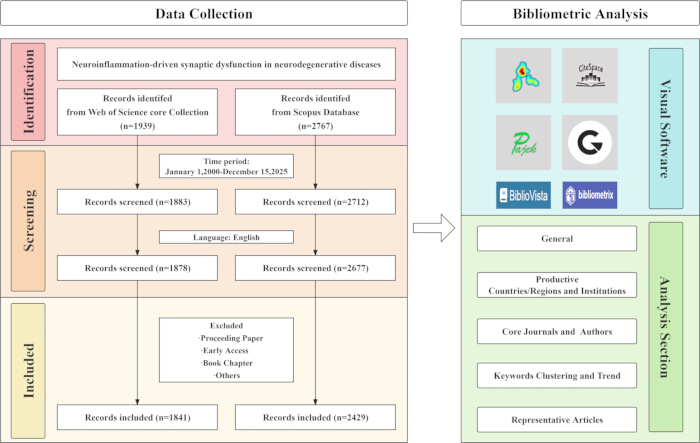
Figure 1. Dual-database parallel analytical framework for systematic data acquisition, curation, and multilevel bibliometric mapping. The workflow shows literature retrieval from the Web of Science Core Collection (WoSCC) and Scopus, database-specific screening and preprocessing, bibliometric analyses, and cross-database comparison. Please click here to view a larger version of this figure.
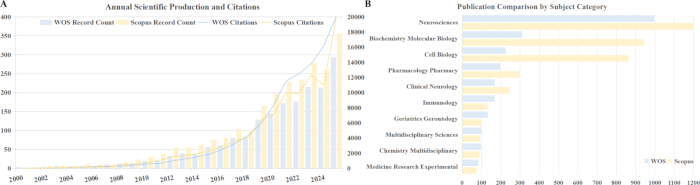
Figure 2. Global temporal dynamics and disciplinary evolution of neuroinflammation-associated synaptic dysfunction research. (A) Longitudinal trends in annual publication output and cumulative citation impact from 2000–2025 across WoSCC and Scopus. (B) Comparative disciplinary distribution of publications across major subject categories indexed in the two databases. Blue and yellow bars denote WoSCC- and Scopus-derived records, respectively. Please click here to view a larger version of this figure.
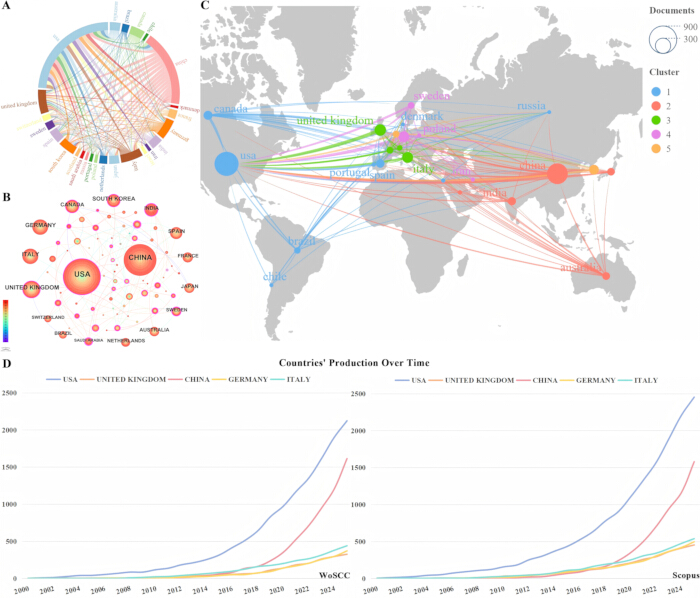
Figure 3. Global collaboration networks and national-level scientific contributions in neuroinflammation-associated synaptic dysfunction research. (A) International collaboration network depicting cooperative relationships, clustering patterns, and global research alliances. (B) Country-level co-authorship network showing major contributing countries and their collaborative intensity. Node size represents publication volume, and link thickness represents collaboration strength. (C) Geographical visualization of international collaborations and transcontinental connectivity. (D) Longitudinal publication trajectories of the five most productive countries in WoSCC and Scopus from 2000–2025. Please click here to view a larger version of this figure.
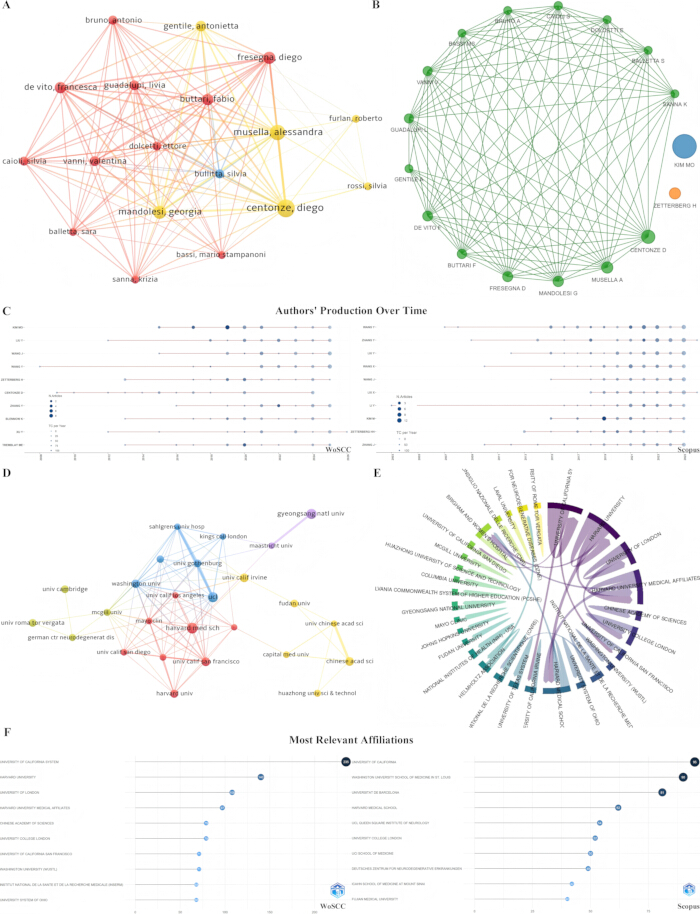
Figure 4. Multiscale authorship and institutional collaboration architecture in neuroinflammation-associated synaptic dysfunction research. (A) Author-level collaboration network showing major research communities and cooperative structures. (B) Topological map of core author collaborations highlighting highly connected investigators and partnership patterns. (C) Temporal evolution of publication output for leading authors in WoSCC and Scopus. (D) Institution-level collaboration network illustrating major research organizations and inter-institutional linkages. (E) Chord-style visualization of representative institutional collaborations. (F) Comparative distribution of the most relevant affiliations in WoSCC and Scopus, ranked by publication output. Please click here to view a larger version of this figure.
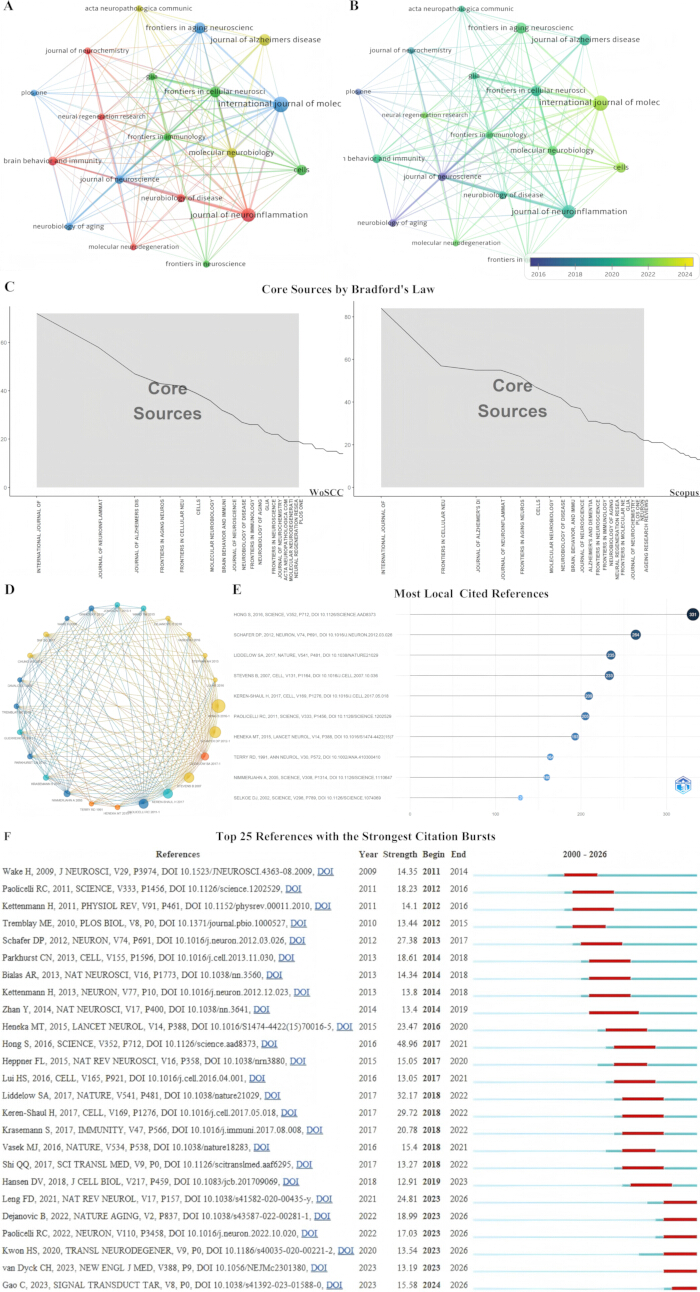
Figure 5. Core journals, intellectual knowledge base, and emerging research fronts in neuroinflammation-associated synaptic dysfunction research. (A, B) Journal co-citation networks in WoSCC and Scopus, illustrating major source journals and their clustering structures. (C) Core source journals identified using Bradford’s law in the two databases. (D) Co-citation network of highly cited references representing the intellectual structure of the field. (E) Most locally cited documents within the analyzed dataset. (F) Top 25 references with the strongest citation bursts, showing temporally prominent research fronts and changing thematic emphases. Please click here to view a larger version of this figure.
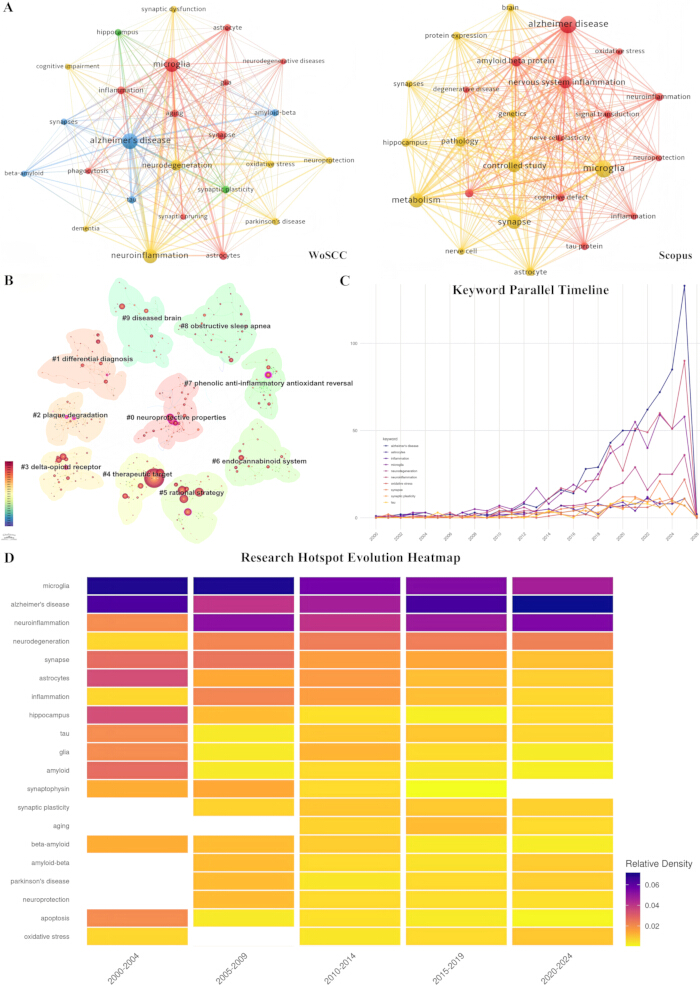
Figure 6. Keyword co-occurrence architecture and evolutionary patterns of research hotspots in neuroinflammation-associated synaptic dysfunction research. (A) Keyword co-occurrence networks derived from WoSCC (left) and Scopus (right), illustrating thematic organization and conceptual structure. (B) Keyword clustering map identifying major research themes and topic communities. (C) Parallel keyword timeline showing the temporal evolution of representative high-frequency terms from 2000–2025. (D) Heatmap showing the temporal dynamics of research hotspots across consecutive time periods. Please click here to view a larger version of this figure.
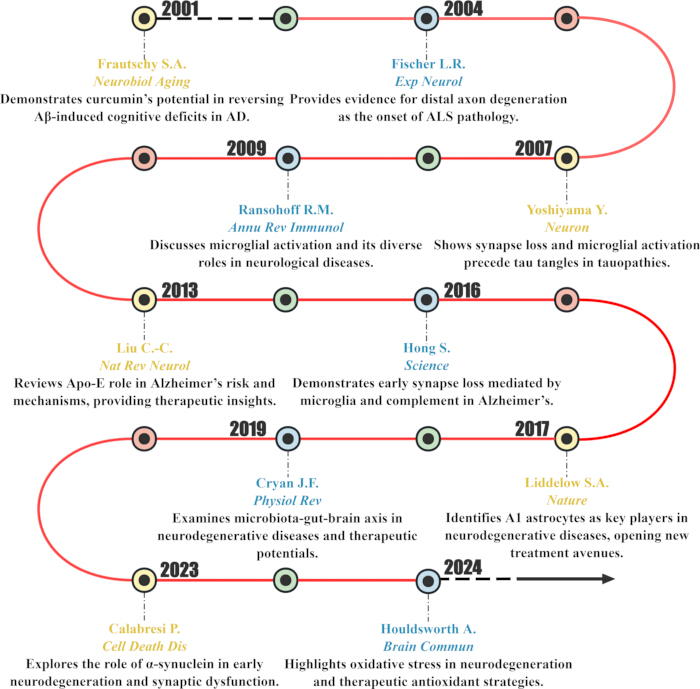
Figure 7. Chronological timeline of representative publications in neuroinflammation-associated synaptic dysfunction research. Selected publications illustrate major developments and conceptual advances in the field from 2000–2025. Please click here to view a larger version of this figure.
| Country/Region | Country-attributed documents | Citations | TLS | SCP | MCP | MCP % |
| WoSCC | ||||||
| USA | 634 | 52596 | 446 | 360 | 117 | 24.5 |
| United Kingdom | 151 | 10611 | 247 | 47 | 34 | 42 |
| Germany | 127 | 6785 | 201 | 41 | 29 | 41.4 |
| China | 472 | 17882 | 173 | 356 | 65 | 15.4 |
| Spain | 81 | 3904 | 127 | 35 | 21 | 37.5 |
| Canada | 89 | 6867 | 119 | 25 | 19 | 43.2 |
| Italy | 138 | 7736 | 99 | 82 | 36 | 30.5 |
| Australia | 67 | 4616 | 66 | 27 | 18 | 40 |
| India | 74 | 1934 | 64 | 44 | 15 | 25.4 |
| Korea | 105 | 5543 | 51 | 66 | 27 | 29 |
| Scopus | ||||||
| USA | 585 | 39460 | 355 | 436 | 149 | 25.5 |
| China | 457 | 30496 | 289 | 370 | 87 | 19 |
| United Kingdom | 135 | 7946 | 123 | 95 | 40 | 29.6 |
| Germany | 110 | 6195 | 110 | 65 | 45 | 40.9 |
| Korea | 106 | 5915 | 108 | 79 | 27 | 25.5 |
| Australia | 97 | 5285 | 104 | 55 | 42 | 43.3 |
| India | 85 | 4444 | 98 | 66 | 19 | 22.4 |
| Spain | 76 | 3814 | 93 | 45 | 31 | 40.8 |
| Canada | 57 | 2483 | 83 | 34 | 23 | 40.4 |
| Japan | 54 | 2273 | 82 | 44 | 10 | 18.5 |
Table 1: Top 10 countries or regions ranked by collaboration strength (total link strength, TLS) in country-level co-authorship networks of the WoSCC and Scopus datasets. Documents, citations, and TLS are reported for each database, together with single-country publications (SCP) and multiple-country publications (MCP).
| Rank | Organization | Documents | Citations | Total link strength | |
| WoSCC | |||||
| 1 | University College London | 43 | 2314 | 125 | |
| 2 | University of Gothenburg | 23 | 1465 | 92 | |
| 3 | University of California, San Francisco | 28 | 4527 | 90 | |
| 4 | Sahlgrenska University Hospital | 17 | 1071 | 84 | |
| 5 | Washington University | 26 | 4039 | 79 | |
| 6 | Harvard Medical School | 38 | 5977 | 73 | |
| 7 | McGill University | 19 | 1072 | 68 | |
| 8 | Mayo Clinic | 18 | 3995 | 52 | |
| 9 | Chinese Academy of Sciences | 28 | 811 | 45 | |
| 10 | German Center for Neurodegenerative Diseases (DZNE) | 19 | 1361 | 41 | |
| Scopus | |||||
| 1 | University College London | 24 | 2000 | 56 | |
| 2 | Sahlgrenska University Hospital | 19 | 1366 | 45 | |
| 3 | Roche Diagnostics GmbH | 11 | 698 | 36 | |
| 4 | University of California, San Francisco | 8 | 323 | 28 | |
| 5 | University of Gothenburg | 7 | 156 | 23 | |
| 6 | Harvard Medical School | 5 | 51 | 19 | |
| 7 | Sorbonne University | 5 | 51 | 19 | |
| 8 | Mayo Clinic | 6 | 98 | 16 | |
| 9 | German Center for Neurodegenerative Diseases (DZNE) | 5 | 310 | 4 | |
| 10 | Chinese Academy of Sciences | 6 | 438 | 2 | |
Table 2: Top 10 institutions ranked by collaboration strength (total link strength, TLS) in institutional co-authorship networks of the WoSCC and Scopus datasets. Documents, citations, and TLS are reported for each institution.
| Rank | Source | Documents | Citations | Total link strength | |
| WoSCC | |||||
| 1 | Journal of Neuroinflammation | 58 | 4063 | 254 | |
| 2 | Journal of Neuroscience | 30 | 4608 | 247 | |
| 3 | International Journal of Molecular Sciences | 72 | 2068 | 235 | |
| 4 | Neuron | 16 | 3237 | 216 | |
| 5 | Frontiers in Cellular Neuroscience | 42 | 2269 | 205 | |
| 6 | Frontiers in Immunology | 26 | 2395 | 153 | |
| 7 | Glia | 23 | 1409 | 151 | |
| 8 | Brain Behavior and Immunity | 32 | 1660 | 125 | |
| 9 | Cells | 39 | 1079 | 125 | |
| 10 | Molecular Neurobiology | 36 | 1334 | 124 | |
| Scopus | |||||
| 1 | International Journal of Molecular Sciences | 84 | 3902 | 285 | |
| 2 | Journal of Neuroinflammation | 48 | 5501 | 271 | |
| 3 | Neuron | 22 | 1986 | 254 | |
| 4 | Brain Behavior and Immunity | 37 | 3120 | 228 | |
| 5 | Frontiers in Neuroscience | 31 | 2080 | 206 | |
| 6 | Molecular Neurobiology | 37 | 1819 | 202 | |
| 7 | Journal of Neurochemistry | 26 | 2815 | 175 | |
| 8 | Frontiers in Immunology | 23 | 7388 | 129 | |
| 9 | Biomolecules | 21 | 715 | 108 | |
| 10 | Glia | 25 | 2073 | 107 | |
Table 3: Top 10 source journals ranked by citation-network connectivity (total link strength, TLS) in the WoSCC and Scopus datasets. Document counts, citation counts, and TLS are reported for each journal.
Table 4: Top 10 most locally cited documents in the WoSCC corpus. Rankings were based on local citations (LC); DOI, global citations (GC), LC/GC (%), normalized local citation score (NLCS), and normalized global citation score (NGCS) are also reported, with normalized scores calculated within publication-year cohorts. Please click here to download this file.
Supplementary Table 1. Search strategy, study selection, and precision assessment of retrieved records. The table presents the search and screening information, precision results, and relevance assessments of sampled records from the WoSCC and Scopus datasets. Please click here to download this file.
Supplementary Table 2. Examples of metadata normalization used for bibliometric analyses. The table presents representative examples of standardized author names, institutional affiliations, and keywords.Please click here to download this file.
Supplementary Table 3. Record overlap between the WoSCC and Scopus bibliographic datasets. The table summarizes shared and database-specific records identified through DOI and title matching.Please click here to download this file.
Supplementary Table 4. Analytical parameters and software settings used for bibliometric analyses. The table summarizes the software, analytical methods, and principal parameters used for network construction, normalization, temporal analysis, citation-burst detection, and visualization.Please click here to download this file.
Discussion
The dual-database analysis identified temporal changes in the literature on neuroinflammation-associated synaptic dysfunction, with increasing attention to immune-, glial-, and synapse-related themes over time. To provide biological context for these bibliometric patterns, Figure 7 presents an illustrative chronological timeline of 10 representative publications rather than a bibliometrically ranked milestone map. These studies are used to contextualize, rather than validate, the thematic evolution observed in the bibliometric analyses. In the early phase, Frautschy et al. (Neurobiology of Aging) examined inflammatory and oxidative mechanisms in amyloid-associated cognitive dysfunction, while Fischer et al. (Experimental Neurology) described distal axonal degeneration in ALS, and Yoshiyama et al. (Neuron) linked synaptic loss and microglial activation with early tau-associated pathology28,29,30. During the subsequent period, Ransohoff (Annual Review of Immunology) emphasized the context-dependent roles of microglia in neurological disease, whereas Liu et al. (Nature Reviews Neurology) discussed ApoE-related mechanisms in Alzheimer’s disease. Later studies increasingly examined interactions among immune signaling, glial states, and synaptic vulnerability31,32. Hong et al. (Science) reported complement- and microglia-associated early synaptic loss in an Alzheimer’s disease model, while Liddelow et al. (Nature) described microglia-induced reactive astrocytes within the historically proposed A1 framework, highlighting glial crosstalk while also illustrating the context dependence of astrocytic states33,34. Cryan et al. (Physiological Reviews) broadened this perspective by reviewing microbiota–gut–brain interactions and their links with neuroimmune regulation. More recent representative publications by Calabresi et al. (Cell Death & Disease) and Houldsworth et al. (Brain Communications) extended attention to α-synuclein-associated synaptic pathology and oxidative stress, respectively35,36,37. Taken together, these representative studies provide mechanistic context for the bibliometrically observed shift in research attention, but they should not be interpreted as demonstrating a single causal pathway or a linear progression toward clinical translation.
A practical methodological strength of this study is the parallel analysis of WoSCC and Scopus as independent corpora rather than their direct aggregation. The two databases showed substantial but incomplete overlap: 1,409 publications were shared, whereas 432 were unique to WoSCC and 1,020 were unique to Scopus, corresponding to a record-level Jaccard similarity of 0.492 (Supplementary Table 3). At the level of leading bibliometric entities, the Jaccard indices were 0.82 for the Top-10 countries or regions, 0.67 for institutions, and 0.54 for source journals, indicating varying degrees of set overlap. Complementary Spearman rank correlation analysis showed positive associations in TLS-based rankings among shared entities, with ρ values of 0.650, 0.881, and 0.679, respectively. Notably, although countries or regions exhibited the highest set overlap, institutional rankings showed the strongest positive association, indicating that shared Top-10 membership does not necessarily correspond to similar relative rankings. These findings reflect both shared bibliometric structures and database-specific differences in coverage and indexing practices. Importantly, neither set overlap nor rank association establishes agreement in absolute bibliometric values or constitutes formal cross-validation. Rather, the parallel design makes both shared patterns and database-specific differences visible, thereby reducing reliance on conclusions derived from a single bibliographic source.
Alternative bibliometric strategies could address complementary questions beyond the scope of the present parallel design. For example, merging and rigorously deduplicating WoSCC and Scopus records could maximize unique literature coverage and generate a single integrated corpus, although this approach would reduce the visibility of database-specific differences in indexing and metadata representation. Fractional rather than full counting could also be applied to collaboration networks to reduce the weight assigned to highly multi-authored or multi-institutional publications. In addition, disease-stratified analyses could clarify whether the observed thematic patterns differ among Alzheimer’s disease, Parkinson’s disease, amyotrophic lateral sclerosis, Huntington’s disease, and other neurodegenerative conditions, while field- or year-normalized citation indicators could reduce the influence of disciplinary and citation-age differences. More granular approaches, including topic modeling and longitudinal thematic analyses, may further characterize changes that are not fully captured by keyword co-occurrence maps. The present study instead retained WoSCC and Scopus as independent analytical corpora because its primary objective was to compare major bibliometric structures across databases while preserving database-specific patterns rather than to construct a unified literature set.
From a practical perspective, the bibliometric maps generated here are best viewed as an evidence-navigation framework for identifying major research communities, recurrent conceptual themes, and areas of sustained or emerging scholarly attention, rather than as direct evidence of biological importance or clinical readiness. Bibliometric methods are well suited to characterizing the intellectual and thematic structure of a research field, but citation-based prominence should be interpreted in conjunction with substantive domain knowledge rather than used as a surrogate for scientific quality or translational value38,39. Within the present field, the recurrent prominence of microglia, astrocytes, complement-related processes, oxidative stress, and synaptic plasticity may therefore help prioritize topics for more focused mechanistic synthesis, but it does not establish that these processes have uniform functions across diseases or stages. This distinction is particularly important because contemporary evidence emphasizes heterogeneous and context-dependent glial states rather than fixed binary phenotypes40,41. Accordingly, themes identified by bibliometric mapping could serve as starting points for disease-specific systematic reviews, experimental validation, and integrative single-cell or spatial analyses capable of resolving cell-state and regional heterogeneity42. Such complementary approaches are necessary before bibliometric prominence can be translated into claims regarding biomarkers, therapeutic targets, or clinical applicability.
Several limitations should be considered when interpreting these findings. First, the analysis was restricted to WoSCC and Scopus and to English-language Articles and Reviews, and therefore may not capture relevant literature indexed elsewhere or published in other languages. Second, although the search strategy combined broad neurodegeneration terms with disease-specific anchors, the disease-specific framework primarily emphasized Alzheimer’s disease, Parkinson’s disease, amyotrophic lateral sclerosis, and Huntington’s disease as representative major neurodegenerative disorders. Therefore, research patterns associated with less extensively studied or rare neurodegenerative conditions may be underrepresented. In addition, retrieval sensitivity may have been influenced by database-specific indexing and the use of selected search expressions. In particular, the original search strategy included the abbreviation “ALS” without explicitly incorporating “amyotrophic lateral sclerosis.” A targeted sensitivity assessment conducted on October 10, 2026, identified four additional records in WoSCC and three in Scopus that met the original publication-period and document-type criteria. Although these records represented a small proportion of the original datasets, their exclusion may have resulted in limited underrepresentation of relevant literature, and potential effects on disease-specific patterns or individual bibliometric indicators cannot be entirely excluded. Third, no full-corpus title-and-abstract screening was performed after the predefined eligibility filters. Instead, topical relevance was assessed using random samples of 50 records from each database, yielding precision estimates of 88.0% for WoSCC and 84.0% for Scopus; some irrelevant records may therefore remain, while relevant records not captured by the original search cannot be excluded. Fourth, Articles and Reviews were analyzed together to characterize the overall structure of the literature, which may partly amplify the representation of already well-established topics. Citation-based indicators are additionally subject to publication-age effects, database-specific citation coverage, and differential indexing practices. Fifth, records from 2025 were incompletely indexed because retrieval ended on December 15, 2025, requiring caution when interpreting the most recent temporal patterns. Sixth, although author names, institutional affiliations, and keywords were standardized before analysis, residual ambiguity in metadata normalization may persist. Finally, the Jaccard indices quantified set overlap, whereas Spearman’s ρ characterized TLS-based rank associations among entities shared by the two Top-10 lists. These descriptive measures were restricted to selected leading entities and do not establish agreement in absolute bibliometric values or constitute formal external or statistical validation. These limitations should be considered when interpreting both the shared and database-specific patterns reported in this study. Within these methodological boundaries, the present study provides a dual-database descriptive map of publication growth, major contributors, collaboration structures, citation patterns, and thematic evolution in neuroinflammation-associated synaptic dysfunction research, while distinguishing shared bibliometric patterns from database-specific variation.
Disclosures
The authors declare no competing financial or non-financial interests. The authors confirm that no artificial intelligence (AI)-assisted tools were used during the preparation, analysis, or writing of this manuscript.
Author contributions:
Lili You: Conceptualization, Data curation, Funding acquisition, Investigation, Methodology, Validation, and Writing – original draft. Zhui Ke: Conceptualization, Data curation, Formal analysis, Investigation, Validation, and Writing – original draft. Boxiang Zhang: Conceptualization, Data curation, Formal analysis, Investigation, Methodology, Software, Visualization, and Writing – original draft. Lucy Yue Lau: Conceptualization, Data curation, Methodology, Software, and Validation. Boyang Li: Conceptualization, Data curation, Formal analysis, and Validation. Zehao Hong: Investigation, Methodology, Software, and Visualization. Richard J. Aldridge: Data curation, Formal analysis, Investigation, and Validation. Elizabeth A. Whitmore: Formal analysis, Investigation, Methodology, Software, and Validation. Fenghai Ji: Conceptualization, Project administration, Resources, Supervision, and Writing – review and editing. Yi Chen: Conceptualization, Data curation, Formal analysis, Methodology, Project administration, Software, Supervision, Visualization, and Writing – review and editing. Shixuan Meng: Conceptualization, Project administration, Resources, Supervision, and Writing – review and editing. All authors reviewed and approved the final manuscript.
Acknowledgements
This work was supported by the Key Project of Yancheng Municipal Health Commission (2025) under Grant No. YCBK2025126.
Materials
| Name | Company | Catalog Number | Comments |
|---|---|---|---|
| bibliometrix | bibliometrix project | Version 4.3.2 | R package used for bibliometric analysis (RRID:SCR_023744) |
| BiblioVista | BiblioVista development platform | Version 1.0.0 | Interactive bibliometric visualization |
| CiteSpace | Chaomei Chen | Version 6.3.R5 | Knowledge-map construction and citation burst detection |
| R | R Foundation for Statistical Computing | Version 4.4.2 | Statistical computing environment |
| Scimago Graphica | SCImago Lab | Version 1.0.51 | Geographic visualization |
| Scopus | Elsevier | Database access | Bibliographic database |
| VOSviewer | Centre for Science and Technology Studies, Leiden University | Version 1.6.21 | Used for co-authorship, co-citation, and keyword co-occurrence network construction (RRID:SCR_023516) |
| Web of Science Core Collection | Clarivate | Database access | Bibliographic database |
References
- Khan AF, Iturria-Medina Y. Beyond the usual suspects: multi-factorial computational models in the search for neurodegenerative disease mechanisms. Transl Psychiatry. 2024;14(1):386.
- Samal S, Nandha A. A comprehensive review of major neurodegenerative disorders. J Pharmacogn Phytochem. 2025;14(3):189-95.
- Tesco G, Lomoio S. Pathophysiology of neurodegenerative diseases: an interplay among axonal transport failure, oxidative stress, and inflammation? Semin Immunol. 2022;59:101628.
- Yang G et al. Microglia-orchestrated neuroinflammation and synaptic remodeling: roles of pro-inflammatory cytokines and receptors in neurodegeneration. Front Cell Neurosci. 2025;19:1700692.
- Gu N et al. Microglia regulate neuronal activity via structural remodeling of astrocytes. Neuron. 2025;113(20):3408-23.e5.
- Düsedau HP, Cangalaya C, Stoyanov S, Dityatev A, Dunay IR. Reduced synaptic tagging by complement protein C3 is associated with elevated extracellular matrix in the middle-aged cerebellum of mice. Front Aging Neurosci. 2025;17:1616390.
- Vishnumukkala T et al. Glial cells as emerging therapeutic targets in neurodegenerative diseases: mechanistic insights and translational perspectives. Cells. 2025;14(19):1497.
- Tanaka M. Parkinson's disease: bridging gaps, building biomarkers, and reimagining clinical translation. Cells. 2025;14(15):1161.
- Dolgacheva LP, Zinchenko VP, Goncharov NV. Molecular and cellular interactions in pathogenesis of sporadic Parkinson disease. Int J Mol Sci. 2022;23(21):13043.
- Gulen MF et al. cGAS-STING drives ageing-related inflammation and neurodegeneration. Nature. 2023;620(7973):374-80.
- Zhang Y, Zou M, Wu H, Zhu J, Jin T. The cGAS-STING pathway drives neuroinflammation and neurodegeneration via cellular and molecular mechanisms in neurodegenerative diseases. Neurobiol Dis. 2024;202:106710.
- Tagliatti E et al. TREM2 expression in microglia is required to maintain normal neuronal bioenergetics during development. Immunity. 2024;57(1):86-105.e9.
- Wang Q et al. Inflammasomes in neurodegenerative diseases. Transl Neurodegener. 2024;13(1):65.
- Negro-Demontel L, Maleki AF, Reich DS, Kemper C. The complement system in neurodegenerative and inflammatory diseases of the central nervous system. Front Neurol. 2024;15:1396520.
- Tillmon H et al. Complement and microglia activation mediate stress-induced synapse loss in layer 2/3 of the medial prefrontal cortex in male mice. Nat Commun. 2024;15(1):9803.
- Faust TE et al. Microglia-astrocyte crosstalk regulates synapse remodeling via Wnt signaling. Cell. 2025;188(19):5212-30.e21.
- Carling GK et al. Alzheimer's disease-linked risk alleles elevate microglial cGAS-associated senescence and neurodegeneration in a tauopathy model. Neuron. 2024;112(23):3877-96.e8.
- Gao R, Gao Y, Su W, Wang R. Decoding microglial polarization and metabolic reprogramming in neurodegenerative diseases: implications for disease progression and therapy. Aging Dis. 2025;17(1):91-113.
- Bairamian D et al. Microbiota in neuroinflammation and synaptic dysfunction: a focus on Alzheimer's disease. Mol Neurodegener. 2022;17(1):19.
- Loh JS et al. Microbiota-gut-brain axis and its therapeutic applications in neurodegenerative diseases. Signal Transduct Target Ther. 2024;9(1):37.
- Guvenek A et al. Transcriptional profiling in microglia across physiological and pathological states identifies a transcriptional module associated with neurodegeneration. Commun Biol. 2024;7(1):1168.
- Ayyubova G, Fazal N. Beneficial versus detrimental effects of complement-microglial interactions in Alzheimer's disease. Brain Sci. 2024;14(5):434.
- Gomez-Arboledas A et al. C5aR1 signaling promotes region- and age-dependent synaptic pruning in models of Alzheimer's disease. Alzheimers Dement. 2024;20(3):2173-90.
- Lee SY, Chung WS. Astrocytic crosstalk with brain and immune cells in healthy and diseased conditions. Curr Opin Neurobiol. 2024;84:102840.
- Zhang Y, Zhang J, Wang Y, Yao J. Global trends and prospects about synaptic plasticity in Alzheimer's disease: a bibliometric analysis. Front Aging Neurosci. 2023;15:1234719.
- Chen YJ, Xie MR, Zhou SQ, Liu F. Synapses-associated research in Parkinson's disease: an explored trends analysis. Front Aging Neurosci. 2025;17:1537119.
- Liu G et al. Knowledge domains and emerging trends of microglia research from 2002 to 2021: a bibliometric analysis and visualization study. Front Aging Neurosci. 2023;14:1057214.
- Frautschy SA et al. Phenolic anti-inflammatory antioxidant reversal of Aβ-induced cognitive deficits and neuropathology. Neurobiol Aging. 2001;22(6):993-1005.
- Fischer LR et al. Amyotrophic lateral sclerosis is a distal axonopathy: evidence in mice and man. Exp Neurol. 2004;185(2):232-40.
- Yoshiyama Y et al. Synapse loss and microglial activation precede tangles in a P301S tauopathy mouse model. Neuron. 2007;53(3):337-51.
- Ransohoff RM, Perry VH. Microglial physiology: unique stimuli, specialized responses. Annu Rev Immunol. 2009;27:119-45.
- Liu CC, Kanekiyo T, Xu H, Bu G. Apolipoprotein E and Alzheimer disease: risk, mechanisms and therapy. Nat Rev Neurol. 2013;9(2):106-18.
- Hong S et al. Complement and microglia mediate early synapse loss in Alzheimer mouse models. Science. 2016;352(6286):712-16.
- Liddelow SA et al. Neurotoxic reactive astrocytes are induced by activated microglia. Nature. 2017;541(7638):481-7.
- Cryan JF et al. The microbiota-gut-brain axis. Physiol Rev. 2019;99(4):1877-2013.
- Calabresi P et al. α-Synuclein in Parkinson's disease and other synucleinopathies: from overt neurodegeneration back to early synaptic dysfunction. Cell Death Dis. 2023;14(3):176.
- Houldsworth A. Role of oxidative stress in neurodegenerative disorders: a review of reactive oxygen species and prevention by antioxidants. Brain Commun. 2024;6(1):fcad356.
- Donthu N, Kumar S, Mukherjee D, Pandey N, Lim WM. How to conduct a bibliometric analysis: an overview and guidelines. J Bus Res. 2021;133:285-96.
- Hicks D, Wouters P, Waltman L, de Rijcke S, Rafols I. Bibliometrics: the Leiden Manifesto for research metrics. Nature. 2015;520(7548):429-31.
- Escartin C et al. Reactive astrocyte nomenclature, definitions, and future directions. Nat Neurosci. 2021;24(3):312-25.
- de Soysa TY, Therrien M, Walker AC, Stevens B. Redefining microglia states: lessons and limits of human and mouse models to study microglia states in neurodegenerative diseases. Semin Immunol. 2022;60:101651.
- Piwecka M, Rajewsky N, Rybak-Wolf A. Single-cell and spatial transcriptomics: deciphering brain complexity in health and disease. Nat Rev Neurol. 2023;19(6):346-62.