方法文章

急性肾损伤研究中双侧肾缺血-再灌注小鼠模型的技术优化

DOI:

10.3791/63957

2023年11月3日

本文内容

摘要

Loading...
$$\rightleftharpoonup{xx}$$ $$\longleftharp{xx}$$, $$\longrightharp{xx}$$,

本研究建立了一种针对双侧肾缺血-再灌注小鼠模型的技术优化方案,用于急性肾损伤研究。

摘要

Loading...
$$\rightleftharpoonup{xx}$$ $$\longleftharp{xx}$$, $$\longrightharp{xx}$$,

心脏骤停对公共卫生构成了重大负担。急性肾损伤(AKI)是心肺复苏成功、自主循环恢复(ROSC)后心脏骤停幸存者中的不良预后标志。相反,AKI后肾功能的恢复是神经功能良好预后和出院的预测指标。然而,目前尚缺乏有效干预措施以预防心脏骤停ROSC后所致的肾脏损伤,提示需要开发额外的治疗策略。肾灌注不足和再灌注是导致心脏骤停后发生AKI的两个病理生理机制。双侧肾脏缺血-再灌注诱导的急性肾损伤(IR-AKI)动物模型在临床环境中与ROSC后发生AKI的患者具有可比性。然而,由于该模型具有高死亡率以及肾损伤程度变异较大,双侧肾脏IR-AKI在技术上难以进行分析,可能影响实验结果的解读。通过选择体重较轻的小鼠,在异氟烷全身麻醉下采用背外侧手术入路,并在术中维持体温,可减少组织损伤,从而建立一种可重复的急性肾IR-AKI研究方案。

引言

Loading...
$$\rightleftharpoonup{xx}$$ $$\longleftharp{xx}$$, $$\longrightharp{xx}$$,

心脏骤停在美国每年发生超过8万例1,2。心脏骤停的死亡率极高3,4,5,6。急性肾损伤(AKI)是与心脏骤停患者在自主循环恢复(ROSC)后高死亡率及不良神经功能预后密切相关的重要危险因素7,8,9,10,11,12,13。AKI的恢复是患者良好神经功能预后及顺利出院的有效预测指标14,15,16。然而,目前仍缺乏针对缺血-再灌注所致急性肾损伤(IR-AKI)的有效治疗手段15,16,17,18,19。需要开发更多治疗策略,以进一步改善该疾病的临床预后。

采用双侧肾缺血方法的肾缺血-再灌注急性肾损伤(IR-AKI)是急性肾损伤(AKI)研究中常用的动物模型之一20,21,22,23,24,25,26。与用于研究心肺复苏后自主循环恢复(ROSC)患者发生AKI的全身性缺血-再灌注损伤模型相比,肾IR-AKI动物模型更为简单6,27,28,29,30。这意味着由于实验中混杂因素较少,肾IR-AKI动物模型更容易获得一致的结果。此外,肾IR-AKI实验方案通常包括单侧或双侧肾蒂阻断。双侧肾IR-AKI实验条件与成功心肺复苏后发生心脏骤停的患者在ROSC后出现AKI的临床情况具有可比性。尽管两种模型的肾脏病理特征均能反映人类肾缺血-再灌注损伤的病理特征31,32,33,但双侧肾缺血方法更贴近人类病理状态下(如心力衰竭、血管收缩和脓毒性休克)的AKI情况35。因此,双侧肾IR-AKI动物模型适用于研究心脏骤停后ROSC阶段的肾缺血-再灌注损伤。

双侧肾缺血-再灌注急性肾损伤(IR-AKI)模型存在技术难度高、实验复杂以及手术时间长等问题23,26,32,33,35,36。为克服这些技术难题,本研究通过若干技术改进,建立了一种可靠的小鼠双侧IR-AKI研究方案。该方案可显著减少手术并发症、减轻组织损伤,并降低术中死亡率。因此,该模型可用于研究心肺复苏后急性肾损伤的病理生理过程,进而开发针对肾脏低灌注及再灌注损伤的新型治疗策略37,38,39

访问受限。请登录或开始试用以查看此内容。

方案

Loading...
$$\rightleftharpoonup{xx}$$ $$\longleftharp{xx}$$, $$\longrightharp{xx}$$,

所有动物实验均按照 实验动物护理和使用的指南,由美国国立卫生研究院(NIH出版物编号85-23,1996年修订版)发布。本研究方案经辅仁天主教大学机构动物照护与使用委员会批准,并遵循其指导方针。参见 材料表 有关本方案中使用的所有材料和仪器的详细信息。

1. 小鼠的准备

  1. 选取8周龄的C57BL/6雄性小鼠,体重为21–23 g。
  2. 将小鼠饲养在温度受控(21 ± 2 °C)、12小时光照/12小时黑暗循环的环境中,可自由摄取食物、标准小鼠饲料颗粒和自来水。

2. 麻醉

  1. 戴上外科口罩和无菌手套。
  2. 在诱导室中使用2%异氟烷与氧气以1 L/min的流速混合,使小鼠进入麻醉状态。
  3. 通过足底反射评估麻醉深度。
    ​注意:足底反射是指用力捏压后肢脚趾时后肢足部的回缩反应。当足底反射消失时,表明麻醉已完全生效。
  4. 待麻醉完全后,将每只小鼠移至带有电热毯的手术平台,使其呈俯卧位,以维持体温。术前应稳定体温,并使用直肠温度探头进行监测。 在双眼涂抹眼用软膏,防止角膜干燥。
  5. 用胶带将小鼠的四肢固定在手术板上。
  6. 将麻醉面罩固定于小鼠面部,持续供给1%异氟烷和1 L/min氧气。
  7. 在手术过程中定期通过足底反射评估麻醉深度,并根据情况调整麻醉剂的供给。

3. 双侧肾缺血-再灌注急性肾损伤手术

  1. 用手触摸小鼠背部,手动定位其腰椎。沿脊柱向头部方向移动,寻找位于小鼠最后一根肋骨两侧下方的肋椎角。
  2. 在双侧肋脊角区域涂抹脱毛乳液,约30秒后用生理盐水清除毛发。
  3. 消毒剃毛后的皮肤 经过三轮 聚维酮碘溶液和75%酒精,使用棉球。
    注意:在整个手术过程中保持无菌区域至关重要。使用手术巾覆盖并采用无菌器械。
  4. 使用精细尖头镊子轻轻提起左侧肋脊角下方的皮肤,然后使用剪刀 沿左侧腰部脊柱中线处的皮肤张力线做一条1 cm长的斜向背外侧切口。使用剪刀切开左侧腰部的肌壁,以暴露左肾。
  5. 重复上述手术步骤以暴露右侧肾脏。使用无菌棉签清除手术过程中产生的少量血液。
  6. 用镊子小心地将左肾从周围组织中推开并分离。暴露左肾后,辨认肾蒂。
    注意:务必小心,避免损伤肾上腺及其周围血管。
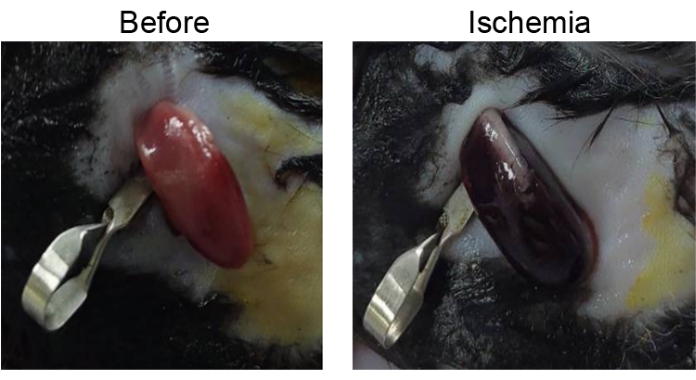
  7. 用微血管夹夹闭左侧肾蒂25分钟。通过观察肾脏颜色由粉红色变为暗红色来确认缺血。
  8. 用无菌生理盐水浸湿的棉球覆盖夹闭的肾脏,以避免左肾蒂夹闭期间肾脏干燥。
  9. 重复上述手术操作,使用微血管夹夹闭右侧肾蒂25分钟。
  10. 用无菌生理盐水浸湿的棉球覆盖已夹闭的肾脏,以防止在右肾蒂夹闭期间肾脏干燥。
  11. 定期监测麻醉深度及无菌生理盐水浸湿的棉球的湿度。
  12. 打开左侧微血管夹,开始左肾再灌注。通过观察左肾颜色由暗红色变为粉红色来确认再灌注成功。
  13. 打开右侧微血管夹,以启动右肾的再灌注。
  14. 确认肾脏颜色变化后,将肾脏放回腹腔。
  15. 使用6-0可吸收缝合线缝合腹腔和皮肤。
  16. 使用棉球蘸取碘伏溶液和75%酒精擦拭伤口以进行消毒。
  17. 仔细观察动物,直到它开始自由活动并进食。
    注意:需密切观察动物,直至其恢复足够的意识以维持胸卧位。
  18. 皮下注射卡洛芬(5 mg/kg,0.2 mL)以预防术后疼痛,持续给药2-3天。

访问受限。请登录或开始试用以查看此内容。

结果

Loading...
$$\rightleftharpoonup{xx}$$ $$\longleftharp{xx}$$, $$\longrightharp{xx}$$,

在进行进一步的显微或分子分析之前,应评估双侧肾缺血-再灌注急性肾损伤(IR-AKI)手术的质量。手术过程中,当使用微血管夹夹闭肾蒂后,若肾脏颜色由粉红色迅速变为深红色,则可确认肾缺血已成功诱导(图1)。术后可通过下颌下采血获取少量血清进行生化分析,以进一步验证IR-AKI手术所致的肾损伤;分析结果应显示血尿素氮和肌酐水平较基线显著升高(图2)。

缺血对实验设置中组织的影响;缺血前后组织颜色变化分析。
图1:肾蒂夹闭后的肾缺血。 肾脏颜色由粉红...

访问受限。请登录或开始试用以查看此内容。

讨论

Loading...
$$\rightleftharpoonup{xx}$$ $$\longleftharp{xx}$$, $$\longrightharp{xx}$$,

所提出的双侧IR-AKI方案适用于研究双肾低灌注及再灌注损伤的机制。该方案建议使用体重较轻的小鼠,采用异氟烷进行全身麻醉,通过背外侧入路实施手术,并在术中维持体温,这些措施有助于减轻相关技术难度,缩短手术时间,并提高急性双侧肾IR-AKI研究中操作的一致性。

技术难度会影响双侧肾缺血-再灌注急性肾损伤(IR-AKI)手术中肾损伤的严重程度33。除了小鼠品系、性别、年龄和加热系统36,40,41,42,43,44外,血管夹的正确放置对于获得一致的结果至关重要。已有研究建议仔细分离周围脂肪组织,以充分暴露肾脏及其肾蒂或肾动脉

访问受限。请登录或开始试用以查看此内容。

披露

Loading...
$$\rightleftharpoonup{xx}$$ $$\longleftharp{xx}$$, $$\longrightharp{xx}$$,

作者声明,本文的发表不存在利益冲突。

致谢

Loading...
$$\rightleftharpoonup{xx}$$ $$\longleftharp{xx}$$, $$\longrightharp{xx}$$,

本研究模型获得了中国台湾科技部(MOST 109-2320-B-030-006-MY3)的经费支持。本稿件由 Wallace Academic Editing 进行了编辑。

访问受限。请登录或开始试用以查看此内容。

材料

本文使用的材料清单
姓名公司目录编号评论
可吸收缝合线,6-0EthiconJ510G-BX
聚维酮碘溶液Shineteh Istrument
卡洛芬SigmaPHR1452
棉球Shineteh Istrument
格雷夫镊Fine Science Tools11051-10
加热垫Shineteh Istrument
异氟烷Piramal Critical Care Inc.26675-46-7
莫里亚血管钳Fine Science Tools18320-11
Olsen-Hegar 持针器Fine Science Tools12002 - 12
生理盐水Shineteh Istrument
手术刀片Shinvas2646
小动物麻醉机Sheng-Cing Instruments Co.STEP AS-01
组织剪Fine Science Tools14072 - 10

参考文献

Loading...
$$\rightleftharpoonup{xx}$$ $$\longleftharp{xx}$$, $$\longrightharp{xx}$$,
  1. Holmberg, M. J., et al. Annual incidence of adult and pediatric in-hospital cardiac arrest in the United States. Circulation: Cardiovascular Quality and Outcomes. 12 (7), 005580(2019).
  2. Benjamin, E. J., et al. Heart disease and stroke statistics-2018 update: a report from the American Heart Association. Circulation. 137 (12), 67(2018).
  3. Lascarrou, J. B., et al. Targeted temperature management for cardiac arrest with nonshockable rhythm. The New England Journal of Medicine. 381 (24), 2327-2337 (2019).
  4. Chang, H. C., et al. Factors affecting outcomes in patients with cardiac arrest who receive target temperature management: The multi-center TIMECARD registry. Journal of the Formosan Medical Association. 121 (1), 294-303 (2022).
  5. Yu, G., et al. Comparison of the survival and neurological outcomes in OHCA based on smoking status: investigation of the existence of the smoker's paradox. Signa Vitae. 18 (2), 121-129 (2022).
  6. Chen, Y. C., et al. Major interventions are associated with survival of out of hospital cardiac arrest patients - a population based survey. Signa Vitae. 13 (2), 108-115 (2017).
  7. Sandroni, C., et al. Acute kidney injury after cardiac arrest: a systematic review and meta-analysis of clinical studies. Minerva Anestesiologica. 82 (9), 989-999 (2016).
  8. Patyna, S., et al. Acute kidney injury after in-hospital cardiac arrest in a predominant internal medicine and cardiology patient population: incidence, risk factors, and impact on survival. Renal Failure. 43 (1), 1163-1169 (2021).
  9. Storm, C., et al. Impact of acute kidney injury on neurological outcome and long-term survival after cardiac arrest - A 10 year observational follow up. Journal of Critical Care. 47, 254-259 (2018).
  10. Geri, G., et al. Acute kidney injury after out-of-hospital cardiac arrest: risk factors and prognosis in a large cohort. Intensive Care Medicine. 41 (7), 1273-1280 (2015).
  11. Guo, Q. Y., Xu, J., Shi, Q. D. Gasping as a predictor of short- and long-term outcomes in patients with cardiac arrest: a systematic review and meta-analysis. Signa Vitae. 17 (2), 208-213 (2021).
  12. Chen, P. C., et al. Prognostic factors for adults with cardiac arrest in the emergency department: a retrospective cohort study. Signa Vitae. 18 (3), 56-64 (2022).
  13. Lee, M. J., et al. Predictors of survival and good neurological outcomes after in-hospital cardiac arrest. Signa Vitae. 17 (2), 67-76 (2021).
  14. Deakin, C. D., et al. European Resuscitation Council guidelines for resuscitation 2010 section 4. adult advanced life support. Resuscitation. 81 (10), 1305-1352 (2010).
  15. Cha, K. C., et al. Recovery from acute kidney injury is an independent predictor of survival at 30 days only after out-of-hospital cardiac arrest who were treated by targeted temperature management. Signa Vitae. 17 (2), 119-126 (2021).
  16. Park, Y. S., et al. Recovery from acute kidney injury as a potent predictor of survival and good neurological outcome at discharge after out-of-hospital cardiac arrest. Critical Care. 23 (1), 256(2019).
  17. Mah, K. E., et al. Acute kidney injury after in-hospital cardiac arrest. Resuscitation. 160, 49-58 (2021).
  18. Pelkey, T. J., et al. Minimal physiologic temperature variations during renal ischemia alter functional and morphologic outcome. Journal of Vascular Surgery. 15 (4), 619-625 (1992).
  19. Kim, H., et al. Effect of different combinations of initial body temperature and target temperature on neurological outcomes in out-of-hospital cardiac arrest patients treated with targeted temperature management. Signa Vitae. , 1-7 (2022).
  20. Wyss, J. C., et al. Differential effects of the mitochondria-active tetrapeptide SS-31 (D-Arg-dimethylTyr-Lys-Phe-NH2) and its peptidase-targeted prodrugs in experimental acute kidney injury. Frontiers in Pharmacology. 10, 1209(2019).
  21. Wang, Y., Wang, B., Qi, X., Zhang, X., Ren, K. Resveratrol protects against post-contrast acute kidney injury in rabbits with diabetic nephropathy. Frontiers in Pharmacology. 10, 833(2019).
  22. Li, S., Yu, L., He, A., Liu, Q. Klotho inhibits unilateral ureteral obstruction-induced endothelial-to-mesenchymal transition via TGF-beta1/Smad2/Snail1 signaling in mice. Frontiers in Pharmacology. 10, 348(2019).
  23. Godoy, J. R., Watson, G., Raspante, C., Illanes, O. An effective mouse model of unilateral renal ischemia-reperfusion injury. Journal of Visualized Experiments. (173), e62749(2021).
  24. Chen, Q., et al. SIRT1 mediates effects of FGF21 to ameliorate cisplatin-induced acute kidney injury. Frontiers in Pharmacology. 11, 241(2020).
  25. Li, H. D., et al. Application of herbal traditional Chinese medicine in the treatment of acute kidney injury. Frontiers in Pharmacology. 10, 376(2019).
  26. Grenz, A., et al. Use of a hanging-weight system for isolated renal artery occlusion during ischemic preconditioning in mice. American Journal of Physiology-Renal Physiology. 292, 475-485 (2007).
  27. Gao, Q., et al. Accumulated epinephrine dose is associated with acute kidney injury following resuscitation in adult cardiac arrest patients. Frontiers in Pharmacology. 13, 806592(2022).
  28. Oh, Y. T., et al. Vasoactive-inotropic score as a predictor of in-hospital mortality in out-of-hospital cardiac arrest. Signa Vitae. 15 (2), 40-44 (2019).
  29. Burne-Taney, M. J., et al. Acute renal failure after whole body ischemia is characterized by inflammation and T cell-mediated injury. American Journal of Physiology-Renal Physiology. 285 (1), 87-94 (2003).
  30. Adams, J. A., et al. Periodic acceleration (pGz) prior to whole body ischemia reperfusion injury provides early cardioprotective preconditioning. Life Sciences. 86 (19-20), 707-715 (2010).
  31. Gaut, J. P., Liapis, H. Acute kidney injury pathology and pathophysiology: a retrospective review. Clinical Kidney Journal. 14 (2), 526-536 (2021).
  32. Hesketh, E. E., et al. Renal ischaemia reperfusion injury: a mouse model of injury and regeneration. Journal of Visualized Experiments. (88), e51816(2014).
  33. Wei, Q., Dong, Z. Mouse model of ischemic acute kidney injury: technical notes and tricks. American Journal of Physiology-Renal Physiology. 303 (11), 1487-1494 (2012).
  34. Wei, Q., Dong, Z. Regulation and pathological role of bid in ischemic acute kidney injury. Renal Failure. 29 (8), 935-940 (2007).
  35. Grenz, A., et al. Use of a hanging-weight system for isolated renal artery occlusion. Journal of Visualized Experiments. (53), e2549(2011).
  36. Skrypnyk, N. I., Harris, R. C., de Caestecker, M. P. Ischemia-reperfusion model of acute kidney injury and post injury fibrosis in mice. Journal of Visualized Experiments. (78), e50495(2013).
  37. Han, S. J., Lee, H. T. Mechanisms and therapeutic targets of ischemic acute kidney injury. Kidney Research and Clinical Practice. 38 (4), 427-440 (2019).
  38. Huang, C. W., et al. A novel caffeic acid derivative prevents renal remodeling after ischemia/reperfusion injury. Biomedicine & Pharmacotherapy. 142, 112028(2021).
  39. Spoelstra-de Man, A. M. E., Oudemans-van Straaten, H. M. Acute kidney injury after cardiac arrest: the role of coronary angiography and temperature management. Critical Care. 23 (1), 193(2019).
  40. Burne, M. J., Haq, M., Matsuse, H., Mohapatra, S., Rabb, H. Genetic susceptibility to renal ischemia reperfusion injury revealed in a murine model. Transplantation. 69 (5), 1023-1025 (2000).
  41. Muller, V., et al. Sexual dimorphism in renal ischemia-reperfusion injury in rats: possible role of endothelin. Kidney International. 62 (4), 1364-1371 (2002).
  42. Schmitt, R., Marlier, A., Cantley, L. G. Zag expression during aging suppresses proliferation after kidney injury. Journal of the American Society of Nephrology. 19 (12), 2375-2383 (2008).
  43. Oxburgh, L., de Caestecker, M. P. Ischemia-reperfusion injury of the mouse kidney. Methods in Molecular Biology. 886, 363-379 (2012).
  44. Delbridge, M. S., Shrestha, B. M., Raftery, A. T., El Nahas, A. M., Haylor, J. L. The effect of body temperature in a rat model of renal ischemia-reperfusion injury. Transplantation Proceedings. 39 (10), 2983-2985 (2007).
  45. IBM Micromedx, I. Phenobarbital sodium. IBM Corporation. , Available from: https://www-micromedexsolutions-com.autorpa.mmh.org.tw/micromedex2/librarian/CS/53C834/ND_PR/evidencexpert/ND_P/evidencexpert/DUPLICATIONSHIELDSYNC/51EFF0/ND_PG/evidencexpert/ND_B/evidencexpert/ND_AppProduct/evidencexpert/ND_T/evidencexpert/PFActionId/evidencexpert.DoIntegratedSearch?SearchTerm=Phenobarbital+Sodium&fromInterSaltBase=true&UserMdxSearchTerm=%24userMdxSearchTerm&false=null&=null# (2022).
  46. IBM Micromedx, Isoflurane. IBM Corporation. , Available from: https://www-micromedexsolutions-com.autorpa.mmh.org.tw/micromedex2/librarian/PFDefaultActionId/evidencexpert.DoIntegratedSearch?navitem=headerLogout# (2022).

访问受限。请登录或开始试用以查看此内容。

重印与许可

申请许可以重复使用本 JoVE 文章的文本或图表

申请许可

标签

相关文章