This paper demonstrates a protocol to characterize the mechanical properties of living cells by means of microindentation using an Atomic Force Microscope (AFM).
A subscription to JoVE is required to view this content. Sign in or start your free trial.
Method Article
Measuring the Mechanical Properties of Living Cells Using Atomic Force Microscopy
In This Article
Summary
Abstract
Mechanical properties of cells and extracellular matrix (ECM) play important roles in many biological processes including stem cell differentiation, tumor formation, and wound healing. Changes in stiffness of cells and ECM are often signs of changes in cell physiology or diseases in tissues. Hence, cell stiffness is an index to evaluate the status of cell cultures. Among the multitude of methods applied to measure the stiffness of cells and tissues, micro-indentation using an Atomic Force Microscope (AFM) provides a way to reliably measure the stiffness of living cells. This method has been widely applied to characterize the micro-scale stiffness for a variety of materials ranging from metal surfaces to soft biological tissues and cells. The basic principle of this method is to indent a cell with an AFM tip of selected geometry and measure the applied force from the bending of the AFM cantilever. Fitting the force-indentation curve to the Hertz model for the corresponding tip geometry can give quantitative measurements of material stiffness. This paper demonstrates the procedure to characterize the stiffness of living cells using AFM. Key steps including the process of AFM calibration, force-curve acquisition, and data analysis using a MATLAB routine are demonstrated. Limitations of this method are also discussed.
Introduction
Mechanical properties, especially stiffness, of individual cells and their surrounding extracellular matrices (ECM) are critical for many biological processes including cell growth, motility, division, differentiation, and tissue homeostasis.1 It has been demonstrated that cell mechanical stiffness is mainly determined by the cytoskeleton, especially the networks of actin and intermediate filaments and other proteins associated with them.2 Results from mechanical tests on in vitro networks of actin and intermediate filaments suggest that the cell mechanics is largely dependent on the cytoskeletal structure and the pre-stress in the cytoskeleton.3-5 Stiffness of live cells is then regarded as an index to evaluate the cytoskeletal structure6, myosin activity7 and many other cellular processes. More importantly, changes in cell mechanical properties are also often found to be closely associated with various disease conditions such as tumor formation and metastasis.8-10 Monitoring the mechanical stiffness of living cells can therefore provide a novel way to monitor cell physiology; to detect and diagnose diseases8 ; and to evaluate the effectiveness of drug treatments.11,12
Multiple methods including particle-tracking microrheology,13-16 magnetic twisting cytometry,17 micropipette aspiration18,19 and microindentation20-22 have been developed to measure the elasticity of cells. Particle tracking microrheology traces the thermal vibrations of either submicron fluorescent particles injected into cells or fiducial markers inside the cell cytoskeleton.23 Elastic and viscous properties of cells are calculated from the measured particle displacements using the fluctuation-dissipation theorem.14,23 This method allows simultaneous measurements of local mechanical properties with high spatial resolution at different places in a cell. However, injecting fluorescent particles into cells may lead to changes in cellular function, cytoskeleton structure, and hence the cell mechanics. The micropipette aspiration method applies negative pressure in a micropipette of diameter ranging from 1 to 5 μm to suck a small piece of cell membrane into the pipette. Cell stiffness is calculated from the applied negative pressure and cell membrane deformation.18 This method, however, cannot detect the heterogeneous distribution of stiffness across the cell. Magnetic twisting cytometry (MTC) applies magnetic field to generate torque on super paramagnetic beads attached to the cell membrane.17 Cell stiffness is derived in this method from the relationship between the applied torque and the twisting deformation of the cell membrane. It is difficult to control the location of magnetic beads in the MTC method, and it is also challenging to characterize the twisting deformation with high resolution. Microindentation applies an indenter with well-defined geometry to punch into the cell. The indenting force and the resulting indentation in cells often follow the prediction of the Hertz model. Young's moduli of cells can be calculated from the force-indentation curves by fitting them to the Hertz model. This method has been widely applied to test the mechanical properties of tissue and cells despite of its limitations such as uncertainty in contact point determination, applicability of the Hertz model, and the potential to physically damage the cells. Among the many devices for microindentaion20, the Atomic Force Microscope (AFM) is commercially available and has been widely applied to characterize mechanical properties of living cells and tissues21,24-27.
This paper demonstrates the procedure of using an Asylum MFP3D-Bio AFM to characterize cell mechanics. AFM not only provides high-resolution topography of cells but also has been widely applied to characterize the mechanical properties of tissue cells. The principle of AFM indentation is illustrated in Figure 1. The AFM cantilever approaches the cell from a few micrometers above; makes contact with the cell; indents the cell so that the cantilever deflection reaches a preselected set point; and pulls away from the cell. During this process the cantilever deflection is recorded as a function of its location as shown in Figure 1. Before making contact with the cell, the cantilever moves in the medium without any apparent deflection. When indenting on the cell, the cantilever bends and the deflection signal increases. The cantilevers are modeled as elastic beams so that their deflection is proportional to the force applied to the cell. By setting the maximum cantilever deflection, the maximum magnitude of force applied to the sample is limited to avoid damage to cells. The portion of the force curve from point b to point c in Figure 1, where the tip indents into the cell, is fit to the hertz model to extract the cell stiffness.

Figure 1. Illustration of AFM microindentation and interpretation of the force curve. The top panel shows the motion of AFM cantilever driven by the piezo scanner. The vertical location of cantilever z and the cantilever deflection signal d is recorded during the process. The cantilever starts from point a, a few micrometers above the cell. While approaching the cell, the sample indentation δ remains zero until it reaches point b, where the tip comes into contact with the cell. The coordinates of point b in the plot are critical values for data analysis, denoted by (z0, d0>). From b to c, the cantilever indents into the cell until the cantilever deflection reaches a set point, which is set to be the ratio between the targeted maximum indenting force and the cantilever spring constant. Once the deflection signal reaches the preset maximum value, the cantilever is then withdrawn from the cell to point d, where it often be pulled downwards due to tip-sample adhesion, detaches from the cell and returns to its initial location at e. The right panel illustrates the relationship between the indentation and the recorded z and d signal. In on the lower left panel is a plot of a representative force curve, the maximum indentation of a cantilever, of which the spring constant is measured to be 0.07N/m, is set to be 17 nm so that the maximum indenting force applied to sample is 1.2 nN. The key locations during the indentation are marked.
Access restricted. Please log in or start a trial to view this content.
Protocol
1. Calibrate the Spring Constant of Cantilever
- Load the cantilever into the AFM according to the manufacturer's instructions. It is necessary to clean the cantilever holder with ethanol before any experiments. This will help limit bacterial contamination to culture during the AFM measurements.
- Calibrate InvOLS (Inverse Optical Lever Sensitivity). This parameter describes the amount of photodiode response (Volts) per nanometer of cantilever deflection.
- Load a clean glass slide onto the sample stage, then install the AFM head and adjust the laser beam and alignment according to the manufacturer's instructions. Engage the AFM tip on the glass slide.
- With the piezo withdrawn, realign the mirror to a photodiode reading of -2 V. Perform a force spectroscopy measurement with a trigger point (maximum photodiode response) of +2 V.
- With the piezo withdrawn, realign the mirror to a photodiode reading of -2 V. Perform a force spectroscopy measurement with a trigger point (maximum photodiode response) of +2 V. Note: The voltage values here are specific to the Asylum AFM. This value should be set according to the specifications provided by manufacturer.
After data acquisition is complete, zoom in to the firm-contact region of the force curve. Perform a linear fit to this region to find the slope, which will be in V/nm. The reciprocal of this value describes the optical sensitivity of the cantilever-photodiode ensemble. - Reset the mirror alignment to a free deflection of 0 V.
- Calibrate the cantilever spring constant. A thermal-tune method is used to determine the spring constant of the cantilever 28.
- After calibrating the InvOLS, raise the scanner away from the sample stage such that there are no interactions between the tip and sample.
- Begin capturing thermal data. During this process, the thermal vibration of the cantilever beam is recorded. The AFM software analyzes a power spectrum of such a thermal vibration and plots it in a data window.
- After a few seconds of data acquisition, perform a fit to the data segment centered at the lowest-frequency (fundamental resonance) peak to determine the spring constant.
2. Loading the Sample
- Install the Dish Heater accessory on the AFM stage, if not already equipped.
- Set the temperature to 37 °C, and wait for 20 min for the system to reach a stable thermal equilibrium.
- Place the culture dish on the AFM stage and secure it using the clamp provided with the dish heater. It is important to minimize the time between removal of the dish from the incubator and placing it on the stage, to avoid trauma to the cells. For measurements longer than 30 min, CO2 independent medium should be used to replace the normal culture medium.
- Apply a small drop of 37 °C culture medium to the tip of the AFM cantilever, and lower the AFM head until the tip is just submerged in liquid.
- Using the top-view CCD camera, realign the laser beam on the cantilever (the alignment in liquid will be different than in air, because of the change in refractive index of the medium).
- Engage the AFM tip on a clean area of the culture dish.
- Perform calibration of the InvOLS as described above, for the cantilever sensitivity in the liquid environment.
Note: a) If cells are cultured on hydrogels, the calibration of InvOLS should be performed in advance against the bottom surface of a culture dish filled with cell culture media. When switching to cell samples, special attention has to be paid to not change the laser beam alignment with the cantilever. b) InvOLS has to be recalibrated whenever there is a change in the laser alignment. c) It is also recommended to take InvOLS as the average of value from several calibration curves, since each calibration generates a different InvOLS. The variation in InvOLS is, however, small comparing to the mean value. For example, calibrating an Bruker DNP-10 cantilever with spring constant 0.06 N/m in liquid by 100 times produce a mean InvOLS value of 66.3 nm/V, with standard deviation of only 0.5 nm/V.
3. Collecting Force Curves of Cell Indentation
- Select a cell for indentation. With the aid of the optical microscope, move the stage to position the cantilever above the cell so that the tip is located in the peri-nuclei region. Precise adjustment of the cantilever position may be accomplished by applying offsets to the X and Y scanners.
Note: The AFM cantilever has to be withdrawn from the sample surface while moving the sample stage to select a target cell. This protects the cantilever from knocking into the sample, since the sample surface may not be flat. - Switch to Force Spectroscopy mode. Set the Indentation rate to within the range of 1-10 μm/sec, low enough to avoid hydrodynamic effects.
- Set the deflection trigger point, which limits the maximum indenting force to avoid damage to cells. Select the Relative triggering option, which will correct for any drift in the deflection signal. A maximum force of 2 nN is a good starting point for most samples. This value, however, should be adjusted according to the sample stiffness. For soft samples a lower value should be used to avoid excessive indentation to the sample. For stiff samples a high value should be used to generate measurable indentation.
- Set the force distance large enough to ensure that the tip will be fully detached from the cell between force measurements. Usually, the force distance is set at 5 μm.
- Command the AFM to take a single force curve.
- Collect at least three force curves at different locations in the peri-nuclei region of each cell. Although it is beneficial to take multiple curves on each cell for reliable statistical data, taking too many force curves can lead to changes in cell stiffness due to stress from the AFM probe.
- When data collection is complete, withdraw the tip, and repeat steps 3.1-3.6 for as many cells as needed for good statistical data on cell stiffness under a certain sample condition. Usually, 30 cells are measured for each condition.
To characterize the distribution of stiffness within a single cell, force-map mode is applied. In the Force-map mode, set a scan size to include the region of interest; set an appropriate resolution; set the indentation parameters as those selected for single force curves; the AFM will then raster across the defined sample area and take single force curves at each pixel in the sample region.
4. Data Analysis
The recorded force curves are analyzed using a custom MATLAB procedure to calculate the cell stiffness. The following is a brief description of MATLAB procedure:
- The MATLAB program identifies the contact point coordinates z0 and d0 (see Figure 1) using an algorithm adopted from a published method by Lin et al. 29:
- For each data point in the force curve, perform a linear fit of the data to the left of the point of interest, and a Hertz model fit to the right (using the selected point as the initial point of contact), up to the set maximum indentation (200-300 nm recommended).
- For each point, calculate the relative RMS error of both fits and sum these values.
- The point which attains the minimum total fitting error is selected as the initial point of contact.
Note: Computation time can be reduced by implementing a golden-section search rather than linearly scanning the entire force curve. - Sample deformation δ and indenting force F are calculated as:

- A least squares fitting is applied to fit the F vs. δ data in the post-contact region, z ≥ z0 , to the Hertz model to extract the Young's modulus, E of the cell:
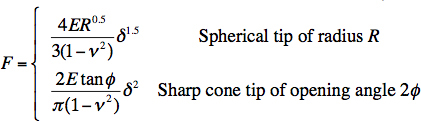
, where v is the Poisson's ratio.
Note: When δ is more than 10% of the sample thickness (cell height), the measured cell stiffness is affected by the substrate stiffness. The thickness of peri-nuclear region is usually on the order of a few micrometers. Therefore, only the first 200-300 nm of F-δ curve is fit to the Hertz model.
Access restricted. Please log in or start a trial to view this content.
Results
Figure 2a shows three representative force curves taken from 3T3 fibroblasts cultured on plastic surface, polyacrylamide gel of Young's moduli 3,000 Pa and 17,000 Pa, respectively. After carefully identifying the contact points in the curves, the indenting force as function of cell deformation is plotted in Figure 2b. Under a force of magnitude smaller than 0.3 nN, a pyramid shape tip indents 3 micrometers into a cell cultured on a 3 kPa polyacrylamide gel. In contrast, a force more than...
Access restricted. Please log in or start a trial to view this content.
Discussion
The AFM indentation method has advantages to characterize mechanical properties of living cells. Albeit less sensitive than the magnetic twisting cytometry and optical tweezers, which can measure forces on the piconewton level32, the AFM can detect resistance force from samples ranging from tens of pico-Newton to hundreds of nano-Newton, comparable to range of force that can be applied to cells using a micropipette19. This range of force fits the needs to create measurable deformations in all types ...
Access restricted. Please log in or start a trial to view this content.
Disclosures
No conflicts of interest declared.
Acknowledgements
The authors thank Dr. Paul Janmey at University of Pennsylvania for providing cell lines used in this paper. QW also acknowledge J.F. Byfield and Evan Anderson for their insightful discussions on AFM techniques.
Access restricted. Please log in or start a trial to view this content.
Materials
| Name | Company | Catalog Number | Comments |
|---|---|---|---|
| Atomic Force Microscope | Asylum Research | MFP3D-BIO |
References
- Discher, D. E., Janmey, P., Wang, Y. L. Tissue cells feel and respond to the stiffness of their substrate. Science. 310, 1139-1143 (2005).
- Wagner, O. I., et al. Softness, strength and self-repair in intermediate filament networks. Exp. Cell Res. 313, 2228-2235 (2007).
- Wang, N., et al. Mechanical behavior in living cells consistent with the tensegrity model. Proceedings of the National Academy of Sciences of the United States of America. 98, 7765-7770 (2001).
- Wang, N., et al. Cell prestress. I. Stiffness and prestress are closely associated in adherent contractile cells. American Journal of Physiology. Cell Physiology. 282, 606-616 (2002).
- Kasza, K. E., et al. Filamin A is essential for active cell stiffening but not passive stiffening under external force. Biophysical Journal. 96, 4326-4335 (2009).
- Elson, E. L. Cellular mechanics as an indicator of cytoskeletal structure and function. Annual Review of Biophysics and Biophysical Chemistry. 17, 397-430 (1988).
- Schafer, A., Radmacher, M. Influence of myosin II activity on stiffness of fibroblast cells. Acta Biomaterialia. 1, 273-280 (2005).
- Guck, J., et al. Optical deformability as an inherent cell marker for testing malignant transformation and metastatic competence. Biophysical Journal. 88, 3689-3698 (2005).
- Cross, S. E., Jin, Y. S., Rao, J., Gimzewski, J. K. Nanomechanical analysis of cells from cancer patients. Nature Nanotechnology. 2, 780-783 (2007).
- Plodinec, M., et al. The nanomechanical signature of breast cancer. Nature Nanotechnology. 7, 757-765 (2012).
- Rotsch, C., Radmacher, M. Drug-induced changes of cytoskeletal structure and mechanics in fibroblasts: an atomic force microscopy study. Biophysical Journal. 78 (00), 520-535 (2000).
- Cross, S. E., Jin, Y. S., Lu, Q. Y., Rao, J., Gimzewski, J. K. Green tea extract selectively targets nanomechanics of live metastatic cancer cells. Nanotechnology. 22, 215101(2011).
- Hoffman, B. D., Crocker, J. C. Cell mechanics: dissecting the physical responses of cells to force. Annual Review of Biomedical Engineering. 11, 259-288 (2009).
- Hoffman, B. D., Massiera, G., Van Citters, K. M., Crocker, J. C. The consensus mechanics of cultured mammalian cells. Proceedings of the National Academy of Sciences of the United States of America. 103, 10259-10264 (2006).
- Lau, A. W., Hoffman, B. D., Davies, A., Crocker, J. C., Lubensky, T. C. Microrheology, stress fluctuations, and active behavior of living cells. Physical Review Letters. 91, 198101(1981).
- Liu, J., et al. Microrheology probes length scale dependent rheology. Physical Review Letters. 96, 118104(2006).
- Deng, L., et al. Fast and slow dynamics of the cytoskeleton. Nature Materials. 5, 636-640 (2006).
- Oh, M. J., Kuhr, F., Byfield, F., Levitan, I. Micropipette Aspiration of Substrate-attached Cells to Estimate Cell Stiffness. J. Vis. Exp. (67), e3886(2012).
- Hochmuth, R. M. Micropipette aspiration of living cells. Journal of Biomechanics. 33, 15-22 (2000).
- Levental, I., et al. A simple indentation device for measuring micrometer-scale tissue stiffness. J. Phys-Condens. Mat. 22, (2010).
- Mahaffy, R. E., Park, S., Gerde, E., Kas, J., Shih, C. K. Quantitative analysis of the viscoelastic properties of thin regions of fibroblasts using atomic force microscopy. Biophysical Journal. 86, 1777-1793 (2004).
- Radmacher, M. Measuring the elastic properties of biological samples with the AFM. IEEE Engineering in Medicine and Biology Magazine: The Quarterly Magazine of the Engineering in Medicine & Biology Society. 16, 47-57 (1997).
- Crocker, J. C., Hoffman, B. D. Multiple-particle tracking and two-point microrheology in cells. Methods in Cell Biology. 83, 141-178 (2007).
- Liu, F., Tschumperlin, D. J. Micro-mechanical characterization of lung tissue using atomic force microscopy. J. Vis. Exp. (54), e2911(2011).
- Solon, J., Levental, I., Sengupta, K., Georges, P. C., Janmey, P. A. Fibroblast adaptation and stiffness matching to soft elastic substrates. Biophysical Journal. 93, 4453-4461 (2007).
- Wu, H. W., Kuhn, T., Moy, V. T. Mechanical properties of l929 cells measured by atomic force microscopy: Effects of anticytoskeletal drugs and membrane crosslinking. Scanning. 20, 389-397 (1998).
- Radmacher, M., Fritz, M., Kacher, C. M., Cleveland, J. P., Hansma, P. K. Measuring the viscoelastic properties of human platelets with the atomic force microscope. Biophysical Journal. 70, 556-567 (1996).
- Levy, R., Maaloum, M. Measuring the spring constant of atomic force microscope cantilevers: thermal fluctuations and other methods. Nanotechnology. 13, 33-37 (2002).
- Lin, D. C., Dimitriadis, E. K., Horkay, F. Robust strategies for automated AFM force curve analysis--I. Non-adhesive indentation of soft, inhomogeneous materials. Journal of Biomechanical Engineering. 129, 430-440 (2007).
- Davis, J. T., Wen, Q., Janmey, P. A., Otteson, D. C., Foster, W. J. Muller cell expression of genes implicated in proliferative vitreoretinopathy is influenced by substrate elastic modulus. Investigative Ophthalmology & Visual Science. 53, 3014-3019 (2012).
- Engler, A. J., Rehfeldt, F., Sen, S., Discher, D. E. Microtissue elasticity: Measurements by atomic force microscopy and its influence on cell differentiation. Method Cell Biol. 83, 521-545 (2007).
- Lele, T. P., et al. Tools to study cell mechanics and mechanotransduction. Methods in Cell Biology. 83 (07), 443-472 (2007).
- A-Hassan, E., et al. Relative microelastic mapping of living cells by atomic force microscopy. Biophysical Journal. 74, 1564-1578 (1998).
- Costa, K. D., Sim, A. J., Yin, F. C. Non-Hertzian approach to analyzing mechanical properties of endothelial cells probed by atomic force microscopy. Journal of Biomechanical Engineering. 128, 176-184 (2006).
- Xiong, Y., Lee, A. C., Suter, D. M., Lee, G. U. Topography and nanomechanics of live neuronal growth cones analyzed by atomic force microscopy. Biophysical Journal. 96, 5060-5072 (2009).
- Byfield, F. J., et al. Absence of filamin A prevents cells from responding to stiffness gradients on gels coated with collagen but not fibronectin. Biophysical Journal. 96, 5095-5102 (2009).
- Cross, S. E., et al. AFM-based analysis of human metastatic cancer cells. Nanotechnology. 19, 384003(2008).
- Storm, C., Pastore, J. J., MacKintosh, F. C., Lubensky, T. C., Janmey, P. A. Nonlinear elasticity in biological gels. Nature. 435, 191-194 (2005).
- Wen, Q., Janmey, P. A. Polymer physics of the cytoskeleton. Current Opinion in Solid State & Materials Science. 15, 177-182 (2011).
- Dimitriadis, E. K., Horkay, F., Maresca, J., Kachar, B., Chadwick, R. S. Determination of elastic moduli of thin layers of soft material using the atomic force microscope. Biophysical Journal. 82 (02), 2798-2810 (2002).
- Trache, A., Lim, S. M. Live cell response to mechanical stimulation studied by integrated optical and atomic force microscopy. J. Vis. Exp. (44), e2072(2010).
- Lim, S. M., Kreipe, B. A., Trzeciakowski, J., Dangott, L., Trache, A. Extracellular matrix effect on RhoA signaling modulation in vascular smooth muscle cells. Exp. Cell Res. 316, 2833-2848 (2010).
Access restricted. Please log in or start a trial to view this content.
Reprints and Permissions
