Electrospinning is a fascinating technique used to fabricate micro- to nano-scale fibers from a wide variety of materials. Molecular entanglement of the constituent polymers in the spinning dope is essential for successful electrospinning. We present a protocol for utilizing rheology to evaluate the electrospinnability of two biopolymers, starch and pullulan.
A subscription to JoVE is required to view this content. Sign in or start your free trial.
Method Article
Molecular Entanglement and Electrospinnability of Biopolymers
In This Article
Summary
Abstract
Electrospinning is a fascinating technique to fabricate micro- to nano-scale fibers from a wide variety of materials. For biopolymers, molecular entanglement of the constituent polymers in the spinning dope was found to be an essential prerequisite for successful electrospinning. Rheology is a powerful tool to probe the molecular conformation and interaction of biopolymers. In this report, we demonstrate the protocol for utilizing rheology to evaluate the electrospinnability of two biopolymers, starch and pullulan, from their dimethyl sulfoxide (DMSO)/water dispersions. Well-formed starch and pullulan fibers with average diameters in the submicron to micron range were obtained. Electrospinnability was evaluated by visual and microscopic observation of the fibers formed. By correlating the rheological properties of the dispersions to their electrospinnability, we demonstrate that molecular conformation, molecular entanglement, and shear viscosity all affect electrospinning. Rheology is not only useful in solvent system selection and process optimization, but also in understanding the mechanism of fiber formation on a molecular level.
Introduction
Electrospinning is a technique that is capable of producing continuous micro- to nano-scale fibers from a wide variety of materials. It has gained increasing academic and industrial interest1. Though the setup and practice of electrospinning seem straightforward, the ability to predict electrospinnability and control fiber properties remains a challenge. The reason may lie in the fact that there are many factors influencing the electrospinning process2 and the process, especially the path travelled by the fiber, is chaotic1. Often an empirical “cook-and-look” approach is used for screening potential electrospinnable materials. However, to gain better control over the electrospinning process and resultant fiber properties, a more complete understanding of the mechanisms that govern electrospinnability is required. Several researchers have found that molecular entanglement of polymers in the spinning dope is an essential prerequisite for successful electrospinning3-5.
Rheology is a powerful tool to probe molecular conformation and interaction in polymer dispersions. For instance, McKee et al. investigated the molecular conformation of linear and branched poly(ethylene terephthalate-co-ethylene isophthalate) copolymers in a solvent containing chloroform/dimethyl terephthalate (7/3, v/v), and determined that the polymer concentration had to be 2-2.5x the entanglement concentration for successful electrospinning4.
There is currently renewed interest in fibers from biopolymers because of their advantages in biodegradability, biocompatibility, and renewability vis-à-vis their synthetic counterparts. Yet practitioners confront many challenges arising generally from their structural complexity, difficulty in thermal processing and inferior mechanical properties. Starch, found in plant tissues, is among the most abundant and inexpensive biopolymers on earth. Pure starch fibers fabricated using an electro-wet-spinning apparatus were recently described6. Pullulan is a linear polysaccharide produced extracellularly by certain bacteria. The regular alternation of (1→4) and (1→6) glucosidic bonds are believed to be responsible for several distinctive properties of pullulan, including excellent fiber/film forming capability7,8. Electrospinning of pullulan fibers from aqueous dispersion has been reported by a number of researchers9,10. In our previous publications, the electrospinnability of two biopolymers, starch11 and pullulan12, has been discussed. This report focuses on demonstrating the protocol for utilizing rheological principles in the investigation of the electrospinnability of these two biopolymers.
Access restricted. Please log in or start a trial to view this content.
Protocol
1. Spinning Dope Preparation
- Prepare a range of biopolymer concentrations to be investigated (0.1% to 30%, w/v) and be sure to consider moisture content of the biopolymer powder in these calculations. For each concentration, weigh the biopolymer (starch or pullulan) powder into a 50 ml test tube. Add aqueous dimethyl sulfoxide (DMSO) solution and a stir bar.
- Place the tube into boiling water with constant stirring on a magnetic stirrer hotplate.
- After about 1 hr, turn off heat and allow the dispersion to cool to room temperature. The dispersion is then ready for rheological testing and electrospinning.
2. Steady Shear Rheology
- Warm up the rheometer and set the stage temperature at 20 °C. Calibrate the gap between the probe (25 mm cone used) and the stage (plate).
- Load 0.41 ml of the biopolymer dispersion onto the center of the stage and lower the probe to set the position (0.053 mm gap for 25 mm cone). Make sure that the dispersion evenly spreads within the gap.
- Perform the rheological test with the following experimental parameters: sweep mode: log, initial rate: 100 sec-1, final rate: 0.1 sec-1, points per decade: 10, delay before measure: 5 sec, measure time: 10 sec, and directions per measure: two (both clockwise and counterclockwise).
- Analyze rheological data to estimate appropriate dispersion concentrations for electrospinning trials.
- Plot apparent shear viscosities against shear rates as a function of polymer concentrations. For each flow curve, approximate zero shear viscosities, η0, by the actual or extrapolated values (e.g., at low concentrations where the low shear rate data are unreliable) for apparent viscosity at 0.1 sec−1.
- Calculate specific viscosity: ηsp = (η0− ηs)/ηs, where ηs is the viscosity of the solvent.
- Plot specific viscosities as a function of concentration. Identify semidilute unentangled and entangled regimes. The semidilute unentangled regime begins from the low concentration end with a small slope, and the semidilute entangled regime has a greater slope following the unentangled regime. Fit power-law regression models in both regimes. The power values are the slopes (concentration dependence) in semidilute unentangled and entangled regimes on a log-log plot. The intersection of the two fitted lines is the entanglement concentration, ce.
3. Electrospinning Parameter Variation
- Assemble the electrospinning setup as shown in Figure 1. Load the syringe with dispersion of appropriate composition, e.g., 15% (w/v) starch or pullulan in 100% DMSO, onto the syringe pump. Clip the high voltage wire (positive) to the needle. Connect the coagulation bath containing pure ethanol to ground by immersing the ground wire (negative) into the bath. Use a lab jack to adjust the distance between the syringe needle and coagulation bath. Immerse a metal mesh in the bath to collect the fiber mat after electrospinning.
- Spin the biopolymer in the following parameter ranges: feed rate from 0.1 to 0.4 ml/hr, spinning distance from 5 to 10 cm, and voltage from 0 to 15 kV.
- Start with a spinning distance of 5 cm. For the first feed rate (0.1 ml/hr), ramp the voltage up slowly from 0 V. Pay attention to the shape of the dispersion extruded at the needle tip and note when the dripping dispersion is accelerated and then elongated.
- Note the voltage at which a tiny jet initiated from the drop surface, indicating electrospinnability of the solution. Record the voltage at which a continuous jet initiates, if any.
- Examine the complete range for each of the three parameters and note successful spinning conditions. Collect the fibers only when there is a continuous jet from the tip.
- After a few minutes of collecting, rinse the fiber mat with pure ethanol. Place the fiber mat into a desiccator containing desiccant under vacuum.
- Repeat for each biopolymer concentration for complete characterization.
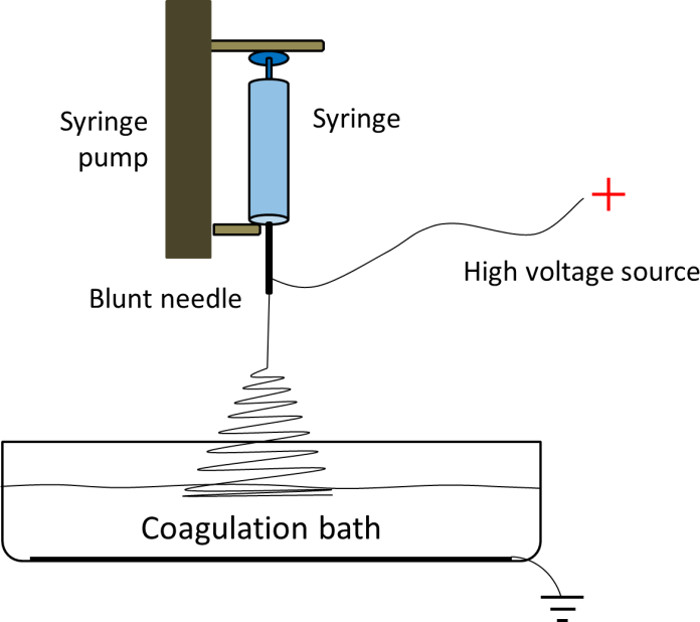
Figure 1. Schematic drawing of the electro-wet-spinning setup. The biopolymer dispersion is extruded from a syringe pump. A high voltage DC power supply provides high voltage to the blunt needle and grounds the coagulation bath. The polymer jet from the needle tip travels through a straight path and then develops a rapid whipping path (aka whipping instability).
4. Morphological Characterization
- Cut a piece of dried fiber mat and immobilize it onto a SEM stub using carbon tape.
- Load the sample stub into the SEM instrument and obtain images for analysis.
Access restricted. Please log in or start a trial to view this content.
Results
Flow curves of the biopolymer dispersions as a function of biopolymer concentration and DMSO concentration in solvent were obtained. Two representative figures show the flow curves of starch (Figure 2A) and pullulan (Figure 2B) as a function of their concentration in pure DMSO solvent. The specific viscosities were plotted against biopolymer concentration (Figure 3A for starch and Figure 3B for pullulan). From these plots, entanglement concentrations wer...
Access restricted. Please log in or start a trial to view this content.
Discussion
Rheology is an essential tool to study the processing of polymers, including conventional fiber spinning and electrospinning13. From the steady shear rheological studies, polymer conformation and their interactions in different solvents can be resolved (Figures 2 and 3). At concentrations not high enough for biopolymer molecules to overlap with one another, their concentration dependence was around 1.4 (Figure 3), which was in good agreement with rep...
Access restricted. Please log in or start a trial to view this content.
Disclosures
The authors declare that they have nothing to disclose.
Acknowledgements
This work is funded in part by the USDA National Institute for Food and Agriculture, National Competitive Grants Program, National Research Initiative Program 71.1 FY 2007 as Grant No. 2007-35503-18392, and National Institutes of Health, Institute for Allergy and Infectious Disease, R33AI94514-03.
Access restricted. Please log in or start a trial to view this content.
Materials
| Name | Company | Catalog Number | Comments |
|---|---|---|---|
| Gelose 80 starch | Ingredion | Used as it is | |
| Pullulan | Hayashibara Co. Ltd | Used as it is | |
| Dimethyl sulfoxide | BDH Chemicals | BDH1115-4LP | |
| Ethanol | VWR International | 89125-172 | 200 proof |
| Rheometer | TA Instruments | ARES | 50 mm cone and plate geometry |
| Syringe (10 ml) | Becton, Dickinson and Company | 309604 | Syringe with Luer-Lok® Tip |
| High voltage generator | Gamma High Voltage Research, Inc. | ES40P | |
| Syringe pump | Hamilton Company | 81620 | |
| Environmental scanning electron microscope | FEI Company | Quanta 200 | for starch fibers |
| Environmental scanning electron microscope | Phenom-World | Phenom G2 Pro | for pullulan fibers |
References
- Greiner, A., Wendorff, J. H. Functional self-assembled nanofibers by electrospinning. Self-aseembled nanomaterials. 1, 107-171 (2008).
- Ramakrishna, S., Fujihara, K., Teo, W. E., Lim, T. C., Ma, Z. An Introduction to Electrospinning and Nanofibers. , World Scientific. Singapore. (2005).
- Klossner, R. R., Queen, H. A., Coughlin, A. J., Krause, W. E. Correlation of Chitosan’s Rheological Properties and Its Ability to Electrospin. Biomacromolecules. 9 (10), 2947-2953 (2008).
- McKee, M. G., Wilkes, G. L., Colby, R. H., Long, T. E. Correlations of Solution Rheology with Electrospun Fiber Formation of Linear and Branched Polyesters. Macromolecules. 37 (5), 1760-1767 (2004).
- McKee, M. G., Hunley, M. T., Layman, J. M., Long, T. E. Solution rheological behavior and electrospinning of cationic polyelectrolytes. Macromolecules. 39 (2), 575-583 (2006).
- Kong, L., Ziegler, G. R. Fabrication of pure starch fibers by electrospinning. Food Hydrocolloids. 36, 20-25 (2014).
- Singh, R. S., Saini, G. K., Kennedy, J. F. Pullulan: microbial sources, production and applications. Carbohydrate Polymers. 73 (4), 515-531 (2008).
- Leathers, T. D. Biotechnological production and applications of pullulan. Applied Microbiology and Biotechnology. 62 (5), 468-473 (2003).
- Karim, M. R., Lee, H. W., et al. Preparation and characterization of electrospun pullulan/montmorillonite nanofiber mats in aqueous solution. Carbohydrate Polymers. 78 (2), 336-342 (2009).
- Stijnman, A. C., Bodnar, I., Hans Tromp, R. Electrospinning of food-grade polysaccharides. Food Hydrocolloids. 25 (5), 1393-1398 (2011).
- Kong, L., Ziegler, G. R. Role of molecular entanglements in starch fiber formation by electrospinning. Biomacromolecules. 13 (8), 2247-2253 (2012).
- Kong, L., Ziegler, G. R. Rheological aspects in fabricating pullulan fibers by electro-wet-spinning. Food Hydrocolloids. 38, 220-226 (2014).
- Han, C. D. Fiber Spinning Rheology and Processing of Polymeric Materials: Volume 2: Polymer Processing. , 257-304 (2007).
- Morris, E. R., Cutler, A. N., Ross-Murphy, S. B., Rees, D. A., Price, J. Concentration and shear rate dependence of viscosity in random coil polysaccharide solutions. Carbohydrate Polymers. 1 (1), 5-21 (1981).
- Thompson, C. J., Chase, G. G., Yarin, A. L., Reneker, D. H. Effects of parameters on nanofiber diameter determined from electrospinning model. Polymer. 48 (23), 6913-6922 (2007).
Access restricted. Please log in or start a trial to view this content.
Reprints and Permissions
