In this study, we describe an in-ovo system as a promising tool to test insulin-mimetic compounds in a living organism. The main advantages include adequate throughput rates and acceptable costs, which enable the identification of phytochemicals with insulin-mimetic properties.
Method Article
An In Ovo Model for Testing Insulin-mimetic Compounds
* These authors contributed equally
In This Article
Summary
Abstract
Elevated blood glucose levels in type 2 diabetes mellitus (T2DM), a complex and multifactorial metabolic disease, are caused by insulin resistance and β-cell failure. Various strategies, including the injection of insulin or the usage of insulin-sensitizing drugs, were pursued to treat T2DM or at least reduce the symptoms. In addition, the application of herbal compounds has attracted increasing attention. Thus, it is necessary to find efficient test systems to identify and characterize insulin-mimetic compounds. Here we developed a modified chick embryo model, which enables testing of synthetic compounds and herbal extracts with insulin-mimetic properties. Using a fluorescence microscopy-based primary screen, which quantifies the translocation of Glucose transporter 4 (Glut4) to the plasma membrane, we were able to identify compounds, mainly herbal extracts, which lead to an increase of intracellular glucose concentrations in adipocytes. However, the efficacy of these substances requires further verification in a living organism. Thus, we used an in-ovo approach to identify their blood glucose-reducing properties. The approval by an ethics committee is not needed since the use of chicken embryos during the first two-thirds of embryonic development is not considered an animal experiment. Here, the application of this model is described in detail.
Introduction
Diabetes mellitus is a metabolic disease characterized by hyperglycemia and is caused by defects in insulin secretion or insulin action1. Ninety percent of all diabetes cases are category type 2 diabetes mellitus (T2DM), where individuals demonstrate insulin resistance and mostly insulin deficiency2. Several factors are known to increase the global incidence of T2DM, including changes in lifestyle, particularly those related to overnutrition, aging, and physical inactivity. Approximately 400 million people have diabetes mellitus worldwide according to the International Diabetes Federation (IDF). This number is expected to reach 600 million within the next 20 years3.
Diabetic complications caused by hyperglycemia and insulin-resistance, such as hypertension, dyslipidemia, glucose intolerance, coronary heart disease, and cerebral vascular disease, lead to a significantly reduced life expectancy and quality4. Affected individuals require glucose-lowering pharmacotherapy; however, the usage of drugs, such as metformin5 is often associated with dramatic side-effects6,7,8. Therefore, further antidiabetic approaches that are safe, widely available and inexpensive are necessary.
Different herbal compounds, extracts, plants, and nutraceuticals have been ascribed to feature insulin-mimetic properties by modulating various cellular functions. An important feature is stimulation of the translocation of glucose transporter 4 (GLUT4) to the plasma membrane from intracellular storage compartments, resulting in an increased uptake of glucose in muscle and adipose tissue in the absence of insulin, known as insulin-mimetic properties9. Previously, we implemented a fluorescence microscopy-based approach to quantify the translocation process of GLUT410. Analysis of numerous plant extracts from an extract library11 using this assay resulted in the identification of promising candidates. However, further tests in living organisms are required. The approach described in detail in this paper, a modified chick embryo model, has proven to be a promising model for identifying substances with insulin-mimetic properties. It represents an attractive tool filling the wide gap between in-vitro and in-vivo studies and offers several advantages in comparison to existing systems such as acceptable costs, simple handling procedures, and adequate throughput rates. In addition, permission by an ethics committee is not required.
Protocol
According to the directive 2010/63/EU, experiments with non-hatched avian embryos during the first two-thirds of embryonic development do not need permission by an ethics committee.
1. Storage and Breeding of the Eggs
- Obtain fertilized hen eggs (Table of Materials) from a local breeder.
NOTE: Eggs may be stored at 14 °C in a humidified atmosphere for up to 10 days after laying before use for experiments. - Incubate the eggs at 38 °C with an average humidity of 40 - 60% for 10 or 11 days in an incubator that constantly turns the eggs.
2. Selection of the Eggs
- Check the eggs for fertilization after incubation of up to 11 days. Use a candling light for this step. Dip the fringe of the candling lamp into an inkpad and candle the pointed side of the egg.
- To identify the air bladder, check for differences in brightness on the top of the egg.
NOTE: The air bladder appears as a round, more transparent region, while the albumen is darker when the egg is candled. - After detection of the air bladder, mark the location by pressing the lamp slightly against the egg with the previously applied ink.
- Exclude non-fertilized eggs at this step, which do not show a difference in brightness between the albumen and air bladder.
3. Injection of Substances
- Prepare the substance of interest (e.g., the herbal extract or insulin) by diluting the substance in the desired concentration in Hank's balanced salt solution (HBSS) buffer. For example, 3.3 U/mL of a commercially available insulin analog in HBSS.
- For the application of the selected compound, carefully peck the eggshell with a pointed pair of tweezers in the marked area of the air bladder. Do not form a hole larger than the diameter of the needle of the syringe. Inject the buffer solution (300 µL) containing the substance of interest into the pecked area via a syringe.
NOTE: Use sterile, 1-ml single-use syringes, pipette tips, and vessels. Wear gloves and a lab coat for the experiments. - To determine the blood glucose-reducing effect of a substance, place the eggs back into the incubator for 60, 120, and 180 min, respectively. To determine basal blood glucose levels, include at least 10 - 15 non-treated control eggs.
4. Toxicity Tests
- After application of the selected compound for 24 h, equilibrate the eggshell membrane with phosphate buffered saline (PBS) buffer (enough to cover the whole eggshell membrane) for at least 30 s.
- Remove excess PBS buffer by pouring it away.
- Pull off the eggshell membrane carefully with a pointed pair of tweezers.
- Check blood vessels for lesions and confirm vitality (e.g., movement) of the chick embryo.
NOTE: See Figure 1 for comparison of vital versus non-vital embryos after application of a toxic herbal extract.
5. Measurement of the Blood Glucose Value
- At the respective time point, carefully remove the eggshell above the air bladder and equilibrate the eggshell membrane with PBS buffer (enough to cover the whole eggshell membrane).
- Remove excess PBS buffer by pouring it away.
- Carefully pull off the eggshell membrane with a pointed pair of tweezers.
- Cut and remove the chorioallantoic membrane with a micro-scissor, to enable good access to suitable blood vessels. Cut the membrane at least 2 - 3 cm. Do not cut any large vessels in the membrane itself to avoid unwanted blood loss of the embryo.
- Locate the large vessel originating from the abdomen of the embryo. Lift this vessel out of the albumen with a closed micro-scissor and place it on a plastic pH-strip. Move the pH strip under the vessel, which is held with the micro-scissor, and pull back the micro-scissor away carefully.
- Remove 1 - 2 mL of the liquid beneath the chorioallantoic membrane with a pipette to avoid dilution of the blood in the next step. Dry the vessel and pH-strip with filter paper, before the vessel is cut.
- Cut the blood vessel carefully with a micro-scissor on one side. Do not cut through the vessel completely.
NOTE: The vessel is approximately 1-mm thick. Do not cut more than half of the vessel to avoid cutting through the vessel entirely, as it may slip off the strip and no blood collection is possible. - Collect the leaking blood on the pH-strip using a pipette. Ten microliters of blood are required to determine glucose levels using the blood glucose meter.
6. Statistical Evaluation
- Calculate the mean value of at least 10 individual eggs per time point and normalize these values to one of the control eggs (non- or buffer-treated eggs).
- Subsequently, determine the percentage of decrease. In addition, use insulin as a positive control.
NOTE: Repeat each experiment at least three times.
Results
Description of the Gluc-HET approach:
After incubation with the substances of interest, the fertilized eggs are opened and prepared for blood collection by removal of the eggshell (Figure 2). Further preparation includes equilibration and removal of the eggshell membrane to gain access to the chorioallantoic membrane. This membrane is then cut carefully to provide access to a suitable blood vessel for blood collection. Preferably, the large vessel originating from the abdomen of the embryo is placed on a plastic pH-strip. To avoid dilution of the blood during collection, the vessel and pH-strip is patted dry with filter paper. The blood vessel is then cut and blood leaking onto the pH-strip is collected for analysis using a pipette.
Effects of selected herbal extracts on blood glucose levels:
With a recently established GLUT4-translocation quantitation-based primary screen, we are able to identify substances with an insulin-mimetic characteristic10. Screening of hundreds of water-soluble herbal extracts resulted in the identification of several hits. These extracts were tested in our in-ovo model. Extracts prepared from Combretum indicum (Rangoon creeper) and a non-disclosed extract (termed extract 0845) were used for these experiments. We dissolved the extracts in HBSS buffer at 300 mg/L, a concentration that turned out to be appropriate in previous studies12,13. Substances were applied to the embryos incubated for 11 days. As indicated in Figure 3, the extract from Rangoon creeper did not result in a significant blood glucose reduction in-ovo. However, the blood glucose concentration was successfully reduced with extract 0845, with a minor decrease after 60 min, which is comparable to the effect observed using a commercially available insulin analog. A significant effect was observed when the incubation time of the eggs was prolonged.
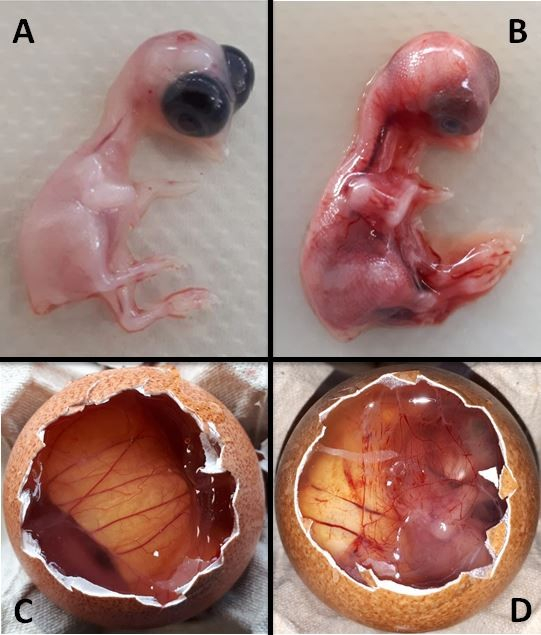
Figure 1: Influence of toxic compounds on embryo vitality. Eggs were incubated for 11 days (A and C) or treated with a toxic herbal extract on day 10 for another 24 h (B and D). Application of the extract led to severe lesions of blood vessels in the chorioallantoic membrane (D) and the embryo (B).

Figure 2: Description of the in-ovo model. From left to right: Opening and removal of the eggshell (1-2); equilibration and removal of the eggshell membrane with chorioallantoic membrane exposed (3); prepared vessel on a pH-strip (4); the collection of blood and measurement of glucose concentration using a glucose meter (5). Adapted from Haselgruebler et al., 201712. Please click here to view a larger version of this figure.
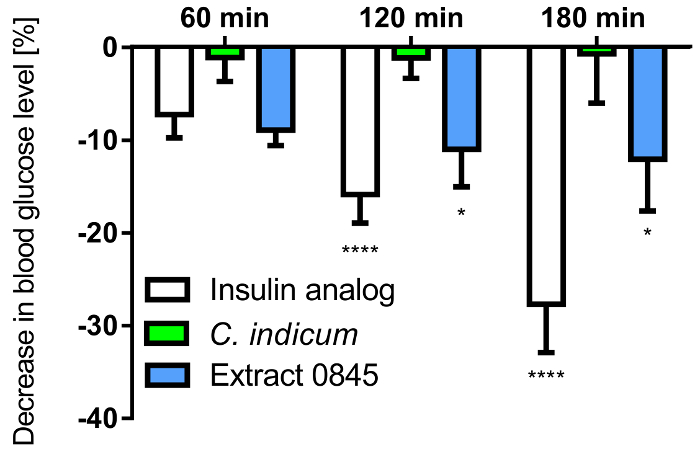
Figure 3: Effect of herbal extracts on blood glucose levels compared to untreated or insulin-treated eggs. Eggs were incubated for 11 days and treated with the indicated substances (commercially available insulin analog: 3.3 U/mL; extracts: 300 mg/L) dissolved in HBSS buffer (300 µL volume) for up to 3 h. Blood glucose levels were determined using a blood glucose meter. Results are shown without the effect of the buffer. Error bars are based on the standard error of the mean. *P <0.05 and ****P <0.0001, significant decrease with respect to HBSS-treated eggs of the same incubation time. Adapted from Haselgruebler et al., 201712. Please click here to view a larger version of this figure.
Discussion
The HET-CAM assay is a widely used alternative test system to animal testing in the industry12. The in-ovo system described here represents a modified version of the HET-CAM assay. While in its original form, HET-CAM experiments are performed to study the irritating properties of compounds and formulation or the analysis of angiogenesis14,15,16, we have adapted the approach to test compounds with putative insulin-mimetic characteristics12. According to the directive 2010/63/EU, experiments with non-hatched avian embryos during the first two-thirds of embryonic development do not need permission by an ethics committee since these experiments are not considered animal experiments. Recent studies have proven the suitability of the in-ovo system to characterize the efficacy of selected herbal extracts, which have been identified in a GLUT4-translocation-based primary screen10, to reduce blood glucose levels in the absence of insulin12,13. Critical points for a good performance of the in-ovo system include: First, a reliable breeder delivering the fertilized eggs. The Lohmann classic brown chicken is a good choice of breed. Second, the implementation of toxicity tests to exclude toxic effects of the investigated compound needs to be done. In addition, the preparation of a suitable blood vessel for blood collection is important. It is important to avoid the cutting of large vessels in the chorioallantoic membrane itself, as this can lead to a non-preferable loss of blood. Furthermore, before the vessel is cut onto the pH strip, it has to be patted dry using filter paper to prevent dilution of the collected blood. Finally, a sufficient number of experiments appears to be important. We recommend using at least 10 eggs for each time point, and a three-fold repetition of the respective experiment.
Naturally, there are some limitations of this in-ovo approach. Since it takes up to 30 minutes until the substances are absorbed through the eggshell membrane and come into close contact with the chorioallantoic membrane, it is not possible to quantify a rapid response of the embryo to the applied compound. Furthermore, some compounds may be toxic in the applied concentration, which frequently results in lesions of the blood vessels in the chorioallantoic membrane. Thus, cytotoxicity testing based on long-term incubation of the compounds for about 24 hours appears reasonable. Finally, we found that the buffer system used for application of the compounds has a significant effect on the performance of the assay.12 Currently, HBSS buffer is used because it results in the smallest effect on the blood glucose levels of the embryo.
For future applications, additional buffer systems as an alternative to HBSS might be tested. Furthermore, the influence of herbal extracts on additional blood parameters such as cholesterol, triglycerides or lipoproteins could be an attractive question.
Our new in-ovo system is a promising and important tool to test substances with insulin-mimetic characteristics in a living organism without the need of an animal experiment. Therefore, it fills the gap between in-vitro and in-vivo approaches. In comparison to existing in-ovo model systems17 there is no need to induce diabetes by streptozotocin (STZ) treatment, as we use embryos at day 10 or 11 of incubation. At this stage, insulin production has not started, but the embryos are already insulin sensitive. Additionally, permission by an ethics committee might be required if embryos aged 14 - 17 days are used17. Furthermore, compared to alternative strategies18, the compound application as described here is less harmful and laborious, increasing experimental through-put rates.
Taken together, this in-ovo approach is an attractive system if a blood-decreasing effect of an insulin-mimetic substance needs to be tested in a living organism.
Disclosures
The authors have nothing to disclose.
Acknowledgements
This work was funded by the Austrian Research Promotion Agency (FFG; project number 850681), the University of Applied Sciences Upper Austria Basic Funding initiative (project GlucoSTAR) and the Center for Technological Innovation in Medicine (TIMed Center) that receives basic funding by the province of Upper Austria.
Materials
| Name | Company | Catalog Number | Comments |
|---|---|---|---|
| Phosphate buffered saline (PBS) | Biochrom | L1825 | |
| Hank’s balanced salt solution (HBSS) | Thermo Scientific | SH30268.02 | |
| NovoRapid | Novo Nordisk | 8-0905-82-304-6 | |
| Hens eggs (Lohmann classic brown chicken) | Local Breeder | ||
| Accu-check performa | Roche | 6454011 | |
| Accu-check Inform II Teststreifen | Roche | 5942861 | |
| Incubator HEKA- Turbo 288 | HEKA Brutgeräte | ||
| Syringe Omnican F 1 mL | Braun | 09161502S | |
| Extracts | PEKISH extract library | ||
| Lamp Tempo Nr. 119 | ORBAN |
References
- Defronzo, R. A. Banting Lecture. From the triumvirate to the ominous octet: a new paradigm for the treatment of type 2 diabetes mellitus. Diabetes. 58 (4), 773-795 (2009).
- American_Diabetes_Association. Diagnosis and classification of diabetes mellitus. Diabetes Care. 37, S81-S90 (2014).
- Han Cho, N., et al. IDF Diabetes Atlas. Cavan, D. 7, International Diabetes Federation. (2015).
- Bailey, C. J., et al. Individualized glycaemic targets and pharmacotherapy in type 2 diabetes. Diabetes & vascular disease research. 10 (5), 397-409 (2013).
- Maruthur, N. M., et al. Diabetes Medications as Monotherapy or Metformin-Based Combination Therapy for Type 2 Diabetes: A Systematic Review and Meta-analysis. Annals of internal medicine. 164 (11), 740-751 (2016).
- Aleman-Gonzalez-Duhart, D., Tamay-Cach, F., Alvarez-Almazan, S., Mendieta-Wejebe, J. E. Current Advances in the Biochemical and Physiological Aspects of the Treatment of Type 2 Diabetes Mellitus with Thiazolidinediones. PPAR research. , 7614270(2016).
- Cohen, F. J., Neslusan, C. A., Conklin, J. E., Song, X. Recent antihyperglycemic prescribing trends for US privately insured patients with type 2 diabetes. Diabetes care. 26 (6), 1847-1851 (2003).
- Desai, N. R., et al. Patterns of medication initiation in newly diagnosed diabetes mellitus: quality and cost implications. The American journal of medicine. 125 (3), e301-e307 (2012).
- Martel, J., et al. Anti-obesogenic and antidiabetic effects of plants and mushrooms. Nature reviews. Endocrinology. , (2016).
- Lanzerstorfer, P., et al. Identification of novel insulin mimetic drugs by quantitative total internal reflection fluorescence (TIRF) microscopy. British journal of pharmacology. 171 (23), 5237-5251 (2014).
- Onur, S., Stöckmann, H., Zenthoefer, M., Piker, L., Döring, F. The Plant Extract Collection Kiel in Schleswig-Holstein (PECKISH) Is an Open Access Screening Library. Journal of Food Research. 2 (4), (2013).
- Haselgrubler, R., et al. Gluc-HET, a complementary chick embryo model for the characterization of antidiabetic compounds. PloS one. 12 (8), e0182788(2017).
- Stadlbauer, V., et al. Biomolecular Characterization of Putative Antidiabetic Herbal Extracts. PloS one. 11 (1), e0148109(2016).
- Greywe, D., et al. Applicability and robustness of the hen's egg test for analysis of micronucleus induction (HET-MN): results from an inter-laboratory trial. Mutation research. 747 (1), 118-134 (2012).
- Manakova, E., Hubickova, L., Kostalova, J., Zemanova, Z. Embryotoxicity of mirtazapine: a study using Chick Embryotoxicity Screening Test. Neuro endocrinology letters. 31, Suppl 2. 8-10 (2010).
- Ribatti, D. Chick embryo chorioallantoic membrane as a useful tool to study angiogenesis. International review of cell and molecular biology. 270, 181-224 (2008).
- Yoshiyama, Y., Sugiyama, T., Kanke, M. Experimental diabetes model in chick embryos treated with streptozotocin. Biological & pharmaceutical bulletin. 28 (10), 1986-1988 (2005).
- Wolf, T., Niehaus-Rolf, C., Luepke, N. P. Some new methodological aspects of the hen's egg test for micronucleus induction (HET-MN). Mutation research. 514 (1-2), 59-76 (2002).
Reprints and Permissions
