
Star Constellations
A star constellation is a group of stars that form a recognizable pattern in the night sky. For thousands of years, people have named constellations,
Video Duration: 1 minute and 21 secondsMIDDLE SCHOOL
Earth and Space Science
A star constellation is a group of stars that form a recognizable pattern in the night sky. For thousands of years, people have named constellations,
Video Duration: 1 minute and 21 seconds
Stars are massive spheres of hot, glowing gases that produce energy through nuclear fusion. The energy from stars, including our Sun, powers the solar
Video Duration: 1 minute and 21 seconds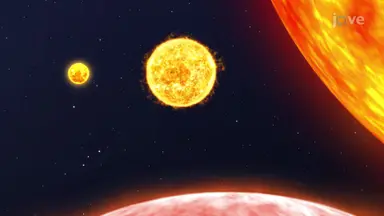
Stars are massive, glowing spheres of gas that generate energy through nuclear fusion. They vary in size, color, and temperature. Scientists classify
Video Duration: 1 minute and 18 seconds
Stars are born from vast clouds of gas and dust in space called nebulae. Gravity pulls these particles together, causing them to heat up and form a de
Video Duration: 1 minute and 21 seconds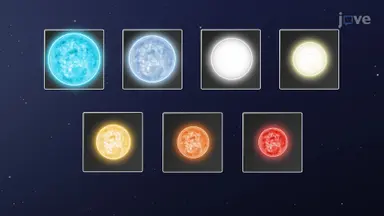
A main sequence star is a star in the most stable phase of its life cycle. During this stage, the star generates energy by fusing hydrogen nuclei into
Video Duration: 1 minute and 30 seconds
Stars go through different stages in their life cycles. After spending millions or even billions of years as a main sequence star, they begin to chang
Video Duration: 1 minute and 14 seconds
The Sun is a massive ball of hot gases that provides light and heat to Earth. Scientists study its interior to understand how it produces energy and i
Video Duration: 1 minute and 29 seconds
The Sun's outer layers are where light and energy travel from its interior into space. These layers regulate solar activity, including sunspots, flare
Video Duration: 1 minute and 17 seconds
The Sun is a massive ball of hot gases with a constantly changing surface. It has several key features, including sunspots, solar flares, prominences,
Video Duration: 1 minute and 24 seconds
Science and Engineering Practices (SEP): Developing and Using ModelsScientists create models to study gravity and its role in the solar system. These
Video Duration: 1 minute and 20 seconds
The solar system is divided into inner and outer planets, each with unique characteristics. The inner planets, Mercury, Venus, Earth, and Mars, are sm
Video Duration: 1 minute and 19 seconds
Mercury is the smallest planet in the solar system and the closest to the Sun. Its rocky surface is covered in craters, and it experiences extreme tem
Video Duration: 1 minute and 25 seconds
The Sun and planets formed from a vast cloud of gas and dust known as the solar nebula. Around 4.6 billion years ago, gravity pulled this material tog
Video Duration: 1 minute and 20 seconds
Earth formed approximately 4.6 billion years ago from a cloud of dust and gas left over after the Sun’s formation. Gravity pulled these particles toge
Video Duration: 1 minute and 17 seconds
The Moon is Earth's only natural satellite and plays a vital role in stabilizing Earth's rotation and influencing tides. Scientists believe the Moon f
Video Duration: 1 minute and 11 seconds
Earth’s atmosphere and oceans have changed significantly since the planet formed about 4.6 billion years ago. In its early history, Earth had a thick
Video Duration: 1 minute and 24 seconds
Everything around us is made of tiny particles called atoms. Atoms are the smallest units of matter and are the building blocks of all substances. Whe
Video Duration: 1 minute and 24 seconds
Earth may look flat from where we stand, but it is actually an oblate spheroid—meaning it is mostly round but slightly flattened at the poles and bulg
Video Duration: 1 minute and 25 seconds