
Formation of the Sun and Planets
The Sun and planets formed from a vast cloud of gas and dust known as the solar nebula. Around 4.6 billion years ago, gravity pulled this material tog
Video Duration: 1 minute and 20 secondsMIDDLE SCHOOL
Earth and Space Science
The Sun and planets formed from a vast cloud of gas and dust known as the solar nebula. Around 4.6 billion years ago, gravity pulled this material tog
Video Duration: 1 minute and 20 seconds
Earth formed approximately 4.6 billion years ago from a cloud of dust and gas left over after the Sun’s formation. Gravity pulled these particles toge
Video Duration: 1 minute and 17 seconds
The Moon is Earth's only natural satellite and plays a vital role in stabilizing Earth's rotation and influencing tides. Scientists believe the Moon f
Video Duration: 1 minute and 11 seconds
Earth’s atmosphere and oceans have changed significantly since the planet formed about 4.6 billion years ago. In its early history, Earth had a thick
Video Duration: 1 minute and 24 seconds
Everything around us is made of tiny particles called atoms. Atoms are the smallest units of matter and are the building blocks of all substances. Whe
Video Duration: 1 minute and 24 seconds
Earth may look flat from where we stand, but it is actually an oblate spheroid—meaning it is mostly round but slightly flattened at the poles and bulg
Video Duration: 1 minute and 25 seconds
Earth has an invisible shield that protects us from harmful space radiation. This shield is called the magnetic field, and it is generated by the move
Video Duration: 1 minute and 19 seconds
Earth is constantly spinning on its axis, an imaginary line passing through the North and South Poles. This motion is called rotation, and Earth takes
Video Duration: 1 minute and 14 seconds
While Earth rotates on its axis, it also moves around the Sun in a path called an orbit. This motion is called revolution, and it takes about 365.25 d
Video Duration: 1 minute and 21 seconds
The Coriolis effect is how Earth’s rotation causes moving air and water to curve rather than move in a straight line. This effect influences weather p
Video Duration: 1 minute and 17 seconds
Due to the tilt of Earth's axis as it revolves around the Sun, the planet experiences four seasons: spring, summer, fall, and winter. Seasons affect t
Video Duration: 1 minute and 25 seconds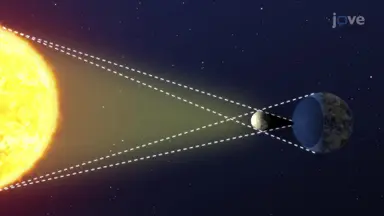
An eclipse occurs when one celestial body moves into the shadow of another. There are two main types of eclipses: solar eclipses and lunar eclipses. A
Video Duration: 1 minute and 13 seconds
A solar eclipse occurs when the Moon moves between the Earth and the Sun, temporarily blocking sunlight. This phenomenon happens only during a new moo
Video Duration: 1 minute and 13 seconds
The Moon does not produce its own light but instead reflects sunlight. As the Moon orbits Earth, different portions of its illuminated side become vis
Video Duration: 1 minute and 20 seconds
A lunar eclipse occurs when the Earth moves between the Sun and the Moon, casting its shadow on the Moon. This can only happen during a full moon when
Video Duration: 1 minute and 18 seconds
Earth’s interior consists of distinct layers, each with unique properties. Scientists classify these layers into four main sections: the crust, mantle
Video Duration: 1 minute and 26 seconds
Earth comprises four major layers, or "spheres," that work together to support life. These layers include:
Video Duration: 1 minute and 26 seconds
Earth is composed of several layers, each with distinct properties. Scientists classify Earth's structure based on composition and mechanical properti
Video Duration: 1 minute and 19 seconds
The Earth's crust is the outermost layer of our planet. It is like the shell of an egg, covering everything we see on the surface. The crust is made o
Video Duration: 1 minute and 20 seconds
Beneath the Earth's surface is a thick layer of rock called the mantle. It sits between the crust and the core and makes up most of the planet's volum
Video Duration: 1 minute and 27 seconds
Earth's core is the deepest layer of our planet. It is made mostly of iron and nickel and is extremely hot. Scientists divide it into two parts: the o
Video Duration: 1 minute and 17 seconds
The Earth's outer layers are divided into two main parts: the lithosphere and the asthenosphere. The lithosphere is the rigid outermost layer that inc
Video Duration: 1 minute and 28 seconds
Rising sea levels are one of the major effects of global climate change. As Earth's average temperature increases, glaciers and ice sheets melt, and w
Video Duration: 1 minute and 27 seconds