We present an optimized inexpensive and reliable negative geotaxis assay in Drosophila melanogaster as a model for neurodegenerative disorders. Being more sensitive to mild locomotor defects, this assay will help screen for potential genetic interactions and drug targets.
Method Article
Quantitative Analysis of Climbing Defects in a Drosophila Model of Neurodegenerative Disorders
In This Article
Summary
Abstract
Locomotive defects resulting from neurodegenerative disorders can be a late onset symptom of disease, following years of subclinical degeneration, and thus current therapeutic treatment strategies are not curative. Through the use of whole exome sequencing, an increasing number of genes have been identified to play a role in human locomotion. Despite identifying these genes, it is not known how these genes are crucial to normal locomotive functioning. Therefore, a reliable assay, which utilizes model organisms to elucidate the role of these genes in order to identify novel targets of therapeutic interest, is needed more than ever. We have designed a sensitized version of the negative geotaxis assay that allows for the detection of milder defects earlier and has the ability to evaluate these defects over time. The assay is performed in a glass graduated cylinder, which is sealed with a wax barrier film. By increasing the threshold distance to be climbed to 17.5 cm and increasing the experiment duration to 2 min we have observed a greater sensitivity in detecting mild mobility dysfunctions. The assay is cost effective and does not require extensive training to obtain highly reproducible results. This makes it an excellent technique for screening candidate drugs in Drosophila mutants with locomotion defects.
Introduction
Devastating neurodegenerative disorders such as Parkinson’s disease, amyotrophic lateral sclerosis, and hereditary spastic paraplegia are increasingly recognized. Unfortunately, most of these neurodegenerative disorders are still without treatments. The widespread clinical use of genome-wide, unbiased genetic tests such as whole exome sequencing has led to an increasing number of genes being implicated in human locomotive disorders. Despite this progress, the pathological progression from early to late stages, remains elusive in these disorders. Drosophila provides one with the genetic tools for studying gene requirement in a controlled spatial and temporal manner. In addition, Drosophila has proven useful in screening drugs for neurological conditions such as Parkinson’s1, Alzheimer’s2, intellectual disability3,4 and epilepsy5,6 among others. Our aim was to develop a cost effective and reliable assay that would allow high throughput analysis that would still be sensitive enough to detect small changes in motor performance.
There are several assays used to quantify the effects of genetic mutation and/or environmental condition on Drosophila climbing behavior. Most of the assays capitalize on the natural tendency of flies to climb, known as negative geotaxis, or the climbing assay. Benzer7 suggested in 1967 that the counter-current apparatus used for the study of phototaxis could also be used to study gravitaxis. Since then, Ganetsky8 and many others9-12 have built on the initial assay. The principle is to place a known number of flies in a vial and tap the vial strongly against a hard surface, causing the flies to fall to the bottom of the vial. As it is an innate behavior, the flies will attempt to climb to the top of the vial, opposed to gravity. This assay is quantitative and measures how many flies have climbed past a marker on the vial during an allotted time period. Measurement of speed instead of total number of flies climbing has become a reliable parameter and shown defects in cases where the number of flies criteria was not significant13.
The climbing assay has proven useful in the study of many neurodegenerative disorders including Parkinson’s disease14. However, we noted that locomotive defects may not be detectable at time where neurodegeneration is already seen in pathological studies14. Thus, use of the traditional assay may limit the ability to study the early stages of disease pathogenesis. The appearance of locomotive defects during later stages of pathology may reflect a disease whose progression is too advanced for complete rescue.
This raises a potential issue with the sensitivity of the traditional climbing assay. The potential inability of the traditional climbing assay to detect mild locomotive defects can be attributed to the height to which the flies are required to climb. The traditional assay15,16 measures the number of flies to successfully climb over a height of 2 to 5 cm in 10 to 20 sec.
Protocol
Research on Drosophila melanogaster was in compliance with the University of Alberta’s research guidelines.
1. Fly Collection
- Collect 20 flies using CO2 (g) anesthetization and place in a 25 mm x 95 mm collection vial containing food.
- Store vials containing flies horizontally to avoid trapping flies in any liquids that may accumulate in the bottom the vial.
- Incubate flies for at least 21 hr at 22 °C at 45% humidity in an incubator for approximately for 15 hr. Set the incubator with a 12 hr light : dark cycle.
2. Climbing Assay
- The following morning, transfer 20 flies from a single vial into a 250 ml glass graduated cylinder. Mark the position of the cylinder to keep it constant everyday. Use one glass cylinder per genotype to prevent cross contamination between the genotypes. Wash at the end of each experiment and rotate them between genotypes.
- Conduct the experiments in ambient light (or red light if there is a potential defect in vision) at temperature and humidity of 22 °C and 40% respectively. To avoid circadian rhythm confound, always perform experiments at the same time of day.
- Seal the top of cylinder with a barrier film (wax film) to prevent the escape of any flies (Figure 2).
- Set up the video camera on a tripod. Focus camera on the 190 ml line of the 250 ml graduated cylinder (17.5 cm).
- Count the number of dead flies at the bottom of the cylinder and in the food vials. Record this number as the mortality.
- Very lightly tap the cylinder against a closed cell foam pad repeatedly with enough force to displace the flies to the inner bottom surface. Tap 5 - 10 times while using the other hand to press record on the camera.
- Press the “Record” button on the camera.
- Start the video camera recording and tap the cylinder six times in a distinct non-rhythmic pattern.
- Conduct each trial for 2 min from the time the flies are last tapped and record the number of flies crossing the height of 17.5 cm (190 ml) at each time point chosen (quantify every 10 sec). Note: The ml marking on the cylinder will vary from one cylinder model to another depending on diameter. To avoid error, measure the height on each cylinder used.
- Once the trial has ended, dispose of flies in 95% ethanol.
- Repeat steps 2.1 to 2.9 until all the replicates have been tested with fresh flies every time.
Note: Although 5 replicates may be enough with a mutation having a strong effect on locomotion, 10 biological replicates of 20 flies (200 flies) is recommended to detect smaller differences. - Upon completion of the experiment, wash the cylinders in the lab dishwasher and dry O/N to be re-used.
3. Analysis
- Analyze videos of each fly trial. Each 10 sec, record the total number of flies that pass the target line.
- If a fly climbs back down or falls, record that fly as -1 and count the next fly to cross the target line as the same number as the fly that climbed back down or fell. For example, if the 15th fly falls below the target line, the next fly to cross the line (the 16th fly) is considered the 15th fly and not the 16th.
- Subtract the mortality from the total number of flies (20) to obtain the number of flies that remain in the trial. At each time point, obtain the fraction of flies above the target line.
- Plot each percentage at each time point (see Figure 3).
- Analyze the performance at the 120 sec data point and perform student t-test when 2 groups are present or ANOVA and a post-test for multiple comparisons (with Bonferroni modification for planned and Tukey for unplanned comparisons). The Kolmogorov-Smirnov tests17 is also performed to ascertain normality and equal variance but also to compare the distributions of the mutant group to the control.
- To present the data over aging, plot the percentage of flies climbing at 120 sec with flies of different ages (2 days, 1 week, 2 weeks) to see if there is a progressive deficit (Figure 4).
Results
Climbing is a strong and reproducible behavior. Indeed, one day old wild-type flies reach the target distance climbing performance rapidly (25 - 30 sec). Mutant flies present a range of performance from mild (or delayed) to complete inability to climb to the target. We illustrate this here with two different mutant alleles. The first one is a severe allele of the gene spastin caused by a complete deletion of the spastin gene (spas5.75) 18. In this line (spas5.75 with TM6b) one day old flies do not reach WT climbing performance even after 2 min. This mutant line presents with severe defects even when using the vial method (Figure 1A, B). The advantage of the method presented here becomes more evident when studying a mutant for the same gene but with an incomplete deletion published by the same group (spas17-7 with TM3)18. In that case performance up to 8 days is normal (Figure 1C-F). At 8 days, those flies present a defect in climbing noted to be mild but significant in the cylinder method but not in the vial method for the same number of repetitions. This may suggest that using a greater target distance allows for detection of defects in less severe mutants. Selection of genetically appropriate controls ensures that the effect is a result of transgenic expression (Figure 3) or genetic interaction. For further proof, include rescue of the behavioral phenotype with the expression of a wild-type protein for the gene studied. For interaction studies, compare flies that are heterozygous for both mutations of interest with flies that only have one mutation of interest. The assay also allows one to monitor the progression of the climbing defect over time, an important aspect in modeling progressive locomotor disorders (Figure 4). In addition, 2 min allow to better see the progression of climbing in severe mutants.
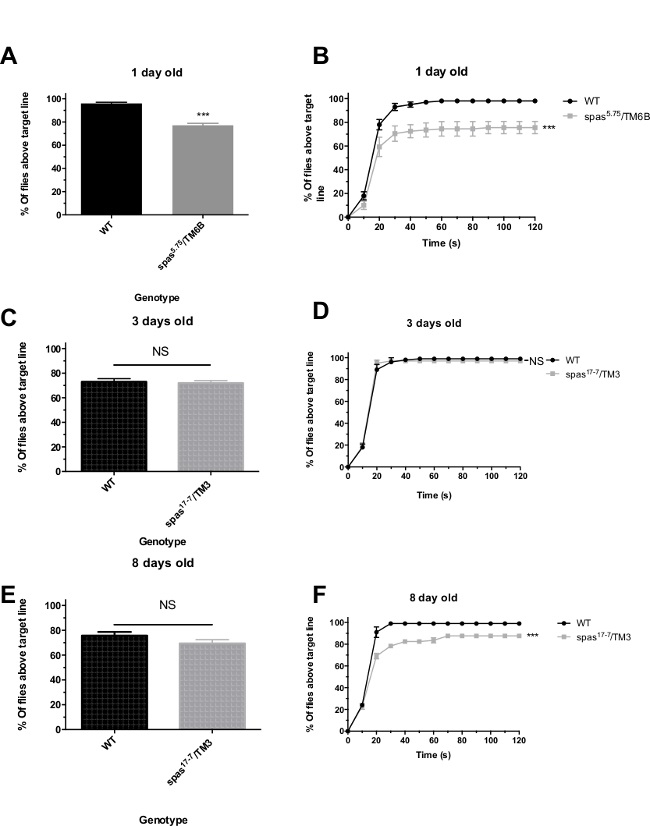
Figure 1. Comparison of different climbing assays. For severe mutations different degrees of climbing defect can be seen using various methods but milder mutations may not be detected with some assays. To demonstrate this we used two published mutant lines for the gene spastin: spastin5-75 which contains a full deletion of the spastin gene and spastin17-7 which contains a partial deletion of the spastin gene. (A) First, climbing is assessed by having flies climb to the top of an empty food vial. The number of flies at the top after 18 sec is recorded. Using this protocol a significant defect is seen in Spast5-75/TM6b when compared to wild-type controls (N = 10, p < 0.001). (B) Next, climbing performance is assessed using the method described here. Climbing is also defective in the same genotype Spast5-75/TM6b. The difference in performance is highly significant (N = 5, p < 0.001), but the gap in performance is larger. For mutations shown to have lesser effect thought (e.g., Spast17-7 contains a partial deletion of spastin gene), the cylinder method presented here may be more sensitive. (C) No significant defect is observed with 3 days old spast17-7/TM3 with the vial method (N = 5). (D) No significant defect is observed with 3 days old spast17-7/TM3 with the cylinder method (N = 5). (E) A non-statistical trend is noted with 8 days old spast17-7/TM3 flies (N = 5). (F) But a significance is observed for 8 days old spast17-7/TM3 tested with the cylinder method presented for the same number of replicates (N = 5, p < 0.001). Please click here to view a larger version of this figure.
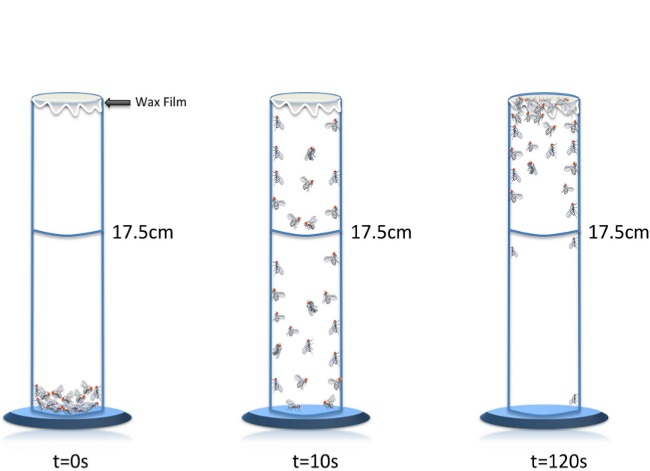
Figure 2. Schematic representation of the experimental set up. 20 flies are inserted in a glass cylinder and then capped with a wax barrier film. The flies are then tapped to the bottom and the number of flies crossing the midline is recorded using a camera for 120 sec. Please click here to view a larger version of this figure.
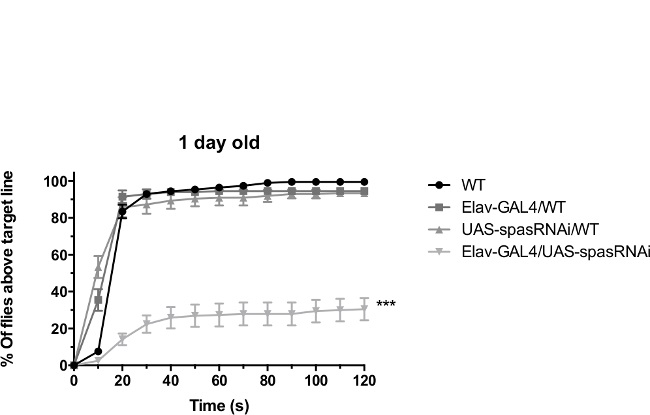
Figure 3. Representative results of the climbing experiment. The percentage of flies having passed the threshold line is represented every 10 sec over the duration of the assay. In this experiment, 3 genetically appropriate controls (Wild-type, UASspas-RNAi/+, Elav-GAL4/+) are compared to transgenic flies containing both UAS and Gal4 components (Elav-GAL4/UASspas-RNAi ). The UAS spas-RNAi is from VDRC #108739. This representation allows for the assessment of the rate of climbing for each genotype. Please click here to view a larger version of this figure.
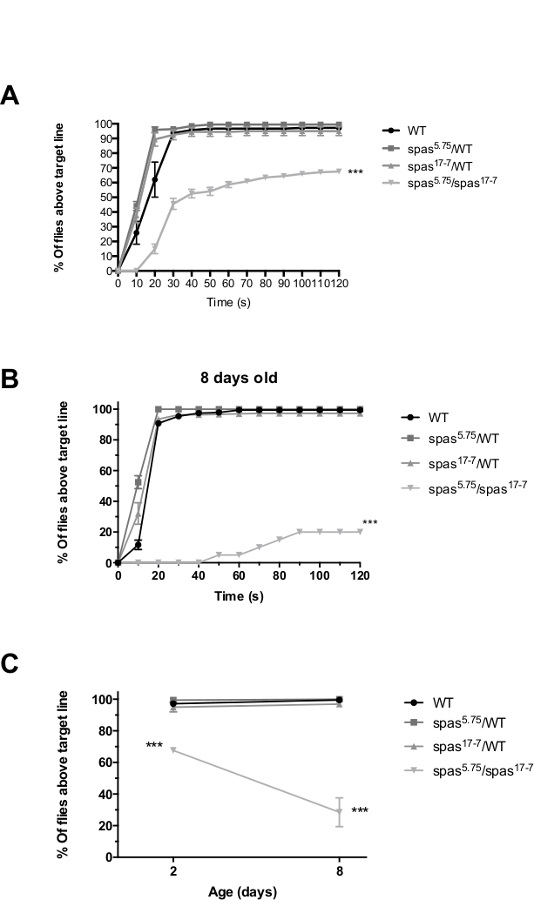
Figure 4. Representative graph for the aging profile. Since many locomotive disorders are progressive, it is important to portray the evolution over time. In this graph, WT flies are compared to heterozygous mutants (spas/WT) and trans-heterozygous mutants (spast5-75/spast17-7) at 2 days (A) and 8 days (B) (N=10, p<0.001). Results are also depicted over time for the 120 sec. time point (C). Please click here to view a larger version of this figure.
Discussion
Drosophila has already proven to be an excellent model in Parkinson’s disease14 and other neurodegenerative conditions1,2. In addition to the genetic tools available in Drosophila, its genome is highly conserved for genes involved in neurological disorders19. The advent of genome wide genetic screening methods (including whole exome sequencing) is likely to continue to provide a larger list of candidate genes associated with human movement disorders. The development of treatments for these conditions will require animal models to increase our understanding of the pathology involved in the early stages of neurodegeneration. The use of Drosophila and the negative geotaxis assay provides an inexpensive and reliable method to identify genes involved in locomotive defects and subsequently screen candidate drugs for phenotype rescue. This adds to the molecular, electrophysiological, and imaging proofs that can also be obtained in the same animal model. Using the climbing assay, others have successfully reproduced motor defects in flies mutant for genes disrupting human locomotion. Nonetheless, previous research has shown that pathological changes could precede the detection of locomotive defects by several days14. This phenomenon is also observed in human neurodegenerative conditions where we speak of subclinical changes. We believe that by understanding and then treating these subclinical changes, disease modification would be improved greatly.
We present here a model that allows the detection of mild locomotion defects that may help with understanding the passage from “presymptomatic to symptomatic” of neurodegenerative pathology using a Drosophila model. Many groups have used a short climbing distance (5-10 cm) but, we increased the distance to 17.5 cm as in Palladino et al.20. Although this difference between climbing heights may seem minor, the increase in height was intended to increase the assay difficulty, thereby aiding in the identification of the comparatively minor climbing defects. Also, some methods chose to illuminate the top of the cylinder with a fiber-optic lamp, to take advantage of the phototaxic response of adult Drosophila. However, the light source can cause light reflection within the cylinder; thus, a diffuse overhead fluorescent light source is used instead. In addition, mutation in genes involved in neurodegeneration may affect eye function and therefore bias the results. The increase in the sample size from 10 to 20 flies increases the statistical power of each trial. Initially, we increased this number to as high as 30 flies, but it was subsequently reduced in order to minimize overcrowding and interaction effects between flies. The samples are discarded after a single use, rather than being run for four repeat trials per sample, to eliminate the possibility of learning or fatigue. Due to flies with extremely poor climbing performance, it was counterproductive to record the time required for 50% of the flies to cross the target line for it could take a considerable amount of time for this criteria to be fulfilled. Rather, flies were given a duration of 2 min to cross the target line. The number of flies to cross the line was recorded and binned in increments of 10s, and the resulting value expressed as a percentage.
These conditions create are a more sensitive assessment of an adult fly’s climbing capabilities. While other designs of the assay are still useful, this paradigm may be considered in cases where mild early defects are investigated. In addition, this assay may help detect smaller changes in the context of drug trials.
An important issue is that the negative geotaxis behavior is based on the flies being tapped to the bottom of the cylinder. It is therefore important to assess other forms of locomotion, such as on a flat surface or flight. Other aspects such as motivation and social interaction need to be considered as potential confound. Another caveat is that the assay presented only allows one to assess locomotion in adult flies. This limits the ability to obtain neuropathological correlates for the behavior observed which is very important in understanding the pathogenesis of a disease. Indeed, most neuroimaging work has been done at the larva neuromuscular junction so far in Drosophila. Obtaining locomotion behavior in larva may be an important step in order to draw direct correlation between behavior and pathological changes.
It is very important to control the temperature and humidity at which the flies are raised and tested. In addition to the effect on fly development, these factors had an important effect on the climbing ability of flies raised and stored in non-ideal conditions. In the presence of increased static electricity or humidity, flies did not perform optimally. This effect was not equal for all genotypes, mutant flies usually being more affected by such factors than controls. In addition, cylinders need to be washed and dried properly between each experiment.
Disclosures
The authors have nothing to disclose.
Acknowledgements
This work is supported by a Canadian Health Research Institute (CIHR) Team Grant to Dr. Bolduc (co-PI) and Dr. Guy Rouleau (PI). We would like to thank Dr. Oksana Suchowersky, Dr. Kathryn Todd, the members of the University of Alberta fly club and Dr. Clayton Dickson for help in development of the method and statistical analysis.
Materials
| Name | Company | Catalog Number | Comments |
|---|---|---|---|
| Drosophila stocks | The stocks are selected depending on the experiments. The temperature and humidity in the room and in the incubator must be controled and consistent to avoid flies being too staticky or too wet. | ||
| Video camera | Any digital camcorder will do. Make sure they can focus on close object. | ||
| Graduated cylinder | Kimble | 20028W | Different models of graduated cylinder may have different diameter. It is therefore imporant to measure the height. |
| Computer | Any model will do. We used the computer to monitor the climbing of the flies and record the number of flies at each time point. |
References
- Auluck, P. K., Bonini, N. M. Pharmacological prevention of Parkinson disease in Drosophila. Nature medicine. 8, 1185-1186 (2002).
- Bonini, N. M., Fortini, M. E. Human neurodegenerative disease modeling using Drosophila. Annual review of neuroscience. 26, 627-656 (2003).
- Bolduc, F. V., Bell, K., Cox, H., Broadie, K. S., Tully, T. Excess protein synthesis in Drosophila fragile X mutants impairs long-term memory. Nature neuroscience. 11, 1143-1145 (2008).
- McBride, S. M., et al. Pharmacological rescue of synaptic plasticity, courtship behavior, and mushroom body defects in a Drosophila model of fragile X syndrome. Neuron. 45, 753-764 (2005).
- Parker, L., Padilla, M., Du, Y., Dong, K., Tanouye, M. A. Drosophila as a model for epilepsy: bss is a gain-of-function mutation in the para sodium channel gene that leads to seizures. Genetics. 187, 523-534 (2011).
- Marley, R., Baines, R. A. Increased persistent Na+ current contributes to seizure in the slamdance bang-sensitive Drosophila mutant. Journal of neurophysiology. 106, 18-29 (2011).
- Benzer, S. Behavioral Mutants Of Drosophila Isolated By Countercurrent Distribution. Proceedings of the National Academy of Sciences of the United States of America. 58, 1112-1119 (1967).
- Ganetzky, B., Flanagan, J. R. On the relationship between senescence and age-related changes in two wild-type strains of Drosophila melanogaster. Experimental gerontology. 13, 189-196 (1978).
- Nichols, C. D., Becnel, J., Pandey, U. B. Methods to assay Drosophila behavior. Journal of visualized experiments : JoVE. , (2012).
- Toma, D. P., White, K. P., Hirsch, J., Greenspan, R. J. Identification of genes involved in Drosophila melanogaster geotaxis, a complex behavioral trait. Nature genetics. 31, 349-353 (2002).
- Inagaki, H. K., Kamikouchi, A., Ito, K. Methods for quantifying simple gravity sensing in Drosophila melanogaster. Nature protocols. 5, 20-25 (2010).
- Gargano, J. W., Martin, I., Bhandari, P., Grotewiel, M. S. Rapid iterative negative geotaxis (RING): a new method for assessing age-related locomotor decline in Drosophila. Experimental gerontology. 40, 386-395 (2005).
- Botella, J. A., et al. The Drosophila carbonyl reductase sniffer prevents oxidative stress-induced neurodegeneration. Current biology : CB. 14, 782-786 (2004).
- Feany, M. B., Bender, W. W. A Drosophila model of Parkinson's disease. Nature. 404, 394-398 (2000).
- Chakraborty, R., et al. Characterization of a Drosophila Alzheimer's disease model: pharmacological rescue of cognitive defects. PLoS One. 6, e20799(2011).
- Orso, G., et al. Disease-related phenotypes in a Drosophila model of hereditary spastic paraplegia are ameliorated by treatment with vinblastine. J Clin Invest. 115, 3026-3034 (2005).
- Lehmann, E. L., D'Abrera, H. J. M. Nonparametrics : statistical methods based on ranks. , 1st edn, Springer. (2006).
- Sherwood, N. T., Sun, Q., Xue, M., Zhang, B., Zinn, K. Drosophila spastin regulates synaptic microtubule networks and is required for normal motor function. PLoS biology. 2, e429(2004).
- Inlow, J. K., Restifo, L. L. Molecular and comparative genetics of mental retardation. Genetics. 166, 835-881 (2004).
- Palladino, M. J., Hadley, T. J., Ganetzky, B. Temperature-sensitive paralytic mutants are enriched for those causing neurodegeneration in Drosophila. Genetics. 161, 1197-1208 (2002).
Reprints and Permissions
