This protocol outlines the use of spectrophotometry to detect ultraviolet-reflecting structures on organisms (in this example, the sailfin molly Poecilia latipinna) and describes dichotomous choice tests for fish that allow inferences to be made on the role of ultraviolet cues during mate selection.
A subscription to JoVE is required to view this content. Sign in or start your free trial.
Method Article
Assays to Detect UV-reflecting Structures and Determine their Importance in Mate Preference using the Sailfin Molly Poecilia latipinna
In This Article
Summary
Abstract
Many organisms use cues and signals beyond human sensitivity during social interactions. It is important to take into account how organisms perceive their worlds when trying to understand their behavior and ecology. Sensitivity to the ultraviolet spectrum (UV; 300 - 400 nm) is found across multiple genera of birds, fish, reptiles, amphibians, and even mammals. This protocol describes a technique for examining organisms for the presence of UV-reflecting structures and a method for testing whether these cues are used as social signals in the context of mate choice. A spectrophotometer is used to detect the presence of UV reflectance and variation in reflective intensity between individuals and sexes. An example of this technique is presented in which a dichotomous mate choice test exposes sexually receptive individuals to opposite sex individuals whose visual appearance can be manipulated by filters that either transmit full spectrum or block UV wavelengths. This system allowed for the determination that female, but not male, sailfin mollies (Poecilia latipinna) were using UV markings as part of their mating decisions. These types of studies serve to expand our knowledge of the range of organisms that utilize UV and provide insight into how UV plays a role in their lives.
Introduction
Understanding the cues and signals used in animal social interactions allows us to comprehend the phenotypic variation both within and among species. This variation plays an important role in evolutionary processes such as population divergence, sexual selection, and speciation. Often, however, researchers are limited to exploring the cues most obvious to human sensory systems, especially those within the visual or auditory realms. Use of spectrophotometry, however, allows us to expand our investigations beyond the human visible spectrum and into wavelengths that may be important in social interactions in other species.
In particular, the short-range communication afforded by ultraviolet (UV; 300 - 400 nm) sensitivity has the potential to be highly advantageous during mate choice1. Many visually-hunting predators of birds and fishes, for example, are unable to detect UV radiation. In systems where males display elaborately to females, these males would reduce their risk of predation while maintaining their ability to attract mates by exploiting the UV spectrum rather than developing cues detectable in the visible spectrum2,3.. If one fails to consider the possibility that organisms are communicating with each other using these "private communication channels", significant drivers of behavior and evolution may be missed.
This protocol outlines an investigation into the use of UV cues for mate choice in the sailfin molly, Poecilia latipinna, a polygamous fish that has no previously known ability to detect UV or utilize UV markings. This fish species has a close phylogenetic proximity to other UV-sensitive live-bearing fishes4 and there is microspectroscopic evidence that P. latipinna, along with other molly species such as P. mexicana and P. formosa, possess a class of cones (photoreceptor cells responsible for color vision) that are most sensitive for UV wavelengths5. In this sexually dimorphic species, female choice has played a strong role in the evolution of the males' brightly colored and enlarged fins6-9. This methodology allows us to explore whether UV is an additional medium by which females assess male quality.
The detection and measurement of UV markings on P. latipinna using a spectrophotometer with a fiber optic probe is detailed here. Further, whether receptive female mollies differentially associate with males viewed through an optical filter transmitting full-spectrum light including UV-A ([UV+]; 320 - 700 nm) and males viewed through an UV-blocking filter ([UV-]; 400 - 700 nm) is discussed. This method has broad applications for discovering UV sensitivity and color patterns in fishes and other organisms, allowing research into a variety of questions involving UV and its role in behavior.
Access restricted. Please log in or start a trial to view this content.
Protocol
All experiments were conducted with the approval of Ohio Wesleyan University's Institutional Animal Care and Use Committee.
1. Recording UV Reflectance of Fish using a Spectrophotometer
- Calibrate a spectrophotometer and light source with a known white standard over the range of wavelengths to be measured according the recommendations of the instrument or software.
- Anesthetize fish by placing in a 0.5% solution of ethyl 3-aminobenzoate methane sulfonic acid salt (MS-222) buffered with an equal quantity of sodium bicarbonate until fish becomes unresponsive. Once unresponsive, immediately place the fish on a black, non-reflective background. Note: MS-222 is potentially toxic, and gloves should be worn at all times.
- Take all measurements in a darkened room to minimize excess light beyond that of the spectrometer light source.
- Measure reflectance using a fiber optic probe held against the body of the organism. Make sure to form a consistent 45° angle between the fiber optics and the body, as is built into some probe designs. Note: For measurement consistency, it may be desirable to average across multiple scans (2 - 5) per body region.
- Record reflectance data with appropriate reflectance analysis software. Note: The software used here was set to: integration time = 2,000 sec, average scans = 2, and pixel smoothing = 5. Data was copied and pasted to a spreadsheet.
- Repeat on multiple body areas to determine presence or absence of UV reflectance and range of phenotypic variation across organisms. Note: Preliminary scans may be necessary to determine which, if any, body areas consistently show UV markings.
- Return the fish to a well-oxygenated holding aquarium until fully recovered, as evidenced by normal operculum beats and swimming behaviors. Note: A commercial protectant to restore the mucous coating to the body may be added to aid in skin recovery.
- Repeat across multiple individuals, including both sexes if desired.
- On spreadsheet where all data have been copied, plot data using a scatterplot, with reflectance on the Y-axis and wavelength on the X-axis. Amplitude peaks in the UV range (300 - 400 nm) indicate the presence of UV reflectance on the fish.
2. Dichotomous Mating Trials
NOTE: Perform control observations, in which focal fish, UV filters, and opaque filters are in place. In these trials, when the opaque filters are removed, focal fish will be exposed to parts of the tank displaying the presence and absence of UV light, but lacking potential mating partners. For details on the validity of dichotomous choice tests in this experiment see Palmer and Hankison (2015)10, although note that these tests also have drawbacks11.
- Use sexually receptive individuals as focal organisms. Use female P. latipinna < 48 hr postpartum5 and males isolated for at least 24 hr prior to testing to improve the likelihood of sexual motivation.
- Place a single focal individual into a neutral area adjacent to two choice compartments. For P. latipinna, use a 75.7 L test aquarium (30.5 cm x 30.5 cm x 75 cm; Figure 1) divided into three sections by transparent Plexiglas partitions, forming a central area for the focal individual flanked by two equal-sized choice compartments. Ensure that no water or olfactory cues are shared between individual tank sections. Repeat for each individual to be observed.
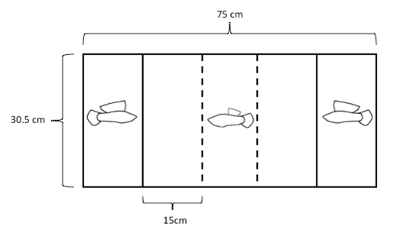
Figure 1. Experimental Aquarium Setup. A rectangular aquarium divided into three sections: a central area that held the focal individual and two end compartments that held object pairs (the figure shows a female in the middle with object males at the ends). Interchangeable filters that either blocked or permitted UV reflectance could be placed over the glass partitions dividing the male and female sections of the aquarium. This figure is modified from Palmer and Hankison (2015) 10. Please click here to view a larger version of this figure.
- Under full-spectrum lighting conditions (lighting whose spectrum extends into the UV-A range), isolate one potential mating partner in each end compartment (choice compartment) of the test aquarium. Ensure that potential mating partners resemble one another as closely as possible in size, coloration and display characteristics, so that the main difference between the two isolated mating partners is whether they appear behind a filter that blocks or transmits UV light.
NOTE: It may be preferable to record reflectance in the visible spectrum to enable the best possible color matching, although here matching was done by eye. - Acclimate individuals under visual isolation (opaque filters) for 15 min. Ensure that UV + and - filters are in place at this time. Following acclimation, remove the opaque filters. To ensure that side biases are not present (inherent preference for one side of the tank regardless of object), randomly assign the UV+ and UV- sides of the tank for each each trial.
- Record the amount of time that the focal individual spends within specific preference zones (areas near the choice compartments, in this case approximately two standard body lengths) by using stopwatches. For female fish, this is the amount of time it spends near each of two males, and vise versa for male focal fish.
NOTE: Event recorder software can also be used for recording. Fifteen minutes trials were used in this experiment and fish that did not visit each preference zone at least once were excluded from the results as being unresponsive. - Record and analyze the time that fish spend near empty UV+ and UV- compartments to ensure that there is not an inherent bias towards a particular lighting environment that may influence the mating choice of the fish. Use paired t-tests to determine if individuals prefer a particular UV condition.
Access restricted. Please log in or start a trial to view this content.
Results
Figures 1 and 2 show the mating preference aquarium set up and UV measurement sites for our experiments.
Measuring UV reflectance allowed for the determination that P. latipinna do possess UV characteristics, especially along the sides of their bodies (Figure 3), in addition to individual variation in these traits. Once UV traits were found, testing revealed that female...
Access restricted. Please log in or start a trial to view this content.
Discussion
Spectrophotometry was successful in identifying UV markings on P. latipinna. Both sexes of P. latipinna possess UV markings along their sides. In addition, some males had UV markings on their dorsal fins, traits previously found to be important in female mating preferences7.
We recommend using UV spectrophotometry as a mechanism to detect the presence of UV markings. Further testing could determine its role in social interactions, including mating preference (as de...
Access restricted. Please log in or start a trial to view this content.
Disclosures
The authors have nothing to disclose.
Acknowledgements
We are grateful to anonymous reviewers for comments and suggestions that greatly improved this manuscript. We thank R. Bowes, R. Carreno, and T. Panhuis for assistance in collecting the fish. We also thank M. Lee for assistance with male preference trials. We are grateful to the Ohio Wesleyan University Department of Zoology for helpful advice and suggestions throughout this study and Arizona State University (McGraw Lab) for software advice.
Access restricted. Please log in or start a trial to view this content.
Materials
| Name | Company | Catalog Number | Comments |
|---|---|---|---|
| Spectrophotometer, P1000 | Ocean Optics | newer models are availabe | |
| DT 1000 xenon UV light source | Ocean Optics | newer models are availabe | |
| Ocean Optics Overture Software | Ocean Optics | newer software is available | |
| R200-Angle-UV bifurcated fiber-optic probe (Guided Wave) | Ocean Optics | newer models are availabe | |
| Certified reflectance standard, white | labsphere | ||
| 75.7 L Aquarium, divided | Experimental Builder | ||
| Full Spectrum Bulb | Nature's Sunlight | ||
| UV blocking sheet | GAM UV Sheet |
References
- Endler, J. A., Zaret, T. M. Natural and sexual selection on color patterns in poeciliid fishes. Evolutionary ecology of neotropical freshwater fishes. , Anonymous Springer Netherlands. 95-111 (1984).
- Cummings, M. E., Rosenthal, G. G., Ryan, M. J. A private ultraviolet channel in visual communication. Proc. R. Soc. Lond. [Biol]. 270 (1518), 897-904 (2003).
- Siebeck, U. E., Parker, A. N., Sprenger, D., Mäthger, L. M., Wallis, G. A Species of Reef Fish that Uses Ultraviolet Patterns for Covert Face Recognition. Curr. Biol. 20 (5), 407-410 (2010).
- Hrbek, T., Seckinger, J., Meyer, A. A phylogenetic and biogeographic perspective on the evolution of poeciliid fishes. Mol. Phylogenet. Evol. 43 (3), 986-998 (2007).
- Körner, K. E., Schlupp, I., Plath, M., Loew, E. R. Spectral sensitivity of mollies: comparing surface- and cave-dwelling Atlantic mollies, Poecilia mexicana. J. Fish Biol. 69 (1), 54-65 (2006).
- Farr, J. A., Travis, J. Fertility Advertisement by Female Sailfin Mollies, Poecilia latipinna (Pisces: Poeciliidae). Copeia. 1986 (2), 467-472 (1986).
- Ptacek, M. B., Travis, J. Mate Choice in the Sailfin Molly, Poecilia latipinna. Evolution. 51 (4), 1217-1231 (1997).
- Ptacek, M. Mating signal divergence, sexual selection and species recognition in mollies (Poeciliidae: Poecilia: Mollienesia). Proceedings from the Second International Symposium on Livebearing Fishes. Grier, H. J., Uribe, M. C. , New Life Publications. Homestead, FL. 71-87 (2005).
- MacLaren, R. D. The effects of male proximity, apparent size, and absolute size on female preference in the sailfin molly, Poecilia latipinna. Behavior. 143 (12), 1457-1472 (2006).
- Palmer, M. S., Hankison, S. J. Use of ultraviolet cues in female mate preference in the sailfin molly, Poecilia latipinna. Acta Ethol. 18 (2), 153-160 (2014).
- Wagner, W. E. Measuring female mating preferences. Anim. Behav. 55 (4), 1029-1042 (1998).
- Rémy, A., Grégoire, A., Perret, P., Doutrelant, C. Mediating male-male interactions: the role of the UV blue crest coloration in blue tits. Behav. Ecol. Sociobiol. 64 (11), 1839-1847 (2010).
- Guillermo-Ferreira, R., Therézio, E. M., Gehlen, M. H., Bispo, P. C., Marletta, A. The Role of Wing Pigmentation, UV and Fluorescence as Signals in a Neotropical Damselfly. J. Insect Behav. 27 (1), 67-80 (2013).
- Ord, T. J., Stamps, J. A., Losos, J. B. Convergent evolution in the territorial communication of a classic adaptive radiation: Caribbean Anolis lizards. Anim. Behav. 85 (6), 1415-1426 (2013).
- Siebeck, U. E., Witzany, G. Communication in the Ultraviolet: Unravelling the Secret Language of Fish. Biocommunication of Animals. , Anonymous Springer Netherlands. 299-320 (2014).
- Modarressie, R., Rick, I. P., Bakker, T. UV matters in shoaling decisions. Proc. Biol. Sci. 273 (1588), 849-854 (2006).
- Lim, M. L. M., Li, J., Li, D. Effect of UV-reflecting markings on female mate-choice decisions in Cosmophasis umbratica, a jumping spider from Singapore. Behav. Ecol. 19, 61-66 (2008).
- Rick, I. P., Bakker, T. Color signaling in conspicuous red sticklebacks: do ultraviolet signals surpass others? BMC Evol. Biol. 8, 189(2008).
- Siebeck, U. E. Communication in coral reef fish: the role of ultraviolet colour patterns in damselfish territorial behaviour. Anim. Behav. 68 (2), 273-282 (2004).
- Cummings, M. E., De Leòn, F. J. G., Mollaghan, D. M., Ryan, M. J. Is UV ornamentation an amplifier in swordtails? Zebrafish. 3, 91-100 (2006).
- Macìas Garcia, c, de Perera, T. Ultraviolet-based female preferences in a viviparous fish. Behav. Ecol. Sociobiol. 52 (1), 1-6 (2002).
Access restricted. Please log in or start a trial to view this content.
Reprints and Permissions
