This article describes a fast and simple manufacturing process of ionic electromechanically active composite materials for actuators in biomedical, biomimetic and soft robotics applications. The key fabrication steps, their importance for the actuators' final properties, and some of the main characterization techniques are described in detail.
Method Article
Fabrication of Carbon-Based Ionic Electromechanically Active Soft Actuators
In This Article
Summary
Abstract
Ionic electromechanically active capacitive laminates are a type of smart material that move in response to electrical stimulation. Due to the soft, compliant and biomimetic nature of this deformation, actuators made of the laminate have received increasing interest in soft robotics and (bio)medical applications. However, methods to easily fabricate the active material in large (even industrial) quantities and with a high batch-to-batch and within-batch repeatability are needed to transfer the knowledge from laboratory to industry. This protocol describes a simple, industrially scalable and reproducible method for the fabrication of ionic carbon-based electromechanically active capacitive laminates and the preparation of actuators made thereof. The inclusion of a passive and chemically inert (insoluble) middle layer (e.g., a textile-reinforced polymer network or microporous Teflon) distinguishes the method from others. The protocol is divided into five steps: membrane preparation, electrode preparation, current collector attachment, cutting and shaping, and actuation. Following the protocol results in an active material that can, for example, compliantly grasp and hold a randomly shaped object as demonstrated in the article.
Introduction
Ionic electromechanically active polymer or polymeric composites are intrinsically soft and compliant materials that have received increasing interest in different soft robotics and biomimetic applications (e.g., as actuators, grippers, or bioinspired robots1,2). This type of material responds to electrical signals in the range of a few volts, which makes them easy to integrate with conventional electronics and power sources3. Many different types of ionic actuator base materials are available, as described in detail elsewhere4, and again very recently5. Moreover, it has been particularly emphasized recently that the development of soft robotic devices will be very closely related to the development of advanced manufacturing processes for relevant active materials and components6. Furthermore, the importance of an efficient and well-established process flow in the preparation of reproducible actuators that have the potential to move from the laboratory to industry has also been highlighted in previous methods-based studies7.
Over the last decades, many fabrication methods have been developed or adapted for the preparation of actuators (e.g., layer-by-layer casting8 and hot-pressing9,10, impregnation-reduction11, painting12,13, or sputtering and subsequent electrochemical synthesis14,15, inkjet printing16 and spin-coating17); some methods are more universal, and some are more limiting in terms of material selection than others. However, many of the current methods are rather complicated and/or more suitable for laboratory scale fabrication. The current protocol focuses on a fast, repeatable, reliable, automatable and scalable actuator fabrication method to produce active laminates with low batch-to-batch and within-batch variability and a long actuator lifetime18. This method can be used by materials scientists to develop high-performance actuators for the next generation of bioinspired applications. Moreover, following this method without modifications gives soft robotics engineers and teachers an active material for the development and prototyping of new devices, or for teaching soft robotics concepts.
Ionic electromechanically active polymer or polymeric actuators are typically made of two- or three-layer laminar composites and bend in response to electrical stimulation in the range of few volts (Figure 1). This bending motion is caused by the swelling and contraction effects in the electrode layers, and it is typically brought along either by faradaic (redox) reactions on the electrodes (e.g., in case of electromechanically active polymers (EAPs) like the conductive polymers) or by capacitive charging of the double-layer (e.g., in carbon-based polymeric electrodes, where the polymer might only act as a binder). In this protocol (Figure 2), we focus on the latter; we show the fabrication of an electromechanically active composite that consists of two high specific surface area electronically conductive carbon-based electrodes that are separated by an inert ion-conductive membrane that facilitates the movement of cations and anions between the electrodes – a configuration very similar to the supercapacitors. This type of actuator bends in response to capacitive charging/discharging and the resulting swelling/contraction of the electrodes is typically attributed to the differences in the volume and mobility of cations and anions of the electrolyte8,10,19. Unless surface-functionalized carbon is used as the active material or the capacitive composite is used outside of the electrochemical stability potential window of the electrolyte, no faradaic reactions are expected to take place on this type of electrodes20. The lack of faradaic reactions is the main contributor to the beneficially long lifetimes of this actuator material (i.e., thousands of cycles in air8,18 shown for different capacitive actuators).

Figure 1: The structure of the carbon-based actuator in the neutral (A) and in the actuated state (B). (B) also highlights the key characteristics that determine the performance of an ionic actuator. Note: the figure is not drawn to scale. Ion size has been exaggerated to illustrate the most commonly cited actuation mechanism prevalent in case of an inert membrane that enables the mobility of both anions and cations of the electrolyte (e.g., ionic liquid). Please click here to view a larger version of this figure.
Obtaining a functional membrane that remains intact throughout the whole fabrication process is one of the key steps in the successful actuator preparation. A high-performance membrane for an actuator is as thin as possible and enables ionic conductivity between the electrodes while blocking any electronic conductivity. The ionic conductivity in the membrane can result from combining the electrolyte with an inert porous network (e.g., the approach used in this protocol) or by the usage of specific polymers with covalently bonded ionized units or other groups that enable interactions with the electrolyte. The former approach is preferred here for its simplicity, whereas specifically tailored interactions between the electrolyte and the polymer network could also have advantages, if unfavorable interactions (e.g., blocking or slowing down ion movement significantly due to interactions) can be ruled out. The vast selection of ionomeric or otherwise active membranes for electromechanically active actuators and their resulting actuation mechanisms have been reviewed recently21. The membrane selection, in addition to the electrode selection, plays a crucial role in the actuator's performance, lifetime and actuation mechanism. The current protocol is mainly focusing on inert membranes that provide the porous structure for ion migration (as shown on Figure 1), although parts of the protocol (e.g., membrane option C) could also prove beneficial for active membranes.
In addition to the membrane material selection, its fabrication method also plays an important role in obtaining a functional separator for the composite. Previously used cast membranes tend to melt during the later hot-pressing step and may therefore form short-circuit hotspots22. Moreover, commercial ionomeric membranes (e.g., Nafion) tend to swell and buckle significantly in response to solvents used in the later manufacturing steps12, and some polymers (e.g., cellulose23) are known to dissolve to some extent in some ionic liquids, possibly causing problems with the repeatability of the fabrication process and resulting in poor uniformity of the electrodes. Therefore, this protocol focuses on actuators with an integral passive and chemically inert component in the membrane (e.g., glass fiber or silk with PVDF or PTFE) that stops the composite from swelling and buckling in later fabrication steps or from forming short-circuit hotspots. Moreover, the addition of an inert and passive component simplifies the manufacturing process significantly and enables larger batch sizes compared to more traditional methods.
The inclusion of a passive reinforcement in the membrane was first introduced by Kaasik et al.18 to tackle the above-mentioned problems in the actuator manufacturing process. The inclusion of a woven textile reinforcement (see also Figure 3B and 3D) further introduces the ability to integrate tools into the active composite24 or to develop smart textiles18. Therefore, the membrane option C in the protocol is more suitable for such applications. However, in case of miniaturized actuators (in the sub-millimeter level), the passive-to-active component ratio in the membrane becomes more and more unfavorable and the inclusion of an ordered textile reinforcement might start to negatively influence the actuator’s performance and the sample-to-sample repeatability. Moreover, the direction of the reinforcement (along or diagonally in respect to the bending direction) might impact the performance of more complexly shaped actuators unexpectedly. Therefore, a less ordered and highly porous inert structure would be more beneficial for miniaturized actuators and more complex actuator shapes.
Polytetrafluoroethylene (PTFE, also know under the trade name Teflon) is one of the most inert polymers know to date. It is typically highly hydrophobic, but surface-treated versions that are rendered hydrophilic exist, which are more easily usable in the actuator fabrication. Figure 3A illustrates the random structure of an inert hydrophilic PTFE filtration membrane that was used in this protocol for actuator preparation. In addition to the uniformity of this material in all directions that is beneficial for cutting out miniaturized actuators or complex shapes, using a commercial filtration membrane with controlled porosity further simplifies the actuator fabrication process by almost eliminating the need for any membrane preparation. Moreover, membrane thicknesses as low as 30 µm are extremely difficult to obtain in the previously described textile-reinforced configuration. Therefore, PTFE-based actuator fabrication methods (options A and B) from this protocol should be preferred in most cases, further considering that option A is faster, but actuators made using option B show larger strains (in the frequency range presented in Figure 4B). The soft gripper introduced in the representative results section was also prepared using the PTFE membrane first soaked in electrolyte.
After a functional membrane has been prepared, the protocol continues with the electrode preparation and current collector attachment. The carbon-based electrodes are added using spray-coating – an industrially established procedure that enables high control over the resultant electrode layer thickness. More uniform electrodes are produced with spray coating compared to, for example, the casting method (or possibly also other liquid methods) where sedimentation of carbon particles during the film drying25 are known to occur. Moreover, a further feature of the presented fabrication method relies in the solvent selection strategy that is most important in case of textile-reinforced membranes. More precisely, 4-methyl-2-pentanone (the solvent in the electrode suspension and glue solution) does not dissolve the inert membrane reinforcements or PVDF that is used in the membrane solution of the textile-reinforced membrane. Therefore, the risk of creating short-circuit hotspots in the composite during spray coating is further reduced.
The capacitive laminate is already active after the application of carbon electrodes. However, an order of magnitude faster actuators26 are obtained with the application of gold current collectors. A further important step in the protocol is the attachment of current collectors while the corresponding electrode is in the stretched state (i.e., the composite is bent). Therefore, in the neutral flat state of the actuator, the gold leaf will be buckled in the submillimeter level. This buffering-by-buckling27 approach enables higher deformations without breaking than would otherwise be possible for a fine (~100 nm) metal sheet.
All the actuator manufacturing steps (membrane preparation, electrode spraying, current collector attachment) have also been summarized in Figure 2. For the performance characterization demonstration, we have prepared a gripper that is compliantly grasping, holding and releasing a randomly shaped object with a random surface texture. Simpler geometries, such as rectangular samples with 1:4 or higher aspect ratio (e.g., 4 mm to 20 mm or even 1 mm to 20 mm28) cut out of the active material and clamped in the cantilever position are also very typical for material characterization or other applications utilizing the bending-type behavior.
The article ends with a brief introduction into the typical ionic electromechanically active capacitive material characterization and troubleshooting techniques using the simpler rectangular actuator geometry. We show how to use common electrochemical characterization techniques like cyclic voltammetry (CV) and electrochemical impedance spectroscopy (EIS) to characterize and troubleshoot the actuator material in more detail. The visualization of the composite in sub-millimeter level is done using scanning electron microscopy (SEM), for which we use the cryo-fracturing technique to prepare the samples. The polymeric nature of the material makes it difficult to obtain clear cross-sections with just regular cutting. However, breaking frozen samples results in well-defined cross-sections.

Figure 2: Overview of the fabrication process. Most important steps are highlighted. Please click here to view a larger version of this figure.
Protocol
CAUTION: Many chemicals and components used in this protocol are hazardous, please consult the relevant safety datasheets (SDS) for further information before starting the experiment. Please use a fume hood and personal protective equipment (gloves, glasses, lab coat) when handling volatile solvents during the experiment (e.g., during the preparation of solutions, making the reinforced membrane, spray-coating the electrodes and attaching the current collectors). Prevent direct skin contact with the final composite (unless it is encapsulated28) by always wearing gloves.
1. Making the separator membrane
- Take a frame, such as an embroidery frame.
NOTE: We have used standard frame sizes from 7.5 cm to 25 cm depending on the desired batch size. Most importantly, the frame should be made of materials that can withstand the solvents and other materials used in the recipe. For example, a polypropylene embroidery frame is used in this protocol. However, if unsure, doing a solvent test on the frame is recommended. - Choose between options A to C (discussed above and presented in Figure 2) to find the most suitable membrane configuration for the planned application. Only one out of the three membranes is needed to prepare functional actuator material.
- Option A: Using highly porous commercial filtration membranes in the preparation of ion-conductive separators
- Take a high-porosity filtration membrane (such as a 30 µm thick, 80% porosity PTFE membrane filter). If the standard filter is too large for the frame, then cut it into shape using scissors. Cut the membrane between transfer sheets to avoid contamination.
- Fasten and taut the dry filtration membrane on the frame.
NOTE: Some filtration membranes can be rather fragile in the dry state. Fasten dry membranes extremely carefully to avoid tearing. - Move to Step 2 to carry on with the electromechanically active composite preparation.
- Option B: Using electrolyte-impregnated commercial filtration membranes in the preparation of ion-conductive separators
- Take a high-porosity filtration membrane (such as a 30 µm thick, 80% porosity PTFE membrane filter). If the standard filter is too large for the frame, then cut it into shape using scissors. Cut the membrane between transfer sheets to avoid contamination.
- Record the dry membrane mass using an analytical balance to calculate electrolyte uptake later. This step is needed only for batch-to-batch repeatability monitoring and can otherwise be skipped.
- Place the dry membrane in a Petri dish and use a pipette to add an excess of ionic liquid (e.g., 1-ethyl-3-methylimidazolium trifluoromethansulfonate ([EMIM][OTf])).
CAUTION: Use gloves to prevent contact with skin. - Slightly tilt the Petri disk to make sure that the whole membrane is covered with ionic liquid or use a pipette to transfer ionic liquid to areas where the membrane is still dry.
- Let the membrane soak in ionic liquid to achieve maximum electrolyte uptake.
- Once the membrane is sufficiently soaked (in the video after about 1 minute), pipet off most of the excess ionic liquid.
- Using tweezers, carefully place the membrane between filter papers to remove the rest of the ionic liquid that has not been absorbed by the membrane. The final membrane should be semi-transparent but not wet.
- Record the mass of the soaked and dried membrane from Step 1.4.7 using an analytical balance. This step is needed for the batch-to-batch repeatability monitoring only and can otherwise be skipped.
NOTE: In case of highly porous PTFE membranes and relatively low-viscosity ionic liquids (e.g., [EMIM][OTf]), maximum ionic liquid uptake is achieved almost immediately. Using different ionic liquids and different (less porous) commercial polymer membranes might result in longer soaking times. Such need can be determined by repeating the steps 1.4.1 to 1.4.8. until a constant membrane mass is obtained. However, if the electrolyte is too viscous or the membrane not porous enough then the actuator's performance might not be very high either. - Fasten and taut the soaked and dried membrane on the frame avoiding wrinkles and folds.
- Option C: Making an ion-conductive textile-reinforced membrane that might be useful when planning to use custom polymers (i.e., polymers not available as commercial (filtration) membranes), custom membrane thicknesses, ionic liquids with higher viscosity or when integrating tools into the actuator. Here we show the basic procedure for textile-reinforced membrane fabrication that can, for example, be modified to include tools or tubing (see Ref24 for more information).
- In a 100 mL Erlenmeyer flask, mix together 2 g of polyvinylidene fluoride (PVDF), 2 g of ionic liquid (e.g., [EMIM][OTf]), 4 mL of propylene carbonate (PC) and 18 mL of N,N-dimethylacetamide (DMAc).
CAUTION: DMAc and PC are toxic and health hazards and can irritate the skin and eyes. Handle with care, use a fume hood and personal protective equipment. - Add a magnetic stirrer bar and close the flask with a stopper.
- Seal the flask with a polyethylene-based laboratory stretch film to prevent the evaporation of solvents.
NOTE: Use a stretch film that can withstand stirring at 70 °C (e.g., the melting point of Parafilm is just 60 °C, and therefore Parafilm would not be suitable for this application). - Stir the solution overnight at 70 °C using a magnetic stirrer and a temperature-controlled hotplate. Set the stirring speed to medium. Too high stirring speed may introduce too much air into the solution, whereas too slow stirring might result in significantly longer preparation time.
NOTE: The experiment can be paused here and carried on later. The prepared solution can be stored in a sealed vessel for an extended period. Reheat and mix the stored solution before starting to use it again (mixing at 70 °C for 1 hour is typically sufficient). - Cut out a piece of fabric (e.g., silk or glass fiber cloth) using scissors.
NOTE: Textiles with inert fiber composition such as silk or glass fiber work best because solvents from the membrane solution do not dissolve these. However, it is advisable to carry out a solvent test before using any fabric. Lightweight fabrics are preferred because these fabrics influence the actuation of the final composite the least. In the video, we have used woven silk fabric (11.5 g/m2). - Fasten and taut the fabric on a frame.
- Trim any excess fabric using scissors and carefully remove any loose fibers by hand.
- While working under the fume hood, cover the fabric with a thin layer of membrane solution using a paintbrush.
- Let the layer dry completely. A hot air gun at low speed alone first and later together with a dedicated setup (see Figure 5 for details) can be used to speed up the solvent evaporation process.
NOTE: Using a too high spin rate with the dedicated setup on a relatively wet membrane might cause deformations to the membrane layers and might result in the loss of membrane material. - After the layer has dried, inspect the composite against backlight for pinholes. A microscope can also be used for this purpose.
- If there are pinholes in the membrane, apply another layer of coating by repeating steps 1.5.8. and 1.5.9.
- Alternate between the sides of the textile when applying the membrane solution to ensure that the reinforcement (i.e., the neutral plane) remains in the middle of the membrane (see the SEM image in Figure 3D that shows textile fibers positioned in the middle of the membrane layer).
NOTE: The solvents in the polymer solution dissolve the previously applied layers slowly. Therefore, add subsequent membrane layers with extreme caution to prevent damage to the already applied membrane. Apply as thin layers as possible and never go over already wet surfaces twice. - Once a defect-free membrane has been obtained, check its final thickness using a micrometer screw gauge. Typically, at least three layers need to be applied, resulting in an about 50 µm thick membrane.
- Let the finished membrane post-dry under the fume hood for at least 24 hours.
NOTE: The experiment can be paused here and carried on later with spraying the electrodes. However, it is advisable to shield the prepared membrane against dust particles during drying.
- In a 100 mL Erlenmeyer flask, mix together 2 g of polyvinylidene fluoride (PVDF), 2 g of ionic liquid (e.g., [EMIM][OTf]), 4 mL of propylene carbonate (PC) and 18 mL of N,N-dimethylacetamide (DMAc).
2. Making the electrodes
NOTE: The electrode suspension consists of electrode solution A (a polymer solution) and electrode suspension B (containing the carbon powder and the electrolyte) that are prepared separately and then mixed together to obtain the final suspension. The solvent selected for the electrode suspension does not dissolve the inert membrane reinforcements or PVDF that is used in the textile-reinforced membrane configuration. Therefore, the risk of damaging the already obtained membrane during the addition of electrodes is kept to a minimum.
- Preparing the electrode solution A
- In a 100 mL Erlenmeyer flask, mix together 2 g of poly(vinylidene fluoride-co-hexafluoropropylene) (PVDF-HFP) and 24 mL of 4-methyl-2-pentanone (MP).
CAUTION: MP is flammable and acutely toxic. Use a fume hood and personal protective equipment. - Add a magnetic stirrer bar and close the flask with a stopper.
- Seal the flask with polyethylene-based laboratory stretch film.
- Stir the solution at medium speed at 70 °C using a magnetic stirrer and a temperature-controlled hotplate until the polymer has dissolved completely, typically overnight.
NOTE: The protocol can be paused here. The prepared solution can be stored in a closed and sealed vessel for an extended period. If the solution has turned into a gel, reheat (to 70 °C) and mix it before using it in Step 2.3. It is not necessary to add more solvent. Typically, the quantities in this recipe yield for about 150 cm2 of active material (final composite thickness about 150 µm). This corresponds to two 10 cm diameter embroidery frame batches.
- In a 100 mL Erlenmeyer flask, mix together 2 g of poly(vinylidene fluoride-co-hexafluoropropylene) (PVDF-HFP) and 24 mL of 4-methyl-2-pentanone (MP).
- Preparing the electrode suspension B
- In another 100 mL Erlenmeyer flask, mix together 1.75 g of carbon (e.g., carbide-derived carbon from TiC or B4C precursor), 2 g of ionic liquid (e.g., [EMIM][OTf]) and 10 mL of MP.
CAUTION: Undesirable electrostatic charging effects could make weighing the carbon powder very difficult. Wear static dissipative footwear during weighing to reduce the accumulation of static electricity. Moreover, use personal protective equipment to prevent the inhalation of fine carbon particles. - Mix the suspension in a closed vessel at room temperature for at least 1 h using a magnetic stirrer. Alternatively, the ultrasonic probe can already be used in this step (see Step 2.3.4)
NOTE: The experiment can be paused here, and the suspension B can be stored or mixed in a closed and sealed vessel for an extended period before mixing it with solution A to obtain the final electrode suspension.
- In another 100 mL Erlenmeyer flask, mix together 1.75 g of carbon (e.g., carbide-derived carbon from TiC or B4C precursor), 2 g of ionic liquid (e.g., [EMIM][OTf]) and 10 mL of MP.
- Preparing the final electrode suspension
- Make sure that the polymer in solution A is completely dissolved by tilting the flask slightly to detect any undissolved polymer pellets (or pieces) and that the solution is in viscous but liquid form. If not, then stir at 70 °C before continuing with the next step.
- Pour the electrode solution A (the polymer solution) into the flask containing the electrode suspension B (carbon, ionic liquid, solvent).
- Use an extra 10 mL of MP to rinse any remaining material off the walls of flask A and pour it to the final suspension in flask B.
- Submerge the ultrasonic probe in the final suspension, set cycle to 0.5 (pulses) and homogenize the suspension under the fume hood for one hour. Avoid contact between the probe and the glass vessel walls. Alternatively, if no ultrasonic probe is available, mixing with a magnetic stirrer for several hours to overnight in a sealed vessel can be used.
NOTE: The experiment can be paused here, and the final electrode suspension can be stored or mixed in a closed and sealed vessel for an extended period.
- Spraying the electrodes
NOTE: An Iwata airbrush HP TR-2 is used here for preparing the electrodes. However, other types of spray guns and industrial automatic spray systems could alternatively be used.- Cover the walls of the fume hood with heavy-duty paper and tape for easier cleaning afterwards. Do not cover the air intake area. Keep the fume hood lid as low as possible during spraying.
- Connect the airbrush to the compressed air supply and adjust the pressure (here, standard connections and pressure of 2 bars are used).
NOTE: The pressure should be sufficient to carry the suspension, but not too high to damage the membrane. - Fill the reservoir of the airbrush with acetone (or any other compatible solvent) and test spraying on a piece of paper or cardboard first to check that the airbrush is clean and free of blockages.
- Check if the electrode suspension prepared in Step 2.3 is in liquid form by tilting the flask. In some cases, it might turn into a gel if stored for an extended period. Reheat it to 70 °C while mixing with a magnetic stirrer bar using a temperature-controlled hotplate to turn it into a liquid again. It is not necessary to add more solvent.
- Pour the electrode suspension from the Erlenmeyer flask into the clean reservoir of the airbrush.
- Test the suspension flow on a piece of paper first. Then move on to covering the prepared membrane.
- Start moving the airbrush before starting to spray. Spray at a distance of about 20 cm and hold the airbrush perpendicular to the membrane. Keep the airbrush moving in straight and controlled strokes to cover the whole membrane.
- Note the number of turns it takes to cover one side of the membrane, or alternatively monitor the suspension volume added to the reservoir to ensure equal electrode thicknesses on both sides of the membrane.
- Let the electrode on one side of the membrane dry under the fume hood. A hot air gun can be used to accelerate the drying process if needed (see Step 1.5.9).
- Apply the second electrode on the other side of the membrane by repeating steps 2.4.7 to 2.4.9.
- Cover both sides of the membrane multiple times until the desired composite thickness is reached (here the final total thickness was about 150 µm). Monitor the thickness of the dry composite using a micrometer screw gauge.
NOTE: The experiment can be paused here. The dry composite can be stored in a zip-lock bag for an extended period before attaching the gold current collectors in Step 3.
3. Attaching the gold current collectors
- Preparing the glue solution
NOTE: This solution can be prepared ahead of time together with the electrode suspension (and membrane solution). Make sure to reheat the glue before using it to make it less viscous.- In a 100 mL Erlenmeyer flask, mix together 2 g of PVDF-HFP, 2 g of ionic liquid (e.g., [EMIM][OTf]), 4 mL of PC and 40 mL of MP.
- Add a magnetic stirrer, close the flask and seal it with polyethylene-based laboratory stretch film.
- Let the solution stir at 70 °C on a temperature-controlled hotplate until the polymer has dissolved, typically overnight.
- Attaching the current collector to the carbon composite (one side)
- Gently remove the actuator material prepared in Step 2 from the frame.
- Cut out a 4 cm x 3 cm piece using a ruler and a scalpel. If a textile-reinforced membrane was used, then align the cut with the fibers (visible from the edges of the composite material).
NOTE: The suggested cut size is most convenient for small to mid-size batches. However, it is not crucial for obtaining working actuators. - Take a metal pipe (here d = 3 cm) and fix the cut piece tightly on it using tape. Try to overlap only about 1 mm of the actuator material with tape to avoid wasting the active material.
NOTE: The material of the pipe or its coating should withstand solvents that were used in the glue solution. The exact composition is not crucial for obtaining working actuators. Materials that conduct heat well (e.g., metals) may be beneficial in accelerating the drying process. However, ceramic or polymer tubes or pipes might be suitable as well. - Using scissors, cut out 4 cm x 4 cm pieces of gold on transfer paper and place one of the pieces on a tissue paper.
NOTE: Placing the gold leaves on transfer paper on a softer surface is crucial for obtaining good quality current collectors. - Prepare a “docking” station for the spray gun, where it can be quickly and safely stored in the upright position. The glue will start to dry as soon as spraying is stopped and therefore it is crucial that there are no delays in applying the gold current collectors.
- While working under the fume hood, spray the glue solution from Step 3.1.3 on the actuator material that has been fixed on a pipe (Step 3.2.3).
- Roll the pipe over the gold leaf (Step 3.2.4) while the glue is still wet. No excessive pressure is needed for rolling.
- Remove the transfer paper and roll over the tissue paper again to make sure that the gold has properly attached.
- Place the material under an infrared (IR) light (distance 10 to 15 cm) or into a vacuum oven (highest possible vacuum at room temperature) to dry for about 20 to 30 minutes.
- If the current collector did not attach properly or there are some larger defects, repeat steps 3.2.3 to 3.2.9 to add a second layer once the first layer has dried to obtain a completely defect-free current collector.
- Attaching the current collector on the other side of the composite.
- Gently remove the tape and release the material from the pipe.
- Clean the pipe with acetone and tissue paper to remove any glue and gold residue.
- Fix the actuator material again on the pipe with gold-coated side facing the pipe.
- Repeat steps 3.2.3 to 3.2.10 to attach the current collector on the other side of the material too.
- Carefully remove the finished composite from the pipe and leave it to post-dry under the fume hood for at least 24 hours.
NOTE: Shield the material against dust particles. After drying, the material can be stored in a zip lock bag. Leaving the sample to dry on the pipe at elevated temperatures instead for an extended period (several hours to days) thermoforms the actuator and therefore it should be avoided unless thermoforming is the aim.
4. Cutting, shaping, making contact and characterizing the actuators
- Cutting the actuator
- Use a sharp scalpel (and a metal ruler) to cut the actuator into the desired shape. Always cut all sides of the material to avoid any short-circuits caused by excess gold on the actuator’s sides.
NOTE: Cutting the material using scissors is not advisable, since this can deform the material and cause short circuits on the sample's sides.
- Use a sharp scalpel (and a metal ruler) to cut the actuator into the desired shape. Always cut all sides of the material to avoid any short-circuits caused by excess gold on the actuator’s sides.
- Shaping the actuator (e.g., into a gripper)
NOTE: The shape of this polymeric composite material can easily be changed from a flat laminate to something more advanced for more interesting applications. Depending on the desired configuration, it might be necessary to attach contacts first.- Take the cut actuator and place it into a mold (e.g., into a small glass vial as shown in the video).
- Place the sample into an oven for at least 1 hour and heat to 60 °C.
- Using the actuator
NOTE: In the video, we show custom magnetic contacts and modified Kelvin clips for contact making. In both cases, 24k gold plates are the only material in direct contact with the actuator.- Clamp the actuator between electrochemically non-reactive contacts (e.g., gold).
NOTE: The contact pressure should be sufficient to obtain reliable electrical contact, but not too high to cause permanent deformations. - Apply step voltage (or current) or use more complicated control signals to control the actuator. Typically, step voltages of ±2 V or less have been used to drive this type of actuators. See Ref24 for more information on actuator control considerations.
- Simultaneously record the actuation using a laser displacement meter or a video camera.
- Clamp the actuator between electrochemically non-reactive contacts (e.g., gold).
- Cryo-fracturing for SEM imaging (PTFE-based actuators)
NOTE: Breaking the samples after freezing them in liquid nitrogen is the preferred approach for obtaining clean cross-sections during SEM imaging.
CAUTION: Never close the cap of a liquid nitrogen container tightly. The pressure buildup and its subsequent release could cause serious injuries. Moreover, liquid nitrogen boils at −196 °C, so care must also be taken to prevent injuries due to the low temperatures.- Pour liquid nitrogen into a thermally insulating container (e.g., a disposable foam cup)
- First, place the sample and later the metal tools into liquid nitrogen and let the sample freeze for about 1 min.
NOTE: Cooling down metal tools (e.g., a scalpel or tweezers) is advisable to prevent any possible delamination due to temperature differences. However, tools need shorter cooling times than the polymeric composite thanks to better thermal conductivity of metals. Moreover, too deeply cooled metal tools might be impossible to handle. - Grab the frozen sample with two sets of cooled tweezers and break it.
- Cryo-fracturing for SEM imaging (textile-reinforced actuators).
NOTE: Textile-reinforced actuators (especially if glass fiber is used) might not break even in the frozen state. Clean cross-sections can be obtained by cutting using a cooled blade.- Freeze the actuator and a scalpel in liquid nitrogen (see the Note in Step 4.4.2).
- Place the frozen sample on a non-stick cutting surface (e.g., a block of PTFE) and chop the actuator material using the cooled scalpel.
Results
The primary endpoint to distinguish between a successful and a failed experiment is the material's response to electrical signals after being contacted to a power supply. In electrical engineering, copper is a well-known material for contact making. However, copper is also electrochemically active and therefore not suitable for making contact with an ionic system introduced here. Using copper contacts could cause short circuits due to dendrite formation through the composite. Moreover, in case of material characterization, it is impossible to distinguish between currents (and actuation) stemming from the electroactive material and that stemming from the electrochemical activity of copper29. We have previously shown that actuation – although unreliable – without any added active material (i.e., without the carbon-based or conductive polymer electrodes) is possible in case of wet ionomer membranes (e.g., Nafion) and just copper terminals29. Therefore, all experiments with the active material here have been performed using inert gold contacts only.
Electrochemical impedance spectroscopy (EIS) is a nondestructive method for the characterization and troubleshooting of the capacitive actuator material before usage. The impedance spectra in Figure 4C and 4D were captured using a potentiostat/galvanostat/FRA in two-electrode configuration. The sample (20 mm x 4 mm x 150 µm) was placed between gold contacts, the input signal amplitude during the impedance measurement was set to 5 mVRMS and frequencies from 200 kHz to 0.01 Hz were scanned. Figure 4C and 4D show the typical impedance spectra from actuators with high (~300 Ω cm2) or with low (~5 Ω cm2) internal resistance, respectively. The spectra were recorded using a sample with the dry PTFE membrane and another sample with the soaked membrane, respectively. Higher ionic conductivity through the material tends to correspond to faster actuators and possibly also more displacement at the same actuation frequency (see Figure 4B), if all other parameters (e.g., mechanical parameters) are kept unchanged and the material in general is active.
The nondestructive nature of EIS is especially beneficial for the detection of short circuits in the composite. In case of actuators prepared following the current protocol, short circuits are most often caused by current collector debris on the actuator’s sides (see cutting instructions in Step 4.1.1) or more rarely by a faulty membrane (e.g., when not covering all pinholes in the textile-reinforced membrane as instructed in Section 1.5). A resistor (in this case a short-circuit) would be presented as a dot on the Nyquist plot of an EIS experiment. Observing such response is a certain indicator of a faulty sample (see Figures 4C and 4D for reference spectra of functional capacitive actuators). Short-circuited samples would typically not actuate. Furthermore, these would most often be rendered permanently useless due to resistive heating and the resulting melting of the composite when tried to actuate.
In its functional form, this material is a double-layer capacitor that shows bending motion in response to charging and discharging of the double layer thanks to specifically tailored electrolytes used in its fabrication. Cyclic voltammetry (CV) is a widely used technique in electrochemistry to study different systems. During a CV experiment, the potential of the working electrode (in this case one of the actuator's electrodes) is varied in respect to a counter electrode (here the other electrode of the actuator) with constant speed (e.g., 800 mV/s between ±2 V) and the current response from the system is recorded using a potentiostat. A typical current response from the capacitive laminate is presented in Figure 4E. The current response of the sample with the soaked PTFE membrane (in dark gray in 4E) resembles that of an ideal capacitor: the current does not depend on the electrode potential and upon reversing the potential, the current direction (and therefore its sign) is changed (almost) immediately, resulting in a (nearly) rectangular voltammogram. The current response of the sample with an initially dry membrane (in pink in 4E) shows less ideal capacitor behavior at this scan rate, probably due to high internal resistance of the material (as also evidenced by EIS in Figure 4C). Still, both samples show the capacitive nature of the composite. On the other hand, light gray lines in Figure 4E show possible behavior from faulty samples (e.g., short-circuited ones) that would closely follow the Ohm’s law.
The performance of different functional actuators is presented in Figure 4A and Figure 4B. Figure 4A shows snapshots from the video where a 5-finger thermoformed actuator grips, holds and releases a randomly shaped object in response to voltage steps. Simpler geometries are typically used for the material characterization purposes. For example, Figure 4B highlights the dry and soaked PTFE membrane actuators’ maximum bending angle28,30 in response to triangular voltage signals between ±2 V. In order to characterize different actuator materials, samples (4 mm x 20 mm x 150 µm) were placed between gold clamps in the cantilever position (leaving 18 mm free length for actuation) and the bending angle was recorded using a video camera. Alternatively, the movement of a single point along the actuator (e.g., 5 mm from the contacts) has been typically monitored in time and used in strain difference calculations31,32. Video processing, although more complicated, gives more information on the whole bending profile of the sample and also enables to reanalyze the performance later, if such a need should arise. The 0.1 Hz point in Figure 4B corresponds to the exact same signal as used in the cyclic voltammetry experiments of Figure 4E, both in terms of actuation voltage as well as actuation frequency. Using the same signal for characterization and actuation allows us, for example, to make conclusions about the capacitive nature of the material and about the stability and lack of electrochemical reactions during actuation.
Electrochemical methods (EIS, CV), visualization of the actuator structure in the (typically) micrometer level (SEM) and displacement characterization are the most common methods for characterizing ionic actuators and evaluating the success of the fabrication process. However, custom experiments to evaluate the actuator's performance in a more specific application are often developed to evaluate application-specific performance (e.g., the ability to carry a load).
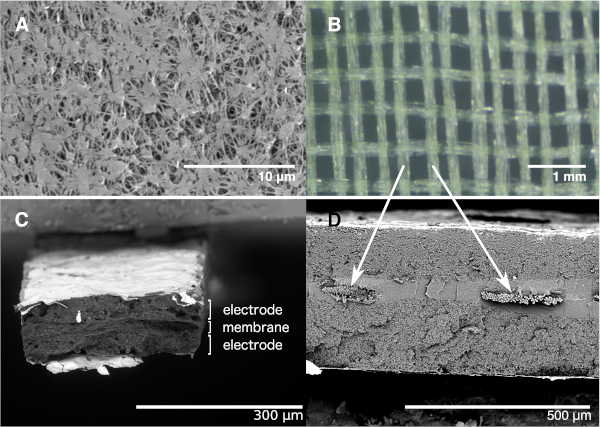
Figure 3: Imaging. Scanning electron micrographs showing the highly porous PTFE membrane (A) and a cross-section of an actuator made using the same membrane showing no delamination (C). SEM micrograph showing a cross-section of a textile-reinforced actuator (D) and an optical photograph of the corresponding silk reinforcement (B). Samples for SEM cross-sections were first cryo-fractured using liquid nitrogen, mounted to a metal sample holder and then sputtered with 5 nm of gold for better definition using a sputter coater. A tabletop scanning electron microscope was used for imaging at 15 keV acceleration voltage. Please click here to view a larger version of this figure.
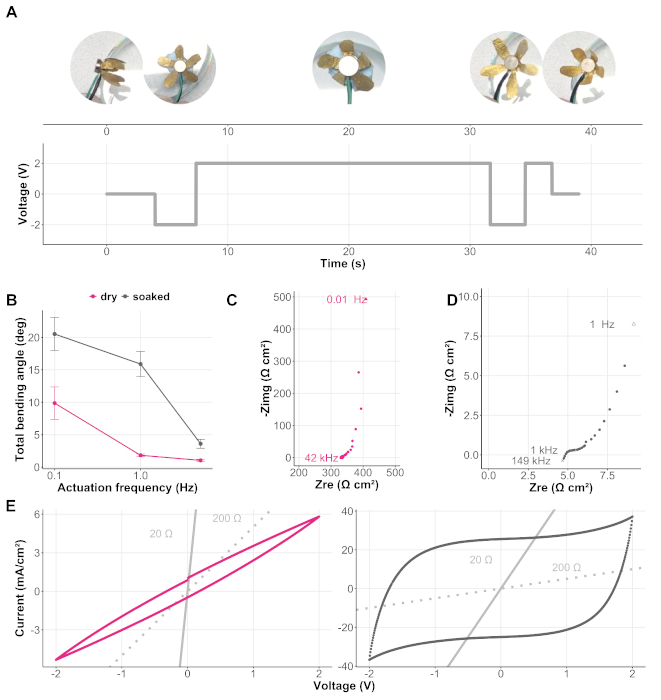
Figure 4: Representative results of the actuator. (A) Voltage steps and corresponding images of the five-arm gripper compliantly grasping an object with random shape (actuator without contacts 21 mg; polystyrene foam load 17.8 mg); (B) total bending angle of 4 mm x 20 mm x 150 µm PTFE-based actuators clamped between gold contacts (18 mm free length) in response to a triangular actuation signal (±2 V) at different actuation frequencies (n=3, error bars represent one standard deviation of the mean); (C and D) typical electrochemical impedance spectra of the electromechanically active capacitive laminates (5 mVRMS signal amplitude); (E) typical cyclic voltammetry of the capacitive laminates (triangular actuation signal using 800 mV/s scan speed that corresponds to the 0.1 Hz points in B). Grey lines on the cyclic voltammograms are for comparison and show response from a potential faulty actuator (essentially a resistor) that would closely follow the Ohm’s law. Please click here to view a larger version of this figure.
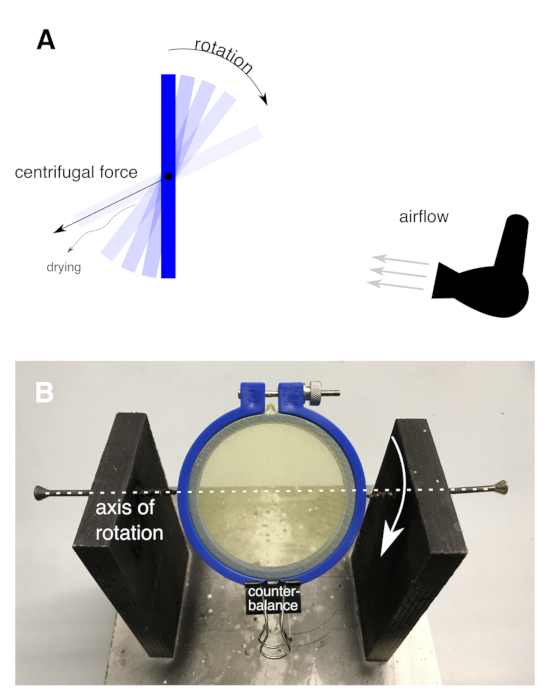
Figure 5: Spin-drying during membrane preparation. (A) schematics of the setup (B) image of the setup with a frame with reinforcement attached. During spin drying, the centrifugal force directs the residual solvent in the membrane layer towards the edge of the frame. This can be beneficial for accelerating the drying process. However, in case of completely wet membranes, this could result in the loss of active material (polymer and ionic liquid) and should therefore be avoided. Please click here to view a larger version of this figure.
Discussion
We presented a simple, fast, repeatable and versatile fabrication method for ionic electromechanically active composite preparation for various actuator applications, and with minor modifications also for energy storage, harvesting33 or sensing34 applications. The current method focuses on membranes with an integral passive and chemically inert component (e.g., a textile-reinforced polymer network or a highly porous Teflon membrane, see also Figure 3) because such membranes significantly simplify the actuator preparation process also in large scale. Moreover, the resulting membranes have a lower risk of swelling and buckling due to solvents (or electrolyte) in the electrode suspension or of short-circuit hotspot formation compared to many other common actuator fabrication methods and materials.
The critical steps in the capacitive actuator laminate preparation are the membrane preparation, electrode fabrication, current collector attachment, cutting, and contacting (Figure 2). Each of these steps leaves room for customization and performance optimization, but also for mistakes. In the following section we will discuss the beneficial modifications and troubleshooting strategies of this fabrication method in further detail. A high-performance composite results from the interplay of several key aspects that need to be kept in mind: sufficient electronic conductivity along the electrode (add gold current collector to carbon electrodes); sufficient ionic conductivity through the membrane (use a thin porous membrane and sufficient amount of low-viscosity electrolyte, reduce the risk on unfavorable interactions between the membrane and the electrolyte by using an inert polymer network); high surface area of the electrode (select a suitable carbon type); tailored electrolytes that result in asymmetrical swelling/contraction of the electrodes (select a suitable electrolyte); mechanical parameters (Young’s moduli of the components). These main aspects of a high-performance carbon-based actuator are also highlighted on Figure 1B.
A high-performance membrane is the central part of this composite. It has two tasks: prevent electron conductivity (short circuits) between the electrodes while enabling high ionic conductivity. Modifications to the membrane could serve several purposes, for example tool integration as introduced by Must et al.24 or the addition of new properties (e.g., biocompatibility, biodegradability or different mechanical properties). The current fabrication method could be modified to use other polymers and electrolytes in the membrane to introduce new properties to the active laminate. Like the solvent selection strategy introduced here for the textile-reinforced actuators, it is advisable to select poorer solvents for the subsequent electrode fabrication compared to the membrane preparation. This ensures that the membrane remains functional and intact also after the addition of electrodes.
The actuation performance of the final composite is influenced by the selected electrode material (carbon), the electrolyte and possibly their compatibility with each other. This protocol introduces the fabrication of carbon-based capacitive laminates using boron carbide derived carbon and 1-ethyl-3-methylimidazolium trifluoromethanesulfonate ([EMIM][OTf]) ionic liquid. However, the same protocol is adaptable to other high specific surface area carbon materials, such as carbide-derived carbons from other sources (e.g., TiC35, SiC or Mo2C36), carbon nanotubes8,37, carbon aerogel38 or graphene39, and others, as also reviewed recently40. Moreover, also other electrolytes could be used in the actuator preparation. Obtaining a functional composite is not limited to the carbon and ionic liquid types presented in this protocol. The carbon particle size, their possible agglomeration in the electrode suspension and the suspension viscosity are more crucial parameters for the spray-coating process.
This method enables the production of electromechanically active laminate material with reproducible properties in large quantities. Miniaturization of actuators made of this material is mainly carried out using high-precision cutting (e.g., Figure 3C). Alternative methods for preparing fine structures, such as masking, and patterning are possible during spray-coating41. Moreover, millimeter-scale structures can also be patterned in the subsequent gold current collector attachment step. However, in sub-millimeter scale this might become quite difficult. Other types of actuators or carbon-based actuator without gold current collectors might be easier to prepare, if the patternable features must be in the micrometer scale.
Intrinsically soft actuators that respond to electrical stimuli have many advantages thanks to their soft and compliant nature, quiet operation and low required voltage levels. The current protocol shows how to produce such material in larger quantities and with high batch-to-batch and within-batch repeatability without compromising the actuation performance. Modifications to the current method to incorporate more bio-friendly and possibly also bio-degradable components that would enable operation close or inside living organisms in addition to successful total encapsulation approaches, and the integration of the introduced active material into soft robotic or biomedical devices are envisioned for the future.
Disclosures
The authors have nothing to disclose.
Acknowledgements
The authors would like to thank Ron Hovenkamp and Marcel Mulder from Philips Research for helpful discussions. This work was partially supported by institutional research funding IUT (IUT 20-24) of the Estonian Ministry of Education and Research, by the Estonian Research Council grant (PUT1696), by the European Regional Development Fund, by the programme Mobilitas Pluss (Grant No MOBTP47), by the European Union’s Horizon 2020 research and innovation program under the Marie Skłodowska-Curie grant agreement No 793377 (BIOACT), and by project IMPACT-MII, an EIT Health innovation project. EIT Health is supported by EIT, a body of the European Union.
Materials
| Name | Company | Catalog Number | Comments |
|---|---|---|---|
| ~150 µm thick gold plates for custom contacts | local jeweler | 99.9% purity (24K) | |
| 1-ethyl-3-methylimidazolium trifluoromethanesulfonate ([EMIM][OTf]) | Solvionic | 99.5% | |
| 100 ml Erlenmeyer flask | |||
| 4-methyl-2-pentanone (MP) | Sigma Aldrich | ≥99% | |
| acetone | technical grade | ||
| analytical balance | Mettler Toledo AB204-S/PH | ||
| carbon powder | Y Carbon | boron carbide derived carbon, particle size <10 µm, specific surface area 1800 m2/g, pore volume 0.5 cm3/g | |
| carbon powder | Skeleton Technologies | titanium carbide derived carbon | |
| circular disk magnets (neodymium) for custom contacts | local hardware store | d = 2 mm, thickness 1 mm | |
| compressed air supply for the airbrush | |||
| crocodile clips with jaws insulated from each other (Kelvin clips) | local hardware store | Optional for making custom contacts. Regular crocodile clips are not suitable because there the jaws are connected to each other at the spring. | |
| disposable foam cup | |||
| epoxy glue | local hardware store | preferaby fast cure epoxy for attaching gold contacts to magnets | |
| filter paper for drying | Munktell, Filtrak | e.g. diameter 150 mm and up if 142 mm PTFE sheet is used. | |
| flat nose tweezers | |||
| glass funnel | |||
| gold leaf on transfer sheets | Giusto Manetti Battiloro | 24K | |
| graduated glass cylinder | |||
| hairdryer or a heat gun | e.g. Philips | ||
| infrared ligth bulb | e.g. Philips | ||
| liquid nitrogen | CAUTION: Never close the lid of a liquid nitrogen container tightly. The pressure build-up could cause serious injuries. | ||
| magnetic stirrer / hotplate | |||
| magnetic stirrer bars | about 1 cm long | ||
| metal pipe | e.g. d = 3 cm | ||
| metal ruler | |||
| micrometer thickness gauge | Mitotuyo | range 0-25 mm, precision 0.001 mm | |
| N,N-dimethylacetamide (DMAc) | Sigma Aldrich | 99.5% | |
| paintbursh | |||
| plastic embroidery hoops | e.g. Pony | select the diameter depending on the desired batch size (e.g. 7.5 cm to 25 cm) | |
| plastic Pasteur pipettes | |||
| polyethylene-based laboratory stretch film | DuraSeal | ||
| polyvinylidene difluoride-co-hexafluoropropylene (PVDF-HFP) | Sigma Aldrich | Mn = 130000, Mw = 400000 | |
| polyvinylidene fluoride (PVDF) | Sigma Aldrich | Mw (g/mol) = 534000 | |
| potentiostat/galvanostat/FRA | PARSTAT 2273 | needed for electrochemical characterization | |
| propylene carbonate (PC) | Merck | 99% | |
| PTFE filtration membrane | Omnipore | JVWP14225 | 0.1 µm pore size, hydrophilic , 142 mm diameter, 30 µm thickness, 80% porosity |
| PTFE filtration membrane | Omnipore | JGWP14225 | 0.2 µm pore size, hydrophilic , 142 mm diameter, 65 µm thickness, 80% porosity |
| scalpel | |||
| scotch tape | |||
| silk (woven textile) | Esaki Model Manufacturing | #3 | 11.5 g/m2 |
| soldering equipment | local hardware store | For connecting the ~150 µm gold plates to the clips | |
| spray gun, airbrush | Iwata HP TR-2 | ||
| sputter coater | Leica EM ACE600 | ||
| tabletop scanning electron microscope | Hitachi TM3000 | ||
| ultrasonic processor | Hielscher UP200S |
References
- Must, I., et al. Ionic and Capacitive Artificial Muscle for Biomimetic Soft Robotics. Advanced Engineering Materials. 17 (1), 84-94 (2015).
- McGovern, S., Alici, G., Truong, V. T., Spinks, G. Finding NEMO (novel electromaterial muscle oscillator): A polypyrrole powered robotic fish with real-time wireless speed and directional control. Smart Materials and Structures. 18 (9), (2009).
- Hines, L., Petersen, K., Lum, G. Z., Sitti, M. Soft Actuators for Small-Scale Robotics. Advanced Materials. 29 (13), (2017).
- Carpi, F. Electromechanically Active Polymers. , Springer International Publishing. Cham. (2016).
- Bar-Cohen, Y., Anderson, I. A. Electroactive polymer (EAP) actuators-background review. Mechanics of Soft Materials. 1 (1), 5(2019).
- Schmitt, F., Piccin, O., Barbé, L., Bayle, B. Soft robots manufacturing: A review. Frontiers Robotics AI. 5, (2018).
- Rosset, S., Araromi, O. a, Schlatter, S., Shea, H. R. Fabrication Process of Silicone-based Dielectric Elastomer Actuators. Journal of Visualized Experiments. (108), 1-13 (2016).
- Fukushima, T., Asaka, K., Kosaka, A., Aida, T. Fully Plastic Actuator through Layer-by-Layer Casting with Ionic-Liquid-Based Bucky Gel. Angewandte Chemie International Edition. 44 (16), 2410-2413 (2005).
- Takeuchi, I., et al. Electromechanical behavior of fully plastic actuators based on bucky gel containing various internal ionic liquids. Electrochimica Acta. 54 (6), 1762-1768 (2009).
- Mukai, K., et al. High performance fully plastic actuator based on ionic-liquid-based bucky gel. Electrochimica Acta. 53 (17), 5555-5562 (2008).
- Fedkiw, P. S., Her, W. H. An Impregnation-Reduction Method to Prepare Electrodes on Nafion SPE. Journal of the Electrochemical Society. 136 (3), 899-900 (1989).
- Akle, B. J., Bennett, M. D., Leo, D. J., Wiles, K. B., McGrath, J. E. Direct assembly process: a novel fabrication technique for large strain ionic polymer transducers. Journal of Materials Science. 42 (16), 7031-7041 (2007).
- Akle, B., Nawshin, S., Leo, D. Reliability of high strain ionomeric polymer transducers fabricated using the direct assembly process. Smart Materials and Structures. 16 (2), 1-6 (2007).
- Otero, T. F., Angulo, E., Rodríguez, J., Santamaría, C. Electrochemomechanical properties from a bilayer: polypyrrole / non-conducting and flexible material - artificial muscle. Journal of Electroanalytical Chemistry. 341 (1-2), 369-375 (1992).
- Smela, E., Inganäs, O., Pei, Q., Lundström, I. Electrochemical muscles: Micromachining fingers and corkscrews. Advanced Materials. 5 (9), 630-632 (1993).
- Simaite, A., Mesnilgrente, F., Tondu, B., Souères, P., Bergaud, C. Towards inkjet printable conducting polymer artificial muscles. Sensors and Actuators B: Chemical. 229, 425-433 (2016).
- Põldsalu, I., Mändmaa, S. -E., Peikolainen, A. -L., Kesküla, A., Aabloo, A. Fabrication of ion-conducting carbon-polymer composite electrodes by spin-coating. Electroactive Polymer Actuators and Devices (EAPAD). , 943019(2015).
- Kaasik, F., et al. Scalable fabrication of ionic and capacitive laminate actuators for soft robotics. Sensors and Actuators, B: Chemical. 246, 154-163 (2017).
- Sugino, T., Shibata, Y., Kiyohara, K., Asaka, K. Actuation mechanism of dry-type polymer actuators composed by carbon nanotubes and ionic liquids. Sensors and Actuators, B: Chemical. 273, 955-965 (2018).
- Conway, B. E. Transition from "Supercapacitor" to "Battery" Behavior in Electrochemical Energy Storage. Journal of The Electrochemical Society. 138 (6), 1539(1991).
- White, B. T., Long, T. E. Advances in Polymeric Materials for Electromechanical Devices. Macromolecular Rapid Communications. 40 (1), 1-13 (2019).
- Addinall, R., et al. Integration of CNT-based actuators for bio-medical applications - Example printed circuit board CNT actuator pipette. IEEE/ASME International Conference on Advanced Intelligent Mechatronics, AIM. , 1436-1441 (2014).
- Zhang, J., Wu, J., Yu, J., Zhang, X., He, J., Zhang, J. Application of ionic liquids for dissolving cellulose and fabricating cellulose-based materials: State of the art and future trends. Materials Chemistry Frontiers. 1 (7), 1273-1290 (2017).
- Must, I., Rinne, P., Krull, F., Kaasik, F., Johanson, U., Aabloo, A. Ionic Actuators as Manipulators for Microscopy. Frontiers in Robotics and AI. 6, (2019).
- Torop, J., Palmre, V., Arulepp, M., Sugino, T., Asaka, K., Aabloo, A. Flexible supercapacitor-like actuator with carbide-derived carbon electrodes. Carbon. 49 (9), 3113-3119 (2011).
- Torop, J., Sugino, T., Asaka, K., Jänes, A., Lust, E., Aabloo, A. Nanoporous carbide-derived carbon based actuators modified with gold foil: Prospect for fast response and low voltage applications. Sensors and Actuators B: Chemical. 161 (1), 629-634 (2012).
- Vella, D. Buffering by buckling as a route for elastic deformation. Nature Reviews Physics. 1 (7), 425-436 (2019).
- Rinne, P., et al. Encapsulation of ionic electromechanically active polymer actuators. Smart Materials and Structures. , (2019).
- Nakshatharan, S. S., Punning, A., Johanson, U., Aabloo, A. Effect of electrical terminals made of copper to the ionic electroactive polymer actuators. Proceedings of SPIE - The International Society for Optical Engineering. 10163, 101632(2017).
- Punning, A., et al. Ionic electroactive polymer artificial muscles in space applications. Scientific Reports. 4 (1), 6913(2014).
- Sugino, T., Kiyohara, K., Takeuchi, I., Mukai, K., Asaka, K. Actuator properties of the complexes composed by carbon nanotube and ionic liquid: The effects of additives. Sensors and Actuators B: Chemical. 141 (1), 179-186 (2009).
- Punning, A., Vunder, V., Must, I., Johanson, U., Anbarjafari, G., Aabloo, A. In situ scanning electron microscopy study of strains of ionic electroactive polymer actuators. Journal of Intelligent Material Systems and Structures. 27 (8), 1061-1074 (2016).
- Must, I., Kaasik, F., Põldsalu, I., Johanson, U., Punning, A., Aabloo, A. A carbide-derived carbon laminate used as a mechanoelectrical sensor. Carbon. 50 (2), 535-541 (2012).
- Kruusamäe, K., Punning, A., Aabloo, A. Electrical model of a carbon-polymer composite (CPC) collision detector. Sensors. 12 (2), Basel, Switzerland. 1950-1966 (2012).
- Palmre, V., et al. Nanoporous carbon-based electrodes for high strain ionomeric bending actuators. Smart Materials and Structures. 18 (9), 095028(2009).
- Torop, J., et al. Microporous and mesoporous carbide-derived carbons for strain modification of electromechanical actuators. Langmuir. 30 (10), 2583-2587 (2014).
- Baughman, R. H. Carbon Nanotube Actuators. Science. 284 (5418), 1340-1344 (1999).
- Palmre, V., et al. Electroactive polymer actuators with carbon aerogel electrodes. Journal of Materials Chemistry. 21 (8), 2577(2011).
- Lu, L., et al. Highly stable air working bimorph actuator based on a graphene nanosheet/carbon nanotube hybrid electrode. Advanced Materials. 24 (31), 4317-4321 (2012).
- Kong, L., Chen, W. Carbon Nanotube and Graphene-based Bioinspired Electrochemical Actuators. Advanced Materials. 26 (7), 1025-1043 (2014).
- Nakshatharan, S. S., Johanson, U., Punning, A., Aabloo, A. Modeling, fabrication, and characterization of motion platform actuated by carbon polymer soft actuator. Sensors and Actuators, A: Physical. 283, 87-97 (2018).
Reprints and Permissions
