-1::1
Simple Hit Counter
Skip to content

Products

Solutions

×
×
Sign In

EN

EN - EnglishCN - 简体中文DE - DeutschES - EspañolKR - 한국어IT - ItalianoFR - FrançaisPT - Português do BrasilPL - PolskiHE - עִבְרִיתRU - РусскийJA - 日本語TR - TürkçeAR - العربية
Sign In Start Free Trial

RESEARCH

JoVE Journal

Peer reviewed scientific video journal

Behavior
Biochemistry
Bioengineering
Biology
Cancer Research
Chemistry
Developmental Biology
View All
JoVE Encyclopedia of Experiments

Video encyclopedia of advanced research methods

Biological Techniques
Biology
Cancer Research
Immunology
Neuroscience
Microbiology
JoVE Visualize

Visualizing science through experiment videos

EDUCATION

JoVE Core

Video textbooks for undergraduate courses

Analytical Chemistry
Anatomy and Physiology
Biology
Cell Biology
Chemistry
Civil Engineering
Electrical Engineering
View All
JoVE Science Education

Visual demonstrations of key scientific experiments

Advanced Biology
Basic Biology
Chemistry
View All
JoVE Lab Manual

Videos of experiments for undergraduate lab courses

Biology
Chemistry

BUSINESS

JoVE Business

Video textbooks for business education

Accounting
Finance
Macroeconomics
Marketing
Microeconomics

OTHERS

JoVE Quiz

Interactive video based quizzes for formative assessments

Authors

Teaching Faculty

Librarians

K12 Schools

Biopharma

Products

RESEARCH

JoVE Journal

Peer reviewed scientific video journal

JoVE Encyclopedia of Experiments

Video encyclopedia of advanced research methods

JoVE Visualize

Visualizing science through experiment videos

EDUCATION

JoVE Core

Video textbooks for undergraduates

JoVE Science Education

Visual demonstrations of key scientific experiments

JoVE Lab Manual

Videos of experiments for undergraduate lab courses

BUSINESS

JoVE Business

Video textbooks for business education

OTHERS

JoVE Quiz

Interactive video based quizzes for formative assessments

Solutions

Authors
Teaching Faculty
Librarians
<<<<<<< HEAD
K12 Schools
Biopharma
=======
K12 Schools
>>>>>>> dee1fd4 (fixed header link)

Language

English

EN

English

CN

简体中文

DE

Deutsch

ES

Español

KR

한국어

IT

Italiano

FR

Français

PT

Português do Brasil

PL

Polski

HE

עִבְרִית

RU

Русский

JA

日本語

TR

Türkçe

AR

العربية

    Menu

    JoVE Journal

    Behavior

    Biochemistry

    Bioengineering

    Biology

    Cancer Research

    Chemistry

    Developmental Biology

    Engineering

    Environment

    Genetics

    Immunology and Infection

    Medicine

    Neuroscience

    Menu

    JoVE Encyclopedia of Experiments

    Biological Techniques

    Biology

    Cancer Research

    Immunology

    Neuroscience

    Microbiology

    Menu

    JoVE Core

    Analytical Chemistry

    Anatomy and Physiology

    Biology

    Cell Biology

    Chemistry

    Civil Engineering

    Electrical Engineering

    Introduction to Psychology

    Mechanical Engineering

    Medical-Surgical Nursing

    View All

    Menu

    JoVE Science Education

    Advanced Biology

    Basic Biology

    Chemistry

    Clinical Skills

    Engineering

    Environmental Sciences

    Physics

    Psychology

    View All

    Menu

    JoVE Lab Manual

    Biology

    Chemistry

    Menu

    JoVE Business

    Accounting

    Finance

    Macroeconomics

    Marketing

    Microeconomics

Start Free Trial
Loading...
Home
JoVE Core
Organic Chemistry
Energy Diagrams, Transition States, and Intermediates
JoVE Core
Organic Chemistry
A subscription to JoVE is required to view this content.  Sign in or start your free trial.
JoVE Core Organic Chemistry
Energy Diagrams, Transition States, and Intermediates

2.11: Energy Diagrams, Transition States, and Intermediates

19,875 Views
02:13 min
May 22, 2025

Overview

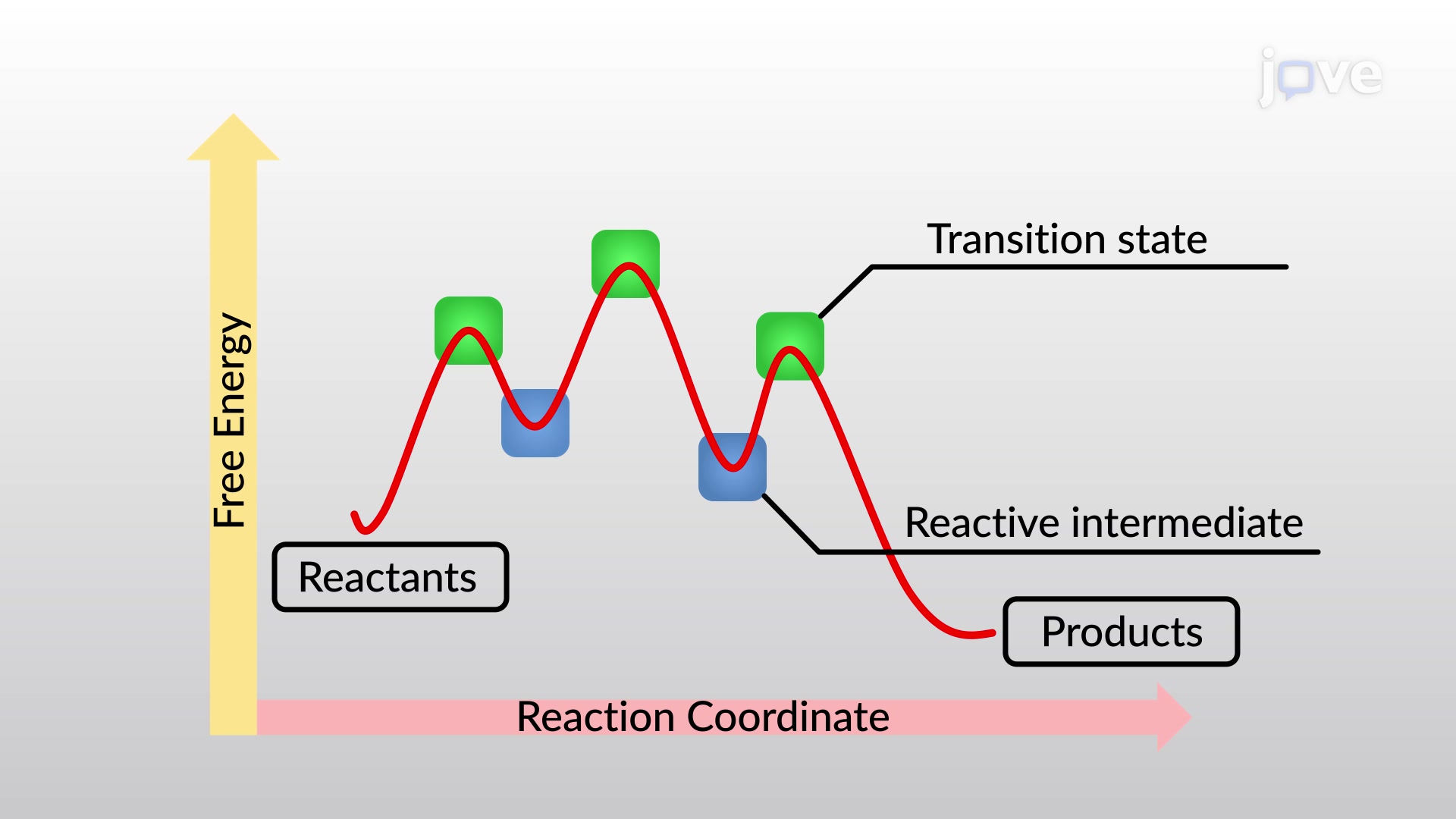
Free-energy diagrams, or reaction coordinate diagrams, are graphs showing the energy changes that occur during a chemical reaction. The reaction coordinate represented on the horizontal axis shows how far the reaction has progressed structurally. Positions along the x-axis close to the reactants have structures resembling the reactants, while positions close to the products resemble the products. Peaks on the energy diagram represent stable structures with measurable lifetimes, while other points along the graph represent unstable structures that cannot be isolated.

This high-energy unstable structure is called the transition state or activated complex. In this high-energy process, bonds are in the process of being broken and/or formed simultaneously. The structure is so strained that it transitions into new, less strained structures.

George Hammond formulated a principle that relates the nature of a transition state to its location on the reaction diagram. The Hammond Postulate states that a transition state will be structurally and energetically similar to the species nearest to it on the reaction diagram. In the case of an exothermic reaction, the transition state resembles the reactant species, whereas, in the case of an endothermic reaction, the transition state resembles the products. In a multi-step reaction, each step has a transition state and corresponding activation energy. The transition states of such reactions are punctuated with reactive intermediates, which are represented as local minima on the energy diagrams.

Reactive intermediates are products of bonds breaking and cannot be isolated for prolonged periods of time. Some of the most common reactive intermediates in organic chemistry are carbon ions or radicals. Carbocations are electrophiles, and carbanions are nucleophiles. Carbon radicals have only seven valence electrons and may be considered electron deficient; however, they do not, in general, bond to nucleophilic electron pairs, so their chemistry exhibits unique differences from that of conventional electrophiles. Radical intermediates are often called free radicals.

Transcript

Energy diagrams are used to represent the change in energy for the molecules involved in a chemical reaction.

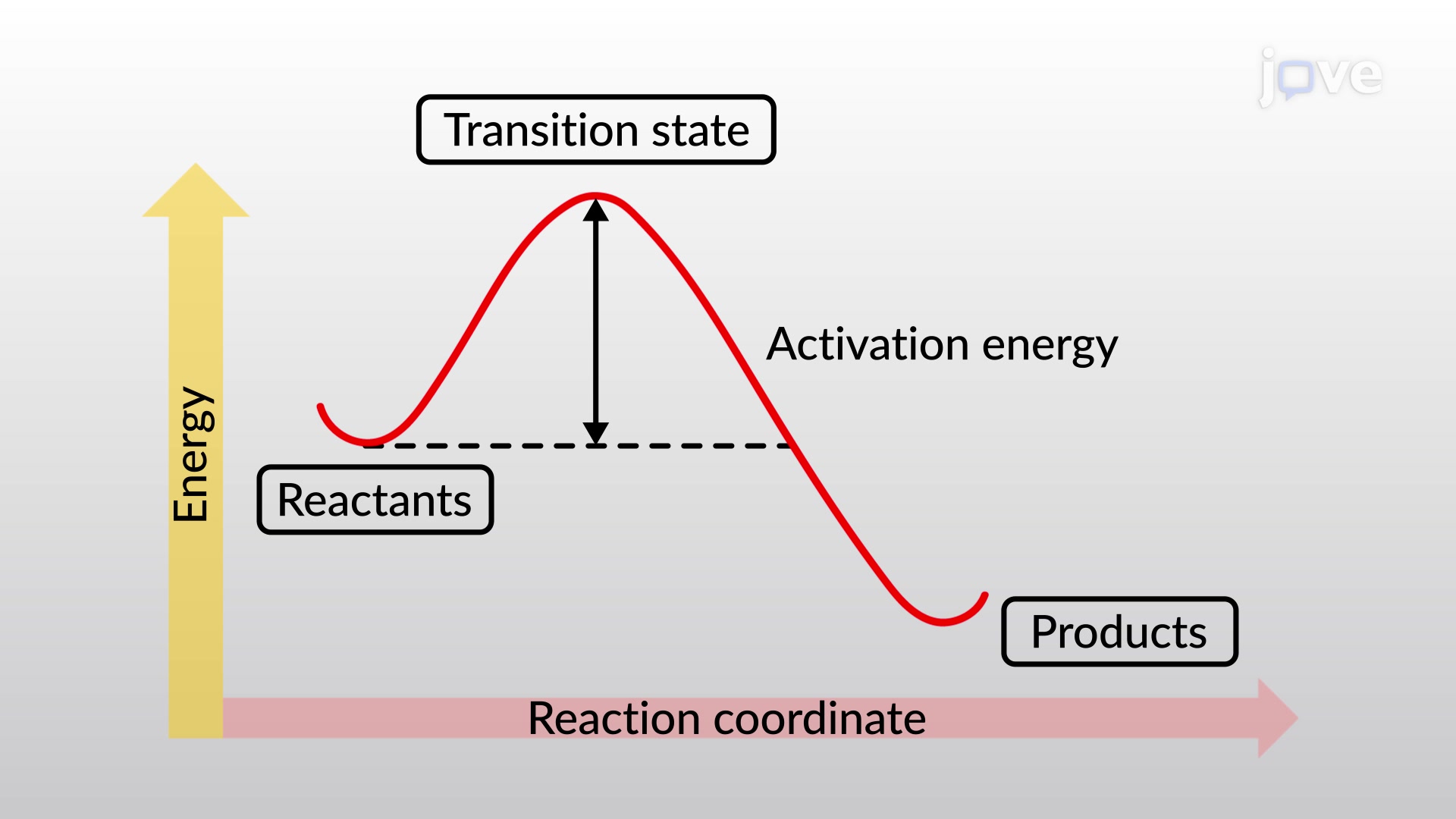
The free energy is measured along the y-axis, and the reaction coordinate is plotted on the x-axis.

The reaction coordinate indicates the progress of the conversion of reactants to products. Peaks on the energy diagram represent the transition states, whereas the valleys represent the reactive intermediates.

As the reaction progresses, the reactants pass through an unstable state of maximum free energy, called the activated complex, or the transition state. They last for less than one picosecond and cannot be isolated. The reactant’s ability to achieve a given transition state depends on the value of the activation energy.

The double dagger symbol is used to describe transition states. If the transition state is easy to achieve, the associated delta-G double-dagger is small, and the reaction is fast. Contrarily, if the transition state is difficult to achieve, the associated delta-G double-dagger is large, and the reaction rate is slow.

According to Hammond's postulate, in a single-step exothermic process, the structure of the transition state closely resembles that of the reactants, as the transition state is closer in energy to the reactants than to the products.

Meanwhile, in a single-step endothermic process, the structure of the transition state closely resembles that of the products, as the transition state is closer in energy to the products than to the reactants.

A reactive intermediate corresponds to an energy minimum between two transition states. Highly reactive intermediates are difficult to isolate and have a short lifespan, while those with lower energies have longer lifetimes.

The most common reactive intermediates in organic chemistry involve carbon radicals or carbon centers without four bonds. For example, carbocations act as electron acceptors and carbanions act as electron donors.
Explore More Videos

Energy DiagramsReaction Coordinate DiagramsChemical ReactionReactantsProductsStable StructuresUnstable StructuresTransition StateActivated ComplexGeorge HammondHammond PostulateExothermic ReactionEndothermic ReactionMulti-step ReactionActivation Energy

Related Videos

Chemical Reactions

02:26

Chemical Reactions

Thermodynamics and Chemical Kinetics

13.2K Views
Enthalpy and Heat of Reaction

02:12

Enthalpy and Heat of Reaction

Thermodynamics and Chemical Kinetics

9.6K Views
Energetics of Solution Formation

02:35

Energetics of Solution Formation

Thermodynamics and Chemical Kinetics

7.3K Views
Entropy and Solvation

02:05

Entropy and Solvation

Thermodynamics and Chemical Kinetics

8.2K Views
Gibbs Free Energy and Thermodynamic Favorability

02:23

Gibbs Free Energy and Thermodynamic Favorability

Thermodynamics and Chemical Kinetics

8.0K Views
Chemical and Solubility Equilibria

02:21

Chemical and Solubility Equilibria

Thermodynamics and Chemical Kinetics

4.8K Views
Rate Law and Reaction Order

02:33

Rate Law and Reaction Order

Thermodynamics and Chemical Kinetics

11.0K Views
Effect of Temperature Change on Reaction Rate

02:28

Effect of Temperature Change on Reaction Rate

Thermodynamics and Chemical Kinetics

4.9K Views
Multi-Step Reactions

02:31

Multi-Step Reactions

Thermodynamics and Chemical Kinetics

8.6K Views
Bond Dissociation Energy and Activation Energy

02:13

Bond Dissociation Energy and Activation Energy

Thermodynamics and Chemical Kinetics

10.7K Views

Energy Diagrams, Transition States, and Intermediates

02:13

Energy Diagrams, Transition States, and Intermediates

Thermodynamics and Chemical Kinetics

19.9K Views
Predicting Reaction Outcomes

02:24

Predicting Reaction Outcomes

Thermodynamics and Chemical Kinetics

9.9K Views

JoVE logo
Contact Us Recommend to Library
Research
  • JoVE Journal
  • JoVE Encyclopedia of Experiments
  • JoVE Visualize
Business
  • JoVE Business
Education
  • JoVE Core
  • JoVE Science Education
  • JoVE Lab Manual
  • JoVE Quizzes
Solutions
  • Authors
  • Teaching Faculty
  • Librarians
  • K12 Schools
  • Biopharma
About JoVE
  • Overview
  • Leadership
Others
  • JoVE Newsletters
  • JoVE Help Center
  • Blogs
  • Site Maps
Contact Us Recommend to Library
JoVE logo

Copyright © 2026 MyJoVE Corporation. All rights reserved

Privacy Terms of Use Policies
WeChat QR code