Deficits in muscular strength occur in many clinical conditions such as motor neuron disease. The inverted screen and weight lifting tests described here measure strength in mice almost exclusively, with minimal influence of factors such as coordination.
In This Article
Summary
Abstract
Kondziela7 devised the inverted screen test and published it in 1964. It is a test of muscle strength using all four limbs. Most normal mice easily score maximum on this task; it is a quick but insensitive gross screen, and the weights test described in this article will provide a finer measure of muscular strength.
There are also several strain gauge-based pieces of apparatus available commercially that will provide more graded data than the inverted screen test, but their cost may put them beyond the reach of many laboratories which do not specialize in strength testing. Hence in 2000 a cheap and simple apparatus was devised by the author. It consists of a series of chain links of increasing length, attached to a "fur collector" a ball of fine wire mesh sold for preventing limescale build up in hard water areas. An accidental observation revealed that mice could grip these very tightly, so they proved ideal as a grip point for a weight-lifting apparatus. A common fault with commercial strength meters is that the bar or other grip feature is not thin enough for mice to exert a maximum grip. As a general rule, the thinner the wire or bar, the better a mouse can grip with its small claws.
This is a pure test of strength, although as for any test motivational factors could potentially play a role. The use of scale collectors, however, seems to minimize motivational problems as the motivation appears to be very high for most normal young adult mice.
Introduction
To a lay person, the idea of measuring strength in mice might appear absurd, even something of an oxymoron. However, it is not without reason that house/lab mice are named Mus musculus. They actually have a very high strength/weight ratio, greater than that of rats. For instance, adult mice can easily support their own body weight, even using only the fore or hind paws; very few adult lab rats can do this.
Mice are playing an ever greater role in biomedical research. They can be used to model many human motor disorders, both somatic and central nervous system in origin. The former include the more than thirty forms of inherited muscular dystrophy1 and myasthenia gravis, while examples of the latter are multiple sclerosis, spinal muscular atrophy, Parkinson's disease, Huntington's disease and amyotrophic lateral sclerosis. For all of these models, a full assessment of their motor deficits must include specific tests of strength.
Protocol
1. Apparatus
1.1 Kondziela's inverted screen test
The inverted screen is a 43 cm square of wire mesh consisting of 12 mm squares of 1 mm diameter wire (Figure 1). It is surrounded by a 4 cm deep wooden beading (which prevents the occasional mouse which attempts to from climbing on to the other side) (Figure 2).
1.2 Weights test
Seven weights constitute the apparatus. Each consists of a ball of tangled fine gauge stainless steel wire, a "scale collector" as used to prevent limestone scale formation in domestic kettles. The weight of this is small (7 g) but each scale collector is attached to a series of steel chain links, each weighing approximately 13 g. The number of links ranges from one to seven. Their weights are therefore: 20, 33, 46, 59, 72, 85 and 98 g (Figures 3 and 4).
2. Procedure
For all tests, bring the mice to the experimental room 5-20 min before testing to ensure they are properly awake. As a general rule, to allow recovery of muscular strength and a return to normal levels of arousal, rest the mice by a return to the home cage after each motor test.
- Kondziela's inverted screen test
- Procedure: Place the mouse in the center of the wire mesh screen, start a stopclock, rotate the screen to an inverted position over 2 sec, with the mouse's head declining first. Hold the screen steadily 40-50 cm above a padded surface. Note the time when the mouse falls off, or remove it when the criterion time of 60 sec is reached. Longer criterion times may be useful for some experiments.
- Scoring the inverted screen:
Falling between 1-10 sec = 1
Falling between 11-25 sec = 2
Falling between 26-60 sec = 3
Falling after 60 sec = 4
Or, e.g. for 2 min:
Falling between 1-10 sec = 1
Falling between 11-25 sec = 2
Falling between 26-60 sec = 3
Falling between 61-90 sec = 4
Falling after 90 sec = 5
3. Weights Test
Hold a mouse by the middle/base of the tail and lower it to allow it to grasp the first weight (20 g) which is lying on the laboratory bench. As it grasps the wire scale collector with its forepaws, start a stop clock and raise the mouse until the link is clear of the bench. A hold of three seconds is the criterion. If the mouse drops the weight in less than 3 sec, note the time it held the weight. Rest the mouse for about 10 sec and try it on the weight once again. If it fails three times, that terminates the trial, and the mouse is assigned the maximum time/weight achieved. If it holds it for 3 sec then try it on the next heaviest weight. If it lifts this for 3 sec, test it on the next heavier weight, after you have tested all its cagemates on the first weight. Again, it is given three chances to hold the weight for 3 sec. A final total score is calculated as the product of the number of links in the heaviest chain held for the full 3 sec, multiplied by the time (sec) it is held. If the heaviest weight is dropped before 3 sec an appropriate intermediate value is calculated. Thus a mouse holding a 5-link weight for 3 seconds, but unable to lift a 6-link weight, is assigned a score of (5 x 3) = 15. If it holds the 6-link weight for 1 second, it scores (5 x 3) + (1) =16.
Sometimes mice may not be adequately motivated to grip the apparatus. This generally occurs in older animals. This problem can be minimized by holding the mice by the tail for a longer time before bringing it within gripping distance of the wire ball.
Results
Expected Results
Contet et al.2 demonstrated that 129S2/sv mice performed similarly on the weights test to C57BL/6 mice. Female C57BL/6 mice scored approximately 15, 129 mice 17, which means they could lift approximately 5 chain links, around 70 g. This is a high value; normally 2-3 chain links (score 6-9, 33-46 g) are lifted by C57BL/6 mice5. These differences are presumably related to factors such as how much handling the mice have received and the details of the experimenter's technique.
Hippocampal lesions did not affect strength as measured either by the weights test or the inverted screen4. Prion (scrapie) diseased mice were impaired on the inverted screen by 18 weeks after infection6. Although somewhat impaired on the horizontal bar and rotarod relative to C57BL/6 mice, C57BL/10 mice were not impaired on weightlifting5. Knockout mice for the KATP channel subunit Kir6.2 were not impaired on the inverted screen or weightlifting tests, although the females scored higher than males on the latter3. This was unusual; normally the heavier males display greater strength than the females.

Figure 1. The inverted screen.
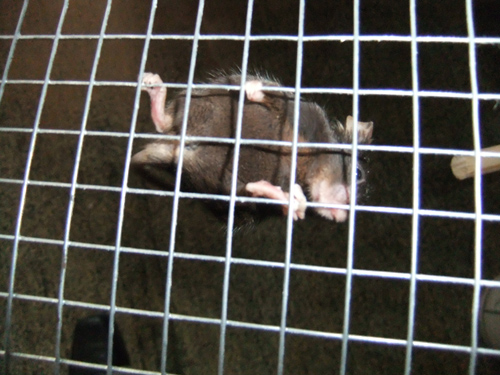
Figure 2. Close view of a mouse on the inverted screen.

Figure 3. Weights, ranging from 20 g to 98 g.

Figure 4. A mouse weightlifting.
Discussion
Mouse models of the many diseases that affect the human motor systems are continually being developed, therefore good assays of strength in mice are essential. Examples include the many forms of muscular dystrophy, Parkinson's disease and Huntington's chorea. Strength assays also find use in models of nerve regeneration after spinal or peripheral nerve damage. Industrial and automobile accidents continue to cause considerable disability to humans, but much preclinical work is presently investigating possible avenues of treatment based on nerve growth factors.
Muscles never work individually. They are activated by the brain, local or higher spinal reflexes, via the neuromuscular junctions and work within the constraints of other muscles and the skeletal system. Therefore, the complexity of the system means in vivo assays of muscular force in the awake animal are essential in the evaluation of its present condition and the effects of any putative treatments. Mice instinctively hold on to materials with a strong grip, thus Mus musculus is an ideal model animal in which to assess disorders of muscular strength and possible treatments.
Disclosures
No conflicts of interest declared.
Acknowledgements
The Wellcome Trust for providing Open Access funding to Oxford University. Robert Deacon is a member of Oxford OXION group, funded by Wellcome Trust grant WT084655MA.
References
- Bulfield, G., Siller, W. G., Wight, P. A., Moore, K.J.X chromosome-linked muscular dystrophy (mdx) in the mouse. Proc. Natl. Acad. Sci. U.S.A. 81, 1189-1192 (1984).
- Contet, C., Rawlins, J. N. P., Deacon, R. M. J. A comparison of 129S2/SvHsd and C57BL/6JOlaHsd mice on a test battery assessing sensorimotor, affective and cognitive behaviours: implications for the study of genetically modified mice. Behavioural Brain Research. 124, 33-46 (2001).
- Deacon, R. M. J., Brook, R. C., Meyer, D., Haeckel, O., Ashcroft, F. M., Miki, T., Seino, S., Liss, B. Behavioral phenotyping of mice lacking the KATP channel subunit Kir6.2. Physiol. Behav. 87, 723-733 (2006).
- Deacon, R. M. J., Croucher, A., Rawlins, J. N. P. Hippocampal cytotoxic lesion effects on species-typical behaviors in mice. Behav. Brain Res. 132, 203-213 (2002).
- Rawlins, J. N. P., Morley, B. J. A comparison of the behavior of C57BL/6 and C57BL/10 mice. Behav. Brain Res. 179, 239-247 (2007).
- Guenther, K., Deacon, R. M. J., Perry, V. H., Rawlins, J. N. P. Early behavioural changes in scrapie-affected mice and the influence of dapsone. Eur. J. Neurosci. 14, 401-409 (2001).
- Kondziela, W. Eine neue method zur messung der muskularen relaxation bei weissen mausen. Arch. Int. Pharmacodyn. 152, 277-284 (1964).
Reprints and Permissions
