The genetic reporter assay is a well-established and powerful tool for dissecting the relationship between DNA sequences and their gene regulatory activities. Coupling candidate regulatory elements to reporter genes that carry identifying sequence tags enables massive parallelization of these assays.
Method Article
Massively Parallel Reporter Assays in Cultured Mammalian Cells
In This Article
Erratum Notice
Important: There has been an erratum issued for this article. View Erratum Notice
Summary
Abstract
The genetic reporter assay is a well-established and powerful tool for dissecting the relationship between DNA sequences and their gene regulatory activities. The potential throughput of this assay has, however, been limited by the need to individually clone and assay the activity of each sequence on interest using protein fluorescence or enzymatic activity as a proxy for regulatory activity. Advances in high-throughput DNA synthesis and sequencing technologies have recently made it possible to overcome these limitations by multiplexing the construction and interrogation of large libraries of reporter constructs. This protocol describes implementation of a Massively Parallel Reporter Assay (MPRA) that allows direct comparison of hundreds of thousands of putative regulatory sequences in a single cell culture dish.
Introduction
Massively Parallel Reporter Assays (MPRA) allow multiplexed measurement of the transcriptional regulatory activities of thousands to hundreds of thousands of DNA sequences1-7. In their most common implementation, multiplexing is achieved by coupling each sequence of interest to a synthetic reporter gene that contains an identifying sequence tag downstream of an open reading frame (ORF; Figure 1). Following transfection, RNA isolation and deep sequencing of the 3’ ends of the reporter gene transcripts, the relative activities of the coupled sequences can be inferred from the relative abundance of their identifying tags.

Figure 1. Overview of MPRA. A library of MPRA reporter constructs is constructed by coupling putative regulatory sequences to synthetic reporter genes that consist of an “inert” ORF (such as GFP or luciferase) followed by an identifying sequence tag. The library is transfected en masse into a population of cultured cells and transcribed reporter mRNA is subsequently recovered. Deep sequencing is used to count the number of occurrences of each tag among the reporter mRNAs and the transfected plasmids. The ratio of mRNA counts over plasmid counts can be used to infer the activity of the corresponding regulatory sequence. Adapted with permission from Melnikov, et al2.
MPRA can be adapted to a wide variety of experimental designs, including 1) comprehensive mutagenesis of individual gene regulatory elements, 2) scanning for novel regulatory elements across a locus of interest, 3) testing the effect of natural genetic variation in a set of putative promoters, enhancers or silencers, and 4) semi-rational engineering of synthetic regulatory elements. Libraries of sequence variants can be generated using a variety of methods, including oligonucleotide library synthesis (OLS) on programmable microarrays2,3,6,7, assembly of degenerate oligonucleotides1,4, combinatorial ligation8 and fragmentation of genomic DNA5.
This protocol describes construction of a library of promoter variants using OLS and the pMPRA1 and pMPRAdonor1 vectors (Addgene IDs 49349 and 49352, respectively; http://www.addgene.org), transient transfection of this library into cultured mammalian cells and subsequent quantitation of the promoter activities by deep sequencing of their associated tags (Tag-Seq). Earlier versions of this protocol were used in the research reported in Melnikov et al. Nature Biotechnology 30, 271-277 (2012) and in Kheradpour et al. Genome Research 23, 800-811 (2013).
Protocol
1. Sequence Design and Synthesis
- Begin MPRA with the design and synthesis of sequences to be assayed for regulatory activity. For compatibility with the pMPRA vector series, design each sequence using the following template: 5’-ACTGGCCGCTTCACTG-var-GGTACCTCTAGA-tag-AGATCGGAAGAGCGTCG-3’ where var denotes the sequence to be assayed and tag denotes one or more identifying tags.
- The two variable regions (var and tag) are separated by a pair of KpnI (GGTACC) and XbaI (TCTAGA) restriction sites to facilitate directional ligation of a reporter gene fragment between them. In addition, two distinct SfiI (GGCCNNNNNGGCC) sites will be added by PCR to allow directional ligation into the pMPRA backbone. The variable regions must not contain additional copies of any of these restriction sites. If necessary, one or more of these restriction enzymes can be replaced, as long as the replacements 1) allow efficient cutting close to the ends of DNA molecules, and 2) do not cut elsewhere in the vector sequence. See Discussion for additional details.
- Obtain the required primers listed in Table 1 from a commercial vendor.
| MPRA_SfiI_F | GCTAAGGGCCTAACTGGCCGCTTCACTG |
| MPRA_SfiI_R | GTTTAAGGCCTCCGTGGCCGACGCTCTTC |
| TAGseq_P1 | AATGATACGGCGACCACCGAGATCTACACT CTTTCCCTACACGACGCTCTTCCGATCT |
| TAGseq_P2 | CAAGCAGAAGACGGCATACGAGAT[index]GTGAC TGGAGTTCAGACGTGTGCTCTTCCGATCTCGAG GTGCCTAAAGG |
Table 1. Primer sequences. [index] denotes a 6 to 8 nt index sequence used for multiplexed sequencing. Obtain at least 8 TagSeq-P2 primers with different indices. All of the primers should be purified by HPLC or PAGE.
- Oligonucleotide libraries can be obtained from a commercial vendor or core facility, or generated by using a programmable microarray-based oligonucleotide synthesizer as described by the manufacturer. Resuspend the OLS products in 100 µl TE 0.1 buffer.
- Run the oligonucleotide libraries on a 10% TBE-Urea denaturing polyacrylamide gel. Load approximately 1 pmol per lane and stain with ssDNA-sensitive fluorescent stain to assess their quality (Figure 2A).
- If a discrete band corresponding to the full-length oligonucleotides can be visualized (Figure 2A, lanes 1 and 2), excise the corresponding acrylamide gel slice and elute oligonucleotides into 100 µl TE 0.1 overnight at room temperature with shaking. Otherwise, proceed using the raw OLS suspension.
- Amplify and add SfiI tails to the oligonucleotide library using emulsion PCR 9.
- Set up 50 µl PCR reaction mixtures as described in Table 2. Then combine with 300 µl oil and surfactant mixture from the Micellula DNA Emulsion and Purification kit and vortex for 5 min at 4 °C.
| Reagent | 1x Volume (µl) |
| Herculase II Fusion DNA Polymerase | 0.5 |
| 5x Herculase II Reaction Buffer | 10 |
| dNTP (10 mM each) | 1.25 |
| BSA (20 mg/ml) | 1.25 |
| Primer MPRA_SfiI_F (25 µM) | 0.25 |
| Primer MPRA_SfiI_R (25 µM) | 0.25 |
| OLS template (1-10 attomol) | varies |
| Nuclease-free water | to 50 |
Table 2. Emulsion PCR reaction mix (water phase).
- Use the concentration that gives the maximal yield of amplification products without the appearance of artifacts (see section 1.12).
- Dispense the resulting emulsion into PCR tubes and perform 20 cycles of PCR (2 min at 95 °C, 20 x[20 sec at 95 °C, 20 sec at 55 °C, 30 sec at 72 °C], 3 min at 95 °C).
- Pool and break each 350 µl emulsion PCR reaction by adding 1 ml isobutanol and briefly vortexing, and then purify the amplification product using a DNA purification column.
- Run an aliquot on a 2% or 4% agarose gel to verify artifact-free amplification (Figure 2B).

Figure 2. Preparation of oligonucleotide synthesis libraries. A) Three different raw oligonucleotide synthesis libraries (OLS) run on denaturing 10% TBE-Urea polyacrylamide gels. Bands corresponding to full length oligonucleotides (*) can be visualized and excised from libraries 1 and 2. Library 3 contains contaminants that interfere with PAGE purification. If this is the case, proceed directly to PCR amplification. B) Products of open and emulsion PCR amplification of the same oligonucleotide library run on an agarose gel. PCR amplification of complex oligonucleotide libraries frequently creates chimeric products and other artifacts that may appear as higher and lower bands. Emulsion PCR can minimize these artifacts.
2. Library Construction
- Prepare a linearized plasmid backbone by digesting vector pMPRA1 with SfiI at 50 °C for 2 hr, run on a 1% agarose gel, excise the backbone band (in this case, 2.5 kb) and purify it using a gel-purification spin column.
- Digest the emulsion PCR products from step 1.4 with SfiI at 50 °C for 2 hr and purify using DNA purification columns.
- To ligate the promoter-tag library into the linearized vector backbone, set up reactions containing 100 ng of the digested PCR product, 50 ng of linearized vector backbone and T4 DNA ligase. Incubate overnight at 16 °C and then heat at 65 °C for 20 min to inactivate the ligase.
- Transform E. coli with the ligation reaction. To preserve library complexity, aim to obtain at least 10x more cfu than there are distinct promoter-tag combinations in the designed library.
- When the total number of tags is approximately 100,000, the target cfu can typically be achieved by performing 6-8 parallel transformations per library.
- For each transformation, combine 50 µl electrocompetent E. coli cells with 2 µl of ligation mix on ice. Transform by electroporation, recover the cells in 800 µl SOC medium by shaking at 37 °C for 1 hr, and then combine cells from the parallel transformations.
- To evaluate the transformation efficiency, plate serial dilutions from an alinquot of recovered cells on LB agar plates with 50-100 µg/ml carbenicillin and incubate overnight at 37 °C. Estimate total cfu as (observed cfu) × (dilution factor) × (V - v) / v, where V is the total volume of recovered cells and v is the volume of the aliquot taken for the serial dilutions.
- At the same time, use the remainder of the recovered cells to inoculate 200 ml LB supplemented with 100 µg/ml carbenicillin. Grow cells at 37 °C overnight in a shaker incubator and then isolate the plasmid DNA following standard procedures.
- Digest an aliquot of the isolated plasmid library with SfiI at 50 °C for 2 hr and run on a 1% agarose gel to confirm the presence of inserts.
- Linearize the plasmid library by cutting between the promoter variants and tags using KpnI and XbaI. To maximize the digestion efficiency, perform serial digestions:
- First, digest with KpnI at 37 °C for 1 hr and purify using magnetic beads. Second, digest with XbaI with addition of 1 U Shrimp Alkaline Phosphatase at 37 °C for 2 hr, heat inactivate at 65 °C for 5 min, and then purify using magnetic beads.
- Run an aliquot on a 1% agarose gel to verify complete linearization. If uncut plasmid is visible, the linearized fragment should be gel purified.
- To generate an MPRA library suitable for transfection into mammalian cells, ligate an ORF with KpnI/XbaI-compatible ends into the linearized intermediate library.
- To prepare a compatible luc2 ORF fragment from pMPRAdonor1, digest this plasmid with KpnI and XbaI at 37 °C for 1 hr and run on a 1% agarose gel. Excise the ORF fragment (1.7 kb in this case) and purify using a gel purification spin column.
- Clone the ORF fragment into the linearized intermediate library as described in steps 2.3-2.8.
- Digest an aliquot (corresponding to 1-2 µg) of the MPRA library with KpnI at 37 °C for 1 hr and run on a 1% agarose gel. If the digested library runs as a single band, proceed to section 3. If additional bands are observed (typically corresponding to carryover of intermediate constructs), the library can be further purified as follows:
- Digest 3-5 µg of the contaminated library with KpnI at 37 °C for 1 hr and run on a 0.8% agarose gel overnight at 4 °C.
- Excise the correct library band, purify the DNA using a gel purification spin column and perform self-ligation using high-concentration T4 DNA ligase at 37 °C for 1 hr. Then repeat the transformation and final library DNA isolation as described in step 2.8.
3. Transfection, Perturbation, and RNA Isolation
- For each independent transfection, culture the required number of cells (as determined by the MPRA library complexity, see Discussion) in appropriate medium. For example, culture HEK293T/17 cells in DMEM supplemented with 10% FBS and L-glutamine/penicillin/streptomycin. Culture cells for at least two independent transfections for each library and experimental condition.
- Transfect the cultured cells with MPRA plasmids. The transfection method and conditions must be optimized for each cell type. For each transfected sample, retain an aliquot (50-100 ng) of the plasmid DNA as a matched control.
- For example, transfect 0.5 x 10⁷ HEK293T/17 cells grown to ~50% confluence in a 10 cm culture dish with 10 µg plasmid DNA in 1 ml Opti-MEM I Reduced Serum Medium using 30 µl Lipofectamine LTX and 10 µl Plus Reagent. Remove the transfection mixture after 5 hours and allow the cells to recover for 24-48 hr.
- Optionally, perform any perturbation required to activate context- or signal-dependent regulatory sequences in the designed library.
- Harvest the cells and isolate poly(A)+ mRNA using standard oligo(dT) cellulose columns or beads using their manufacturer’s instructions.
- Ensure that the maximum binding capacity of the columns or beads exceed the total amount of mRNA expected from the harvested cells. For example, the expected yield from section 3.3 is approximately 0.5-2.5 µg mRNA.
4. Tag-Seq
- To eliminate carryover of vector DNA from the transfected cell lysates, treat each 20 µl mRNA sample with 1 µl Turbo DNase (2 U) and 2.3 µl 10x Turbo DNase buffer at 37 °C for 1 hr, add 2.4 µl Turbo DNase Inactivation Reagent at RT for 5 min with mixing, centrifuge at 10,000 g for 90 sec, and then transfer the solution to a fresh tube.
- Verify purity by performing PCR as described in section 4.6 on 60-100 ng of each mRNA sample, and then running the products on an agarose gel. If specific amplicons are visible (0.25 kb if using pMPRA1 with luc2), column purify the treated mRNA and then repeat the DNase treatment.
- To generate Tag-Seq sequencing libraries, convert reporter mRNA to cDNA and add sequencing adapters by PCR.
- Set up mRNA/RT primer mixtures as described in Table 3. Incubate at 65 °C for 5 min, then place on ice. In parallel, set up cDNA synthesis reactions as described in Table 4.
| Reagent | 1x Volume (µl) |
| mRNA sample (400-700 ng total) | 8 |
| Oligo-0dT (50 µM) | 1 |
| dNTP (10 mM each) | 1 |
Table 3. RNA/Reverse transcription primer mix for cDNA synthesis.
| Reagent | 1x Volume (µl) |
| 10x SuperScript III RT Buffer | 2 |
| MgCl2 (25 mM) | 4 |
| DTT (0.1 M) | 2 |
| RNaseOut (40 U/µl) | 1 |
| SuperScript III (200 U/µl) | 1 |
Table 4. cDNA synthesis reaction mix.
- Gently combine mRNA/RT primer mixes with cDNA synthesis mixes. Incubate at 50 °C for 50 min, 85 °C for 5 min and then place on ice. Finally, incubate with 2 U of Ribonuclease H at 37 °C for 20 min.
- Set up PCR reactions as described in Table 5 with 4-6 µl cDNA reaction mixture or 50 ng reporter plasmid as templates. Then perform PCR amplification (95 °C for 2 min, 26 x [95 °C for 30 sec, 55 °C for 30 sec, 72 °C for 30 sec], 72 °C for 3 min).
| Reagent | 1x Volume (µl) |
| 2x PfuUltra II HotStart PCR Master Mix | 25 |
| Primer TagSeq_P1 (25 µM) | 0.5 |
| Primer TagSeq_P2 (25 µM) | 0.5 |
| Template (mRNA, cDNA mix or plasmid DNA) | varies |
| Nuclease-free water | to 50 |
Table 5. Tag-Seq PCR reaction mix.
- Run the PCR products through a 2% agarose gel, excise bands corresponding to the Tag-Seq library amplicons (0.25 kb if using pMPRA1 with luc2) and purify these using gel purification spin columns.
- Pool, denature and sequence the purified Tag-Seq amplicons directly with an Illumina sequencing instrument.
- Filter low-quality reads by removing all that a) contain one or more position with a Phred quality score less than 30 within the sequenced tag or b) does not exactly match a designed tag. Count the number of times each remaining tag appears in each library. Normalize the tag counts to TPM (tags per million sequenced tags) and then compute the ratio of mRNA-derived tag counts over plasmid-derived tag counts for each pair of sequencing libraries. If multiple different tags were linked to each sequence variant, use their median ratios for downstream analysis.
Results
MPRA facilitates high-resolution, quantitative dissection of the sequence-activity relationships of transcriptional regulatory elements. A successful MPRA experiment will typically yield highly reproducible measurements for the majority of sequences in the transfected library (Figure 3A). If poor reproducibility is observed (Figure 3B), this is indicative of a too low concentration of reporter mRNAs in the recovered RNA samples, due to either 1) low absolute activity among the assayed sequences, or 2) low transfection efficiency.
Figure 4 shows a representative “information footprint”1,2 generated by assaying ~37,000 random variants of a 145 bp sequence upstream of the human IFNB gene in HEK293 cells with or without exposure to Sendai virus. The promoter TATA-box and known proximal enhancer10 can be clearly identified as information-rich regions in a virus-dependent manner.
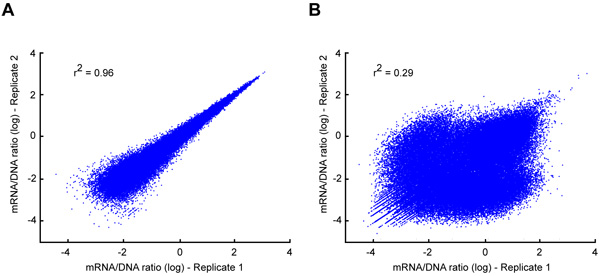
Figure 3. Tag-Seq reproducibility. Scatter plots showing examples of Tag-Seq data from two independent replicate transfections with high (A) and low (B) reproducibility. The latter plot shows many outlier tags with high mRNA counts in only one of the two replicates. Such artifacts typically indicate that the concentrations of reporter mRNAs were too low for quantitative PCR amplification, either due to low absolute activities among the reporter constructs, or low transfection efficiencies.
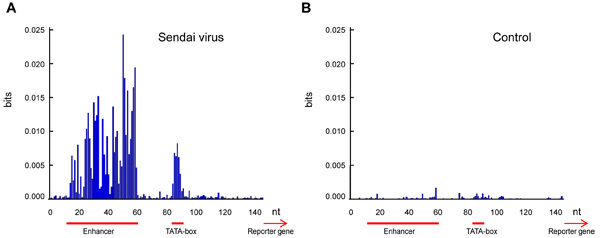
Figure 4. Information footprinting of the human IFNB transcription start site and proximal enhancer. Approximately 37,000 random variants of a 145 nucleotide (nt) region upstream of the human IFNB gene were assayed using MPRA in HEK293 cells with (A) and without (B) exposure to Sendai virus. The blue bars show the mutual information between the reporter output and the nucleotide at each position. The proximal enhancer and TATA-box stand out as regions of high information content upon viral infection.
Discussion
MPRA is a flexible and powerful tool for dissection of sequence-activity relationships in gene regulatory elements. The success of MPRA experiments depend on at least three factors: 1) careful design of the sequence library, 2) minimization of artifacts during amplification and cloning, and 3) high transfection efficiency.
The possible lengths of the variable regions in the reporter constructs are largely determined by the synthesis or cloning technology used. Standard OLS is generally limited to about 200 nt, but this protocol is compatible with inserts up to at least 1,000 nt. Note that variable regions that are highly repetitive or contain strong secondary structures may end up underrepresented due to PCR and cloning biases. The length of the tags that identify each of the variable regions should be 10-20 nt and the collection of tags should ideally be designed such there are at least two nucleotide differences between any pair. Tags that contain the seed sequences of known microRNA or other factors that might influence mRNA stability should also be avoided when possible.
A key parameter in the design of MPRA experiments is the total number of distinct reporter constructs to be included in the library (the design complexity, denoted CD). In practice, CD is limited by the number of cultured cells that can be transfected. As a rule of thumb, the total number of transfected cells should be at least 50-100 times greater than CD. For example, if 20 million cells can be transfected with a transfection efficiency of 50%, then CD should be no more than ~200,000. Note that CD is equal to the number of distinct regulatory sequence variants multiplied by the number of distinct tags per sequence. The more distinct tags are linked to each regulatory sequence, the more accurate the estimate of the activity of that sequence can be made (because measurements from distinct tags can be averaged), but the fewer distinct variants can be assayed in one experiment. The optimal choice depends on the experimental design. In a simple “promoter bashing” experiment, where a mathematical model will be fitted to the aggregated measurements, a single tag per variant is usually sufficient. In a screen for single-nucleotide polymorphisms that cause changes in regulatory activities, it may be necessary to use 20 or more tags per allele to obtain statistically robust results, because comparing each pair of alleles requires a separate hypothesis test.
If the sequences to be assayed are not expected to contain transcription start sites, a constant promoter can also be added in the same fragment. For example, pMPRAdonor2 (Addgene ID 49353) includes a minimal TATA-box promoter that is useful when the upstream variable region is expected to have significant enhancer activity, while pMPRAdonor3 (Addgene ID 49354) includes a modified, strong SV40 viral promoter that is useful when the variable region is expected to contain silencer activity or other negative regulatory elements.
Raw OLS products often contain a significant fraction of truncated oligonucleotides. These may interfere with accurate PCR amplification of the designed sequences, particularly when there is significant homology between them. Using PAGE purification to remove truncated synthesis products and emulsion PCR to minimize amplification artifacts are effective techniques for ensuring high library quality. If either step is impractical, it is imperative to minimize the number of PCR cycles used at each amplification step. Selection and expansion of the cloned library in liquid culture is generally sufficient to maintain the design complexity, but if recombination-prone vectors are to be used or significant representation bias is observed, the recovered cells can instead be plated directly onto large LB agar plates, expanded as individual colonies and then scraped off for DNA isolation. It is also important to consider the potential impact of synthesis errors, which are typically found at a rate of 1:100-500 in OLS. Full-length sequencing of the reporter constructs prior to transfection is recommended to identify and correct for such errors.
It is not necessary to introduce reporter constructs into every cell in the transfected culture, but transfection efficiencies below ~50% may lead to poor signal to noise ratios. It is advisable to optimize transfection conditions prior to performing MPRA experiments in a new cell type. When working with hard-to-transfect cell types, MPRA signals can be boosted by pre-selecting transfected cells. The pMPRA vector series includes variants that constitutively express a truncated cell surface marker that can be used to physically enrich for transfected cells prior to RNA isolation (for example, Addgene IDs 49350 and 49351).
Disclosures
The authors declare that they have no competing financial interests.
Acknowledgements
This work was supported by the National Human Genome Research Institute of the National Institutes of Health under Award Number R01HG006785.
Materials
| Name | Company | Catalog Number | Comments |
|---|---|---|---|
| Oligonucleotide library synthesis | Agilent, CustomArray, or other OLS vendors | custom | If using OLS construction method |
| pMPRA1 | Addgene | 49349 | MPRA plasmid backbone |
| pMPRAdonor1 | Addgene | 49352 | luc2 ORF donor plasmid |
| TE 0.1 Buffer (10 mM Tris-HCl, 0.1 mM EDTA, pH 8.0) | Generic | n/a | OLS buffer |
| Novex TBE-Urea Gels, 10% | Life Technologies | EC6875BOX | PAGE purification of OLS products |
| Novex TBA-Urea Sample Buffer | Life Technologies | LC6876 | PAGE purification of OLS products |
| SYBR Gold Nucleic Acid Gel Stain | Life Technologies | S-11494 | PAGE purification of OLS products |
| Micellula DNA Emulsion & Purification Kit | EURx/CHIMERx | 3600-01 | Library amplification by emulsion PCR |
| Herculase II Fusion DNA Polymerase | Agilent | 600675 | Polymerase for emulsion PCR |
| SfiI | New England Biolabs | R0123S | Library cloning with pMPRA vectors |
| KpnI-HF | New England Biolabs | R3142S | Library cloning with pMPRA vectors |
| XbaI | New England Biolabs | R0145S | Library cloning with pMPRA vectors |
| T4 DNA Ligase (2,000,000 units/ml) | New England Biolabs | M0202T | Library cloning with pMPRA vectors |
| One Shot TOP10 Electrocomp E. coli | Life Technologies | C4040-50 | Library cloning with pMPRA vectors |
| LB agar and liquid media with carbenicllin | Generic | n/a | Growth media for cloning |
| E-Gel EX Gels 1% | Life Technologies | G4010-01 | Library verification and purification |
| E-Gel EX Gels, 2% | Life Technologies | G4010-02 | Library verification and purification |
| MinElute Gel Extraction Kit | Qiagen | 28604 | Library and backbone purification |
| EndoFree Plasmid Maxi Kit | Qiagen | 12362 | Library DNA isolation |
| Cell culture media | n/a | n/a | Experiment-specific |
| Transfection reagents | n/a | n/a | Experiment-specific |
| MicroPoly(A)Purist Kit | Life Technologies | AM1919 | mRNA isolation |
| TURBO DNA-free Kit | Life Technologies | AM1907 | Plasmid DNA removal |
| SuperScript III First-Strand Synthesis System | Life Technologies | 18080-051 | cDNA synthesis |
| PfuUltra II Hotstart PCR Master Mix | Agilent | 600850 | Polymerase for Tag-Seq PCR |
| Primers (see text) | IDT | custom | PAGE purify Tag-Seq primers |
References
- Kinney, J., Murugan, A., Callan, C. G., Cox, E. C. Using deep sequencing to characterize the biophysical mechanism of a transcriptional regulatory sequence. Proceedings of the National Academy of Sciences USA. 107 (20), 9158-9163 (2010).
- Melnikov, A., et al. Systematic dissection and optimization of inducible enhancers in human cells using a massively parallel reporter assay. Nature Biotechnology. 30 (3), 271-277 (2012).
- Patwardhan, R. P., Lee, C., Litvin, O., Young, D. L., Pe’er, D., Shendure, J. High-resolution analysis of DNA regulatory elements by synthetic saturation mutagenesis. Nature Biotechnology. 27 (12), 1173-1175 (2009).
- Patwardhan, R. P., et al. Massively parallel functional dissection of mammalian enhancers in vivo. Nature Biotechnology. 30 (3), 265-270 (2012).
- Arnold, C. D., Gerlach, D., Stelzer, C., Boryń, ŁM., Rath, M., Stark, A. Genome-wide quantitative enhancer activity maps identified by STARR-seq. Science (New York, N. Y.). 339 (6123), 1074-1077 (2013).
- Kheradpour, P., et al. Systematic dissection of regulatory motifs in 2000 predicted human enhancers using a massively parallel reporter assay. Genome Research. 23 (5), 800-811 (2013).
- White, M. A., Myers, C. A., Corbo, J. C., Cohen, B. A. Massively parallel in vivo enhancer assay reveals that highly local features determine the cis -regulatory function of ChIP-seq peaks. Proceedings of the National Academy of Sciences USA. 110 (29), 11952-11957 (2013).
- Mogno, I., Kwasnieski, J. C., Cohen, B. A. Massively parallel synthetic promoter assays reveal the in vivo effects of binding site variants. Genome Research. 23 (11), 1908-1915 (2013).
- Schütze, T., et al. A streamlined protocol for emulsion polymerase chain reaction and subsequent purification. Analytical Biochemistry. 410 (1), 155-157 (2011).
- Panne, D., Maniatis, T., Harrison, S. C. An atomic model of the interferon-beta enhanceosome. Cell. 129 (6), 1111-1123 (2007).
Reprints and Permissions
Erratum
Formal Correction: Erratum: Massively Parallel Reporter Assays in Cultured Mammalian Cells
Posted by JoVE Editors on 3/01/2015. Citeable Link.
null
