A protocol for fast CRISPR/Cas9-mediated gene disruption in mouse and human primary hematopoietic cells is described in this article. Cas9-sgRNA ribonucleoproteins are introduced via electroporation with sgRNAs generated through in vitro transcription and commercial Cas9. High editing efficiencies are achieved with limited time and financial cost.
Method Article
Highly Efficient Gene Disruption of Murine and Human Hematopoietic Progenitor Cells by CRISPR/Cas9
* These authors contributed equally
In This Article
Summary
Abstract
Advances in the hematopoietic stem cell (HSCs) field have been aided by methods to genetically engineer primary progenitor cells as well as animal models. Complete gene ablation in HSCs required the generation of knockout mice from which HSCs could be isolated, and gene ablation in primary human HSCs was not possible. Viral transduction could be used for knock-down approaches, but these suffered from variable efficacy. In general, genetic manipulation of human and mouse hematopoietic cells was hampered by low efficiencies and extensive time and cost commitments. Recently, CRISPR/Cas9 has dramatically expanded the ability to engineer the DNA of mammalian cells. However, the application of CRISPR/Cas9 to hematopoietic cells has been challenging, mainly due to their low transfection efficiencies, the toxicity of plasmid-based approaches and the slow turnaround time of virus-based protocols.
A rapid method to perform CRISPR/Cas9-mediated gene editing in murine and human hematopoietic stem and progenitor cells with knockout efficiencies of up to 90% is provided in this article. This approach utilizes a ribonucleoprotein (RNP) delivery strategy with a streamlined three-day workflow. The use of Cas9-sgRNA RNP allows for a hit-and-run approach, introducing no exogenous DNA sequences in the genome of edited cells and reducing off-target effects. The RNP-based method is fast and straightforward: it does not require cloning of sgRNAs, virus preparation or specific sgRNA chemical modification. With this protocol, scientists should be able to successfully generate knockouts of a gene of interest in primary hematopoietic cells within a week, including downtimes for oligonucleotide synthesis. This approach will allow a much broader group of users to adapt this protocol for their needs.
Introduction
The advent of CRISPR/Cas9 has radically simplified gene editing in mammalian cells. Early CRISPR/Cas9 protocols utilized plasmid or virus-based delivery of Cas9 protein and sgRNA1,2,3. These approaches proved revolutionary for the development of cellular and animal models and have been also successfully applied to primary hematopoietic stem and progenitor cells (HSPCs)4,5. However, these methods have a number of drawbacks. First, gene disruption efficiency remains often below 50%4,5. While this is sufficient for generating knockout (KO) clones in cell lines, the necessity for short-term culture makes HSPCs not amenable to such a strategy. Second, the requirement for cloning limits the amount of sgRNAs that can be tested in single experiments and generates large, difficult to transfect constructs. Third, these approaches force scientists to slow turnaround times.
In order to overcome these limitations, our group developed and recently published an alternative CRISPR/Cas9 approach in HSPCs using Cas9-sgRNA ribonucleoproteins (RNPs)-based delivery6. In this strategy, the raw components of CRISPR (Cas9 protein and in vitro transcribed sgRNA) are pre-complexed and directly delivered into target cells via electroporation (Figure 1). As the half-life of the Cas9-sgRNA RNP complex is shorter than the time that plasmid or viral nucleic acid is transcribed, the off-target rate is lower compared to early approaches7. Moreover, the RNP approach adds the benefit of eliminating any source of exogenous DNA, which can randomly integrate into the target cell genome leading to cellular transformation.
This protocol is based on a streamlined workflow for RNP-based gene disruption experiments, as represented in Figure 1. The first step is designing and ordering primers for each sgRNA. These primers are utilized to make sgRNA DNA templates that are used for in vitro transcription (IVT) to obtain the sgRNAs. Purified sgRNAs are then incubated with previously purchased Cas9 protein, to form Cas9-sgRNA RNP complexes. Finally, pre-complexed Cas9-sgRNA RNPs are electroporated into cells. Following electroporation, editing efficiency can be tested and in vitro/in vivo experiments can be started, depending on needs. Below a detailed description of this innovative experimental approach can be found.
Protocol
The protocol follows the guidelines of Baylor College of Medicine human ethics committee. All experimental procedures performed on mice are approved by Baylor College of Medicine Institutional Animal Care and Use Committee.
1. sgRNA Fwd Design
- Navigate to http://www.crisprscan.org/?page=track8 to begin designing sgRNAs of interest.
- Click on the "Mouse" or "Human" button depending on the cell type of interest.
- Enter the gene of interest into the UCSC search box and press go.
- Zoom in and move to the region of the gene (i.e. a specific exon) that is of interest to target.
Note: To achieve efficient gene disruption it is recommended targeting the earliest exon(s) present in all transcribed isoforms in your specific cell type. - Ensure that the potential sgRNA target sequences are listed under a "CRISPRscan predictions on genes (CDS)" heading.
- Find and click on a target sequence with a relatively high score and few off-targets (highlighted in bright green). Copy the full sequence displayed under the "Oligo sequence" section and paste it into a text document. Add "ATAGC" to the 3' end of the sequence. Once completed, place the order for the full-length sequence.
Note: For each target sequence, CRISPRscan8 provides an "integrated" forward sgRNA primer that includes the T7 promoter, the protospacer (target) sequence, and the universal scaffold overlap sequence (see Figure 1A). A full-length sequence is made of either 56 or 57 nucleotides depending on the length of protospacer.
2. sgRNA DNA Template Synthesis
- Dissolve and dilute the sgRNA Fwd and universal Rev primer (see Table 1 for the complete sequence). In order to obtain a 10 µM final concentration, follow the manufacturer instruction on how to dilute primers to 100 µM, then make a 1:10 dilution with nuclease-free water.
- To perform overlapping PCR (see Figure 1B), mix the following in PCR strip tubes: 2 µL Forward sgRNA primer (10 µM), 2 µL Universal Rev scaffold primer (HPLC purified) (10 µM), 10 µL High fidelity DNA polymerase master mix (2x) and 6 µL nuclease-free water.
- Run the PCR with the following program: 95 °C for 3 min,98 °C for 5 s, 60 °C for 5 s, 72 °C for 10 s, Go to 2 for 6 cycles, 72 °C for 1 min, 4 °C forever.
- Purify the PCR product using DNA purification columns (See Table of Materials). Follow manufacturer instructions and elute with 11.5 µL of elution buffer.
- Measure the concentration of the PCR products on a spectrophotometer. Blank the instrument with elution buffer.
Note: The DNA concentration should be between ~50 and ~120 ng/µL.
3. In Vitro Transcription of sgRNA
- Mix the following components in PCR strip tubes (reagents are provided in the RNA synthesis kit): 4 µL of eluted DNA, 4 µL of dNTPs, 1 µL of 10x Reaction Buffer, and 1 µL of T7 RNA polymerase enzyme mix.
- Incubate the samples at 37 °C for at least 4 h.
- Apply the RNase cleaning agent to remove RNase from gloved hands.
- Bring each RNA sample up to a total volume of 50 µL with nuclease-free water (first step of RNA purification following manufacturer instructions).
- Proceed with RNA purification following manufacturer instructions and elute in 50 µL of kit-provided nuclease-free water.
- Measure the concentration of the eluted sgRNA on a spectrophotometer. Blank the instrument with nuclease-free water.
Note: The expected yield after purification is 50 - 80 µg of RNA (i.e. concentration of 1.0 - 1.5 µg/µL). - Use the purified sgRNA immediately or store in aliquots of 2 - 4 µL at -80 °C for the long-term.
4. HSPC Isolation and Culture
- Murine HSPCs isolation and culture
Note: Male and female Ubc-GFP mice (JAX004353) and Rosa26-LSL-tdTomato (JAX007914) crossed with Vav-iCre (JAX008610) at 2 - 6 months of age were used to obtain the results shown below.- Euthanize anesthetized mice through cervical dislocation.
Note: Two trained persons should independently verify successful euthanasia by noting a lack of respiration and heartbeat for at least 5 min. Remove the skin from the animals. - Dissect tibias, femurs, and iliac crests of mice and remove all muscle and connective tissue around the dissected bones. Place intact bones into a tissue culture dish on ice with HBSS supplemented with 2% FBS (HBSS+). Move to a laminar flow hood as soon as al the bones have been cleaned and transferred to the tissue culture dish.
- Transfer cleaned bones to sterile mortar, containing 2 mL ice-cold HBSS+ per 3 bones. Using the pestle, crush bones into bone fragments, releasing marrow from within. Continue pestling until bones stop cracking under the pestle.
- Collect supernatant from the mortar and filter into a 50-mL conical tube using a 40 µm cell strainer. Rinse the remaining bone fragments with 5 mL ice-cold HBSS+ and filter into the same 50 mL conical tube using the same 40 µm strainer.
- Wash the cells twice by topping off the tube with ice-cold HBSS+ and centrifuging at 400 x g for 7 min. Discard the supernatant.
- Following the second wash resuspend the cell pellet in 20 mL of ice cold PBS. Count viable cells by trypan-blue exclusion9.
- Incubate 1 x 10⁸ viable cells per 1 mL ice-cold HBSS+ with biotin-conjugated c-kit antibody at 1:100 dilution for 45 min on ice.
- Wash the cells with ice-cold HBSS+ by centrifuging at 400 x g for 7 min and discarding the supernatant.
- Incubate the cells with anti-biotin magnetic beads following manufacturer instructions.
- Isolate c-kit positive cells using magnetic columns or magnetic-activated cell sorters following manufacturer instructions. Collect c-kit positive cells in 15 mL conical tubes.
- Wash the cells twice with PBS by topping off the 15-mL conical tube and centrifuging at 400 x g for 7 min. Discard the supernatant. Between the two washes calculate the total number of viable cells by trypan blue exclusion9.
- Resuspend c-kit+ cells at a concentration of up to 106 viablecells per 100 µL of culture medium for murine HSPCs supplemented with 2% FBS, 50 ng/mL mouse stem cell factor (SCF), 50 ng/mL mouse thrombopoietin (TPO), 10 ng/mL mouse IL-3, and 10 ng/mL mouse IL-6.
- Incubate the cells at 37 °C, 5% CO2 for at least 1 h to a maximum of 24 h prior to the electroporation.
- Euthanize anesthetized mice through cervical dislocation.
- Human HSPCs isolation and culture
Note: These steps must be performed in a laminar flow hood.- Filter bone marrow/cord blood cells through a 40 µm cell strainer.
- Dilute 1:2 the filtered bone marrow/cord blood cells with PBS supplemented with 1 mM EDTA (PBS/EDTA).
- Dispense 15 mL of density gradient medium into a 50-mL conical tube. Gently pour 30 mL of the diluted bone marrow/cord blood on the density gradient medium surface. If the volume of cell suspension is greater than 30 mL prepare multiple tubes.
Note: Make sure to keep the interface between the blood and the density gradient medium as sharp as possible. - Spin the tubes at 750 x g for 30 min with no deceleration.
- Collect the mononuclear cell layer detectable at medium's interface and transfer to a clean 50 mL conical tube. Fill up the tube with PBS/EDTA and spin the cells at 280 g for 15 min. Discard the supernatant.
- Wash the cells twice in PBS/EDTA spinning at 400 x g for 7 min and discarding the supernatant.
- Incubate the mononuclear cells with anti-CD34 magnetic beads following manufacturer instructions.
- Isolate CD34+ cells using magnetic columns or magnetic-activated cell sorters following manufacturer instructions. Collect CD34+ cells in 15 mL conical tubes.
- Wash collected CD34+ cells twice by topping off the tube with PBS and spinning at 400 x g for 7 min and discarding the supernatant. Between the two washes calculate the total number of viable cells by trypan blue exclusion9.
- Resuspend the cells in culture medium supplemented with 100 ng/mL human SCF, 100 ng/mL human FLT3 ligand (FLT3L), 100 ng/mL human TPO at a concentration of ~2.5 x 10⁵ viable cells/ml. Culture isolated CD34+ cells at 37 °C, 5% CO2 for 24 h to a maximum 48 h prior to electroporation.
Note: Prior to electroporation check purity of enriched CD34+ population by flow cytometry.
5. Electroporation
Note: The following protocol is optimized for 10 µL electroporation tips. All steps should be performed in a laminar flow hood.
- Count cells by trypan blue exclusion9. Collect 2 x 10⁵ viable cells per replicate (e.g. collect 6 x 10⁵ cells for 3 electroporations).
- Wash cells twice with PBS, spinning at 300 x g for 7 min and carefully remove the supernatant.
- In parallel, prepare Cas9-sgRNA RNP complexes by incubating in PCR tubes for 20 - 30 min at RT 1.5 µg Cas9 with 1 µg of total sgRNA for each replicate, except the Cas9 only control.
Note: Cas9 protein is provided at 10 µg/µl concentration. To ensure accurate pipetting, dilute 1:10 the total amount of Cas9 protein needed with nuclease-free water (e.g for 10 electroporations take 1 µl of Cas9 protein and dilute it with 9 µl of nuclease-free water and incubate 1 µl of diluted Cas9 per replicate. Depending on the concentration of the sgRNA, the total volume of Cas9 and sgRNA should be comprised between 1.7 and 2 µl per replicate. If using two sgRNAs incubate 500 ng of each sgRNA per replicate; if using 3 sgRNAs incubate 330 ng of each sgRNA per replicate, and so on. - Calculate the total volume of resuspension Buffer T needed by multiplying 10 µL by the number of total replicates needed (e.g. 30 µL for 3 replicates). Resuspend pelleted cells with the calculated volume of Buffer T. Ensure that the final concentration of the cell suspension is 2 x 10⁷ cells/mL.
- Aliquot 10 µL of resuspended cells/replicate into each PCR tube containing the pre-complexed sgRNA/Cas9 RNP (e.g. for a triplicate aliquot 30 μL of cell suspension into a PCR tube containing pre-complexed Cas9-sgRNA).
- To set up the electroporation system turn on the instrument and add 3 mL of buffer E into an electroporation cuvette, and slide the cuvette into the cuvette holder.
- Set the desired electroporation conditions on device: human HSPCs (1600 V, 10 ms, 3 pulses) or mouse HSPCs (1700 V, 20 ms, 1 pulse).
Note: If desired, before performing experiments on CD34+ HSPCs, sgRNA efficiency can be tested on acute myeloid leukemia (AML) cell lines (e.g. HL60) using the same strategy (use antibiotic-free medium for AML cell lines) with the following electroporation conditions: Buffer R, 1350 V, 35 ms, 1 pulse. - The electroporation is performed with a special electroporation pipette, which has a claw that latches onto the electroporation pipette tip. Hold the electroporation pipette, extend the claw, grab the disc inside the pipette tip, and then firmly press the pipette down to secure the tip.
- Pipette the sample up and down 10 times to mix. Take out 10 µL, making sure there are no bubbles, and insert the pipette tip directly into the electrolytic buffer in the electroporation cuvette. Try not to touch the walls of the cuvette. Press "start" on the screen. After the "complete" message appears, remove the pipette, and dispense contents into well with new HSPC culture medium.
- Repeat for all samples. Change pipette tips between samples, only if necessary.
Results
The goal of this protocol is to perform gene knockout (KO) in mouse and human HSPCs using Cas9-sgRNA RNPs. The workflow is easy and fast and allows for completion of experiments in less than a week from experimental design to assessment of KO efficiency.
Compared to plasmid- or virus-based approaches, the success of our protocol builds upon the combination of sgRNA RNPs and electroporation. This cloning-free strategy significantly shortens the time needed to obtain the components to transfect. Moreover, electroporation allows for transfection of up to 95% of cells, maximizing the delivery of the RNPs. sgRNAs can be synthetized in the lab through in vitro transcription (IVT), while purified Cas9 protein can be purchased from several companies (see protocol). sgRNA DNA templates for IVT are obtained performing a short PCR using the sgRNA Fwd primer (Figure 1A, B) and the universal scaffold Rev primer (Figure 1B - see Protocol). The PCR product is then used as a template for the IVT (Figure 1C). Cas9-sgRNA RNP complexes are generated incubating for 15 - 30 minutes the sgRNAs and the Cas9 (Figure 1C). Finally, sgRNA RNPs are electroporated into cells. Edited HSPCs can then be used to perform both in vitro and in vivo experiments.
Gene disruption in mouse cells
To demonstrate the efficacy of the Cas9-sgRNA RNP electroporation strategy, c-kit+ HSPCs isolated from mice ubiquitously expressing GFP or tdTomato have been electroporated with sgRNA against GFP or tdTomato. Among the three sgRNA designed against GFP, GFP sg1 performed most efficiently, exhibiting approximately 70 - 75% disruption of GFP expression as determined by flow cytometry (Figure 2A, B). To quantify the gene disruption frequency at the genomic level, genomic DNA from the electroporated cells was isolated and T7 endonuclease I-based (T7EI) assay was performed. As shown in Figure 2C, T7EI assay detected up to 60% indel formation. Note that T7EI assays tend to underestimate the frequencies of indels. We also generated sgRNA against tdTomato and electroporated HSPCs expressing tdTomato from the Rosa26 locus. As shown in Figure 2D, tdTomato sg1 efficiently ablated the expression of tdTomato.
Gene disruption in human cells
Here, efficient disruption obtained with a single sgRNA approach targeting CD45, a cell surface marker expressed on hematopoietic cells, is shown. Three sgRNAs targeting different exons of CD45 were designed (CD45 sg1, sg2, and sg3). The efficiency of the sgRNAs was tested in the HL60 AML cell line (Figure 3A). Protein KO was assessed by flow cytometry 5 days after electroporation. CD45 sg1 was the most efficient (98% KO efficiency - Figure 3A) and was used for further experiments. Figure 3B shows CD45 KO in primary human CD34+ progenitor cells using CD45 sg1, assessed by flow cytometry 5 days after electroporation. While CD34 expression was unaffected, CD45 expression was lost in about 80% of the cells. 200.000 edited primary CD34+ cells were retro-orbitally transplanted into NSG mice 6 hours after electroporation. Bone marrow and spleen cells were harvested 3 months after transplant. Edited cells (HLA-ABC positive, CD45 negative, highlighted in red) are detectable only in sgRNA treated samples and not in Cas9 only controls (Figure 3C).
If desired, two sgRNAs targeting nearby sequences can be used to generate deletions. This approach allows for a fast estimate of the editing efficiency with a PCR and often produces higher disruption efficiency. Figure 3D shows the efficient generation of a 58 bp deletion in exon 10 of DNMT3A. 200.000 edited CD34+ cells were transplanted into NSG mice 6 hours after electroporation. The 58 bp deletion was clearly detected in the peripheral blood of engrafted NSG mice 5 months after injections (Figure 3E) confirming the editing of CD34+ cells with long-term engraftment capabilities.
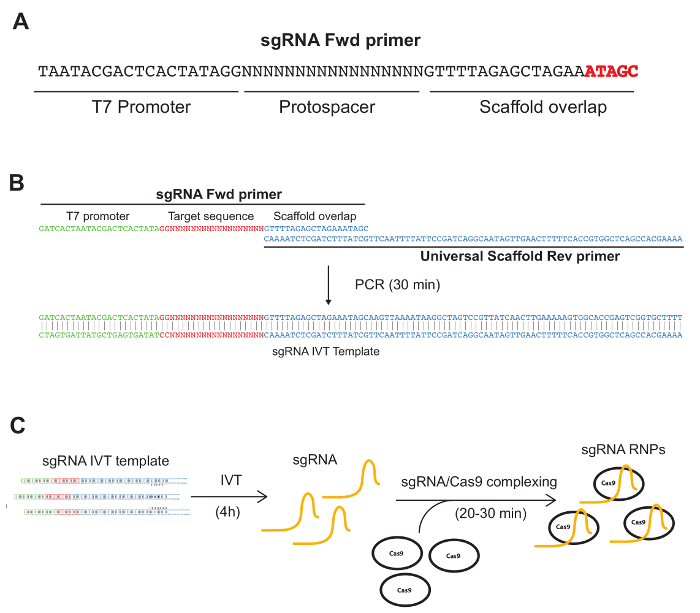
Figure 1: The fast and easy approach to generate sgRNA RNPs. A) Representation of the sgRNA Fwd primer. The sgRNA Fwd primer is a DNA oligonucleotide containing the T7 promoter, the protospacer sequence and an overlap sequence with the sgRNA scaffold. At the 3' end, highlighted in red, is the "ATAGC" sequence that needs to be added to the sgRNA Fwd primer sequence obtained on CRISPRscan. B) Schematic representation of the overlap PCR performed to obtain the IVT template. The overlap between the sgRNA Fwd primer and the Universal Scaffold Rev primer allows for the extension and amplification by PCR. C) Cartoon describing the IVT reaction and the sgRNA RNP pre-complexing. The PCR product is purified and used as a template for the IVT. IVT generates a high amount of sgRNAs that can be used in multiple replicates (see protocol). sgRNA RNPs are generated incubating the sgRNA purified from IVT and the previously purchased Cas9 protein. Please click here to view a larger version of this figure.
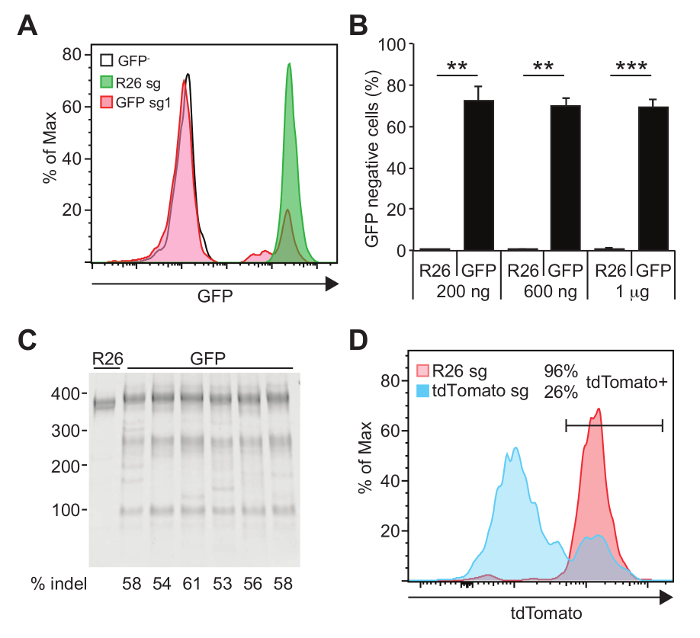
Figure 2: Efficient gene disruption in mouse hematopoietic progenitor cells. A) An sgRNA targeting GFP (GFP sg1) together with Cas9 protein was electroporated into murine c-kit+ HSPCs expressing GFP, and analyzed by flow cytometry 24 hours after electroporation. B) Different amount of GFP sg1 was complexed with 1 µg of Cas9 protein and electroporated. As little as 200 ng of GFP sg1 efficiently ablated GFP expression. C) T7EI assay performed on genomic DNA isolated from cells used in A-B. PCR amplicon spanning the Cas9-sgRNA cleavage site was diluted 1:4 in 1x Buffer 2 and hybridized slowly in a thermal cycler. Hybridized fragments were then digested with 1.25 U of T7 endonuclease I for 10 minutes at 37 °C. Digested fragments were separated by polyacrylamide gel electrophoresis. Band intensities were analyzed using ImageJ software by plotting band intensities of each lane. % cleavage was calculated by the ratio of the intensities of the cleaved bands to uncleaved bands. D) c-kit+ HSPCs isolated from mice expressing tdTomato was electroporated with Cas9 protein complexed with sgRNA against tdTomato. Flow cytometry performed 24 hours after electroporation revealed that approximately 74% of cells deleted tdTomato. R26 = Rosa26. * p <0.05, ** p <0.01, *** p < 0.001. This figure has been adapted from Gundry et al.6 Please click here to view a larger version of this figure.
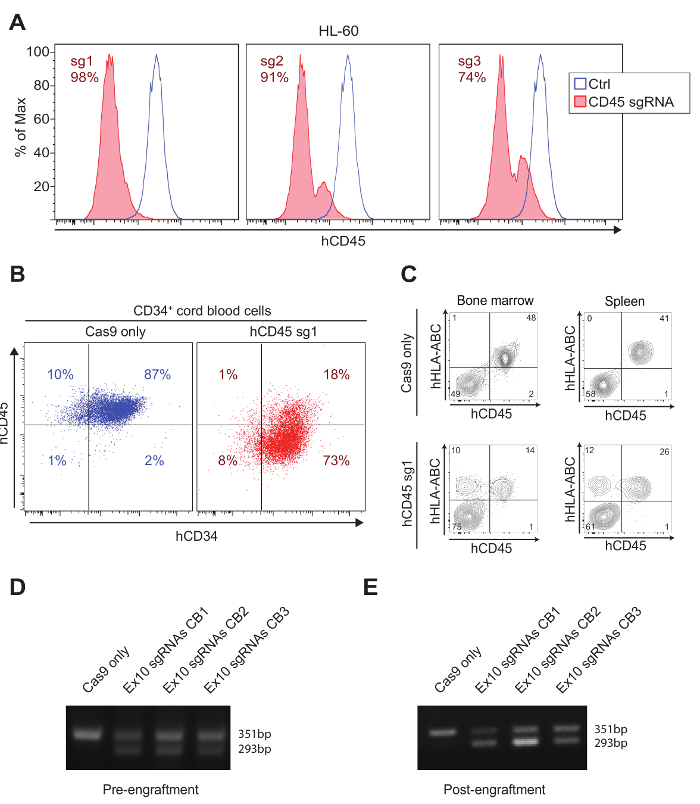
Figure 3: Efficient gene disruption in human hematopoietic cells. A) Three sgRNAs targeting CD45 (CD45 sg1, sg2, and sg3) were designed and tested in the HL60 AML cell line (see protocol for electroporation conditions). Flow cytometry was performed 5 days after electroporation. CD45 sg1 was selected as the most efficient among the three sgRNAs (KO efficiency 98%). B) CD45 KO in primary human cord blood CD34+ HSPCs using CD45 sg1. CD45 loss can be detected in roughly 80% of the cells. Note that CD34 expression is unchanged after editing. C) Edited human HSPCs can be efficiently engrafted into NSG mice. Human nucleated cells display the normal HLA+/CD45+ phenotype in Cas9-only engrafted mice, whereas in mice engrafted with CD45-sg1 treated CD34+ cells, both HLA+/CD45+ and HLA+/CD45- populations are observed indicating engraftment of human CD45 KO cells. D) 2% agarose gel showing a 58 bp deletion generated by 2 sgRNAs (dual guide approach) in exon 10 of DNMT3A in human HSPCs from 3 different cord blood (CB1, CB2, and CB3). PCR was performed 3 days after the electroporation. E) 2% agarose gel demonstrating the persistence of the 58 bp deletion 5 months after transplantation into NSG mice. This figure has been adapted from Gundry et al.6 Please click here to view a larger version of this figure.
| Oligonucleotide | Sequence | Note | ||
| Universal Rev scaffold primer | agcaccgactcggtgccactttttcaagttgataacggactagccttattttaacttgctatttctagctctaaaac | Universal reverse primer for overlap PCR | ||
| hCD45 sgRNA 1 | taatacgactcactataGGTGCTGGTGTTGGGCGCACgttttagagctagaaatagc | sgRNA Fwd primer sequence for overlap PCR | ||
| hCD45 sgRNA 2 | taatacgactcactataGGGAGCAAGTGAGGATCCTCgttttagagctagaaatagc | sgRNA Fwd primer sequence for overlap PCR | ||
| hCD45 sgRNA 3 | taatacgactcactataGGGATGCTTGTTCCCTTCAGgttttagagctagaaatagc | sgRNA Fwd primer sequence for overlap PCR | ||
| hDNMT3A Ex10 sg1 | taatacgactcactataGGACACTGCCAAGGCCGTGGgttttagagctagaaatagc | sgRNA Fwd primer sequence for overlap PCR | ||
| hDNMT3A Ex10 sg2 | taatacgactcactataGGGTGGCCAGCAGCCGCGCGgttttagagctagaaatagc | sgRNA Fwd primer sequence for overlap PCR | ||
| Rosa26 sgRNA | taatacgactcactataGGACACTGCCAAGGCCGTGGgttttagagctagaaatagc | sgRNA Fwd primer sequence for overlap PCR | ||
| GFP sg1 | taatacgactcactataGGGCGAGGAGCTGTTCACCGgttttagagctagaaatagc | sgRNA Fwd primer sequence for overlap PCR | ||
| tdTomato sg1 | taatacgactcactataGGGGTACAGGCGCTCGGTGGgtttaagagctagaaatagc | sgRNA Fwd primer sequence for overlap PCR | ||
Table 1: Complete sequences of sgRNA Fwd primers used in the experiments and Universal Rev primer.
Discussion
The RNP approach described in this detailed protocol enables efficient gene knockout in both mouse and human primary hematopoietic cells as well as in suspension cell lines. Although very high KO efficiencies are often obtained, several critical variables need to be considered. First, proper exon choice is key in guaranteeing that efficient indel incorporation corresponds to gene knockout. Two important factors related to exon choice are conservation across isoforms and exon position within transcripts. Isoform expression patterns are variable across cell types, so if gene KO across cell types is desired, exons that are invariant between cell types should be targeted. Isoform patterns can be verified using q-PCR or RNA-sequencing data. For exon position within transcripts, it is best to target early exons as frameshift mutations in the terminal or penultimate exon may escape nonsense-mediated decay10, producing proteins with novel or unknown functions rather than true nulls.
Determining the indel frequency is a critical step to estimate the KO efficiency and to correctly interpret the biological outcome of the experiment. Endonucleases assays (e.g. surveyor assay) have the advantage of being relatively fast and easy to perform. However, they tend to be inaccurate due to significant background signals and results are often difficult to reproduce. Moreover, they do not provide information on the quality of indels generated (e.g. length of insertions and deletions) in the experiment. Sanger sequencing provides a valuable alternative to endonuclease assays. Platforms such as TIDE11 (https://tide.nki.nl/) help to decompose sanger traces and produce accurate estimates of allelic disruption efficiency, while also providing the frequencies of individual indels. The major drawback is an absolute dependence on high-quality Sanger sequencing traces. High-throughput amplicon sequencing overcomes most of these issues. Amplicon libraries can be prepared starting with very low DNA inputs and the high coverage ensures reliable results. To reduce the cost of amplicon sequencing, we usually spike in amplicon libraries into larger sequencing runs (e.g. RNA-sequencing) using only 1 - 1.5% of the total reads. Finally, to confirm successful knockout, we strongly recommend assessing protein levels by western blots or flow cytometry, when possible.
As previously described, the method presented here is fast and straightforward and represents a new tool to study gene knock out in mouse and human HSPCs. While our protocol provides instructions for gene knockout with a tip-based electroporation system, other systems have been demonstrated to be highly effective12,13.
Two major limitations need to be acknowledged with respect to the RNP approach. First, as described by our group, the viability of HSPCs electroporated with in-vitro transcribed sgRNAs can be significantly compromised by electroporation, especially when conditions are not optimal6. If needed, commercially synthesized sgRNAs (i.e. eliminating in vitro transcription) may overcome this issue. These are becoming less expensive with time and can be purchased from several vendors. In this scenario, in vitro transcription could be used to generate a pool of sgRNA to screen for efficacy, and then the most efficient sgRNA(s) can be selected for synthesis. The second major limitation of the RNP approach is the inability to track successfully transfected cells, as in viral-based approaches. However, the high KO efficiency and rapid editing obtained with Cas9-sgRNA RNPs may outweigh these drawbacks in many experimental scenarios. We recommend using high-throughput amplicon sequencing to exactly determine the disruption efficiency in each experiment. If the knock-out of the gene of interest is expected to confer a proliferative phenotype (i.e. either reduced or increased proliferation compared to wild-type cells), determining the indel frequency at multiple time points allows one to assess whether KO cells undergo enrichment (i.e. indel frequency increases over time) or are outcompeted (i.e. indel frequency decreases over time).
Performing in vivo or in vitro experiments to understand the biological effects of loss of gene function requires the appropriate controls. As previously mentioned, in vitro transcribed sgRNAs may be toxic to cells, especially primary progenitor cells6. Additionally, DNA double-strand breaks caused by Cas9 protein can cause gene independent anti-proliferative response14. Therefore, we often use a number of control sgRNAs in CRISPR experiments and recommend a cell surface marker expressed on your cell type as well as a second target gene that is not expressed.
Short-term culture of human HSPCs in the presence of cytokines increases the gene disruption efficiency6 and is necessary to achieve high-efficiency KO. We have found 36 - 48 hours to be the ideal period of culture prior to electroporation6. Following electroporation, the cells can be further cultured keeping in mind that the longer the culture the higher the risk of losing multilineage engraftment capacity. Therefore, we usually perform transplants 6 hours after electroporation and never later than 24 hours after electroporation.
CRISPR/Cas9 has dramatically improved the ability of scientists to successfully edit the genome of mammalian cells. Making gene disruption more feasible in primary hematopoietic progenitor cells is predicted to rapidly enhance the scientific knowledge in the field of HSPCs and hematologic diseases. Importantly, the protocol described here makes it also possible to simultaneously generate multiple knockouts with high efficiency, allowing for the modeling of complex genetic landscapes, often seen in leukemic diseases.
Although the protocols described herein are focused on gene disruption, they may be easily adapted for gene knock-in experiments. This can be accomplished through the co-delivery of single-stranded oligonucleotide templates for homology-directed repair6,13 (HDR) or through the transduction of cells post-electroporation with AAV6 vectors containing the homology template12. The ability to repair or introduce specific mutations in HSPCs will facilitate new therapeutic strategies for gene therapy and the expanded study of cancer driver mutations in AML and other hematologic diseases. While HDR in human HSPCs has been successfull6,12,13, mouse HSPCs have been difficult to edit using this strategy6. Optimization of HDR protocols in human and particularly in mouse HSPCs will enable more specific editing and the development of tools to track edited cells using endogenous tagging.
Finally, it is also envisioned that disruption of mutant gain-of-function alleles could represent a potential therapeutic approach for congenital and acquired hematopoietic disorders. In this scenario, a DNA-free approach is advised in order to avoid possible integrations that could promote transformation. Moreover, the "hit and run" approach reduces the possibility of undesired off-target effects. More effort is needed in order to develop specific delivery systems that would open new avenues for the treatment of malignant and non-malignant hematologic diseases.
Disclosures
No conflict of interest to disclose
Acknowledgements
This work was supported by the Cancer Prevention and Research Institute of Texas (RP160283, RP140001, and R1201), the Gabrielle’s Angel Foundation for Cancer Research, the Edward P. Evans Foundation, and the NIH (DK092883, CA183252, CA125123, P50CA126752, CA193235, and DK107413). M.C.G. is supported by Baylor Research Advocates for Student Scientists. Flow cytometry was partially supported by the NIH (National Center for Research Resources grant S10RR024574, National Institute of Allergy and Infectious Diseases AI036211, and National Cancer Institute P30CA125123) for the Baylor College of Medicine Cytometry and Cell Sorting Core.
Materials
| Name | Company | Catalog Number | Comments |
|---|---|---|---|
| Tissue culture plates according to cell numbers | |||
| 1.5 ml Eppendorf microtubes | Sigma | Z606340-1000EA | |
| 50ml Falcon tubes | Corning | 352070 | |
| Nuclease Free Water - DEPC treated | ThermoFisher Scientific | AM9915G | |
| KAPA HiFi HotStart ReadyMix (2X) | KAPA Biosystems | KK2600 | |
| MinElute PCR purification Kit | Qiagen | 28004 | |
| RNAse Zap RNAse Decontamination Solution | ThermoFisher Scientific | AM9780 | |
| RNA Clean and Concentrator-25 | Zymo | R1017 | |
| HiScribe T7 High Yield RNA Synthesis Kit | New England Biolabs | E2040S | |
| Alt-R S.p. Cas9 Nuclease 3NLS, 100 µg | IDT | 1074181 | |
| 40 mm Cell Strainers | VWR | 352340 | |
| Dulbecco's Phosphate Buffered Saline (PBS) | GenDEPOT | CA008-050 | |
| Fetal Bovine Serum (FBS), Regular | Corning | 35010CV | |
| AutoMACS Pro Separator or MACS manual Cell Separation columns | Miltenyi | ||
| Neon Transfection System Device | ThermoFisher Scientific | ||
| Neon Transfection System 10mL kit | ThermoFisher Scientific | MPK1025 | For larger numbers of cells (see protocol) Neon Transfection System 100 mL kit (# MPK10025) can be used |
| Name | Company | Catalog Number | Comments |
| UltraPure 0.5M EDTA, pH 8.0 | ThermoFisher Scientific | 15575020 | For human experiments only |
| Lymphoprep | Stem Cell Technologies | 7851 | For human experiments only |
| CD34 MicroBead Kit UltraPure human | Miltenyi Biotec | 130-100-453 | For human experiments only |
| Stem Span SFEM II | Stem Cell Technologies | 9605 | For human experiments only |
| Recombinant Human SCF | Miltenyi Biotec | 130-096-695 | For human experiments only |
| Recombinant Human TPO | Miltenyi Biotec | 130-094-013 | For human experiments only |
| Recombinant Human FLT3L | Miltenyi Biotec | 130-096-479 | For human experiments only |
| Name | Company | Catalog Number | Comments |
| Mouse dissection tools | For mouse experiments only | ||
| Mortar and Pestle | For mouse experiments only | ||
| Hank's Balanced Salt Solution (HBSS) | Gibco | 14170112 | For mouse experiments only |
| Biotin-conjugated anti c-kit antibody | eBioscience | 13-1171-82 | For mouse experiments only |
| Anti-Biotin MicroBeads | Miltenyi Biotec | 130-090-485 | For mouse experiments only |
| X VIVO-15, with L-Glutamine, Genatmycin and Phenol Red | Lonza | 04-418Q | For mouse experiments only |
| Mouse IL-6 | Peprotech | 216-16 | For mouse experiments only |
| Mouse TPO | Peprotech | 315-14 | For mouse experiments only |
| Mouse IL-3 | Peprotech | 213-13 | For mouse experiments only |
| Mouse SCF | Peprotech | 250-03 | For mouse experiments only |
References
- Jinek, M., et al. A programmable dual-RNA-guided DNA endonuclease in adaptive bacterial immunity. Science. 337, 816-821 (2012).
- Hsu, P. D., Lander, E. S., Zhang, F. Development and applications of CRISPR-Cas9 for genome engineering. Cell. 157, 1262-1278 (2014).
- Sternberg, S. H., Doudna, J. A. Expanding the Biologist's Toolkit with CRISPR-Cas9. Mol Cell. 58, 568-574 (2015).
- Heckl, D., et al. Generation of mouse models of myeloid malignancy with combinatorial genetic lesions using CRISPR-Cas9 genome editing. Nat Biotechnol. 32, 941-946 (2014).
- Mandal, P. K., et al. Efficient ablation of genes in human hematopoietic stem and effector cells using CRISPR/Cas9. Cell stem cell. 15, 643-652 (2014).
- Gundry, M. C., et al. Highly Efficient Genome Editing of Murine and Human Hematopoietic Progenitor Cells by CRISPR/Cas9. Cell Rep. 17, 1453-1461 (2016).
- Kim, S., Kim, D., Cho, S. W., Kim, J., Kim, J. S. Highly efficient RNA-guided genome editing in human cells via delivery of purified Cas9 ribonucleoproteins. Genome Res. 24, 1012-1019 (2014).
- Moreno-Mateos, M. A., et al. CRISPRscan: designing highly efficient sgRNAs for CRISPR-Cas9 targeting in vivo. Nature methods. 12, 982-988 (2015).
- Strober, W. Trypan Blue Exclusion Test of Cell Viability. Current protocols in immunology. 111, A3 B 1-3 (2015).
- Lykke-Andersen, S., Jensen, T. H. Nonsense-mediated mRNA decay: an intricate machinery that shapes transcriptomes. Nat Rev Mol Cell Biol. 16, 665-677 (2015).
- Brinkman, E. K., Chen, T., Amendola, M., van Steensel, B. Easy quantitative assessment of genome editing by sequence trace decomposition. Nucleic Acids Res. 42, e168(2014).
- Dever, D. P., et al. CRISPR/Cas9 beta-globin gene targeting in human haematopoietic stem cells. Nature. 539, 384-389 (2016).
- DeWitt, M. A., et al. Selection-free genome editing of the sickle mutation in human adult hematopoietic stem/progenitor cells. Sci Transl Med. 8, 360ra134(2016).
- Aguirre, A. J., et al. Genomic Copy Number Dictates a Gene-Independent Cell Response to CRISPR/Cas9 Targeting. Cancer Discov. 6, 914-929 (2016).
Reprints and Permissions
