
1. Adjusting biomass moisture content
- See the Table of Materials outlining all major equipment and materials necessary to perform bench or lab scale AFEX pretreatment using the custom-built tubular AFEX reactor (Figure 2).
- Determine the total moisture content of biomass using a moisture analyzer, or an oven set at 105 °C for 8 h. For the oven method, transfer the samples to a heat-resistant desiccator to cool to prevent water adsorption prior to drying. Perform the process in duplicate or triplicate and calculate the average moisture content.
- For a given dry biomass loading in the reactor (here, it holds 25 g), use the moisture content determined in step 1.2, to calculate how much wet biomass needs to be loaded.
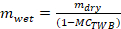 [1]
[1]
Where mwet = total mass of biomass (wet weight basis); mdry = mass of biomass on a dry weight basis; MCTWB = biomass moisture content on a total weight basis - Weigh out this amount of biomass (mwet) in a plastic container.
- Calculate how much water needs to be mixed with the wet biomass to achieve the desired moisture content. For corn stover, this is typically 0.6 g of H2O per g of dry biomass.
 [2]
[2]
Where mwater = mass of water added to the reactor (in addition to the water in the biomass); xwater = AFEX water loading (g:g dry biomass) - Using a spray bottle, slowly add this amount of water (mwater) to the biomass that had been previously weighed out and mix well by hand.
2. Load and assemble the reactor
- Assemble the reactor body by placing a cap and Teflon gasket on the bottom of the reactor tube. Bolt a clamp in place, tightening both nuts evenly using a rachet.
- Transfer the wet biomass to the assembled reactor base and place a plug of glass wool at the top of the biomass.
- Place a Teflon gasket on the top of the reactor. Ensure the region is free of biomass and glass wool, which could prevent an effective seal, and place the reactor head on top, maneuvering the thermocouple through the glass wool and biomass.
- Bolt the clamp to the top of the reactor using a ratchet evenly on both sides.
- Weigh the reactor (mreactor) and record the weight.
3. Set up the reactor system and fill the ammonia transfer cylinder
- Confirm that all equipment is plugged in and operable (temperature controller, temperature monitor, syringe pump, timers).
- Set the timers to desired residence time for each reactor and sample to be run.
- Turn on and, if using a programmable syringe pump, set up the ammonia delivery method on the syringe pump.
Step 1: Withdrawal.
Step 2: Wait for 15 seconds (to allow time to open and close valves).
Step 3: Infuse (to transfer the ammonia into the reactor).- Save as the AFEX method to allow for easy reuse.
- Verify that all valves into and out of the small ammonia cylinder are closed.
- If the cylinder has been used previously and contains residual ammonia/nitrogen, slowly open valve A on the top of the small ammonia cylinder to bleed off any nitrogen and close the valve once liquid ammonia begins to sputter out.
- To fill the small ammonia cylinder, open the large anhydrous ammonia cylinder and all valves on the ammonia line. Slowly open valve (B) near the top of the small ammonia cylinder until the pressure stabilizes. Wait for 5 min before continuing to the next step. Approximately 120 mL of ammonia gets charged from the main cylinder to the transfer cylinder during this time.
- Close all valves between the ammonia tank and the small ammonia cylinder, working from the left to right, beginning from the small cylinder (valve B) and finishing at the main valve on top of the tank.
- Set the nitrogen regulator to 350 psi. Open the valve on the nitrogen cylinder and the valve on the attached regulator. Open valve C on the small ammonia cylinder to slowly add nitrogen, overpressuring the system. Adjust the pressure of the small cylinder to 350 psi, as needed, by adjusting the set point on the regulator. Keep nitrogen lines open while dispensing ammonia.
4. Preheat the reactor (for reaction temperatures of >100 °C)
- Plug in the temperature monitor to the thermocouple and the heating tape to the temperature controller.
- Manually adjust the temperature controller to bring the reactor up to 60 °C.
5. Load the reactor with ammonia
- Turn on the syringe pump if not already on.
- Calculate the volume of ammonia required based on the desired ammonia loading (g:g dry biomass) and a previously determined ammonia calibration.
 [3]
[3]
NOTE: Because the ammonia pump loads on a volume basis, when first using it, calibrate to convert from the required mass to volume. Follow the same procedure used for AFEX, but end the run (vent the reactor) immediately after loading the ammonia and weighing the reactor. Follow the same procedure for unloading the reactor. - Set up the method to load the correct amount of ammonia:
- Select the AFEX method from section 3.3.
- Press Step Definition | Step: 1 | Set Target Volume or Time.
- Key in the volume required in mL using the number pad and press the green checkmark.
- If more than 85 mL is required, enter the target volume as half of the amount specified in the spreadsheet and fill the reactor twice using the same syringe volume.
- Repeat steps 5.3.2 through 5.3.4 for “Step: 3”.
- Press the back button.
- Open valve (D) on the bottom of the small ammonia cylinder towards the exhaust, and then close it once any residual ammonia has exited.
- Open valve (E) on the end of the syringe pump towards the front of the fume hood, and then open valve (F) to release any residual ammonia. Close valves (E) and (F).
- Disconnect the reactor from the temperature monitor and the temperature controller. Attach the reactor to the quick connect.
- Open valve (D) towards the small ammonia cylinder and open valve (E) towards the small ammonia cylinder.
- Press the green arrow on the pump to start the sequence and draw ammonia into the syringe.
- When the syringe stops automatically for the wait period, turn the syringe valve (E) towards the reactor, and the reactor inlet valve so it is pointing towards the quick connect stem.
After the delay, the syringe will begin infusing, stopping automatically at the set point. - If more than 85 mL of ammonia is required, repeat steps 5.7 through 5.9.
- Close the reactor valve and valve (D). Open valve (F) to release residual ammonia from the syringe, and then close valve (F) and close valve (E).
- Open valve (D) towards the exhaust, and then close it once the residual ammonia has left.
- Wearing cryogenic gloves, remove the reactor from the quick connect. Be careful of potential ammonia spray. Use the elephant trunk vent line to vent the released ammonia, if necessary.
- Start the timer for the appropriate reactor.
- Weigh the reactor unit to verify that the appropriate weight of ammonia was added based on the spreadsheet calculations.
6. Begin heating and monitor the reaction
- Plug in the temperature monitor to the thermocouple and the heating tape to the temperature controller.
- Record the initial temperature and pressure of the reactor following ammonia addition (the start of the residence time).
- Manually adjust the temperature controller to bring the reactor up to the set temperature. The goal is to reach the set point in <5 min.
- Record the pressure and temperature of the reactor every 3 min until the end of the residence time.
- At the end of the residence time, disconnect the reactor from the temperature controller and thermocouple, remove the reactor from the stand, and slowly open the ball release valve inside the fume hood.
NOTE: Always wear a face shield during this step.
7. Shut down the system
- After allowing the reactor to cool for a few minutes, use a ratchet wrench to open the clamps on the reactor.
- Unload the biomass and glass wool from the reactor inside a fume hood. In order to prevent airborne contamination of the biomass as residual ammonia evaporates, it is best to dry inside an enclosed drying box inside a ventilated space.
- Clean the reactor with distilled water until the water runs clear and allow reactors to dry.
- If still open, close all valves on and connecting to the ammonia cylinder.
- Close all valves on nitrogen line.
- Turn off the temperature controller, temperature monitor, balance, syringe pump, and timer.
CAUTION: If planning to run more reactions, it is not necessary to vent the small ammonia cylinder. However, if there is no plan to run more experiments, for safety it is best to vent the small cylinder into the hood at the end of the experiment. When doing this, it is important to leave the valves open as the release of ammonia can cause ice formation that may block some lines. As the lines thaw, additional ammonia can be released. Always make sure to have the ventilation functioning while allowing the system to vent. Any ammonia-treated biomass, even if it is not intended to be used, must be dried in the fume hood overnight to allow residual ammonia to evaporate. It cannot be immediately disposed of in the garbage.
Following AFEX pretreatment, the biomass is darker in color, but otherwise visually unchanged (Figure 3). AFEX process generates a highly digestible material at a variety of scales besides the one outlined in this protocol. Here, we pretreated the same corn stover sample in our small 200 mL, packed-bed, bench-scale system; a larger 5 gallon, stirred Parr reactor; and MBI’s pilot reactor. The conditions used for the two smaller reactors (i.e., 200 mL and 5 gallon scale) were 1.0 g NH3:g dry biomass, 0.6 g H2O:g dry biomass, for 30 min at 100 ± 5 °C. Pilot-scale AFEX4 was carried out on the same material at 0.6 g NH3:g dry biomass, 0.6 g H2O:g dry biomass, for 30 min at 100 ± 5 °C. Details regarding the protocols used for conducting AFEX pretreatment at larger scales are provided in the supporting information (see Supplemental File 1). The following ‘Quality Control Criteria’ have been established based on target temperature for AFEX pretreatment. If after reaching the set point, the reactor temperature goes outside ± 10 °C from the set point, the experiment must be aborted. If the target temperature (within 5 °C) is not reached within 5 min after ammonia pumping, abort the experiment. In addition, pretreatment efficacy for the AFEX process can be tested using cellulolytic enzyme cocktails to hydrolyze the accessible polysaccharides into fermentable sugars. Samples were enzymatically hydrolyzed for 72 hours at 6% glucan loading, pH 5.0, 50 °C, and 250 rpm in a shaking incubator. A commercial cocktail of enzymes consisting of 60% cellulase (CTec3):40% hemicellulase (HTec3 or NS22246) on a fixed total protein loading basis loaded at 15 mg enzyme/g glucan was employed for all saccharification assays. The results (Figure 4) demonstrate that AFEX pretreatment significantly increases the yield of fermentable sugars in all cases. Furthermore, the cellulose/xylan hydrolysis yields for biomass pretreated using the lab-scale AFEX process is comparable to the larger 5-gallon Parr reactor and MBI’s pilot-scale packed bed AFEX process.
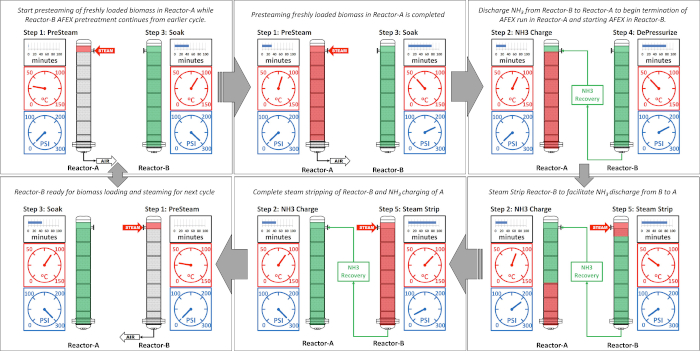
Figure 1. Schematic outline of steps involved in the pilot scale operation of MBI’s AFEX reactor for pretreating lignocellulosic biomass fully-integrated with efficient ammonia recycle. Please click here to view a larger version of this figure.
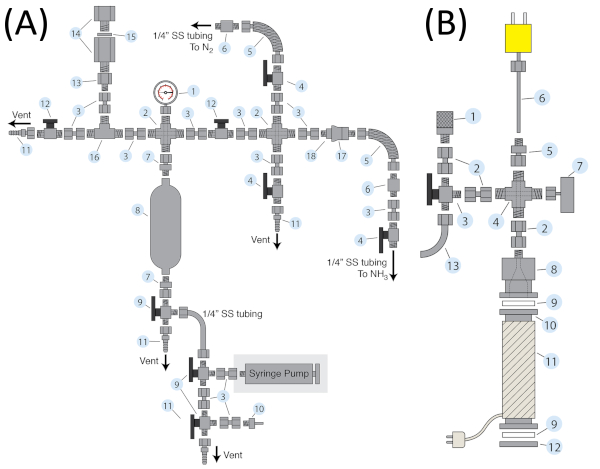
Figure 2. Schematics of lab-scale of A) ammonia delivery system and B) small 200 mL AFEX pretreatment reactor utilized to perform AFEX process outlined in the video protocol. Please click here to view a larger version of this figure.
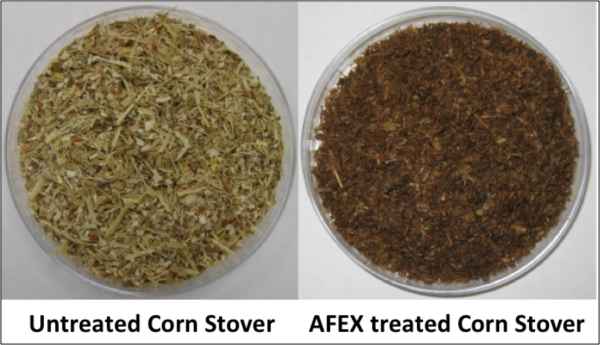
Figure 3. AFEX pretreated biomass has a very similar gross morphology compared to untreated biomass, apart from being slightly darker in color. Please click here to view a larger version of this figure.
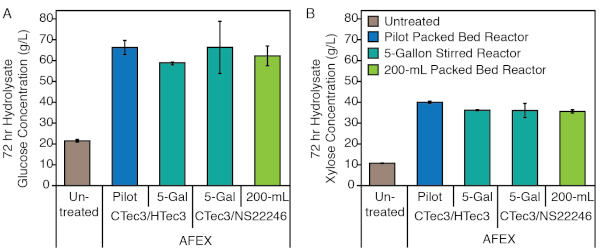
Figure 4. Glucose and xylose yields obtained after 72 h enzymatic hydrolysis of 6% glucan loading AFEX treated corn stover is shown here. All saccharification assays were carried out in duplicate with mean values (m) reported here. Standard deviations (1s) are reported here as error bars. Please click here to view a larger version of this figure.
Supplemental File 1: Additional protocols Please click here to download this file.
Supplemental Table 1: Ammonia delivery system and strut frame Please click here to download this file.
