In this video, we demonstrate the isolation of mouse blastocysts and the derivation of trophoblast stem cells from blastocysts. We also describe conditions for maintenance of the stem cell property as well as induction of differentiation in culture.
A subscription to JoVE is required to view this content. Sign in or start your free trial.
Method Article
Derivation of Mouse Trophoblast Stem Cells from Blastocysts
In This Article
Summary
Abstract
Specification of the trophectoderm is one of the earliest differentiation events of mammalian development. The trophoblast lineage derived from the trophectoderm mediates implantation and generates the fetal part of the placenta. As a result, the development of this lineage is essential for embryo survival. Derivation of trophoblast stem (TS) cells from mouse blastocysts was first described by Tanaka et al. 1998. The ability of TS cells to preserve the trophoblast specific property and their expression of stage- and cell type-specific markers after proper stimulation provides a valuable model system to investigate trophoblast lineage development whereby recapitulating early placentation events. Furthermore, trophoblast cells are one of the few somatic cell types undergoing natural genome amplification. Although the molecular pathways underlying trophoblast polyploidization have begun to unravel, the physiological role and advantage of trophoblast genome amplification remains largely elusive. The development of diploid stem cells into polyploid trophoblast cells in culture makes this ex vivo system an excellent tool for elucidating the regulatory mechanism of genome replication and instability in health and disease. Here we describe a protocol based on previous reports with modification published in Chiu et al. 2008.
Protocol
In this protocol, we describe the preparation of mouse blastocysts and the establishment of TS cell lines. General mouse manipulations prior to the collection of blastocysts, including the set up for natural mating and the induction of super ovulation, basically follow the standard protocol illustrated by Nagy et al. 2003 (pp146-150).
Derivation and maintenance of TS cells
- Setup breeding cross between mice of interest.
- Prepare mouse embryonic fibroblasts (MEFs) as feeder cells. Two days before the collection of blastocysts, MEFs (2 x 10⁶ cells) are plated in 100 mm dishes. Next day, these cells are treated with 10 ml of TS medium containing mitomycin C (20 mg/ml) for a 2 hour-incubation at 37°C, 5% CO2. This is followed by washing cells twice with PBS. The mitomycin C treated cells are then seeded in 12-well plates (1 x 10⁵ cells/well).
- On the day of blastocyst collection (3.5 dpc, referred to as day one), MEF culture medium is replaced by TS medium plus 1x FGF4/Heparin (0.5 ml/well).
- Preparation for collection of the uterus: euthanize the mouse and locate the uterus (Figure 1A).
- Remove the uterus by grasping it with forceps at the cervix (located behind the bladder) and cut across the junction of uterus and cervix (Figure 1B). Pull the uterus, trim the membrane and fat tissues away and cut the uterus below the junction with the oviduct (Figure 1C). Place the uteri (Figure 1D) in a small volume (0.2 ml) of TS medium in a 60 mm plate.
- Flush each uterus horn with 1 ml of TS medium using a 1-ml syringe with a 26-gauge needle. Insert the needle into the base of uterus and flush slowly into a new 60 mm plate with 1 ml TS medium. The uterus should be inflated and extended fully during flushing.
- Collect and transfer the blastocysts carefully into a clean 12 well plate containing TS medium using a mouth-controlled pipette. Wash blastocysts three times by serial transfer through TS medium in 12-well plates. Place one blastocyst per well (Figure 2A) in a 12-well plate containing the mitomycin C-treated MEF feeders and culture at 37°C, 5% CO2.
- The blastocysts will hatch from zona pellucida and attach to the wells in 24 to 36 hours. A small outgrowth will be readily observed on day 3. Feed the cultures with 500 μl fresh TS medium plus 1x FGF4/Heparin.
- On day 4 or 5, the blastocyst outgrowth should be ready for disaggregation depending on its size. The ideal size for TS cell disaggregation is illustrated in Figure 3B. Wash the cultures once with 0.5 ml PBS. Add 100 ml 0.25% trypsin/EDTA and incubate for 5 minutes at 37°C, 5% CO2. Break the outgrowth into small clumps by pipetting up and down vigorously with a P100 pipetteman. Stop the trypsinization by adding TS-70CM-1.5F4H (30% TS medium, 70% MEF-CM plus 1.5x FGF4/Heparin) into the well. Change medium 8 hours after disaggregation and continue to feed cells every 2 days.
- Between days 6 and 10 (highly variable) TS cell colonies can be observed. They have flat, epithelial sheet like morphology with a clear colony boundary (Figure 2C). Continue to feed the cultures every 2 days
- When TS cells reach 50% confluency (usually between days 15 and 20), wash once with PBS and add 100 ml 0.25% trypsin/EDTA. Pipette up and down during trypsinization to ensure a near single-cell suspension. Stop the trypsinization by adding TS-70CM-1.5F4H and transfer to new 6-well or 60mm plates containing the mitomycin C-treated MEF feeders (2.5 x 10⁵ cells/6-well or 5 x10⁵ cells/60mm plate).
- Change medium 8 hours after passage and continue to feed the cultures every 2 days.
- After one or two more passages (3-5 days between passages) on the MEF feeders, TS cells may be cultured without them. Because MEFs attach to the culture plate much faster than TS cells after trypsinization, such difference in the adherent rate can be utilized to separate TS cells from the MEF feeders. After passing the cultured cells, incubate them at 37°C, 5% CO2 for 30 min. Most MEFs will attach to the plate and the TS population remains in suspension. Transfer the supernatant to a new plate. Repeat this process for several passages to obtain a pure TS population.
- Maintain TS cells in TS-70CM-1.5F4H and pass them every 4 days (1:10 to 1:20 split) or when the culture reaches 70% confluency. Passing the cells with high density (higher than 1:5 split) or culturing them when overly confluent may cause their differentiation.
- The identity of TS cells can be confirmed by immunostaining of a cell marker, Cdx2 (Figure 3).
Freezing TS cells
- Prepare 2x freezing medium (50% FBS, 30% TS medium and 20% DMSO).
- Collect TS cells by trypsinization, followed by centrifugation at 450g for 6 min. Resuspend them in TS medium with equal volume of 2x freezing medium.
- Freeze the cells slowly using an isopropyl alcohol chamber at -70°C and transfer to liquid nitrogen after 24-48 hours.
- A 60 mm plate (70% confluent) is usually kept in 2 vials.
Thawing TS cells
- Quickly thaw the vial in 37°C, collect them in 10 ml TS media by centrifugation (450g, 6 min), and resuspend in 30% TS media, 70CM-1.5F4H.
- One vial of cells is seeded in a 60 mm plate.
TS cell differentiation into TGC
Differentiation of TS cells into trophoblast giant cells (TGCs) can be induced by the withdrawal of MEF-CM, FGF4 and heparin. The TGC phenotype (large nuclei) can be detected four days after the induction (Tanaka et al., 1998 and Chiu et al. 2008). Immunostaining of p450scc detect the expression of this TGC marker in the differentiated culture (Figure 4A). Flow cytometric analysis of PI (propidium iodide) stained cells further shows the presence of differentiated cells containing higher DNA content (Figure 4B). These results suggest that TS cells undergo endoreduplication to become polyploid TGCs.
Representative Results
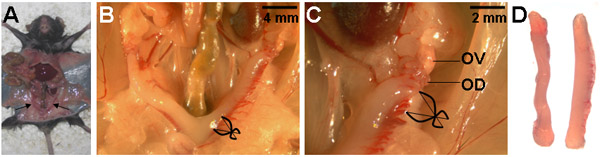
Figure 1. Dissection of mouse uteri. (A) Location of the uteri is indicated by arrows. (B) Cut across the junction of uterus and cervix as shown. (C) Cut the uterus just below the oviduct (OD) underneath the ovary (OV). (D) Image of the uteri.
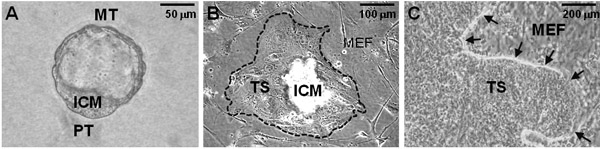
Figure 2. Representative pictures illustrate mouse blastocyst, blastocyst outgrowth and trophoblast colony. (A) A mouse blastocyst collected at E3.5 is shown. ICM, inner cell mass; MT, mural trophectoderm; PT, polar trophectoderm. (B) A trophoblast outgrowth on MEF feeders is shown. TS, trophoblast stem cell. (C) A trophoblast stem cell colony shows a clear edge on MEF feeders. Arrows indicate the cell boundary.
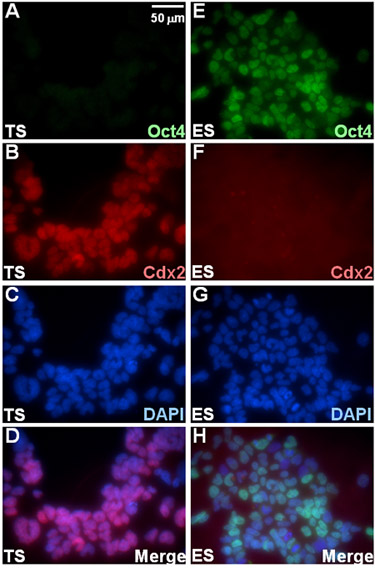
Figure 3. Identification of TS cells by immunostaining analysis. TS (A-D) and ES (control, E-H) cells are subject to marker identification. Cells are immunostained with antibodies to recognize Oct4 (A, E) or Cdx2 (B, F), and counterstained by DAPI (C, G) presented in merged images (D, H). Scale bar, 50 μm.
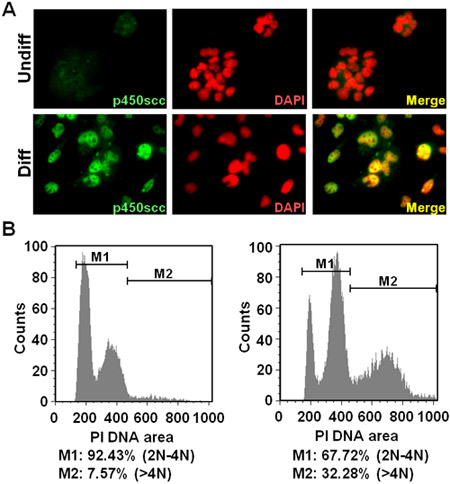
Figure 4. Differentiation of TS cells in vitro. (A) Undifferentiated (Undiff) or differentiated (Diff) cells in culture were examined for the expression of a TGC marker, p450scc (green), counterstained with DAPI (red). (B) Flow cytometric analysis of the differentiated cells, stained with PI, measures the DNA contents (M1, two to four copies; M2, more than four copies). The M2 population represents the polyploid trophoblast cells.
Access restricted. Please log in or start a trial to view this content.
Discussion
In this video, we demonstrate the process to collect E3.5 blastocysts from uteri and experimental procedures to establish TS cell lines. We also describe the condition to maintain the stemness of TS cells and to induce their differentiation into differentiated cells. Two critical steps to obtain pure TS cell lines are the timing for outgrowth disaggregation (step 9) and processing the first passage (step 11). It has been reported that primitive endoderm-derived cells can arise in the culture after extensive blastocyst ou...
Access restricted. Please log in or start a trial to view this content.
Disclosures
No conflicts of interest declared.
Acknowledgements
The authors thank Janet Rossant for the original protocol. This study was supported by National Institute of Health grant CA106308 to WH.
Access restricted. Please log in or start a trial to view this content.
Materials
| Name | Company | Catalog Number | Comments |
|---|---|---|---|
| Reagents | |||
| TS medium: RPMI-1640, 20% FBS, 1 mM sodium pyruvate, 100 mM beta-mercapt–thanol and 100 mg/ml penicillin-streptomycin. | |||
| Mitomycin C: Dissolve 2 mg mitomycin C (Sigma M-0503) in 2 ml PBS and add this 2 ml mixture into 200 ml TS medium (10 ng/ml). Make 20 aliquots (10 ml) and store at -20°C until use. Add one aliquot per 100 mm plate. | |||
| Mouse embryonic fibroblast-condition medium (MEF-CM): Plate MEFs in 100 mm plates (1 x 10⁶/plate). Next day, add 10 ml TS medium per dish and continue to culture for 48 hours. Collect the culture medium, filter them (0.45 mm) and store at -20°C in 35 ml aliquots. Thaw each aliquot when needed which can be stored at 4°C. The MEFs can be used to prepare for two more batches of CM before they become confluent. | |||
| PBS/BSA: Dissolve BSA, fraction V (Sigma A3311, 0.1% (w/v)) in PBS (10 ml), filter through a 0.45 mm syringe filter and make 1 ml aliquots in 1.5 ml tubes. Store at -70°C and thaw one tube when needed to prepare FGF4. | |||
| FGF4 (1000x): Resuspend lyophilized FGF4 (Sigma F8424, 25 mg) with 1 ml of the PBS/BSA solution. Mix well and make 10 aliquots (100 ml) into 1.5 ml tubes and store at -70°C. Thaw each tube when needed and store the remaining at 4°C, do not re-freeze. Dilute 1000 times in TS medium to obtain 1x FGF4 (25 ng/ml). | |||
| Heparin (1000x): Resuspend heparin (Sigma H3149, 10,000 units) in PBS to a final concentration of 1 mg/ml (1000x). Make 100 ml aliquots into 1.5 ml tubes and store at -70°C. Thaw aliquots when needed and store the remaining at 4°C, do not re-freeze. Dilute 1000 time in TS medium to obtain 1x heparin (1 ng/ml). |
References
- Chiu, S. Y., Asai, N., Costantini, F. &, Hsu, W. SUMO-specific protease 2 is essential for modulating p53-Mdm2 in development of trophoblast stem cell niches and lineages. PLoS Biol. 6, E310-E310 (2008).
- Kunath, T., Arnaud, D., Uy, D. G., Okamoto, I., Chureau, C., Yamanaka, Y., Heard, E., Gardner, R. L., Avner, P., Rossant, J. Imprinted X-inactivation in extra-embryonic endoderm cell lines from mouse blastocysts. Development. 132, 1649-1661 (2005).
- Nagy, A., Gertsenstein, M., Vintersten, K., Behringer, R. Manipulating the Mouse Embryo: The Laboratory Manual. , Cold Spring Harbor Laboratory Press. Cold Spring Harbor, NY. (2003).
- Tanaka, S., Kunath, T., Hadjantonakis, A. K., Nagy, A., Rossant, J. Promotion of trophoblast stem cell proliferation by FGF4. Science. 282, 2072-2075 (1998).
Access restricted. Please log in or start a trial to view this content.
Reprints and Permissions
