The presented protocol integrates various evaluation methods and demonstrates a method to evaluate the keyboard design on smartphones. Pairs matched by English characters are proposed as the input material, and the transition time between two keys is used as the dependent variable.
A subscription to JoVE is required to view this content. Sign in or start your free trial.
Method Article
An Assessment Method and Toolkit to Evaluate Keyboard Design on Smartphones
In This Article
Erratum Notice
Important: There has been an erratum issued for this article. View Erratum Notice
Summary
Abstract
Keyboard input has played an essential role in human-computer interaction with a vast user base, and the keyboard design has always been one of the fundamental objects of studies on smart devices. With the development of screen technology, more precise data and indicators could be collected by smartphones to in-depth evaluate the keyboard design. The enlargement of the phone screen has led to unsatisfactory input experience and finger pain, especially for one-handed input. The input efficiency and comfort have attracted the attention of researchers and designers, and the curved keyboard with size-adjustable buttons, which roughly accorded with the physiological structure of thumbs, was proposed to optimize the one-handed usage on large-screen smartphones. However, its real effects remained ambiguous. Therefore, this protocol demonstrated a general and summarized method to evaluate the effect of curved QWERTY keyboard design on a 5-inch smartphone through a self-developed software with detailed variables, including objective behavioral data, subjective feedback, and the coordinate data of each touchpoint. There is sufficient existing literature on evaluating virtual keyboards; however, only a few of them systematically summarized and took reflection on the evaluation methods and processes. Therefore, this protocol fills in the gap and presents a process and method of the systematic evaluation of keyboard design with available codes for analysis and visualization. It needs no additional or expensive equipment and is easy to conduct and operate. In addition, the protocol also helps to get potential reasons for the disadvantages of the design and enlightens the optimization of designs. In conclusion, this protocol with the open-source resources could not only be an in-class demonstrative experiment to inspire the novice to start their studies but also contributes to improving the user experience and the revenue of input method editor companies.
Introduction
Keyboard input is the mainstream method of the human-smartphone interaction1,2, and with the penetration of smartphones, keyboard input gets billions of users. In 2019, the global smartphone penetration rate had reached 41.5%3, while the United States, with the highest penetration, had come up to 79.1%4. Up to the first quarter of 2020, the Sogou mobile keyboard had about 480 million daily active users5. Up to May 6, 2020, the Google Gboard had been downloaded more than 1 billion times6.
....
Access restricted. Please log in or start a trial to view this content.
Protocol
The study was conducted in accordance with the ethical principle and was approved by the Ethics Committee of Tsinghua University. Figure 1 shows the process of evaluating the keyboard design of smartphones.
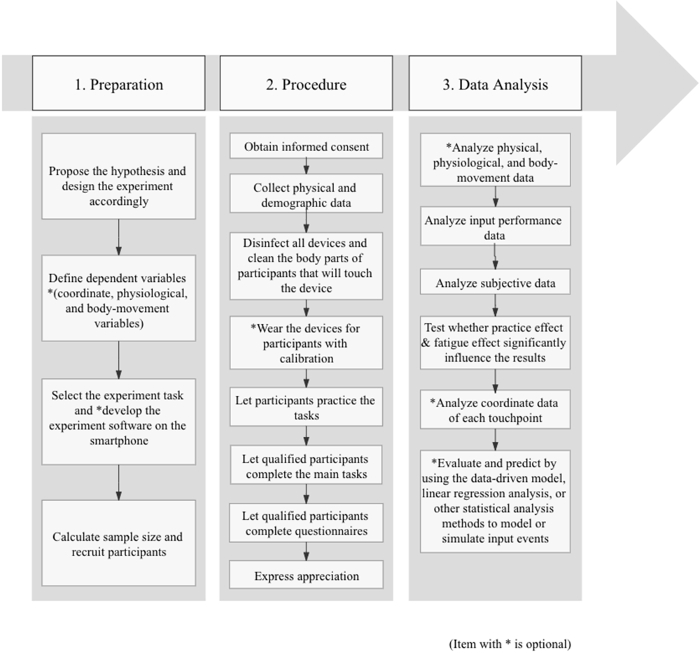
Figure 1: General process of conducting a keyboard experiment and evaluating the keyboard design.
Access restricted. Please log in or start a trial to view this content.
Results
The representative study is mainly following the mentioned protocol. The study adopts a 2 (Keyboard layout: Curved QWERTY vs. Traditional QWERTY) × 2 (Button size: large, 6.3 mm × 9 mm vs. small, 4.9 mm × 7 mm) within-subject design to evaluate whether the curved QWERTY could improve the input efficiency and comfort when compared with the traditional QWERTY in different sizes of buttons by the character pair input task through our self-developed software (Figure 3). This study has not adopte.......
Access restricted. Please log in or start a trial to view this content.
Discussion
In this study, based on the development of screen technology, we presented a summarized and general protocol of keyboard design evaluation to assess the keyboard design systematically and precisely. Existing indicators and methods from previous studies, pairs matched by English characters, and transition time between two keys are integrated and modified to generate an effective protocol.
Several critical points need to be noticed in this protocol. The selection of variables and indicators is e.......
Access restricted. Please log in or start a trial to view this content.
Disclosures
The authors declared no financial disclosure or conflicts of interest.
Acknowledgements
This research is supported by the Tsinghua University Initiative Scientific Research Program (Ergonomic design of curved keyboard on smart devices). The authors appreciate Tianyu Liu for his kind suggestions and coding assistance on figures.
....Access restricted. Please log in or start a trial to view this content.
Materials
| Name | Company | Catalog Number | Comments |
|---|---|---|---|
| Changxiang 6S smartphone | Huawei | Smartphone used in the examplar study | |
| Curved QWERTY keyboard software | Tsinghua University | Developed by authors | |
| SPSS software | IBM | Data analysis software | |
| G*Power software | Heinrich-Heine-Universität Düsseldorf | Sample size calculation | |
| E4 portable wireless wristband | Empatica | Recording galvanic skin response and heart rate | |
| Arqus | Qualysis | Motion capture camera platform | |
| Passive marker | Qualysis | Appropriate sizes: 2.5 mm, 4 mm, and 6.5 mm | |
| Trigno sEMG | Delsys | Recording electromyographic activity | |
| Visual Studio Code | Microsoft | Python editor |
References
- Lee, S., Zhai, S. The performance of touch screen soft buttons. Proceedings of the SIGCHI Conference on Human Factors in Computing Systems. , USA. (2009).
- Smith, B. A., Bi, X., Zhai, S. Optimizing touchscre....
Access restricted. Please log in or start a trial to view this content.
Reprints and Permissions
Erratum
Formal Correction: Erratum: An Assessment Method and Toolkit to Evaluate Keyboard Design on Smartphones
Posted by JoVE Editors on 9/01/2022. Citeable Link.
An erratum was issued for: An Assessment Method and Toolkit to Evaluate Keyboard Design on Smartphones. The Authors section was updated.
Yincheng Wang1
Ke Wang1
Yuqi Huang1
Di Wu2
Jian Wu3
Jibo He4,1
1Department of Psychology, School of Social Sciences, Tsinghua University
2Department of Computer Science, Beijing Normal University
3Haier Innovation Design Center, Haier Company
4Key Laboratory of Emotion and Mental Health in Chongqing, User Experience and Human-computer Interaction Technology Institute, Chongqing University of Arts and Sciences
to:
Yincheng Wang1
Ke Wang1
Yuqi Huang1
Di Wu2
Jian Wu3
Jibo He1
1Department of Psychology, School of Social Sciences, Tsinghua University
2Department of Computer Science, Beijing Normal University
3Haier Innovation Design Center, Haier Company
Explore More Articles
