Drug resistance to targeted therapeutics is widespread and the need to identify mechanisms of resistance--prior to or following clinical onset--is critical for guiding alternative clinical management strategies. Here, we present a protocol to couple derivation of drug-resistant lines in vitro with sequencing to expedite discovery of these mechanisms.
Method Article
Implementation of In Vitro Drug Resistance Assays: Maximizing the Potential for Uncovering Clinically Relevant Resistance Mechanisms
In This Article
Summary
Abstract
Although targeted therapies are initially effective, resistance inevitably emerges. Several methods, such as genetic analysis of resistant clinical specimens, have been applied to uncover these resistance mechanisms to facilitate follow-up care. Although these approaches have led to clinically relevant discoveries, difficulties in attaining the relevant patient material or in deconvoluting the genomic data collected from these specimens have severely hampered the path towards a cure. To this end, we here describe a tool for expeditious discovery that may guide improvement in first-line therapies and alternative clinical management strategies. By coupling preclinical in vitro or in vivo drug selection with next-generation sequencing, it is possible to identify genomic structural variations and/or gene expression alterations that may serve as functional drivers of resistance. This approach facilitates the spontaneous emergence of alterations, enhancing the probability that these mechanisms may be observed in the patients. In this protocol we provide guidelines to maximize the potential for uncovering single nucleotide variants that drive resistance using adherent lines.
Introduction
Detailed molecular characterization of tumor genomes by robust sequencing technologies and improved data analytical tools has led to the discovery of key genetic alterations in specific cancer types1,2. Development of targeted therapies aimed at these genetic lesions, such as HER2, BCR-ABL, EGFR and ALK, have significantly improved quality of life for patients1,2. However, despite the specificity of this approach, the clinical response to most single therapies has been sub-optimal as resistance ultimately emerges. Recently, significant progress has been made in understanding the molecular underpinnings of resistance to targeted therapeutics. Intriguingly, it is becoming evident that a prominent mechanism of resistance involves persistent target/pathway activity. As a case in point, androgen receptor (AR)-directed enzalutamide treatment of prostate cancer leads to enrichment of activating mutations in AR itself, maintaining AR-signaling output in the presence of the inhibitor3-5. This knowledge has led to an aggressive campaign to 1) develop third generation antagonists that can continue to suppress both WT and mutant-AR function in enzalutamide-resistant PCa3 and 2) identify potential downstream nodes of AR signaling that may be targeted for therapeutic intervention. Similarly, resistance to other classes of inhibitors such as those targeting EGFR, BRAF and ABL often lead to mutations that reactivate the original addicting kinase pathway1.
With the knowledge that resistance inevitably emerges in most patients, developing approaches to expeditiously bring these mechanisms to light will allow development of effective follow-up therapies. One approach that is being widely used is to analyze the genomics of clinical refractory tumors relative to treatment-naïve or -sensitive tumors to identify enrichments/depletions in genetic lesions that may be amenable to drug discovery. Despite its promise, there are two major liabilities of this approach that hamper quick discovery. Firstly, gaining timely access to tumor material for genomic interrogation may serve as a significant hurdle in moving from therapy to cure. Secondly, deconvolution of the myriad of genetic lesions in the resistant setting may be challenging since tumors can present significant intra-tumoral heterogeneity 6,7.
In light of these challenges, there has been increased reliance on preclinical discovery of resistance mechanisms. This approach may allow identification of prominent resistance mechanisms prior to the clinical trials1 that may guide alternative clinical management strategies in those patients that bear these mechanisms either prior to therapy or following onset of resistance.
One such preclinical discovery tool that is being widely used is to apply unbiased functional RNAi screens. For example, Whittaker and colleagues applied a genome-scale RNAi screen to identify that NF1 loss mediates resistance to RAF and MEK inhibitors through sustained MAPK pathway activation8. These findings were found to be clinically relevant as loss-of-function mutations in NF1 were observed in BRAF-mutant tumor cells that are intrinsically resistant to RAF inhibition and in melanoma tumors resistant to vemurafenib activation8. However, despite the success of this approach, many clinically relevant targets are often not identified, presumably due to the loss-of-function bias of this approach.
In contrast, a less biased tool for preclinical discovery of resistance mechanisms involves the generation of resistant cell lines through prolonged exposure to compound of interest coupled with NGS-based genomic or transcriptomic profiling. This approach has been successfully implemented by several groups to identify spontaneous recurrent single nucleotide variants or expression alterations that enable resistance5,9,10. For example, a recurrent F876L mutation in AR was recently discovered in resistant clones in vitro3-5 and in xenograft tumors in vivo5 prior to identification of this mutation in the clinic4. Very recently, Bhang and colleagues (2015)11 used ClonTracer in two clinically relevant models to show that majority of resistant clones that arise during prolonged drug exposure were part of a pre-existing subpopulation suggesting that most functionally relevant mutations are likely already pre-existing that become selected for during selection11.
In contrast to the genomic profiling of tumors discussed earlier, this approach benefits from less heterogeneity as 'homogenous' resistant clones are used for analysis facilitating more accurate genetic dissection of potential drivers. Furthermore, excitingly, in addition to the potential for uncovering mechanisms of resistance, this method can also be applied to identify the cellular mechanisms of action and targets of bioactive small molecules for which this information is unknown10. Given the clear advantages and the multiple uses of this approach, here we present a protocol detailing successful implementation of such a preclinical screen to maximize the potential for clinically meaningful discoveries.
Protocol
1. Assessing GI50 for Compound(s) of Interest
- Generate growth curve(s) for cell lines of interest to assess the appropriate seeding density. Plot the cell number at various time points following seeding (days 2, 4, 6 and 8) relative to day 0. This will provide a relative growth rate of the cell line of interest and should be used to assess the initial seeding density such that confluence is not reached in 96-well plates within 7 days.
- Once growth curves have been determined, seed appropriate number of cells in non-transparent, clear bottom 96-well plates in 100 µl of cell media to assess GI50. Seed the number of cells based on the cell line used and determined in 1.1. Typically, seed 3x10³ cells for fast-growing cell lines with a doubling-time of ~24 hr, e.g., HCT116.
- Prepare an assay plate (day-1). For the assay plate, seed cells at desired density in 100 µl of culture media in wells shaded in blue (Figure 1). Wells highlighted in white contain only media.
- Prepare a control plate (day-1). For the control plate, seed the same density of cells as in step 1.2.1 in 100 µl of culture media in a separate 96-well plate. This 'Day 0' reading will help in interpreting the cytostatic/cytotoxic nature of the compounds being analyzed (Figure 2).
- The next day (day 0), read the control plate. Equilibrate luminescent cell viability reagent (cellTiter-Glo substrate mixed with buffer according to manufacturer's instructions) to RT and mix gently by inverting contents to obtain a homogenous solution. Add 80 µl of reagent to the 100 µl of cell/media mix and shake contents for 30 min to induce cell lysis.
- Record luminescence with a luminometer set to an exposure of 0.1-1.0 sec and detection wavelength of 560 nm.
- Add test compounds (compounds of interest) to assay plates (day 0). Make a 1:4 serial dilution of compounds in DMSO at 200x final concentration for a total of 10 concentrations (9 dilutions containing compound and one DMSO only, compound plate). As an initial starting point, aim for a 200x lowest dose of 0.03 µM and a top dose of 2,000 µM (final volume 200 µl).
- Add serially diluted compounds to medium to make a compound-medium mix at 10x final concentration (final volume 100 µl, intermediate plate). Store the compound plate at -20 °C for use on day 3 of the assay. Add 10 µl of compound-medium mix to cells in triplicates such that the highest dose is 10 µM (e.g., rows B, C and D, day 0) (Figure 1). Incubate assay plates for 3 days at 37 °C. Discard intermediate plate(s) after use.
- On day 3, prepare a 400 µl 1x compound-medium mix using the compound plates prepared in 1.4. Invert assay plates to remove media and pat dry on autoclaved paper towels 2-3x to remove residual media. Add compound/media (100 µl/well) to wells shaded in blue and add 100 µl of media to perimeter wells to prevent evaporation (Figure 1). Re-incubate the assay plates at 37 °C for an additional 3 days.
- On day 6, assess relative number of viable cells by performing a luminescence reading as described in step 1.3.
- Use the day 0 reading to assess the static/toxic nature of compounds. Toxic agents induce apoptosis whereas cytostatic agents induce cell cycle arrest. If compound is toxic (day 6 reading is below day 0 reading), consider choosing GI50, and GI50 x 5 concentrations for resistance assays. However, if the compound induces stasis (equal to or higher than d0 reading), consider GI100 and GI100x5 for resistance assays (Figure 2).
2. Setting up Drug Resistance Assays
- If working with a cytostatic agent, seed cells at a confluence of 30-40% in 150 mm2 tissue culture dishes (volume= 30 ml) for the resistance assay. If working with a toxic agent, seed at a 70-80% confluence.
- For cell lines which harbor an intact mismatch repair (MMR) mechanism, incubate cells from step 2.1 O/N at 37 °C with the carcinogen N-ethyl-N-nitrosourea (ENU). Treat cells with 30 µl of a stock solution of 50 mg/ml ENU (final concentration 50 µg/ml) to enhance genomic instability. For cell lines that have a defective MMR (Tables 2 and 3), treatment with ENU or other carcinogens may not be necessary.
- For other cell lines, determine MMR-deficiency by NCI criteria using microsatellite instability12, or based on the published characterization using microsatellite instability assays or genomic/epigenomic profiling of MMR genes13-15.
- Treat cells with the test compound(s) of interest at the concentration determined in step 1.8. For highly toxic compounds which cause cell death in a typical three-day viability assay10, start with a low dose treatment (i.e., GI50) and incrementally increase the concentration (multiples of GI50) of compound every 2-3 weeks until robust resistance is observed. Replenish media and compound every 3 d.
- Once the selection has been initiated, change media/compound mix every 3-4 days until resistant clones emerge. Resistance by definition emerges when treated cells show greater growth/viability during drug treatment relative to acute treatment of DMSO-treated control cells.
3. Isolating Single Cell Clones
- Examine culture dish using phase-contrast microscopy (magnification 40x) for viable clusters of cells.
- Mark satisfactory clones at the bottom of the dish with a marking pen. Pick clones that are of average size (larger colonies may originate from multiple cells) and well isolated from other colonies. Pick clones using one of two approaches outlined in step 3.3.
- Approach 1: Using a Pipettor (Figure 3)
- Remove growth media and rinse with 1x PBS to remove any floating cells.
- Use black marks as guide to 'picking' clones with pipet tip (attached to pipettor, p200 preferably).
- Transfer clones into 48-well plates with 200 μl fresh media (with half compound concentration to allow optimal recovery of cells).
- Allow cells to recover for 2-3 days before adding 200 μl fresh media/ideal compound concentration.
- Continue to change media/compound every 3-4 days and continue to expand clones.
- Approach 2: Using Cloning Discs (Figure 3)
- Mark clones as described in step 3.2.
- Place 3 mm cloning discs in a 10 cm tissue culture dish containing 5 ml of 0.25% trypsin-EDTA for 2 min.
- Aspirate media from dish containing resistant clones and overlay clones with trypsin soaked cloning discs using sterile disposable forceps.
- Leave for 1-2 min, depending on how easily clones lift off the plates, in a 37 °C incubator.
- Pick up cloning discs using sterile forceps and transfer into 48-well plates with 200 μl fresh media and half concentration of compound.
- Pipette up and down gently to dislodge the cells from cloning discs and incubate O/N at 37 °C (leave cloning discs in wells).
- The next morning, remove the cloning discs from 48-well plates and replenish wells with 200 μl fresh media/compound (half ideal compound concentration).
- Three days later, replenish media with the ideal concentration of compound.
- Continue to change the media/compound every 3-4 days and continue to expand clones.
4. Assessing Degree of Resistance of Isolated Clones
- Once 10-20 colonies are expanded, generate GI50 curves as described in step 1 to assess the degree of resistance.
- Always include control populations treated with DMSO during the selection process. It is very likely that the spectrum of resistance is going to be large (some showing partial whereas others showing full resistance). Collect a few clones from each of these classes as the mechanism of resistance may vary between the two groups.
5. Next-generation Sequencing
- Spin down 2 million cells (control and resistant clones) (500 x g for 5 min) in 15 ml conical vials for both gDNA and RNA collection (therefore 2 x 2 million).
- Wash twice with 1x PBS and freeze pellets in -80 °C until ready for isolation.
- Use a commercial extraction kit to isolate RNA or gDNA according to manufacturer's protocol.
- Submit samples for next-generation sequencing using vendor's protocol10.
6. Bioinformatics analysis of samples (whole-exome sequencing)
- Preprocess sequence data according to a best practice DNA-seq pipeline16.
- Map all reads to reference human genome GRCh37 using BWA17. Convert uncompressed SAM formatted alignments to compressed BAM format with Samtools18. Sort alignments by coordinate with Samtools. Add read groups using Picard. (For specific BWA, Samtools and Picard commands, see Supplementary Text 1, lines 1-4)
- Mark all duplicates reads using the MarkDuplicates command from the Picard tool set19. Index this file with Samtools. (Supplementary Text 1, lines 5-6)
- To minimize mismatched bases across all reads, realign reads locally at regions harboring small insertions or deletions using an indel realigner20. (Supplementary Text 1, lines 7-8)
- To further improve the accuracy of variant calling, empirically recalibrate base quality scores using a base quality score recalibration tool. The base quality calibration tool should not only correct initial quality score, but also take into account covariation of several features, including read group, machine cycle, base position, and dinucleotide context (previous+current bases). Generate recalibrated BAM with Picard PrintReads. (For specific commands for this step, see Supplementary Text 1, lines 9-10)
- Repeat steps 6.1.1 through 6.1.4 (Supplementary Text 1, lines 1-10) for each sample sequenced.
- Identify single nucleotide variation (SNV) in each clone using a paired variant calling tool19, 21-23. For each clone sequenced, run paired variant calling using the parental clone as the matched “normal”. (Supplementary Text 1, line 11)
- Filter recurrent, high-quality variants and prepare for annotation with a variant annotation tool24. Deprioritize variants not common to all resistant clones. (See R script in Supplementary Text 2)
- Annotate variants with an annotation tool25, 26. Many variant annotation tools have an accompanying web app allowing data to be uploaded and processed by a remote server.
- Use a functional impact prediction tool27-29 to prioritize those variants predicted of having high functional impact. Like variant annotation, several tools are available for functional impact prediction through a web interface.
Results
To maximize the potential for discovering key functional drivers of resistance, select single cell clones for expansion, phenotypic testing and sequencing. As illustrated in Figure 4A, HCT116 cells treated for a prolonged period with cytotoxic compound #1 led to the spontaneous emergence of resistant clones that continued to grow during treatment (dashed black circles). These clones were picked using approach #1 highlighted in Figure 3 and subsequently expanded for phenotypic analysis. As shown in Figure 4B, resistant clones 1-3 all showed significant resistance to compound #1 and its close analog compound #2 (greater viability/growth), whereas all clones showed sensitivity to an unrelated cytotoxic compound velcade. Following confirmation of phenotypic resistance, gDNA was isolated and submitted for whole-exome sequencing analysis. Bioinformatics tools were applied to narrow in on those structural variants that are 1) recurrent and 2) have the potential for functional impact (Figure 5A). Structural variants that met these two criteria were confirmed by an independent sequencing tool. As illustrated in Figure 5B, a heterozygous missense mutation that was identified using whole-exome sequencing was confirmed using the Sanger sequencing method (upper panel, WT sequence; lower panel, mutant sequence). Following sequence confirmation, the parental cell line originally used for the resistance assay was genetically engineered to express the mutant cDNA to functionally confirm the role of the mutation. As illustrated in Figure 6, whereas overexpression of the WT cDNA failed to confer resistance, forced expression of the mutant cDNA significantly conferred phenotypic resistance to compound #1, confirming the functional role of this structural variation as a driver of resistance. All reagents used for this experiment are outlined in Table 1.
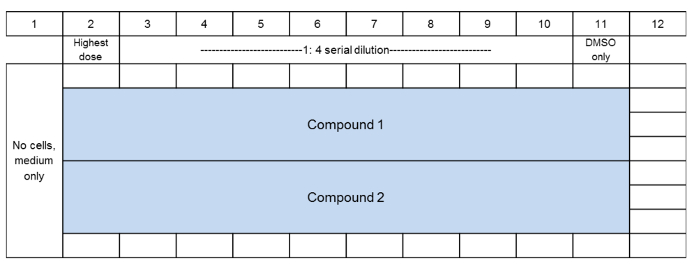
Figure 1. Layout of assay and control plates. Blue shade, compound treatment wells. White shade, medium only. Compounds are serially diluted 1:4 and are administered in triplicates (B-D or E-G). 2 compounds can be applied per plate.
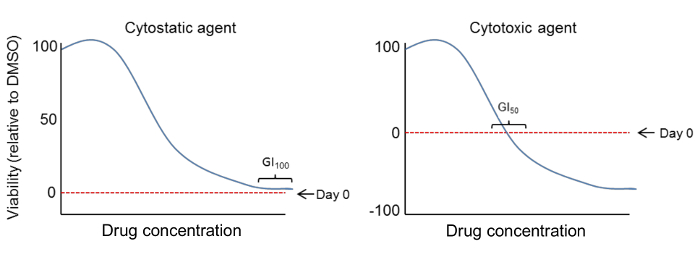
Figure 2. Representative viability curves. Red dotted line represents the day 0 reading. x-axis indicates increasing doses of compound to the right and y-axis represents viability relative to DMSO control wells. GI100= dose used to achieve 100% growth inhibition; GI50= dose used to reduce viability to 50% of DMSO control.
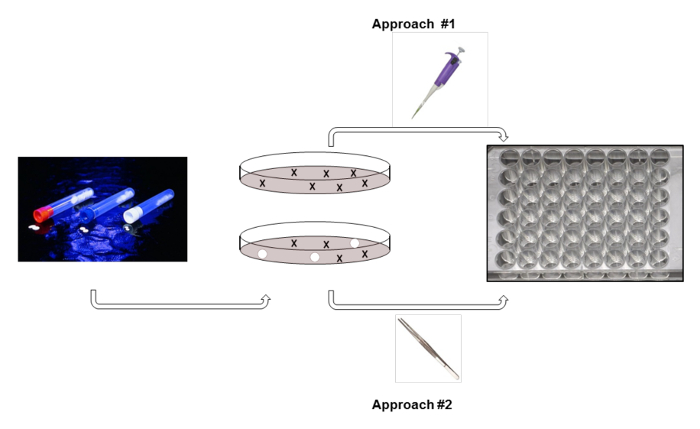
Figure 3. Two approaches for picking resistant clones for expansion. Approach 1- use pipettor to pick up and transfer well-defined clones to 48-well plates. Approach 2- use trypsin-soaked cloning discs to lift clones and transfer to 48-well plates.
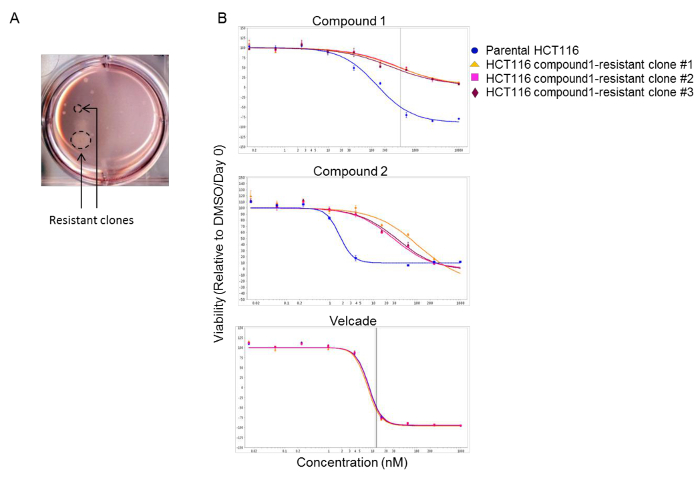
Figure 4. Confirmation of the resistance achieved for HCT116 clones to compound #1 in vitro. (A) Compound #1-resistant HCT116 clones emerged following continuous three-week selection. (B) Viability of control and resistant clones was tested after 72 hr treatment with various compounds. Compound #2 is a close analog of compound #1. Velcade was used as a control cytotoxic agent. Data are shown as average + standard deviation of three biological replicates.
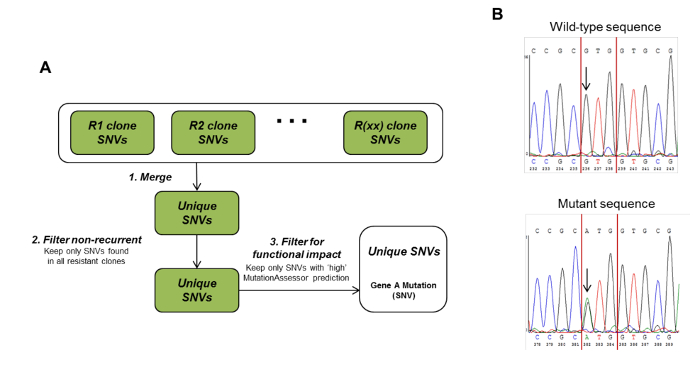
Figure 5. Identification of a unique, recurrent mutation (single nucleotide variants, SNVs) in gene A in compound #1-resistant HCT116 clones. (A) Work flow to identify SNVs present in all resistant clones and predicted to have a high functional impact by MutationAssessor. (B) Confirmation of the mutation in gene A by Sanger Sequencing.
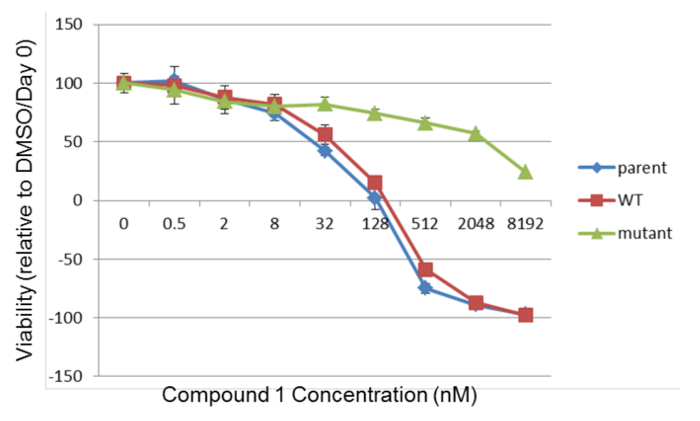
Figure 6. Re-expression of mutated gene A conferred resistance to compound #1 in vitro. Viability of the engineered HCT116 cell lines was tested after 72 hr treatment with compound #1. HCT116-WT or mutant cell lines are stably expressing WT or mutant cDNAs of gene A, respectively. Data are shown as average + standard deviation of three biological replicates.
| Sample Name | Amino Acid | Primary Tissue | Zygosity | |
| C-33-A | p.E768fs*44 | cervix | Heterozygous | |
| C-33-A | p.S860* | cervix | Heterozygous | |
| CML-T1 | p.? | haematopoietic_and_lymphoid_tissue | Homozygous | |
| CP66-MEL | p.C822F | skin | Heterozygous | |
| CTV-1 | p.0? | haematopoietic_and_lymphoid_tissue | Homozygous | |
| EFO-27 | p.Q130fs*2 | ovary | Heterozygous | |
| EFO-27 | p.? | ovary | Heterozygous | |
| HCC2218 | p.E467K | breast | Heterozygous | |
| J-RT3-T3-5 | p.R711* | haematopoietic_and_lymphoid_tissue | Homozygous | |
| LNCaP | p.? | prostate | Homozygous | |
| LoVo | p.? | large_intestine | Homozygous | |
| MOLT-13 | p.R711* | haematopoietic_and_lymphoid_tissue | Homozygous | |
| NALM-6 | p.? | haematopoietic_and_lymphoid_tissue | Homozygous | |
| NCI-H630 | p.R680* | large_intestine | Heterozygous | |
| SKUT-1 | p.L787fs*11 | endometrium | Homozygous | |
| SKUT-1B | p.L787fs*11 | endometrium | Homozygous | |
| SUP-T1 | p.? | haematopoietic_and_lymphoid_tissue | Homozygous | |
Table 1. MSH2-mutated Cell Lines. Cell line (sample name), amino acid substitution, the lineage of origin and the zygosity are indicated.
| Sample Name | Amino Acid | Primary Tissue | Zygosity | |
| CCRF-CEM | p.R100* | haematopoietic_and_lymphoid_tissue | Heterozygous | |
| CCRF-CEM | p.? | haematopoietic_and_lymphoid_tissue | Heterozygous | |
| CW-2 | p.Y130fs*6 | large_intestine | Homozygous | |
| DU-145 | p.? | prostate | Homozygous | |
| GR-ST | p.? | haematopoietic_and_lymphoid_tissue | Homozygous | |
| HCT-116 | p.S252* | large_intestine | Homozygous | |
| IGROV-1 | p.S505fs*3 | ovary | Homozygous | |
| MN-60 | p.? | haematopoietic_and_lymphoid_tissue | Homozygous | |
| NCI-SNU-1 | p.R226* | stomach | Homozygous | |
| P30-OHK | p.? | haematopoietic_and_lymphoid_tissue | Homozygous | |
| PR-Mel | p.? | skin | Homozygous | |
| REH | p.? | haematopoietic_and_lymphoid_tissue | Homozygous | |
| SK-OV-3 | p.0? | ovary | Homozygous | |
| SNU-1544 | p.S2L | large_intestine | Heterozygous | |
| SNU-1746 | p.E523K | large_intestine | Homozygous | |
| SNU-324 | p.C233R | pancreas | Heterozygous | |
| SNU-324 | p.V384D | pancreas | Heterozygous | |
| SNU-478 | p.V384D | pancreas | Heterozygous | |
Table 2. MLH1-mutated Cell Lines. Cell line (sample name), amino acid substitution, the lineage of origin and the zygosity are indicated.
Discussion
Selection of cell line(s): Characterization of genetic state and genomic instability
Undoubtedly, the single most critical factor in successfully uncovering clinically relevant resistance mechanisms is the initial cell line selection. Two factors should be considered. First, aim to select cell line(s) of the same lineage/subtype harboring the defining genetic traits of the disease (e.g., BRAFV600E in melanoma). Interrogation of publically available transcriptomic and mutation data for both cell lines30-32 and primary/metastasis tumors for a variety of indications33,34 will facilitate the selection process. Although identification of cell lines with clinically relevant genetic alterations is ideal, in some instances this may not be possible due to lack of available cell lines or feasible due to factors such as difficulty and length of the screening process.
With regards to the aforementioned point, a second factor to consider then during cell line selection is the ease or feasibility of resistance screening using the desired line. For example, factors such as proliferation and intrinsic mutation rates can greatly impact on the speed of discovery. To this end, cell lines can be utilized with faster growth kinetics and deficient in DNA MMR mechanisms in the hopes that emergence of spontaneous resistance can be accelerated35. Based on the COSMIC database, several candidate cell lines exist with deficiency in one of two frequently mutated MMR genes, MSH2 or MLH1 (Tables 2 and 3). Alternatively, if cell lines of interest do not exist bearing defects in MMR, acute treatment with physical or DNA reactive chemical mutagens such as the alkylating agent N-ethyl-N-nitrosourea (ENU) can be used to enhance genomic instability. Although both approaches may significantly shorten the time to attain resistant clones and follow-up sequencing, stringent functional testing should be performed on candidate genes as a greater number of non-functional, passenger mutations are likely to emerge. SNVs can be rank ordered to maximize chances for identifying functionally relevant mutations. Firstly, choosing those mutations that are recurrent in independent clones will increase the likelihood these mutations are drivers of resistance. In the event recurrent mutations are not identified, focusing on SNVs that fit the mechanism of action of the drug (for example, the drug target or a known downstream effector of the drug target) may be meaningful. Ultimately, the gold standard is always experimental evaluation of resistance-conferring activity of the candidate SNVs by ectopic cDNA expression in drug-sensitive parental cells.
DNA vs RNA sequencing
Once resistant clones have been generated, DNA and/or RNA can be sequenced depending on the need. DNA sequencing, either exome or whole-genome sequencing, will allow identification of germline and somatic variants, such as SNPs, indels and copy number variants. Whereas the more cost-friendly exome sequencing focuses on generating reads from known coding regions, whole-genome sequencing will generate sequencing data for the entire genome which may facilitate identification of mutations in non-coding elements such as enhancers or miRNAs36. However, since gene expression data is not gauged during DNA sequencing, it is difficult to predict which mutation(s) is likely to be a functional driver. In this regard, sequencing of RNA, although more costly, offers this advantage. The fact that mutation calling is only performed on expressed RNA species enhances the likelihood that the mutation of interest may be a functional driver. In addition to allowing a more focused survey of mutations for follow-up functional testing, RNA sequencing also offers the added advantage of being able to identify gene expression alterations, alternative splicing and novel chimeric RNA species, including gene fusions that may also serve as potent drivers of resistance.
Bioinformatics pipeline
Example commands are provided for illustration purposes, but more detailed documentation and tutorials are available from the Broad Institute16 and should be read thoroughly before beginning NGS analysis. The following commands are designed for a UNIX shell environment on a system on which all tools and reference data have been pre-installed. These commands also assume FASTQ files containing paired-end sequence reads from two samples, named "parental" and "resistant," have been received from the vendor and placed in the "data" directory. In most cases these commands should be adapted or optimized for a specific application using additional command-line arguments (e.g., adding "-t 8" to the bwa command allows multithreaded operation across 8 CPU cores). Read groups (which assign alignments to biological samples), must often be added to BAM files even if there is only one sample per bam file, in order to comply with file format requirements for certain tools. Read group parameters RGID, RGSM, RGPL, RGPU, and RGLB can be arbitrary strings describing the sample name, sequencing platform, and library strategy.
In vitro vs in vivo assays
Although several resistance mechanisms identified by in vitro selection have been verified to be clinically relevant, there exists a possibility that the mechanisms may not serve as relevant or predominant mechanisms of clinical resistance. One reason for this may include an essential role for the micro-environment in driving resistance to therapy, a component that is devoid in the experimental protocol/setup discussed thus far. Indeed, several studies have shown that anti-cancer agents that are capable of killing tumor cells are rendered ineffective when the tumor cells are cultured in the presence of stromal cells implying innate mechanisms of resistance conferred by the stroma37,38. To identify such stroma-induced acquired resistance mechanisms, one may consider performing in vitro co-culture or in vivo tumor resistance assays. Since the former assay is quite complex, many have resorted to generating drug-resistant tumor xenografts to address the potential role of the stroma in driving resistance. Such studies have uncovered both identical5 and unique39 mechanisms of resistance relative to in vitro selection, implying that the stroma may indeed play a role in the latter. However, one must be mindful of the length of time it may take to generate such resistant tumors and the complexity of the follow-up genomic analysis-complexities due to the intra-tumoral molecular and cellular heterogeneity.
Target identification
In addition to uncovering drug resistance mechanisms, this NGS-based genomic profiling approach can also be applied to identify cellular targets of chemical probes. Historically, multiple unbiased methods have been used to identify the cellular mechanisms of action and targets of low-molecular weight chemicals with biological activities, including affinity purification coupled with quantitative proteomics, yeast genomic methods, RNAi screening, and computational inference approaches40. As an extension to elucidation of drug-resistance mechanisms using NGS-based genomic or transcriptomic profiling of phenotypically resistant cell populations, identification of unique recurrent single nucleotide variations (SNVs) or expression alterations that enable resistance can offer insights into functional cellular targets of compounds. This is based on the idea that a subset of resistance mechanisms observed may involve recurrent mutations in genes that encode the direct protein targets of the small molecule. Recently, several reports validated the utility of the approach, particularly by combining with other approaches including large-scale cancer cell line sensitivity profiling, to revealing the cellular targets of small-molecule probes9,10.
Disclosures
Publication fees for this article are paid by H3 Biomedicine.
Acknowledgements
The authors would like to acknowledge our colleagues at H3 Biomedicine for their feedback during the manuscript preparation.
Materials
| Name | Company | Catalog Number | Comments |
|---|---|---|---|
| 48-well plates | Fisher Scientific | 07-200-86 | Expanding clones |
| 96-well plates | Fisher Scientific | 07-200-588 | Generating GI50 curves |
| CellTiter-Glo | Promega | G7572 | Viability testing |
| Cloning discs (3 mm) | Sigma | Z374431 | Picking clones |
| Sterile forceps | Unomedical | DF8088S | Picking clones |
| RNeasy Plus RNA extraction kit | Qiagen | 74134 | Isolating RNA |
| Blood and Tissue DNeasy extraction kit | Qiagen | 69581 | Isolating gDNA |
| GATK | The Broad Institute | Indel realigner | |
| MuTect | The Broad Institute | Paired variant calling tool | |
| Oncotator | The Broad Institute | Variant annotation tool | |
| MutationAccessor | The Broad Institute | Functional impact prediction tool |
References
- Sellers, W. R. A blueprint for advancing genetics-based cancer therapy. Cell. 147 (1), 26-31 (2011).
- Housman, G., et al. Drug resistance in cancer: an overview. Cancers (Basel). 6 (3), 1769-1792 (2014).
- Balbas, M. D., et al. Overcoming mutation-based resistance to antiandrogens with rational drug design. Elife. 2, e00499(2013).
- Joseph, J. D., et al. A clinically relevant androgen receptor mutation confers resistance to second-generation antiandrogens enzalutamide and ARN-509. Cancer Discov. 3 (9), 1020-1029 (2013).
- Korpal, M., et al. An F876L mutation in androgen receptor confers genetic and phenotypic resistance to MDV3100 (enzalutamide). Cancer Discov. 3 (9), 1030-1043 (2013).
- Lawrence, M. S., et al. Mutational heterogeneity in cancer and the search for new cancer-associated genes. Nature. 499 (7457), 214-218 (2013).
- Gerlinger, M., et al. Intratumor heterogeneity and branched evolution revealed by multiregion sequencing. N Engl J Med. 366 (10), 883-892 (2012).
- Whittaker, S. R., et al. A genome-scale RNA interference screen implicates NF1 loss in resistance to RAF inhibition. Cancer Discov. 3 (3), 350-362 (2013).
- Wacker, S. A., Houghtaling, B. R., Elemento, O., Kapoor, T. M. Using transcriptome sequencing to identify mechanisms of drug action and resistance. Nat Chem Biol. 8 (3), 235-237 (2012).
- Adams, D. J., et al. NAMPT Is the Cellular Target of STF-31-Like Small-Molecule Probes. ACS Chem Biol. 9 (10), 2247-2254 (2014).
- Bhang, H. E., et al. Studying clonal dynamics in response to cancer therapy using high-complexity barcoding. Nat Med. 21 (5), 440-448 (2015).
- Boland, C. R., et al. A National Cancer Institute Workshop on Microsatellite Instability for cancer detection and familial predisposition: development of international criteria for the determination of microsatellite instability in colorectal cancer. Cancer Res. 58 (22), 5248-5257 (1998).
- Heinen, C. D., Richardson, D., White, R., Groden, J. Microsatellite instability in colorectal adenocarcinoma cell lines that have full-length adenomatous polyposis coli protein. Cancer Res. 55 (21), 4797-4799 (1995).
- Yamada, N. A., Castro, A., Farber, R. A. Variation in the extent of microsatellite instability in human cell lines with defects in different mismatch repair genes. Mutagenesis. 18 (3), 277-282 (2003).
- Ahmed, D., et al. Epigenetic and genetic features of 24 colon cancer cell lines. Oncogenesis. 2, e71(2013).
- GATK. , The Broad Institute. Cambridge, Massachusetts, USA. Available from: https://www.broadinstitute.org/gatk/guide (2015).
- Li, H., Durbin, R. Fast and accurate long-read alignment with Burrows-Wheeler transform. Bioinformatics. 26 (5), 589-595 (2010).
- Li, H., et al. The Sequence Alignment/Map format and SAMtools. Bioinformatics. 25 (16), 2078-2079 (2009).
- Picard. , The Broad Institute. Cambridge, Massachusetts, USA. Available from: http://broadinstitute.github.io/picard (2015).
- McKenna, A., et al. The Genome Analysis Toolkit: a MapReduce framework for analyzing next-generation DNA sequencing data. Genome Res. 20 (9), 1297-1303 (2010).
- Cibulskis, K., et al. Sensitive detection of somatic point mutations in impure and heterogeneous cancer samples. Nat Biotechnol. 31 (3), 213-219 (2013).
- Larson, D. E., et al. SomaticSniper: identification of somatic point mutations in whole genome sequencing data. Bioinformatics. 28 (3), 311-317 (2012).
- Koboldt, D. C., et al. VarScan 2: somatic mutation and copy number alteration discovery in cancer by exome sequencing. Genome Res. 22 (3), 568-576 (2012).
- Oncotator. , The Broad Institute. Cambridge, Massachusetts, USA. Available from: https://www.broadinstitute.org/oncotator (2015).
- Wang, K., Li, M., Hakonarson, H. ANNOVAR: functional annotation of genetic variants from high-throughput sequencing data. Nucleic Acids Res. 38 (16), e164(2010).
- Cingolani, P., et al. A program for annotating and predicting the effects of single nucleotide polymorphisms, SnpEff: SNPs in the genome of Drosophila melanogaster strain w1118; iso-2; iso-3. Fly. 6 (2), 80-92 (2012).
- Reva, B., Antipin, Y., Sander, C. Predicting the functional impact of protein mutations: application to cancer genomics. Nucleic Acids Res. 39 (17), (2011).
- Ng, P. C., Henikoff, S. SIFT: Predicting amino acid changes that affect protein function. Nucleic Acids Res. 31 (13), 3812-3814 (2003).
- Adzhubei, I., Jordan, D. M., Sunyaev, S. R. Predicting functional effect of human missense mutations using PolyPhen-2. Curr Protoc Hum Genet. Chapter 7, Unit 7.20(2013).
- Barretina, J., et al. The Cancer Cell Line Encyclopedia enables predictive modelling of anticancer drug sensitivity. Nature. 483 (7391), 603-607 (2012).
- Abaan, O. D., et al. The exomes of the NCI-60 panel: a genomic resource for cancer biology and systems pharmacology. Cancer Res. 73 (14), 4372-4382 (2013).
- Forbes, S., et al. Cosmic 2005. Br J Cancer. 94 (2), 318-322 (2006).
- Shah, S. P., et al. The clonal and mutational evolution spectrum of primary triple-negative breast cancers. Nature. 486 (7403), 395-399 (2012).
- Behjati, S., et al. Recurrent PTPRB and PLCG1 mutations in angiosarcoma. Nat Genet. 46 (4), 376-379 (2014).
- de las Alas, M. M., Aebi, S., Fink, D., Howell, S. B., Los, G. Loss of DNA mismatch repair: effects on the rate of mutation to drug resistance. J Natl Cancer Inst. 89 (20), 1537-1541 (1997).
- Kotani, A., et al. A novel mutation in the miR-128b gene reduces miRNA processing and leads to glucocorticoid resistance of MLL-AF4 acute lymphocytic leukemia cells. Cell Cycle. 9 (6), 1037-1042 (2010).
- Straussman, R., et al. Tumour micro-environment elicits innate resistance to RAF inhibitors through HGF secretion. Nature. 487 (7408), 500-504 (2012).
- Yang, X., Sexauer, A., Levis, M. Bone marrow stroma-mediated resistance to FLT3 inhibitors in FLT3-ITD AML is mediated by persistent activation of extracellular regulated kinase. Br J Haematol. 164 (1), 61-72 (2014).
- Arora, V. K., et al. Glucocorticoid receptor confers resistance to antiandrogens by bypassing androgen receptor blockade. Cell. 155 (6), 1309-1322 (2013).
- Schenone, M., Dancik, V., Wagner, B. K., Clemons, P. A. Target identification and mechanism of action in chemical biology and drug discovery. Nat Chem Biol. 9 (4), 232-240 (2013).
Reprints and Permissions
