Laparoscopic pancreatoduodenctomy (LPD) may offer advantages over open pancreatoduodenectomy, including early postoperative mobilization, less delayed gastric emptying and a shorter hospital stay. However, LPD is technically challenging and not well-standardized, especially regarding the pancreatic anastomosis. We describe a standardized technique for the pancreatic anastomosis during LPD: modified Blumgart pancreaticojejunostomy.
Method Article
Laparoscopic Pancreatoduodenectomy With Modified Blumgart Pancreaticojejunostomy
In This Article
Summary
Abstract
Minimally invasive pancreatic resections are technically demanding but rapidly increasing in popularity. In contrast to laparoscopic distal pancreatectomy, laparoscopic pancreatoduodenectomy (LPD) has not yet obtained wide acceptance, probably due to technical challenges, especially regarding the pancreatic anastomosis.
The study describes and demonstrates all steps of LPD, including the modified Blumgart pancreaticojejunostomy. Indications for LPD are all pancreatic and peri-ampullary tumors without vascular involvement. Relative contra-indications are body mass index >35 kg/m2, chronic pancreatitis, mid-cholangiocarcinomas and large duodenal cancers.
The patient is in French position, 6 trocars are placed, and dissection is performed using an (articulating) sealing device. A modified Blumgart end-to-side pancreaticojejunostomy is performed with 4 large needles (3/0) barbed trans-pancreatic sutures and 4 to 6 duct-to-mucosa sutures using 5/0 absorbable multifilament combined with a 12 cm, 6 or 8 Fr internal stent using 3D laparoscopy. Two surgical drains are placed alongside the pancreaticojejunostomy.
The described technique for LPD including a modified Blumgart pancreatico-jejunostomy is well standardized, and its merits are currently studied in the randomized controlled multicenter trial. This complex operation should be performed at high-volume centers where surgeons have extensive experience in both open pancreatic surgery and advanced laparoscopic gastro-intestinal surgery.
Introduction
Laparoscopic surgery has a fast evolution during the last decades and is being performed for increasingly complex surgical procedures. Despite increasing recognition of the benefits of this approach, the majority of pancreatic surgeons remain uncertain about the advantages of this technique1,2,3,4,5. Laparoscopic distal pancreatectomy is now proven to be safe and readily available, although its use in the treatment of adenocarcinoma is still debated2,4,6,7. Since the first report on laparoscopic pancreatoduodenectomy (LPD) in 19948, few studies have described the technique9,10,11,12. Non-randomized studies reported a reduction in delayed gastric emptying and in the estimated intraoperative blood loss has been reported for LPD, as compared to open pancreatoduodenectomy13,14. One randomized trial and a systematic review reported that LPD could reduce a hospital stay, without increasing the overall costs15,16. Unfortunately, LPD seems to be associated with higher rates of postoperative pancreatic fistula and readmission, especially in low volume centers17. The best pancreatic anastomosis technique is still open for debate. The most common anastomoses performed during open pancreatoduodenectomy are being reproduced in LPD. However, as for open pancreatic surgery, the results obtained with LPD are controversial. Safety, feasibility, reproducibility and simplicity of the pancreatic anastomosis have a crucial role in the diffusion of this technique and in its surgical results.
The Blumgart pancreatic anastomosis is a simple and effective technique that combines the principle of duct-to-mucosa anastomosis with jejunal covering over the raw surface of the pancreas18. The Blumgart anastomosis has been associated with lower pancreatic fistula rate to than the other techniques19.
This article aims to demonstrate the safety and feasibility of LPD and specifically the pancreaticojejunostomy (PJ) with a modified Blumgart anastomosis and its surgical oncologic outcome in a patient with an ampullary tumor.
Protocol
No specific ethics approval is required since this operation was performed in routine clinical care. The patient is a 67-year-old female with a 1 cm ampullary tumor, presenting with obstructive jaundice, pale colored stools, dark colored urine, itching and 10 kg weight loss in 1 year. Patient's clinical history shows hypertension and type II diabetes mellitus. Endoscopic ultrasound (EUS) shows a large pedunculated polypoid lesion of the ampulla.
1. Patient Selection
- Select patients on the basis of a pancreatic or peri-ampullary tumor without any signs of involvement of major vessels on a recent (max 4 weeks old) contrast enhanced CT-scan.
- Examine the CT for any vascular abnormalities such as aberrant course of the right hepatic artery.
- During training, exclude patients with a body mass index >35 kg/m2, recurrent acute or chronic pancreatitis, previous major abdominal surgery, pancreas-targeted radiotherapy, mid-cholangiocarcinomas, and large duodenal cancers, due to expected technical difficulties. Once extensive experience with LPD has been obtained, vascular resections are also feasible during LPD20.
2. Patient Preparation
- Perform a preoperative endoscopic retrograde cholangiopancreatography (ERCP) to relieve the obstructive jaundice.
- Place a 7Fr plastic biliary stent and take biopsies. Pathology shows a tubulovillous adenoma of common bile duct (CBD) with focal high-grade dysplasia. Figure 1 illustrates the appearance of the lesion on CT scan.
3. Surgical Technique
- Operation setting
- Place the patient in French position with a heating device on a short grain mattress with the right arm in and left arm abducted to 90°.
- During sterile exposition, remember to keep the suprapubic region free for a Pfannenstiel incision to remove the specimen. The first surgeon stands between the patient's legs, the 1st and the 2nd assistant are on the left and right side, respectively. Use a 6-port technique to perform the procedure, see Figure 2.
- After creation of pneumoperitoneum, place the sub-umbilical 12 mm trocar and then 4 trocars along a semi-circular plane (two 12 mm trocars left and right of the umbilicus, two 5 mm trocars four fingers subcostal left and right in the anterior axillary line).
- Place the 6th trocar just sub-xiphoidal (Figure 2) for liver retraction.
- Choose an appropriated (articulating) sealing device, along with laparoscopic monopolar hook and laparoscopic bipolar clamp diathermy.
- Exploration Phase
- Perform a diagnostic laparoscopy to exclude peritoneal and liver metastases. Place a straight needle transcutaneously in the epigastric region, around the Teres ligament to retract the ligament to the ventral abdominal wall.
- Dissect the gallbladder hilum and the cystic artery and then divide the duct between clips and suture Hartmann's pouch to the ventral abdominal wall for further liver retraction and exposure of the hepato-duodenal ligament.
- Dissection Phase
- Open the lesser sac by dividing the gastrocolic ligament 2 cm distal from the gastroepiploic vessels. Free the stomach from the pancreas and let the assistant retract the stomach anteriorly. Mobilize the hepatic flexure. Thereafter, the left assistant retracts the duodenum to the patient's left side, while the right assistant pushes the colon caudo-medially with a gauze.
- Kocher Maneuver
- Perform a wide Kocher maneuver, exposing the inferior caval vein, the origin of the superior mesenteric artery (SMA) and the ligament of Treitz. Expose also the superior mesenteric vein (SMV) and its confluence with the gastroepiploic vein. Dissect the latter and transect it using clips and articulating sealer.
- Pancreatic Tunnel
- Now, create the beginning of a wide pancreatic tunnel.
- Next, free the distal part of the stomach, just 1 cm proximal to the pylorus, and transect it using an endostapler after the nasogastric tube is pulled back. On the cranial side of the pancreas, dissect the hepatic artery lymph node station (number 8a) and send it for pathology. Hereafter, identify the hepatic artery, portal vein and gastroduodenal artery.
- Encircle the gastroduodenal artery with a vessel loop and divide it, leaving 2 locking clips on the patient's side and 1 on the specimen's side. Complete the pancreatic tunnel by blunt dissection using the articulating sealer and sling the pancreas with a quarter length vessel loop, securing it with a plastic self-locking clip.
- Ligament of Treitz resection
- Mobilize the duodenojejunal flexure (ligament of Treitz), and divide the first jejunal loop with an endostapler using a vascular cartridge. Now complete the mobilization of the first loop up to the mesenteric root. Hereafter, suture the two free ends of the jejunum to each other and pass both under the mesenteric root to the patient's right side.
- Pancreatic resection
- For the pancreatic head dissection, move the camera to the right sided 12-mm trocar as this offers a better view of the SMA and SMV. Dissect the uncinate process with the articulating sealer from the lateral aspect of the SMV and first jejunal branch. Work in layers from ventral to dorsal, while retracting the SMV medially to expose the SMA.
- Transect the pancreas using monopolar diathermy, manage bleeding with bipolar diathermy.
- Transect the pancreatic duct with scissors to avoid sealing of the duct. Dissect all retroperitoneal nodes, while visualizing the SMA.
- Bile duct resection
- Follow up the common hepatic artery to the right hepatic artery and take care in case of aberrant vascular anatomy. Hereafter, encircle the hepatic duct with a vessel loop and divide it between a laparoscopic bulldog on the proximal hepatic duct, and a plastic locking clip (or second bulldog) on the distal hepatic duct.
- Next, place the specimen in a plastic retrieval bag and temporarily leave it in the lower abdomen. Remove the specimen later simultaneously with the gallbladder. Take a short pause before start of the reconstruction phase.
- Reconstruction Phase
- Pancreatic anastomosis
- With 3D laparoscopy, start the reconstruction phase performing the PJ, according to the modified Blumgart technique, with 4 barbed sutures (large blunt needle, 3/0, 23cm length) (Figure 3).
- Pass the sutures through the pancreas approximately 1 cm from the cut edge, then pass them dorsally through the bowel and back through the pancreas. After passing, drive the needle through its own loop, tighten and place it far from the pancreas.
- Repeat this procedure for each suture, taking care not to obstruct the pancreatic duct (Figure 3.1). The 3D laparoscopy facilitates easy needle placement and suturing.
- Duct-to-mucosa anastomosis
- Create a 2 mm enterotomy in the jejunum using the diathermy hook (about 5 mm from the pancreatic duct).
- Subsequently, place 4-6 duct-to-mucosa sutures using a small blunt needle (5/0). In case of four sutures, place them at 8, 5, 11 and 2 o'clock. Choose the position in order to overcome more difficult suturing of the typical 9 and 3 o'clock sutures in small pancreatic ducts.
- First, place the 8 and 5 o'clock sutures with the knot inside. Place a 12 cm 6 or 8 Fr pediatric nasogastric tube as internal pancreatic stent (Figure 3.2).
- Next, place the 11 and 2 o'clock sutures with the knot outside. Complete the anastomosis picking up the ventral side of the jejunum with the original four barbed sutures, inserting them first anteriorly through the jejunal wall and then back through the ventral side of the pancreas, and retracting toward the spleen to prevent tearing of the pancreas.
- Secure each suture with a clip on the pancreatic surface before cutting (Figure 3.3 and 3.4).
- Biliary anastomosis
- Approximately 5-7 cm further on the jejunal loop, create a 2-4mm antimesenterial enterotomy with the diathermy hook.
- Perform an end-to-side hepaticojejunostomy (HJ) with interrupted absorbable threaded (5/0) sutures, starting with a suture between 6 o'clock on the bile duct to 12 o'clock in the enterotomy.
- Continue it from caudal to cranial alternating between the left and right sides of the HJ. A tension-releasing suture may be placed between the jejunal loop and the gallbladder bed. In case of a wide, thick-walled bile duct use a running suture with the surgeon standing on the patient's left or right side.
- Place a surgical drain from the right subcostal space through the foramen of Winslow ending at the superior border of the PJ. Complete the cholecystectomy and place the gallbladder in a second retrieval bag. Pull up the first jejunal loop to the stomach.
- Gastric anastomosis
- After a small enterotomy and small gastrostomy just ventral from the staple line perform a stapled side-to-side antecolic gastrojejunostomy (GJ). Close the remaining opening with a single suture with a barbed 3/0 suture.
- Create a Pfannenstiel incision of 5 cm to extract the pancreatoduodenectomy specimen and the gallbladder. Close this incision in layers and insufflate the abdomen to place a second drain through the most right sided 5 mm trocar at the inferior border of the PJ, with the tip under the GJ.
- Cover the PJ and the stump of the GDA with the greater omentum. Close the fascia of the three 12 mm trocars. Close all incisions by intracutaneous sutures (4/0) (Figure 4).
- Pancreatic anastomosis
Results
The operation time was 6 hours with 150 mL of blood loss. The patient's postoperative course was uncomplicated. No postoperative pancreatic fistula was detected. The postoperative day 3 amylase level in both drains were 1373 U/L and 804 U/L, which had normalized by day 5 where after the drains were removed. The patient was discharged on the 6th postoperative day. Pathology assessment revealed a 1.5 cm tubulovillous adenoma of the papilla of Vater with low grade dysplasia. Resection margins were microscopically radical (R0) and none of the thirteen lymph nodes harvested were involved by tumor cells.

Figure 1 Preoperative CT scan
The images show the ampullary tumor, causing obstructive jaundice. Please click here to view a larger version of this figure.
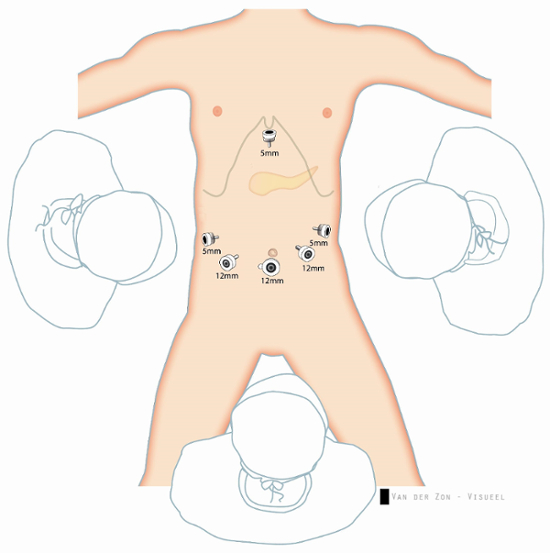
Figure 2 Setting of the patient
The operator is between the legs, the 1st and the 2nd assistant on the left and right, respectively. The procedure is performed by a 6-port technique. Please click here to view a larger version of this figure.
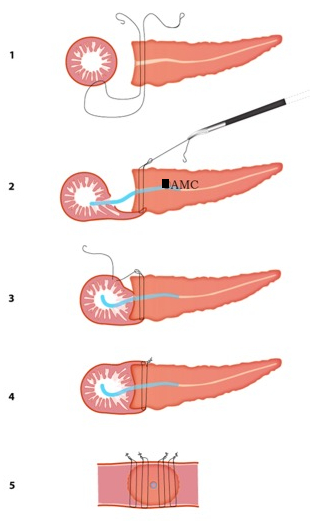
Figure 3 Pancreaticojejunostomy according to the modified Blumgart technique
The modified Blumgart pancreaticojejunostomy is performed with four barbed sutures (3/0), large needle, for the transpancreatic U-sutures (3.1). An 12cm internal 6 or 8 Fr pancreatic stent is placed and the duct-to-mucosa anastomosis is performed using 4-6 absorbable threaded 5/0 sutured with a small blunt needle (3.2). The anastomosis is completed by picking up the ventral side of the jejunum with the original four barbed sutures (3.3, 3.4). Lateral view of the final result (3.5).
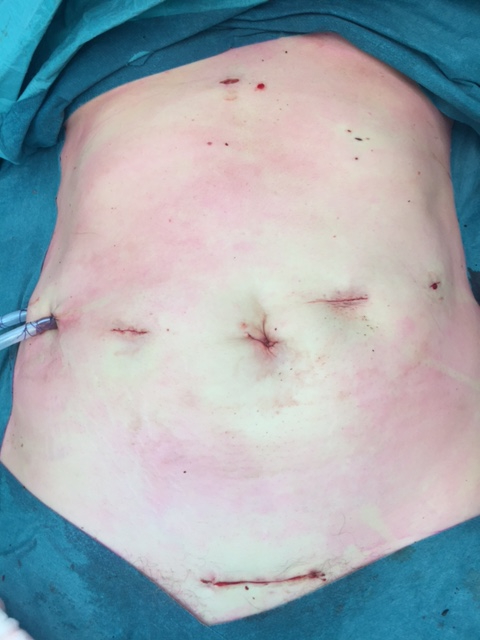
Figure 4 Postoperative Result
This is the final result after laparoscopic pancreatoduodenectomy with modified Blumgart pancreaticojejunostomy.
Discussion
LPD is a technically challenging but well standardized, safe and reproducible procedure. LPD may offer the advantages of minimally invasive approaches, including early mobilization, early return of bowel function and short hospital stay21. It is widely recognized that laparoscopy offers a better quality of the visualization, enlarging all the details of the surgical field and minimal manipulation of the tissue22. The pathological outcomes are also comparable between the LPD and the open technique. Particularly, the same R0 resection and lymph node harvest rates have been reported10.
The use of the French position, the 6-port technique, 3D laparoscopy (especially during the anastomotic phase) and the appropriate laparoscopic devices can reduce the obstacles of the minimal invasive approach. We suggest also some technical tips, previously described by Palanivelu et al.23 such as the transcutaneous needle in the epigastric region to retract the Teres' ligament or the suture of the Hartmann's pouch to the ventral abdominal wall, to improve the exposure of the hepatoduodeneal ligament.
Unfortunately, there is a price to be paid; this complex operation must be performed at high volume centers where surgeons have extensive experience in both open pancreatic resections and advanced laparoscopic procedures15. Although the modified Blumgart pancreaticojejunostomy is a reproducible technique to perform the pancreatic anastomosis, careful surgery is required. The surgeon needs to take care to not obstruct the pancreatic duct with the barbed sutures. The duct-to-mucosa sutures also needs to be placed meticulously. Each suture is placed under direct visualization, but does not need to be tightened immediately and could be kept initially for traction. When initially cutting the pancreatic duct, it may be kept somewhat longer to facilitate these sutures.
Laparoscopic pancreaticoduodenectomy requires advanced laparoscopic skills and extensive experience with open pancreatic surgery. Further studies need to investigate the oncological results of this technique. Whether the minimal invasive approach is safe and beneficial for these patients has to be establish in a randomized setting. In the Netherlands, the LEOPARD-2 (trial registry NTR5689) multicenter trial is currently randomizing patients between minimally invasive and open pancreatoduodenectomy using the described technique24.
Disclosures
The authors have nothing to disclose.
Acknowledgements
The authors have no acknowledgements. The described technique is used in both institutions of the authors.
Materials
| Name | Company | Catalog Number | Comments |
|---|---|---|---|
| Bair Hugger | 3M COMPANY | 79500 | Patient Warming Unit, Model 795, 120V-ENG-E, Refurbished 79500 |
| ENSEAL | Ethicon Endo-Surgery, Cincinnati, OH, USA | NSLG2C45 | articulating sealing device |
| Weck Hem-o-lok Polymer Ligation System - Automatic | Weck Surgical Instruments, Teleflex Medical, Durham, NC | 543965 | The Weck Hem-o-lok Auto Endo5 delivers 15 true Medium-Large clips on a 5mm platform. The Medium-Large clip is designed for 3-10 mm size vessels. Designed for security, the non-absorbable locking polymer clip is inert, nonconductive, radiolucent, and does not interfere with CT or X-ray diagnostics. |
| ECHELON FLEX Powered Plus Stapler | Ethicon Endo-Surgery, Cincinnati, OH, USA | PLEE60A | The ECHELON FLEX GST System controls tissue movement |
| Echelon black | Ethicon Endo-Surgery, Cincinnati, OH, USA | GST60T | Black reload intended for use in very thick tissue |
| Echelon blue | Ethicon Endo-Surgery, Cincinnati, OH, USA | GST60B | Blue reload intended for use in regular tissue |
| V-Loc | Covidien | VLOCM1824 | The V-Loc wound closure device is a revolutionary technology that supports optimal patient outcomes by closing wounds securely without the need to tie knots. |
| VICRYL Suture | ETHICON | J303H | Suture USP: 5-0 Brand: Coated Vicryl Suture Color: Violet Strands per Pack: 1 Suture Length (Inches): 27 Needle Type: RB-1 |
References
- de Rooij, T., et al. Impact of a Nationwide Training Program in Minimally Invasive Distal Pancreatectomy (LAELAPS). Ann Surg. , (2016).
- van Hilst, J., et al. Worldwide survey on opinions and use of minimally invasive pancreatic resection. HPB (Oxford). , (2017).
- de Rooij, T., et al. Laparoscopic Distal Pancreatectomy for Pancreatic Ductal Adenocarcinoma: Time for a Randomized Controlled Trial? Results of an All-inclusive National Observational Study. Ann Surg. , (2016).
- de Rooij, T., et al. Pan-European survey on the implementation of minimally invasive pancreatic surgery with emphasis on cancer. HPB (Oxford). 18 (2), 170-176 (2016).
- Hogg, M. E., et al. Training in Minimally Invasive Pancreatic Resections: a paradigm shift away from "See one, Do one, Teach one". HPB (Oxford). 19 (3), 234-245 (2017).
- Magge, D., et al. Comparative effectiveness of minimally invasive and open distal pancreatectomy for ductal adenocarcinoma. JAMA Surg. 148 (6), 525-531 (2013).
- Venkat, R., et al. Laparoscopic distal pancreatectomy is associated with significantly less overall morbidity compared to the open technique: a systematic review and meta-analysis. Ann Surg. 255 (6), 1048-1059 (2012).
- Gagner, M., Pomp, A. Laparoscopic pylorus-preserving pancreatoduodenectomy. Surg Endosc. 8 (5), 408-410 (1994).
- Boggi, U., et al. Laparoscopic pancreaticoduodenectomy: a systematic literature review. Surg Endosc. 29 (1), 9-23 (2015).
- Mendoza, A. S. 3rd, Han, H. S., Yoon, Y. S., Cho, J. Y., Choi, Y. Laparoscopy-assisted pancreaticoduodenectomy as minimally invasive surgery for periampullary tumors: a comparison of short-term clinical outcomes of laparoscopy-assisted pancreaticoduodenectomy and open pancreaticoduodenectomy. J Hepatobiliary Pancreat Sci. 22 (12), 819-824 (2015).
- Asbun, H. J., Stauffer, J. A. Laparoscopic vs open pancreaticoduodenectomy: overall outcomes and severity of complications using the Accordion Severity Grading System. J Am Coll Surg. 215 (6), 810-819 (2012).
- Palanivelu, C., et al. Laparoscopic pancreaticoduodenectomy: technique and outcomes. J Am Coll Surg. 205 (2), 222-230 (2007).
- de Rooij, T., et al. Outcomes of a Multicenter Training Program in Laparoscopic Pancreatoduodenectomy (LAELAPS-2). Ann Surg. , (2017).
- de Rooij, T., et al. Laparoscopic pancreatic surgery for benign and malignant disease. Nat Rev Gastroenterol Hepatol. 13 (4), 227-238 (2016).
- de Rooij, T., et al. Minimally Invasive Versus Open Pancreatoduodenectomy: Systematic Review and Meta-analysis of Comparative Cohort and Registry Studies. Ann Surg. 264 (2), 257-267 (2016).
- Palanivelu, C., et al. Randomized clinical trial of laparoscopic versus open pancreatoduodenectomy for periampullary tumours. Br J Surg. 104 (11), 1443-1450 (2017).
- Nassour, I., et al. Minimally Invasive Versus Open Pancreaticoduodenectomy: A Propensity-Matched Study From a National Cohort of Patients. Ann Surg. , (2017).
- Grobmyer, S. R., Kooby, D. A., Hochwald, S. N., Blumgart, L. H. Blumgart anastomosis for pancreaticojejunostomy minimizes severe complications after pancreatic head resection. Br J Surg. 97 (1), 134-135 (2010).
- Wang, S. E., Chen, S. C., Shyr, B. U., Shyr, Y. M. Comparison of Modified Blumgart pancreaticojejunostomy and pancreaticogastrostomy after pancreaticoduodenectomy. HPB (Oxford). 18 (3), 229-235 (2016).
- Croome, K. P., et al. Pancreaticoduodenectomy with major vascular resection: a comparison of laparoscopic versus open approaches. J Gastrointest Surg. 19 (1), 189-194 (2015).
- Kendrick, M. L., et al. Minimally invasive pancreatoduodenectomy. HPB (Oxford). 19 (3), 215-224 (2017).
- Song, K. B., et al. Matched Case-Control Analysis Comparing Laparoscopic and Open Pylorus-preserving Pancreaticoduodenectomy in Patients With Periampullary Tumors. Ann Surg. 262 (1), 146-155 (2015).
- Palanivelu, C., et al. Evolution in techniques of laparoscopic pancreaticoduodenectomy: a decade long experience from a tertiary center. J Hepatobiliary Pancreat Surg. 16 (6), 731-740 (2009).
- Besselink, M. G. Laparoscopic versus open pancreatoduodenectomy: a multicenter randomized controlled phase 2 trial. , http://www.trialregister.nl/trialreg/admin/rctview.asp?TC=5689 (2016).
Reprints and Permissions
