Fishery-induced changes to exploited crustacean fisheries, such as the American lobster fishery, could potentially influence their reproductive dynamics, leading to a reduction in mating success. This study's goal was to develop a noninvasive method for ascertaining the mating success of female lobsters that may be physiologically or functionally mature.
A subscription to JoVE is required to view this content. Sign in or start your free trial.
Method Article
A Noninvasive Method For In situ Determination of Mating Success in Female American Lobsters (Homarus americanus)
In This Article
Summary
Abstract
Despite being one of the most productive fisheries in the Northwest Atlantic, much remains unknown about the natural reproductive dynamics of American lobsters. Recent work in exploited crustacean populations (crabs and lobsters) suggests that there are circumstances where mature females are unable to achieve their full reproductive potential due to sperm limitation. To examine this possibility in different regions of the American lobster fishery, a reliable and noninvasive method was developed for sampling large numbers of female lobsters at sea. This method involves inserting a blunt-tipped needle into the female's seminal receptacle to determine the presence or absence of a sperm plug and to withdraw a sample that can be examined for the presence of sperm. A series of control studies were conducted at the dock and in the laboratory to test the reliability of this technique. These efforts entailed sampling 294 female lobsters to confirm that the presence of a sperm plug was a reliable indicator of sperm within the receptacle and thus, mating. This paper details the methodology and the results obtained from a subset of the total females sampled. Of the 230 female lobsters sampled from George's Bank and Cape Ann, MA (size range = 71-145 mm in carapace length), 90.3% were positive for sperm. Potential explanations for the absence of sperm in some females include: immaturity (lack of physiological maturity), breakdown of the sperm plug after being used to fertilize a clutch of eggs, and lack of mating activity. The surveys indicate that this technique for examining the mating success of female lobsters is a reliable proxy that can be used in the field to document reproductive activity in natural populations.
Introduction
American lobster (Homarus americanus) is one of the most productive fisheries in the North Atlantic (~ 56,000 mt in 2011, valued over $390 million)1. However, there is a general lack of understanding regarding the reproductive dynamics of this species in wild populations. Generating more accurate estimates of reproductive output, including the number and sizes of individuals actively participating in reproduction, may improve the stock assessment process. For example, females that are prevented from achieving their full reproductive potential due to sperm limitation have been identified as a concern for several commercially exploited marine crustaceans including: spiny lobsters2, blue crabs3, king crabs4, stone crabs5, and snow crabs6. The overall goal is to determine if sperm limitation might be a factor in certain regions of the American lobster fishery as well.
The first signs of a potential sperm limitation problem in lobsters were observed while conducting an unrelated tagging study with ovigerous female lobsters (with visibly intact, recently extruded eggs). Recapture reports from fishermen indicated that ~15% of these animals had dropped their egg clutches after only 1-2 months. The working hypothesis was that some lobsters were carrying eggs that had not been fertilized and, as a result, 'fell off'7. Preliminary data from a subsequent study have confirmed the fact that lobsters will extrude eggs even if they have not successfully mated and these unfertilized eggs are only carried for ~ 1 month8. Therefore, given the observation of females carrying unfertilized eggs in natural populations, we sought to determine the extent to which sperm limitation might be contributing to a submaximal level of reproduction by sexually mature lobsters. To achieve this goal, a technique was developed to detect the spermatophore deposited by males during mating.
This paper and video describe a noninvasive, simple method developed for ascertaining the mating success of female lobsters. The technique can be utilized quickly and reliably at sea, either aboard research or commercial fishing vessels. The details of this sampling method as well as some representative findings are presented to illustrate the application of the technique.
Access restricted. Please log in or start a trial to view this content.
Protocol
Part A: Field Sampling Technique
1. Female Measurements
- For each female lobster, measure the carapace length (CL) and the width of the second abdominal segment to the nearest 1.0 mm using a pair of calipers.
NOTE: The second abdominal segment is measured because the width of the abdomen (where females carry their eggs) is an indicator of sexual maturity. In addition, it might be advantageous to ascertain the molt stage to later match these data with reproductive stage (see step 1.2). - Clip a small distal portion off one of the abdominal pleopods (a standard methodological protocol in lobsters) and store the pleopod in clean seawater for later viewing with a dissecting microscope9.
NOTE: This step might also reveal the presence of cement glands on the pleopods, which are an indication that females are preparing to extrude their eggs10.
2. Needle Insertion
- Insert the syringe needle (18 G, see Table 1) ~1 cm into the seminal receptacle, angled toward the tail at ~45° (Figure 1).
NOTE: In lobsters with intact sperm plugs, the needle may meet some resistance during insertion, as it is pushed through the sperm plug prior to reaching the highest concentration of sperm at the bottom of the seminal receptacle (Figure 1).
NOTE: The presence of the plug, in itself, is a reliable indicator that lobsters have mated. In some animals there may be little resistance, possibly because no spermatophore is present, the spermatophore is small, it has not hardened into a plug yet, or it may have already been used to fertilize one or more clutches of eggs.
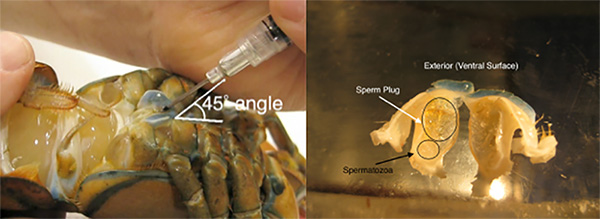
Figure 1. Needle insertion and view of lobster seminal receptacle. Inserting the blunt-tipped needle into the seminal receptacle of the lobster to extract a sperm sample. The angle and depth of the needle are both critical to obtaining consistent samples. Right: View of a seminal receptacle that has been dissected and split vertically. The sperm plug occupies the top or outermost portion of the receptacle, while the spermatozoa are located at the bottom (deepest point) of the receptacle. It is important to note that sampling below this depth may puncture the receptacle and result in a blood-contaminated sample. Click here to view larger image.
3. Penetrating the Sperm Plug
- After the initial insertion, steepen the angle of the needle to nearly vertical (perpendicular to the body axis), and very slowly start to work it downwards into the receptacle.
- Keep the needle tilted at an angle so that the tip is pointed slightly towards the tail. In this case the needle tip is compressing the top of the plug, until it eventually penetrates into the matrix.
- Continue to slowly push the needle downwards until resistance is felt once more - this is the bottom of the receptacle and where the sample is taken.
4. Sperm Removal
- Remove a sample (often solid plug material, liquid sperm and other fluid) from the bottom of the receptacle and deposit the sample into a labeled 2.0 ml plastic tube.
- Flush the receptacle with ~0.1-0.5 ml of cold seawater.
- Remove approximately 0.3 ml of fluid and place in the same tube.
- Store sperm samples on ice until they can be examined in the laboratory.
Part B: Examination of Sperm Samples in the Lab
NOTE: Samples removed from the seminal receptacles of individual lobsters should be examined to determine if sperm cells were present or absent. - Remove ~50 µl of fluid from each plastic tube, place on a glass slide with a cover slip, and view at 100X with a compound microscope.
- Score samples as: sperm scarce, numerous, or absent (this study did not quantify actual sperm numbers, Figure 2).
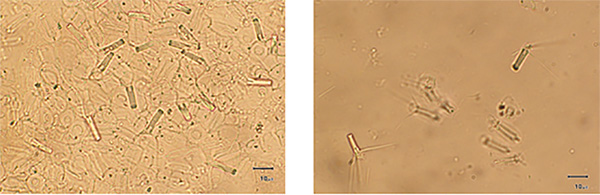
Figure 2. Lobster sperm sample images. Images of lobster sperm samples taken from a female's seminal receptacle, as viewed with a compound microscope at 40X magnification. Image on left shows a sample that contained numerous sperm while the other (right) illustrates a sparse sample (scale bar = 10 μm). Click here to view larger image.
Access restricted. Please log in or start a trial to view this content.
Results
The data reported here were for a subset of female lobsters that originated from both nearshore and offshore locations. The nearshore group consisted of 44 lobsters that were captured in the coastal waters near Cape Ann, Massachusetts and transported in coolers to the laboratory for examination. A total of 186 offshore lobsters were captured on George's Bank and sampled at a commercial holding facility in New Hampshire.
Sperm samples were obtained from all of the animals and immediately examin...
Access restricted. Please log in or start a trial to view this content.
Discussion
This video and paper outline and demonstrate a method for determining if female lobsters have successfully mated. This approach is simple enough that it can be used for large-scale sampling of lobsters at sea by a variety of users. The method is based on detecting the presence of a spermatophore in the seminal receptacle that is passed from male to female lobsters during mating. These spermatophores partially harden into a sperm plug shortly after they are deposited in the receptacle; thus, the presence of a sperm plug i...
Access restricted. Please log in or start a trial to view this content.
Disclosures
The authors declare no conflicts of interest.
Acknowledgements
The authors would like to thank all the New England commercial lobstermen whose boats we were allowed to sample from - their cooperation is much appreciated. In addition, we thank Little Bay Lobster Company (Newington, NH) and Champlin's Seafood (Point Judith, RI) who allowed us to conduct sampling at their facilities. The following UNH students provided invaluable assistance throughout this study: Haley White, Françoise Morrison, Sarah Havener, Audra Chaput, and May Grose. This project was supported by grants from NH SeaGrant to WHW (project # R/CFR-11) and a UNH Marine Program Grant to JSG.
Access restricted. Please log in or start a trial to view this content.
Materials
| Name | Company | Catalog Number | Comments |
|---|---|---|---|
| Calipers | Mitutoyo Digimatic | 500-196-20 | http://www.globalindustrial.com |
| 3 ml Luer-Lok syringe | Beckton-Dickinson | 309585 | www.bd.com |
| Monoject aluminum hub blunt needles, 18 G x 1 | Webster Veterinary | 8881202348 | www.mywebstervet.com |
| 2.0 ml Plastic storage tubes | Eppendorf | wu-06333-72 | http://www.coleparmer.com |
| Styrofoam cooler with ice | |||
| Compound light microscope | Olympus | BH System | http://www.olympusamerica.com |
| Glass sides with cover slip | 75 mm x 25 mm, ~1 mm thickness | ||
| Pipettor with disposable tips |
References
- FAO and Agriculture Organization of the United Nations). Fisheries and Aquaculture Department. , Available from: http://www.fao.org (2012).
- MacDiarmid, A., Butler, M. J. Sperm economy and limitation in spiny lobsters. Behav. Ecol. Sociobiol. 46, 14-24 (1999).
- Kendall, M. S., Wolcott, D. L., Wolcott, T. G., Hines, A. H. Influence of male size and mating history on sperm content of ejaculates of the blue crab Callinectes sapidus. 230, 235-240 (2002).
- Sato, T., Ashidate, M., Goshima, S. Effects of male mating frequency and male size on ejaculate size and reproductive success of female spiny king crab, Parolithodes brevipes. Mar. Ecol. Prog. Ser. 296, 251-262 (2005).
- Sato, T., Goshima, S. Impacts of male-only fishing and sperm limitation in manipulated populations of an unfished crab, Hapalogaster. 313, 193-204 (2006).
- Rondeau, A., Sainte-Marie, B. Variable mate-guarding time and sperm allocation by male snow crabs (Chionoecetes opilio) in response to sexual competition, and their impact on the mating success of females. Biol. Bull. 201, 204-217 (2001).
- Waddy, S. L., Aiken, D. E. Mating and insemination in the Ameri can lobster,Homarus americanus. Crustacean sexual behavior. Bauer, R. T., Martin, J. W. , Columbia University Press. NY. 126-144 (1990).
- Johnson, K. J., Goldstein, J. S., Watson, W. H. Two methods for determining the fertility status in early-stage American lobster, Homarus americanus, eggs. J. Crust. Biol. 31, 693-700 (2011).
- Aiken, D. E. Proecdysis, setal development, and molt prediction in the American lobster (Homarus). 30, 1337-1344 (1973).
- Aiken, D. E., Waddy, S. L. Cement gland development, ovary maturation, and reproductive cycles in the American lobster Homarus americanus. J. Crust. Biol. 2, 315-327 (1982).
- Pugh, T. L., Goldstein, J. S., Lavalli, K. L., Clancy, M., Watson, W. H. At-sea determination of female American lobsters (Homarus americanus) mating activity: Patterns vs. expectations. Fish. Res. 147, 327-337 (2013).
- Bauer, R. T. Phylogenetic trends in sperm transfer and storage complexity in decapod crustaceans. J. Crust. Biol. 6, 313-325 (1986).
- Talbot, P., Helluy, S. Reproduction and embryonic development. Biology of the Lobster: Homarus americanus. Factor, J. R. , Academic Press. NY. 177-216 (1995).
- Cooper, R. A., Uzmann, J. R. Ecology of juvenile and adult Homarus. The biology and management of lobsters. Cobb, J. S. 2, Academic Press. NY. 97-142 (1980).
- Estrella, B. T., McKiernan, D. J. Catch-per-unit-effort and biological parameters from the Massachusetts coastal lobster (Homarus americanus) resource: description and trends. NOAA Tech. Rep. NMFS. 81, (1989).
- Waddy, S. L., Aiken, D. E. Multiple fertilization and consecutive spawning in large American lobster, Homarus americanus. Can. J. Fish. Aquat. Sci. 43, 2291-2294 (1986).
- Atlantic States Marine Fisheries Commission (ASMFC). American lobster stock assessment report for peer review. ASMFC Stock Assessment. , Washington, D.C. (2009).
Access restricted. Please log in or start a trial to view this content.
Reprints and Permissions
