Transcranial direct current stimulation (tDCS) over the cerebellum exerts a remote effect on the prefrontal cortex, which can modulate cognition and performance. This was demonstrated using two information-processing tasks of varying complexity, whereby only cathodal tDCS improved performance when the task was difficult, but not easy.
Method Article
Modulating Cognition Using Transcranial Direct Current Stimulation of the Cerebellum
In This Article
Summary
Abstract
Numerous studies have emerged recently that demonstrate the possibility of modulating, and in some cases enhancing, cognitive processes by exciting brain regions involved in working memory and attention using transcranial electrical brain stimulation. Some researchers now believe the cerebellum supports cognition, possibly via a remote neuromodulatory effect on the prefrontal cortex. This paper describes a procedure for investigating a role for the cerebellum in cognition using transcranial direct current stimulation (tDCS), and a selection of information-processing tasks of varying task difficulty, which have previously been shown to involve working memory, attention and cerebellar functioning. One task is called the Paced Auditory Serial Addition Task (PASAT) and the other a novel variant of this task called the Paced Auditory Serial Subtraction Task (PASST). A verb generation task and its two controls (noun and verb reading) were also investigated. All five tasks were performed by three separate groups of participants, before and after the modulation of cortico-cerebellar connectivity using anodal, cathodal or sham tDCS over the right cerebellar cortex. The procedure demonstrates how performance (accuracy, verbal response latency and variability) could be selectively improved after cathodal stimulation, but only during tasks that the participants rated as difficult, and not easy. Performance was unchanged by anodal or sham stimulation. These findings demonstrate a role for the cerebellum in cognition, whereby activity in the left prefrontal cortex is likely dis-inhibited by cathodal tDCS over the right cerebellar cortex. Transcranial brain stimulation is growing in popularity in various labs and clinics. However, the after-effects of tDCS are inconsistent between individuals and not always polarity-specific, and may even be task- or load-specific, all of which requires further study. Future efforts might also be guided towards neuro-enhancement in cerebellar patients presenting with cognitive impairment once a better understanding of brain stimulation mechanisms has emerged.
Introduction
Electricity has been used in medicine for over 100 years. Today, brain stimulation is becoming more frequently used in various labs and clinics as a research tool for testing hypotheses about how motor and cognitive functions are performed by the cerebrum and the cerebellum, and how connections between these two brain regions support these functions. With regards to the cerebellum, this is partly because the lateral cerebellar hemispheres, which are thought to be involved in cognition (see below), are accessible to transcranial electrical stimulation, are sensitive to the effects of polarizing currents, and because the procedure is relatively inexpensive and easy to perform in human participants. The brain stimulation procedure described in the present article demonstrates how cognitive processes such as working memory and attention can be facilitated during tasks that are 'more' rather than 'less' cognitively demanding1. The interpretation of these task-specific results, are firmly constrained by an understanding of the physiology of the cerebro-cerebellar pathway. Neuro-enhancement effects, even when tasks are difficult, are also observed after electrical stimulation of the prefrontal cortex2,3,4,5.
The cerebellum plays an important role in predicting, timing and executing movements6. However, various lines of research now suggest that the cerebellum may influence cognitive processes. In the anatomical domain, for example, numerous studies have suggested that reciprocal connections between regions of the prefrontal cortex and the cerebellum (i.e., the cerebro-cerebellar pathway) might support cognition7,8,9,10,11,12. In the clinical domain, some patients with damage to specific parts of the posterior cerebellum present with intellectual and emotional problems whose symptoms are conceptualized in the 'dysmetria of thought' hypothesis, and clinically termed the 'cerebellar cognitive affective syndrome (CCAS), while those with damage to anterior portions of the cerebellum, present with motor impairments (e.g., ataxia) and conceptualized as 'dysmetria of movement'13,14,15. In the brain imaging domain, Schmahmann and colleagues16,17 have used functional magnetic resonance imaging (fMRI) and functional connectivity to map task-specific regions of the cerebellum and the connections these areas make with the prefrontal lobe during motor and cognitive tasks.
The cognitive tasks presented in this study were selected because they have previously been shown to activate so-called non-motor regions of the cerebellum. But they also enabled us to partition out motor and cognitive task components, which was achieved by varying the level of cognitive relative to motor demands that are required to perform them correctly, and the intervention of a brain stimulation procedure that has previously been shown to modulate brain-behaviour relationships. Recent attempts to modulate brain function and behaviour have included the use of polarizing currents across the scalp, termed, transcranial direct current stimulation (tDCS). In fact, clinicians have been stimulating the cerebellar cortex with implanted electrodes in patient populations since the 1970's with encouraging therapeutic results18. Today, stimulating the brain across the scalp is realised to be useful for studying brain-behaviour relationships in healthy participants.
TDCS in humans normally involves delivering a low (1-2 mA) direct current (DC) continuously through a pair of saline-soaked electrodes for 15-20 min. A typical electrode montage for stimulating the brain might involve one (anodal) electrode being placed on the head (over the brain region of interest), and the other (cathodal) electrode being placed on the cheek (cephalic) or shoulder (non-cephalic) on the contralateral side of the body. In the case of stimulating the cerebellum, intracerebral current flow between the two electrodes has relatively little functional spread to nearby regions (e.g., visual cortex19) and is thought to excite or depress Purkinje cells in the cerebellar cortex20, producing both neurophysiological and behavioural changes. The spread of current and effects of cerebellar-tDCS in humans are inferred from modelling data or from animal studies, and from indirect effects on the motor cortex. In the motor domain, the effects are also shown to be polarity-specific as evidenced by the consequences of cerebellar stimulation on motor cortex excitability20. For example, anodal stimulation generally has an excitatory effect and increases the output of Purkinje cells; increasing inhibition of the facilitatory pathway from the cerebellar nuclei to the cerebral cortex, while cathodal stimulation generally has an opposite effect i.e., dis-inhibition of the cerebral cortex by reducing Purkinje cell inhibition of the cerebellar nuclei. Anatomical studies in primates reveal how Purkinje cells could exert a facilitatory drive onto both motor and cognitive circuits, via a synaptic relay in the ventral-lateral thalamus21. However, recent tDCS studies in humans suggest that the anodal-cathodal distinction may not be clear cut. For example, the after-effects of tDCS over motor cortex are highly variable between individuals, and are not always polarity-specific22. Similar criticisms are also levied towards results in the cognitive domain23. This may help to explain why effects on cognitive functions are more difficult to detect and to interpret than the direct effects of the cerebellum on motor areas due to cerebellar-brain inhibition (CBI20). Such observations highlight the need to better understand individual factors that determine the efficacy of brain stimulation, and to develop improved protocols for stimulating the brain.
Changes in both motor and cognitive functions are physiologically plausible via electrical stimulation of the cerebello-thalamo-cortical pathway24. With regards to cognitive functions, a modulatory effect of cerebellar-tDCS on verbal working memory has been reported25,26. And lasting effects on cognition from stimulating regions of the prefrontal cortex are also observed2,3,4,5. However, the physiological effects of brain stimulation on neurons are different depending on whether behaviour is tested during (on-line effects) or after (off-line effects) the stimulation period27. It has been suggested that on-line effects may include changes in the intracellular environment (e.g., ion concentrations) and the electrochemical gradient (e.g., membrane potentials), while off-line effects might include longer lasting changes in neural activity due to altered intracellular processes (e.g., receptor plasticity)27. The present study investigates off-line effects, whereby tDCS is applied in-between two sessions of cognitive testing, and behaviour is compared between the two sessions.
Investigating a role for the cerebellum in cognition is assisted by the use of tasks that have previously been shown to involve cerebellar functioning. One particular task involves arithmetic reasoning and divided attention and is called the Paced Auditory Serial Addition Task (PASAT28). It has been used extensively to assess various cognitive functions in both healthy and patient populations. The test typically involves participants listening to numbers presented every 3 sec, and adding the number they hear to the number they heard before (rather than giving a running total). It is a challenging task and imposes a high degree of WM, attention and arithmetic ability. It also involves activity in the cerebrum and the cerebellum associated with these particular elements of the task as revealed on PET29 and MRI30. To make the task more cognitively difficult and attentionally demanding (as confirmed by others in a recent study31, the original instructions were changed so that participants were required to subtract the number they hear from the number they heard before. We call this new task the Paced Auditory Serial Subtraction Task (PASST1), and it is more difficult to perform than the PASAT as evidenced by subjective ratings of task difficulty and significantly longer reaction times1. Both versions of the task were included so that one was more cognitively difficult and attentionally demanding to perform than the other, while motor demands (covert speech operations) were comparable between tasks. If the cerebellum is involved in cognition, then perturbing its function with tDCS might interfere with the role of this structure during performance on the PASST, but not necessarily on the PASAT.
Another task used extensively to investigate a role for the cerebellum during speech and language aspects of cognition is the Verb Generation Task (VGT32,33,34,35,36,37). Like the PASAT, it has been used extensively to test verbal working memory in healthy and patient populations. Basically, the VGT requires participates to say aloud a verb (e.g., drive) in response to a visually presented noun (e.g., car), compared with performance on a control task whereby participants read nouns aloud. Generating verbs and reading nouns have similar perceptual and motor demands, but different verbal WM demands (i.e., greater semantic analysis). And greater activity in a cerebro-cerebellar network is associated with generating verbs compared with reading of nouns34,35,36. Words are also generated more quickly (an effect of priming) when the tasks are repeated using the same words (in a random order) across blocks, and cerebro-cerebellar activity increases as observed on PET33 and fMRI37.
In this article, a procedure is described for applying tDCS over the cerebellum to investigate a role for this brain structure in cognition, together with two arithmetic (experiment one) and three language tasks (experiment two) of varying difficulty, which three separate groups of participants performed before and after the stimulation period. We hypothesized, given a role for the cerebellum in cognition, that performance on the more demanding tasks (i.e., PASST and verb generation) would be affected more by tDCS (off-line effects) than performance on the less demanding tasks (PASAT and noun/verb reading).
Protocol
NOTE: All participants gave informed consent and the study was approved by the University of Birmingham Ethics Committee.
1. Ask the participant to read the information sheet and complete the tDCS screeningquestionnaire (Appendix 1), and if there are no contraindications to performing tDCS, ask them to sign the consent form.
2. Perform experiment one (calculation tasks) and experiment two (language tasks), one after the other, in pseudo-random order, before (session one) and after (session two) the stimulation period in a quiet room to reduce distractions and permit accurate recording of auditory response times, which are calculated off-line.
3. In experiment one, present the auditory stimuli (i.e., numbers) over a headset (Table of Materials/Equipment). In experiment two, present the visual stimuli (i.e., words) on a computer screen. In both experiments, gate the headset microphone by the amplitude of participants' auditory responses.
NOTE: All tasks were computerized and ran on a laptop computer controlled by stimulus presentation and recording software (Table of Materials/Equipment).
4. At the end, explain to participants the purpose of the study (i.e., debrief), and ask them to rate the difficulty of each task on a scale of 1 (easy) – 10 (hard). Also, explain to participants not to take part in another brain stimulation experiment for at least 7 days, and to contact the experimenter if they should feel any adverse effects of tDCS.
5. Experiment One (Calculation Tasks)
5.1) Performing the Paced Auditory Serial Addition Task
NOTE: The PASAT comes in a 3 sec and a 2 sec version.
- Use the 60 items each contained in the 3 sec and 2 sec versions for the addition task and the subtraction task, respectively. Furthermore, use the items on the PASAT-Form A before the stimulation period (session one), and the items on the PASAT-Form B, after the stimulation period (session two).
NOTE: Counterbalance the order in which participants perform the PASAT and the PASST, so that performance on one task does not transfer to the other. - Sit the participant in front of the computer screen and explain to them that they are going to hear a series of numbers through the headset, and that they will be required to add the number they hear to the number they heard immediately before it, and then vocalise the answer, and continue to add the number they hear to the one before it (and not to give a running total). Position the microphone in front of the participant’s mouth before starting the task.
- Start the task and ask the participant to read the standard instructions that are presented on the computer screen, which formally explains how to perform the PASAT. Carry out the task once the participant has fully understood the instructions.
NOTE: A written example is also presented to them. These instructions are similar to those of the original version of the task. - During the task, write down each answer on the printed score sheet (Appendix 2) for subsequent verification. Give no score if the participant provides an incorrect answer or fails to respond. Ensure that the stimuli are audible so that the task can be followed (alternatively present the experiment through loud speakers), and mark each correct answer in turn.
- Tell participants not to talk and/or perform oral calculations (or use fingers to assist performance) during the task and that only the answer should be spoken aloud.
5.2) Performing the Paced Auditory Serial Subtraction Task
- Tell participants that the instructions for the subtraction task (PASST) are the same for the addition task (PASAT), except this time they are required to subtract the number they hear from the number they heard immediately before it, and then vocalise the answer, and continue to subtract the number they hear from the one immediately before it (and not to give a running total). Again, make sure that the microphone has not moved away from the participant’s mouth.
- Once the participant has read the instructions presented to them on the computer screen related to the subtraction task, and fully understood them – carry out the task. Again, remind participants not to perform calculations orally or with the aid of the fingers.
5.3) Perforing the Practice Sessions (PASAT AND PASST)
NOTE: A practice session is performed by each participant prior to carrying out each task in experiment one to determine the rate at which participants can perform the tasks within a certain limit to avoid ceiling effects. Achieve this by including 45 items during practice (opposed to the original 10 items).
- Explain to the participant that they are going to perform the PASAT and/or the PASST (depending on which task is to be performed first) as described above. During the practice session only, increase the presentation rate of the auditory items by reducing the inter-stimulus interval by 300 msec after every block of five items, between the interval range of 4.2-1.8 sec.
- During practice, note the presentation rate that caused the participant to make 3 consecutive errors (but allow them to finish the practice session), and use the rate preceding this cut-off point during the task.
- Select the stimulus presentation rate for each participant, and maintain this rate between sessions one and two (i.e., before and after stimulation). Give the participant a short break between each task (approximately 30 sec).
6. Experiement Two (Language Tasks)
6.1) Performing the Verb Generation Task
NOTE: Perform the noun reading, the verb generation and the verb reading task in this order (separated by a short break) so that the words presented in the verb reading task do not prime a quicker response in the verb generation task. Each task is made up of 3 practice words and 6 blocks of 10 trials.
- Construct a list of 40 concrete nouns related to tools/objects that could be manipulated with the hands or feet, and 40 concrete verbs related to actions performed with the tools/objects from an independent group of participants whereby the same noun-verb pairs are generated by more than half the group as in Pope and Miall1. Avoid noun-verb pairs that generate the same responses (e.g., dinner-eat, apple-eat) or do not relate to human actions (e.g., oven-bake). Present half the words in session one and the other half in session two.
- Explain to the participant that they have to say an appropriate verb (e.g., drive) in response to the presented noun (e.g. car). Clarify this noun-verb relationship to participants at the beginning of the task.
- Present the words centrally on the computer screen in a different random order in blocks 1-5 (repeated words), and present new words in block 6 (novel words). Make sure each word is replaced by the next word when the microphone detects a response.
NOTE: Ensure that the word lists in sessions one and two are different, and counterbalanced between participants. - Start the task and ask the participant to read the standard instructions that are presented on the computer screen, which formally explains how to perform the verb generation task.
- Once the participant has fully understood the task, position the microphone in front of the mouth, and instruct them to produce words as soon as they appear on the computer screen.
- Write down or record each answer spoken aloud by the participant for subsequent verification. Make a note of any errors or missed responses.
6.2) Performing the Noun and Verb Reading Tasks
NOTE: Present the words in the same manner as in the verb generation task. Participants read nouns in the noun reading task, and verbs in the verb reading task.
- For both reading tasks, instruct the participant to read each word aloud as soon as it appears on the computer screen.
- Verify that the participant has read each word correctly during both reading tasks by looking at the screen as words are being read aloud.
NOTE: Ensure that the position of the microphone has not moved from the participant’s mouth in between tasks.
7. Performing Cerebellar tDCS
NOTE: TDCS is considered safe to use in humans. However, the researcher administering tDCS in this study was a first-aider. It is advisable that a first aider is at hand when performing tDCS, to ensure that the participants' safety is not compromised if they feel unwell/faint during the procedure. Never leave a participant unattended when administering tDCS.
- Presoak two sponge electrodes (surface area = 25 cm2) in a standard 0.9% NaCl saline solution until they are saturated.
- To administer excitatory (anodal) stimulation over the right cerebellar cortex, place the red electrode, 1 cm under, and 4 cm to the right of the most prominent projection of the occipital bone (inion).
NOTE: This lateral position on the scalp approximates the location of cerebellar lobule VII. - To complete the electrode montage, place the reference or cathodal electrode (blue) on the right shoulder over the deltoid muscle.
- To administer inhibitory (cathodal) stimulation, repeat the above procedure and position the two sponge electrodes the other way round (i.e., place the blue electrode on the head and the red electrode on the shoulder).
- To administer sham tDCS, deliver pseudo stimulation (e.g., 110 uA over 15 msec, every 550 msec) for 20 min instead of the stimulation current. Position the two electrodes the same as above, but counterbalance the position of the red and blue electrodes between participants in the sham group.
- Secure the wet electrodes firmly to the head and upper arm with rubber straps or self-adherent wrap. Place some paper towel around the back of the participant’s neck to mop up dripping saline solution.
NOTE: Check that the intended position of the electrodes has not moved after they have been secured. To ensure optimal electrode-skin interface, make sure the electrodes are placed flat on the scalp, and not over the hair. - To onset and offset each stimulation intervention increase and decrease, respectively, the DC current in a ramp-like manner over 10 sec38,39. Set the intensity of stimulation at 2 mA and deliver for 20 min using a reliable current-regulated DC stimulator (Table of Materials/Equipment).
NOTE: This intensity is similar to that used by others25, and is considered a safe level of exposure40, well below the threshold for causing tissue damage41. - Tell the participant to rest/relax during the stimulation period, and discourage them from using electronic devices, so to avoid introducing confounding variables that may potentially influence the outcome of the experiment.
NOTE: It is common for participants to feel a mild itching sensation at one or both electrode sites (and/or a metallic taste in the mouth) when the stimulation current begins. Reassure participants that these sensations disappear after a few seconds – leaving tDCS unperceived. - Apply anodal, cathodal or sham stimulation to three separate groups of participants in pseudo random order (between-participants, unrelated samples). Ensure that the overall number, gender and average age of participants is comparable between groups as in Pope and Miall1.
8. Following brain stimulation, repeat the PASAT (steps 5.1-5.1.5) and the PASST (steps 5.2-5.2.2) in a counterbalance order, and the noun and verb reading tasks (steps 6.2-6.2.2) and the verb generation task (steps 6.1-6.1.6) in this order. Perform experiment one (calculation tasks) and experiment two (language tasks) in pseudo-random order. Do not provide practice on either task following brain stimuation.
NOTE: In other studies of cognition, real and sham stimulation has been applied to the same cohort (within-participants, related samples), separated by a wash-out duration of at least 5-7 days25,26. However, differentiating sham and real stimulation is easier at higher current strengths42. This could be problematic in a within-participants design, but not so in a between-participants design as described here.
Results
Data Analysis
In experiment one, the results were analysed in terms of the number of correct responses or accuracy scores (expressed as percent correct), and the mean and variability (standard deviation) of participants' verbal response times using separate mixed ANOVAs, for both Tasks (PASAT vs. PASST), between Sessions (before vs. after) and across Groups (anodal, cathodal or sham). In experiment two, the mean and variability of participants' verbal responses were analysed by comparing them between the first (Block 1) and last (Block 5) set of repeated words (total amount of learning) using separate mixed ANOVAs within each Task (verb generation vs. noun reading vs. verb reading), Session (before vs. after) and Group (anodal, cathodal or sham). The results from incorrect answers were excluded from all data analysis, together with answers that were prolonged (exceeding +2SD of the mean) in experiment two only.
Experiment One (Arithmetic Tasks)
Stimulus Presentation Rate
Pair-wise t-tests adjusted for multiple comparisons confirmed that the participant-specific stimulus presentation rates established during practice did not differ significantly between the three groups (sham, anodal and cathodal groups, 2.56, 2.50 and 2.49 sec, respectively, F2,63 = 0.23 P = 0.79).
Accuracy Scores
The number of correct answers increased on session two (84.47 %) compared with on session one (76.30 %) presumably due to practice (Figure 1), but more so after cathodal (77.50 vs. 89.32 %), than after anodal (77.80 vs. 82.80 %) or sham (77.81 vs. 80.91 %) stimulation, as confirmed by a Task x Session x Group interaction that was significant with ANOVA (F2,63 = 4.61, P <0.05).
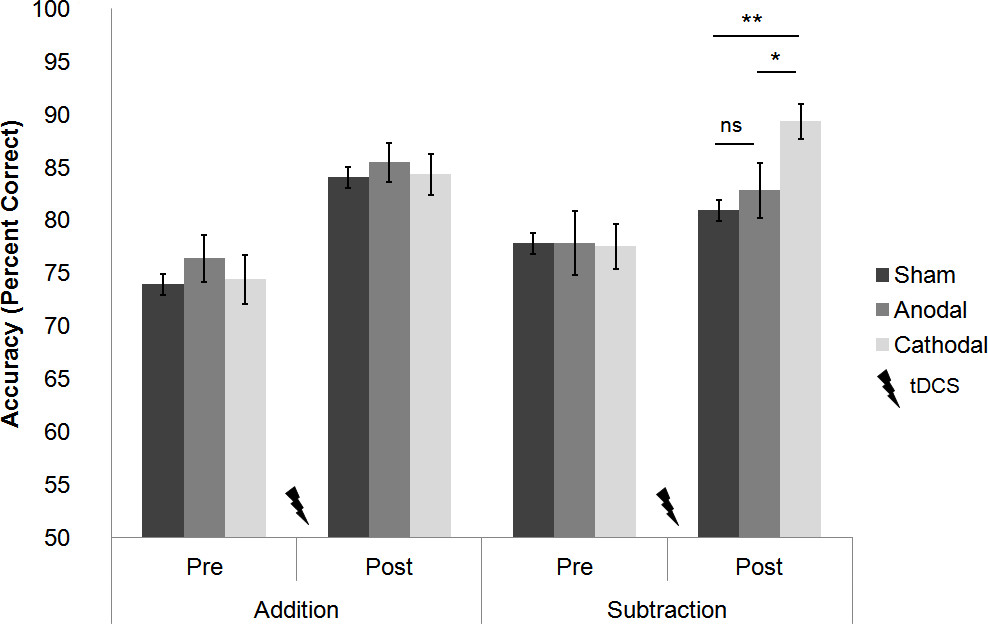
Figure 1: Accuracy scores before and after cerebellar tDCS. The numbers of correct responses (mean +1 SEM, n = 20) selectively improved after cathodal stimulation from session one (pre-stimulation) to session two (post-stimulation), significantly more in the subtraction task (PASST) than in the addition task (PASAT). Asterisks show significant differences (P <0.05) as revealed with corrected paired-comparisons. This figure has been modified from Pope and Miall1.
Verbal response times
Correct answers were significantly faster during the PASAT than during the PASST (1372 vs. 1447 msec; F1,57 = 11.70, P <0.001), and more so after tDCS (1446 vs. 1374 msec; F1,57 = 36.43, P <0.001). Indeed, the Task by Session by Group interaction was almost significant (F1,57 = 2.65, P = 0.08), whereby response times during the PASST decreased more after cathodal stimulation (1509 vs. 1322 msec), than after anodal (1491 vs. 1427 msec) or sham (1504 vs. 1427 msec) stimulation. This trend was not evident during the PASAT.
Response time variability
The consistency of response times also decreased significantly between session one (386 msec) and two (354 msec; F1,57 = 16.86, P <0.001) as shown in Figure 2b. Of special interest, the Task x Session x Group interaction was significant (F2,57 = 11.16, P <0.001). This result suggests that response time variability during the PASST decreased more after cathodal (403 vs. 273 msec), than after anodal (418 vs. 398 msec) or sham (396 vs. 368 msec). The reduction in response time variability was equal across the three stimulation groups during the addition task.
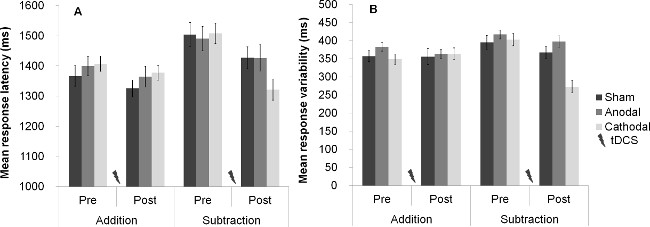
Figure 2: (A) Mean verbal response times before and after cerebellar tDCS. The mean of participants' verbal response times (mean +1 SEM, n = 20) selectively improved after cathodal stimulation from session one (pre-stimulation) to session two (post-stimulation), albeit not significantly (P = 0.08) in the subtraction task than in the addition task. This figure has been modified from Pope and Miall1. (B) Verbal response time variability before and after cerebellar tDCS. The variability (standard deviation) of participants' verbal response times (mean +1 SEM, n = 20) selectively improved significantly after cathodal stimulation between sessions during subtraction, but not during addition. This figure has been modified from Pope and Miall1.
Experiment Two (Language Tasks)
Mean total learning
An effect of learning between blocks 1-5 was calculated for each participant and found to be comparable during the noun (0.03 sec) and verb (0.03 sec) reading tasks, but greater during the verb generation task (0.20 sec [See Figure 3]) as revealed by a significant main effect of Task (F2,56 = 67.17, P <0.001). Interestingly, a significant Session x Task x Group interaction, (F4,114 = 2.44, P = 0.05) suggested that tDCS selectively improved learning between sessions on the verb generation task after cathodal (0.18 vs. 0.31 sec), but not after anodal (0.18 vs. 0.17 sec) or sham (0.17 vs. 0.19 sec).
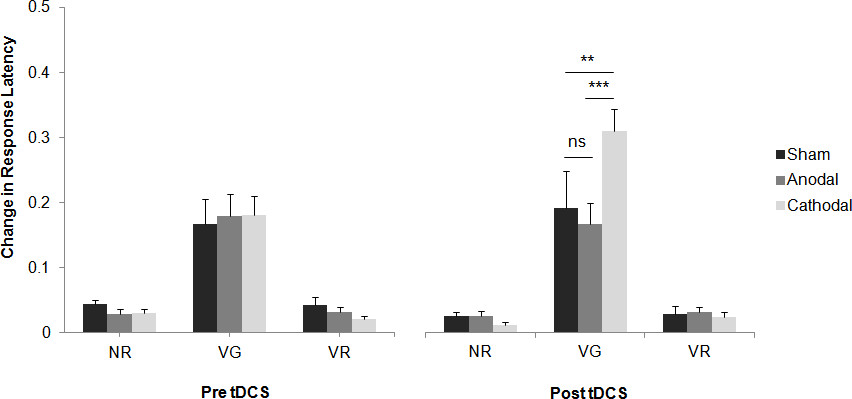
Figure 3: Mean total learning between repeated blocks. Mean responses (mean +1 SEM, n = 20) between blocks 1-5 were faster after tDCS during the verb generation (VG) task, than during the noun reading (NR), verb reading (VR) tasks. Asterisks show significant differences (P <0.05) as revealed with corrected paired-comparisons. This figure has been modified from Pope and Miall1.
Total learning variability
The consistency of learning between blocks 1-5 was also computed (See Figure 4), and found to be selectively improved during the verb generation task after cathodal (0.08 vs. 0.19 sec), but not after anodal (0.08 vs. 0.08 sec) or sham (0.08 vs. 0.06 sec) tDCS as marked by a significant Session x Task x Group interaction, (F4,114 = 2.23 P <0.05).
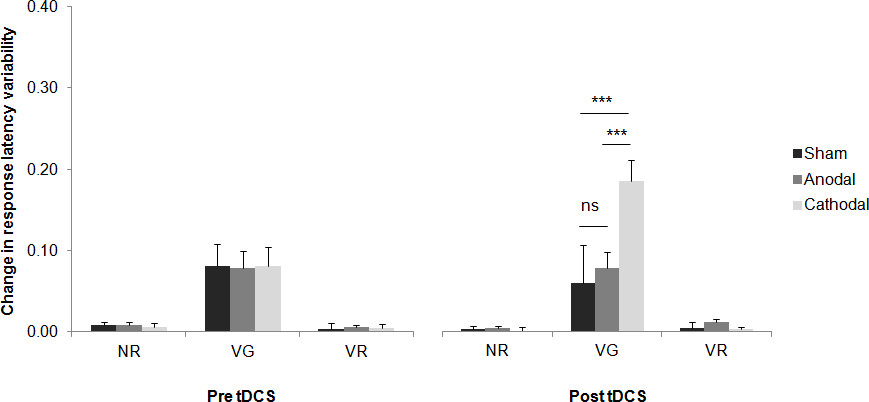
Figure 4: Total learning variability between repeated blocks. The variability of responses (mean SD +1 SEM, n = 20) between blocks 1-5 were more consistent after tDCS during the verb generation (VG) task, than during the noun reading (NR), verb reading (VR) tasks. Asterisks show significant differences (P <0.05) as revealed with corrected paired-comparisons. This figure has been modified from Pope and Miall1.
Discussion
TDCS has become a popular tool in recent years for studying brain-behaviour relationships. The present article describes a procedure for investigating cognitive functions of the cerebellum using tDCS and various tests of arithmetic and language that require varying degrees of working memory and attention. The results for experiment one showed how cathodal stimulation of the right cerebellar hemisphere improved task accuracy and verbal response variability (relative to anodal and sham stimulation) during a difficult and cognitively demanding information-processing task involving mental subtraction (the paced auditory serial subtraction task [PASST]), but not during a simpler and less demanding version involving mental addition (the paced auditory serial addition task [PASAT]). Since both these tasks share similar motor control (i.e., verbal operations), but dissimilar cognitive load (i.e., mental effort), we speculated in our previous study1 that cathodal depression of the right cerebellar cortex might release extra cognitive resources when task demands are high. Cathodal tDCS was expected to hyperpolarize the cerebellum, depress Purkinje cell output, and reduce cerebellar-brain inhibition (CBI20). This view is supported by the finding that functional connectivity between the cerebellum and the prefrontal cortex (i.e., cerebello-thalamo-cortical pathway10) during arithmetic is task- and difficulty- sensitive43. The results from experiment one cannot be explained by any change in cerebellar contribution to motor control, as these are comparable in the PASAT and the PASST, but the mental processes required to perform subtraction versus addition are different. The results from this experiment suggest instead that effects of cerebellar-tDCS on cognition are likely task- or load-specific. In experiment two, cathodal stimulation also selectively improved task performance during a language protocol, such that responses got faster and were more consistently timed over five consecutive blocks of trials in which participants generated verbs in response to visually presented nouns. This priming effect complemented the results from experiment one, and also findings by others showing how anodal tDCS over the left dorsolateral prefrontal cortex (DLPFC) can improve verbal fluency40 and picture naming latencies41,44– supporting the hypothesis that the same facilitation patterns may be observed after cathodal tDCS over the right cerebellar hemisphere (as observed in experiment two). Taken together, these findings support a role for the cerebellum – albeit indirect – in language, learning and memory45, lending further support to the idea that the cerebellum can influence cognitive processes in the prefrontal cortex: a major site for many working memory (WM) operations.
Cognitive enhancements are physiologically plausible because the cerebellum exerts a remote influence over excitability in the DLPFC, via excitation of the cerebro-cerebellar pathway. Further evidence for coupling between the cerebellum and the prefrontal cortex is described in the work by Hamada and colleagues, whereby associative plasticity induced by sensory/motor stimuli paired at 25 ms – paired associative stimulation (PAS), was observed to be blocked by cerebellar-tDCS46. And daily sessions of transcranial magnetic stimulation (TMS) over the cerebellum has been shown to improve postural control and walking, and dual-tasking in a patient with cerebellar atrophy47. These motor and cognitive improvements were marked by an increase in motor evoked potentials induced by motor cortical stimulation when the cerebellum was also excited a few milliseconds beforehand (investigated with dual-coil, paired-pulse TMS), due to reduced cerebellar-brain inhibition (CBI) that lasted 6 months after treatment. Farzan and colleagues47 credited the improvements in cognitive function to a consequence of enhanced motor function and the liberation of resources for the performance of the dual-task. The reduction in CBI induced by TMS may also have improved prefrontal cortical function directly, through exciting cerebro-cerebellar circuits – improving cognitive capacity. This latter explanation is in agreement with that observed using the methods described in the present article that demonstrate a procedure for selectively improving verbal WM after cerebellar-tDCS.
The methods described here demonstrate how electrical brain stimulation of the cerebellum can modulate cognitive functions and enhance performance during tasks that require a high level of cognitive load. This finding parallels the positive effects from stimulating the DLPFC, which can enhance arithmetic performance over long durations2, and facilitate solution generation for difficult problems, but not for easy problems3. In fact, tDCS over prefrontal cortex can enhance performance in a variety of cognitive tasks in healthy participants4,5, leading researchers to employ electrical brain stimulation as a therapeutic tool for treating cognitive deficits in patients after stroke48, and in patients with Parkinson's disease41. Indeed, future directions for tDCS include its use as a tool for modifying behaviour by inducing lasting changes in the brain. TDCS as a form of brain stimulation therapy is worth exploring in patient populations for obvious reasons24.
In this article, the most critical steps for successful modulation of cognition using tDCS are: 1) tailoring task-difficulty to participants' level of performance; 2) consistent and accurate placement of the stimulation electrode over the desired brain region; 3) ensuring that both electrodes are kept moist throughout the stimulation period to prevent the stimulator powering off (moisten with extra saline if necessary). It is also important to reassure participants (reducing anxiety) that sensations felt during stimulation disappear after a few seconds – leaving tDCS unperceived. Future modifications might include administering tDCS during task performance (or so it overlaps with behaviour) to investigate on-line effects. Task performance would then be compared between active and baseline conditions (i.e., anodal vs. sham and/or cathodal vs. sham), rather than comparing performance before and after the stimulation period. The long-term effectiveness of DC stimulation is also worth exploring from the perspective of using tDCS to remedy the symptoms of cognitive dysfunction, together with paradigms that may produce more robust effects. This may involve protocols that deliver a succession of short stimulation periods (rather than a single block), whereby subsequent sessions of tDCS 'top-up' the effects from the preceding session. Delivering multiple stimulation sessions may produce cumulative increases in performance, rather than lesser changes that develop more slowly over a single session. Challenges such as these and also future directions for clinical research with tDCS have been reviewed by Brunoni and colleagues49.
The potential for using tDCS as a therapeutic tool for remedying the cognitive symptoms of certain diseases will only emerge once the procedure has been better understood and mastered. For example, the effects of tDCS over motor cortex have recently been found to be highly variable between individuals, and not always polarity-specific22,23. The same has also been said for effects of tDCS in the cognitive domain23. There is still a limited about of data pertaining to the neuro-enhancing effects of tDCS in general. But it may be the case that off-line effects of tDCS over the cerebellum are most capable of improving behaviour when participants have to fully engage with a difficult cognitive task, or when they find the task difficult to perform because it makes high demands on WM and attentional resources. This view suggests that the effects of cerebellar-tDCS on cognition may be task- or load- dependent: mediated perhaps by improving cognitive functions in parts of the cerebro-cerebellar pathway that are active during stimulation. This interpretation of our data parallels well with that of on-line effects of tDCS on cognition, which are currently thought to be sensitive to the state of the active network during the time of stimulation50. TDCS may not lead to changes in performance if there are sufficient cognitive resources available to perform the task well, but only when the system is engaged so that it uses more resources. Indeed, fMRI studies show how neural activity in a frontal-parietal network is positively correlated with increased task complexity51.
To conclude, this article described a brain stimulation procedure that used tDCS to stimulate the cerebellum during a series of information-processing tasks with varying cognitive load, in which cathodal depression of cerebellar activity (and not anodal excitation) improved performance during attentionally demanding and difficult cognitive tasks. We speculated whether this might be achieved by dis-inhibition of WM regions of the prefrontal cortex: releasing extra cognitive resources when certain tasks are difficult to perform. A better understanding of individual factors that determine the efficacy of tDCS is now needed that will hopefully emerge from further study, together with improved protocols for delivering electrical brain stimulation in healthy and patient populations. Thus, future efforts might be guided towards remedying the cognitive symptoms of certain diseases using transcranial electrical brain stimulation as a cognitive rehabilitation tool to modulate cerebro-cerebellar circuits.
Disclosures
The author has nothing to disclose.
Acknowledgements
Acknowledgement: This work was funded by Wellcome Trust grant WT087554.
Materials
| Name | Company | Catalog Number | Comments |
|---|---|---|---|
| Headset | Beyerdynamic | DT234 Pro | Ensure the microphone does not move from the participants mouth in between testing. |
| DC stimulator | Magstim | DC Stimulator Plus | Electrode placement is a critical success factor for tDCS efficacy |
| Stimulus presentation and recording software | www.neurobs.com | Presentation (Version 14.2) | Maintain participant-specific stimulus presentation rate between sessions in experiment one |
References
- Pope, P. A., Miall, R. C. Task-specific facilitation of cognition by cathodal transcranial direct current stimulation of the cerebellum. Brain Stimulation. 5, 84-94 (2012).
- Snowball, A., et al. Long-term enhancement of brain function and cognition using cognitive training and brain stimulation. Current Biology. 23, 987-992 (2013).
- Metuki, N., Sela, T., Lavidor, M. Enhancing cognitive control components of insight problems solving by anodal tDCS of the left dorsolateral prefrontal cortex. Brain Stimulation. 5, 110-115 (2012).
- Zaehle, T., Sandmann, P., Thorne, J. D., Jäncke, L., Herrmann, C. S. Transcranial direct current stimulation of the prefrontal cortex modulates working memory performance: combined behavioural and electrophysiological evidence. BMC Neuroscience. 12, 2(2011).
- Fregni, F., et al. Anodal transcranial direct current stimulation of prefrontal cortex enhances working memory. Experimental Brain Research. 166, 23-30 (2005).
- Pope, P., Miall, R. C. How might the cerebellum participate in motor control, if life one is possible. ACNR. 10, 16-18 (2011).
- Hoover, J. E., Strick, P. L. The organization of cerebellar and basal ganglia outputs to primary motor cortex as revealed by retrograde transneuronal transport of herpes simplex virus type 1. Journal of Neuroscience. 19, 1446-1463 (1999).
- Kelly, R. M., Strick, P. L. Cerebellar loops with motor cortex and prefrontal cortex of a nonhuman primate. Journal of Neuroscience. 23, 8432-8444 (2003).
- Middleton, F. A., Strick, P. L. Cerebellar output: motor and cognitive channels. Trends in Cognitive Science. 2, 348-354 (1998).
- Middleton, F. A., Strick, P. L. Cerebellar 'projections' to the prefrontal cortex of the primate. Journal of Neuroscience. 21, 700-712 (2001).
- Balsters, J. H., et al. Evolution of the cerebellar cortex: The selective expansion of prefrontal-projecting cerebellar lobules. Neuroimage. 43, 388-398 (2010).
- Strick, P. L., Dum, R. P., Fiez, J. A. Cerebellum and non-motor function. Annual Review of Neuroscience. 32, 413-434 (2009).
- Schmahmann, J. D. An emerging concept: the cerebellar contribution to higher function. Archive of Neurology. 48, 1178-1187 (1991).
- Schmahmann, J. D. Dysmetria of thought: clinical consequences of cerebellar dysfunction on cognition and affect. Trends in Cognitive Science. 2, 362-371 (1998).
- Schmahmann, J. D., Sherman, J. C. The cerebellar cognitive affective syndrome. Brain. 121, 561-579 (1998).
- Stoodley, C. J., Schmahmann, J. D. Functional topography in the human cerebellum: a meta-analysis of neuroimaging studies. Neuroimage. 44, 489-501 (2009).
- Stoodley, C. J., Valera, E. M., Schmahmann, J. D. Functional topography of the cerebellum for motor and cognitive tasks: An fMRI study. Neuroimage. 59, 1560-1570 (2012).
- Heath, R. G., Llewellyn, R. C., Rouchell, A. M. The cerebellar pacemaker for intractable behavioral disorders and epilepsy: follow-up report. Biological Psychiatry. 15, 243-256 (1980).
- Parazzini, M., Rossi, E., Ferrucci, R., Liorni, I., Priori, A., Ravazzani, P. Modelling the electric field and the current density generated by cerebellar transcranial DC stimulation in humans. Clinical Neurophysiology. 125, 577-584 (2013).
- Galea, J. M., Jayaram, G., Ajagbe, L., Celnik, P. Modulation of cerebellar excitability by polarity-specific noninvasive direct current stimulation. Journal of Neuroscience. 29, 9115-9122 (2009).
- Middleton, F. A., Strick, P. L. Basal ganglia and cerebellar loops: motor and cognitive circuits. Brain Research Reviews. 31, 236-250 (2000).
- Wiethoff, S., Hamada, M., Rothwell, J. C. Variability in response to transcranial direct current stimulation of the motor cortex. Brain Stimulation. 3, 468-475 (2014).
- Jacobson, L., Koslowsky, M., Lavidor, M. tDCS polarity effects in motor and cognitive domains: a meta-analytical review. Experimental Brain Research. 216, 1-10 (2012).
- Pope, P. A., Miall, R. C. Restoring cognitive functions using non-invasive brain stimulation techniques in patients with cerebellar disorders. Frontiers in Psychiatry. 5, 33(2014).
- Ferrucci, R., et al. Cerebellar transcranial direct current stimulation impairs the practice-dependent proficiency increase in working memory. Journal of Cognitive Neuroscience. 20, 1687-1697 (2008).
- Boehringer, A., Macher, K., Dukart, J., Villringer, A., Pleger, B. Cerebellar transcranial direct current stimulation modulates verbal working memory. Brain Stimulation. 6, 649-653 (2013).
- Stagg, C. J., Nitsche, M. A. Physiological Basis of Transcranial Direct Current Stimulation. Neuroscientist. 17, 37-53 (2011).
- Gronwall, D. M. Paced auditory serial-addition task: a measure of recovery from concussion. Perceptual and Motor Skills. 44, 367-373 (1977).
- Lockwood, A. H., Linn, R. T., Szymanski, H., Coad, M. L., Wack, D. S. Mapping the neural systems that mediate the Paced Auditory Serial Addition Task (PASAT). Journal of the International Neuropsychological Society. 10, 26-34 (2004).
- Hayter, A. L., Langdon, D. W., Ramnani, N. Cerebellar contributions to working memory. Neuroimage. 36, 943-954 (2007).
- Yasuda, K., Sato, Y., Iimura, N., Iwata, H. Allocation of Attentional Resources toward a Secondary Cognitive Task Leads to Compromised Ankle Proprioceptive Performance in Healthy Young Adults. Rehabilitation Research and Practice. 2014, (2014).
- Fiez, J. A., Peterson, S. E., Cheney, M. K., Raichle, M. E. Impaired non-motor learning and error detection associated with cerebellar damage. A single case study. Brain. 115, 155-178 (1992).
- Raichle, M. E., et al. Practice-related changes in human brain functional anatomy during nonmotor learning. Cerebral Cortex. 4, 8-26 (1994).
- Petersen, S. E., Fox, P. T., Posner, M. I., Mintun, M., Raichle, M. E. Positron emission tomographic studies of the cortical anatomy of single-word processing. Nature. 331, 585-589 (1988).
- Petersen, S. E., Fox, P. T., Posner, M. I., Mintun, M., Raichle, M. E. Positron emission tomographic studies of the processing of single words. Journal of Cognitive Neuroscience. 1, 153-170 (1989).
- Ackermann, H., Wildgruber, D., Daum, I., Grodd, W. Does the cerebellum contribute to cognitive aspects of speech production? A functional magnetic resonance imaging (fMRI) study in humans. Neuroscience Letters. 247, 187-190 (1998).
- Seger, C. A., Desmond, J. A., Glover, G. A., Gabrieli, J. D. E. Functional magnetic resonance imaging evidence for right-hemisphere involvement in processing unusual semantic relationships. Neuropsychology. 14, 361-369 (2000).
- Nitsche, M. A., Liebetanz, D., Antal, A., Lang, N., Tergau, F., Paulus, W. Modulation of cortical excitability by weak direct current stimulation–technical, safety and functional aspects. Supplements to Clinical Neurophysiology. 56, 255-276 (2003).
- Hummel, F., et al. Effects of non-invasive cortical stimulation on skilled motor function in chronic stroke. Brain. 128, 490-499 (2005).
- Iyer, M. B., Mattu, U., Grafman, J., Lomarev, M., Sato, S., Wassermann, E. M. Safety and cognitive effect of frontal DC brain polarization in healthy individuals. Neurology. 64, 872-875 (2005).
- Boggio, P. S., et al. Effects of transcranial direct current stimulation on working memory in patients with Parkinson's disease. Journal of Neurological Sciences. 249, 31-38 (2006).
- Davis, N., Gold, E., Pascual-Leone, A., Bracewell, R. Challenges of proper placebo control for noninvasive brain stimulation in clinical and experimental applications. European Journal of Neuroscience. 38, 2973-2977 (2013).
- Feng, S., Fan, Y., Yu, Q., Lu, Q., Tang, Y. Y. The cerebellum connectivity in mathematics cognition. BMC Neuroscience. 9, P155(2008).
- Fertonani, A., Rosini, S., Cotelli, M., Rossini, P. M., Miniussi, C. Naming facilitation induced by transcranial direct current stimulation. Behavioral Brain Research. 208, 311-318 (2010).
- Desmond, J. E., Fiez, J. A. Neuroimaging studies of the cerebellum: Language, learning and memory. Trends in Cognitive Science. 2, 355-362 (1998).
- Hamada, M., et al. Cerebellar modulation of human associative plasticity. Journal of Physiology. 590, 2365-2374 (2012).
- Farzan, F., et al. Cerebellar TMS in treatment of a patient with cerebellar ataxia: evidence from clinical, biomechanics and neurophysiological assessments. Cerebellum. 12, 707-712 (2013).
- Jo, J. M., Kim, Y. H., Ko, M. H., Ohn, S. H., Joen, B., Lee, K. H. Enhancing the working memory of stroke patients using tDCS. American journal of Physical Medicine and Rehabilitation. 88, 404-409 (2009).
- Brunoni, A. R., et al. Clinical Research with Transcranial Direct Current Stimulation (tDCS): Challenges and Future Directions. Brain Stimulation. 5, 175-195 (2012).
- Miniussi, C., Harris, J. A., Ruzzoli, M. Modelling non-invasive brain stimulation in cognitive neuroscience. Neuroscience & Biobehavioral Reviews. 37, 1702-1712 (2013).
- Kroger, J. K., Sabb, F. W., Fales, C. L., Bookheimer, S. Y., Cohen, M. S., Holyoak, K. J. Recruitment of Anterior Dorsolateral Prefrontal Cortex in Human Reasoning: a Parametric Study of Relational Complexity. Cerebral Cortex. 12, 477-485 (2001).
Reprints and Permissions
