Different levels and patterns of fluid shear are known to modulate endothelial gene expression, phenotype and susceptibility to disease. We discuss the assembly and use of 'shear rings': a model that produces unidirectional, periodic shear stress patterns. Shear rings are simple to assemble, economical and can produce high cell yields.
A subscription to JoVE is required to view this content. Sign in or start your free trial.
Method Article
The Assembly and Application of 'Shear Rings': A Novel Endothelial Model for Orbital, Unidirectional and Periodic Fluid Flow and Shear Stress
In This Article
Summary
Abstract
Deviations from normal levels and patterns of vascular fluid shear play important roles in vascular physiology and pathophysiology by inducing adaptive as well as pathological changes in endothelial phenotype and gene expression. In particular, maladaptive effects of periodic, unidirectional flow induced shear stress can trigger a variety of effects on several vascular cell types, particularly endothelial cells. While by now endothelial cells from diverse anatomic origins have been cultured, in-depth analyses of their responses to fluid shear have been hampered by the relative complexity of shear models (e.g., parallel plate flow chamber, cone and plate flow model). While these all represent excellent approaches, such models are technically complicated and suffer from drawbacks including relatively lengthy and complex setup time, low surface areas, requirements for pumps and pressurization often requiring sealants and gaskets, creating challenges to both maintenance of sterility and an inability to run multiple experiments. However, if higher throughput models of flow and shear were available, greater progress on vascular endothelial shear responses, particularly periodic shear research at the molecular level, might be more rapidly advanced. Here, we describe the construction and use of shear rings: a novel, simple-to-assemble, and inexpensive tissue culture model with a relatively large surface area that easily allows for a high number of experimental replicates in unidirectional, periodic shear stress studies on endothelial cells.
Introduction
Fluid shear stress has been shown to modulate endothelial gene programs1-5 through activation of cis-regulatory elements6, histone acetyltransferase activity7 and shear stress response elements (SSRE)8. Shear stress influences endothelial contributions towards coagulation by modulating tissue factor9 and tissue plasminogen activator (tPA)10 expression. Shear stress also influences control of angiogenesis11 and vessel remodeling by regulating PDGF-B synthesis and responsiveness8. The endothelial derived vasoactive mediators adrenomedullin, endothelin-1, urotensin II and relaxin are also regulated by shear12. Transcription of endothelial nitric oxide synthase production and nitric oxide production are both shear dependent10. Shear also controls endothelial ICAM-1 expression13. Flow-induced shear stress can therefore powerfully influence a large variety of endothelial responses. Importantly, vascular pulsations now also appear to play important roles in the pathophysiology of both normal vascular aging and forms of vascular dementia14 and may even contribute to other neurodegenerative diseases, such as multiple sclerosis15.
Venous and arterial endothelial cells are inherently exposed to diverse hemodynamic flow patterns in vivo, and many different endothelial cell phenotypes can be exhibited16. Depending on the magnitude and periodicity of flow, effects on endothelial cells may include inflammatory cell activation and apoptosis, which may reflect changes in gene or protein expression17,18. Studies on endothelial cell responses to shear phenomena therefore remain complicated by the difficulties in producing in vitro models that adequately produce such shear patterns.
Many different experimental protocols have been developed to apply fluid shear stress to endothelial cell monolayers. One of the most commonly used systems is the parallel plate flow chamber, which creates uniform laminar flow within the chamber19-21. A peristaltic pump is typically connected to create periodic flow, which can recapitulate flow characteristics typically found in many locations in vivo22. Another common set-up uses the 'cone and plate' model, where fluid shear stress is determined by the rotational speed of the cone23. Both systems, and other arrangements similar to them, can be tedious to set up and require components that can be relatively expensive and inaccessible to many laboratories.
Another major limitation of these current models is the relatively low number of replicate studies that can be simultaneously performed, each with a relatively low surface area. This increases the time and complexity of such approaches. Therefore, an ideal model that induces unidirectional and periodic shear might be one where a high number of study replicates can be easily set up, each with a relatively large surface area. Furthermore, the aforementioned models require a fairly sophisticated setup, which may be cost-prohibitive for many users. A model that can produce fluid shear disturbances using basic laboratory materials might have several advantages.
A simple and highly economical method of applying unidirectional, periodic shear stress involves the placement of circular dishes on an orbital shaker24. This protocol is very simple and can be scaled up to achieve high numbers of study replicates, each with a relatively large surface area, as needed. However, cells located in the center of the dish are exposed to different flow patterns than cells along the periphery, yielding mixed cellular phenotypic responses in the same dish.
In this current report, we describe the construction and use of 'shear rings', our model for creating unidirectional and periodic shear stress. The design for the shear ring effectively limits 'mixed' cellular shear-induced phenotypes by restricting the flow pathway within a circular culture dish to the periphery through the placement of an inner ring. The construction and operation of the shear ring is simple and economical and can be easily scaled to accommodate a wide range of orbital shakers using widely available tissue culture supplies. This model can be applied in endothelial cell experiments to provide unidirectional and periodic flow patterns within physiological and pathophysiological levels.
Access restricted. Please log in or start a trial to view this content.
Protocol
1. Construction of 150 mm Diameter Shear Rings (Figure 1)
NOTE: Shear rings may be constructed to create many different dimensions by varying the outer and inner Petri dish sizes, resulting in devices with different total surface areas, cell yields and developed ranges of shear forces. This report describes a 150 mm dish combined with an inner 100 mm dish for a total surface area of 98 cm2 (Figure 2).
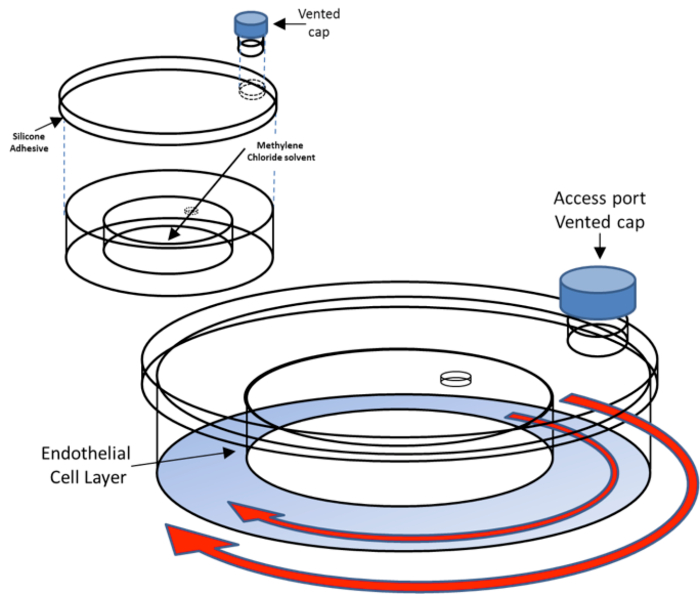
Figure 1. Shear ring assembly. The top portion of the figure shows a partially assembled shear ring. Inject 0.5 ml of methylene chloride through the 3 mm hole with a transfer pipet if a tight seal has not completely formed between the inner and outer dishes. The shear ring is sealed shut by applying a 1 mm thick bead of silicon rubber adhesive around the inner edge of the shear ring top. The bottom portion of the figure shows the assembled shear ring. The blue represents the area of plated endothelial cells. The outer and inner red arrows indicate the orbital motion of the shear ring and media inside the shear ring when placed on an orbital shaker. Please click here to view a larger version of this figure.

Figure 2. Surface measurements for a 150 mm shear ring (not drawn to scale). Top panel shows centrifugal shifting of fluid towards outer ring in response to orbital rotation. Please click here to view a larger version of this figure.
- Create a shear ring construction template by generating a 150 mm outer edge profile in presentation software with a 100 mm internal diameter placed in the center of the 150 mm circle. Print the template on a sheet of A4 white paper.
- Pipet 10 ml of methylene chloride (dichloromethane) into a 150 mm glass Petri dish. It is critical that the dish is glass and not polystyrene (or other vinyl plastic), as methylene chloride solubilizes most plastics and is used here to join plastic components.
CAUTION: Use gloves for all construction with adequate hood ventilation. Methylene chloride is a contact irritant and is hepatotoxic. - Align a 150 mm plastic Petri dish onto the outer shear ring template.
- Drill a 3 mm hole in the center of a 100 mm dish using a rotary tool. Remove any plastic shavings produced from the drilling.
- While holding with a gloved hand, invert and dip the top edge of the 100 mm Petri dish from the previous step into the pool of methylene chloride for approximately 3 sec.
- Transfer the "wetted" 100 mm dish edge-down onto the center of a 150 mm dish, carefully aligning the 100 mm dish onto the marked template. The methylene chloride will fuse the plastic, joining the 100 mm and 150 mm dishes. Gently rotate the 100 mm dish clockwise and counterclockwise a few times to ensure good adhesion to the 150 mm dish.
NOTE: Take great care to ensure proper alignment of the inner dish to the center of the outer dish. Eccentric alignment may result in variations of the shear stress at different locations in the shear ring. Take care to not allow methylene chloride to accidentally drip onto the outer track portion of the 150 mm Petri dish during the placement of the 100 mm dish. This will melt the plastic on the bottom surface where cells will be growing, creating an uneven surface that may cause flow disturbances. - Once the methylene chloride has dried, flip the newly bound Petri dishes over and carefully inspect the points of contact to ensure that a tight seal has been formed between the two Petri dishes.
- If a tight seal has not completely formed, inject 0.5 ml of methylene chloride through the 3 mm hole with a transfer pipet. Pick up the dish and gently rotate it to allow the methylene chloride to reach the edge.
NOTE: If rotated too quickly, the methylene chloride can spill into the outer portion of the 150 mm dish, deforming the surface where cells will grow and ruining the shear ring. Leaking shear rings should be discarded. - Seal off the hole in the 100 mm dish by applying a 3 mm bead of silicon rubber sealant.
- Using a rotary tool fitted with a flat cutting head, cut off the top 3 cm portion of a 15 ml conical polystyrene tissue culture tube, leaving at least 1 cm of the tube below the cap. Polish the edge of the cut tube until smooth and flat using the flat side of the cutting head. Remove any plastic shavings produced by grinding.
- Trace the cut off 15 ml conical tube onto the lid of the 150 mm dish with a marker, approximately 0.5 cm away from the edge of the dish. Drill a hole inside the drawn circle, leaving a margin approximately 1-2 mm from the edge of the circle.
- Place the cut off conical tube top over the drilled hole. Using a transfer pipet, apply approximately 250 µl of methylene chloride to the cut off edges of the conical tube to bind the conical tube to the 150 mm lid.
- Seal the 150 mm lid onto the 150 mm dish by applying a 1 mm thick bead of silicon rubber sealant around the inner edge of the top Petri dish.
2. Sterilization of Shear Rings
- Pipet approximately 10 ml of phosphate buffered saline into the newly formed shear ring through the 15 ml conical tube port. Swirl around to remove any debris inside the shear ring. Remove the phosphate buffered saline with a Pasteur pipet/vacuum aspirator.
- Repeat the previous step until debris is removed.
- To sterilize the shear ring, use a combination of a 70% ethanol rinse with UV irradiation.
- Unscrew the vented cap, pipet approximately 10 ml of 70% ethanol through the access port, and screw the cap back on. Rotate and flip over the shear ring multiple times, ensuring that the inside of the shear ring is thoroughly washed.
- Under a fume hood, aspirate out excess 70% ethanol. With a spray bottle, thoroughly spray the cap and access port with 70% ethanol.
- Place the shear ring and cap under UV radiation within the tissue culture hood until completely dry.
- Once dry, screw the cap back on and store sterilized shear rings at room temperature until used in cell culture plating.
3. Shear Stress Studies
- Plate endothelial cells in sterilized shear rings following the standard cell culture protocol typically using a 1:4 split ratio for transformed endothelial cell lines.
NOTE: Rat retinal microvascular endothelial cells were obtained commercially. Human brain endothelial cells (hCMEC/D3) cells were provided as a generous gift from Dr. Pierre-Oliver Couraud (Inserm, France) and were cultured in complete endothelial basal medium (EBM). - Allow cultures to reach confluence prior to initiation of flow studies. Use 30 ml of tissue culture media (10% fetal calf serum, Dulbecco's modified Eagle's medium with 1% penicillin/streptomycin/amphotericin). Change cell culture medium every 3 days and maintain cells at 37 °C with 7.5% CO2 and 92.5% room air.
- Place the orbital shaker in the incubator.
Note: Orbital shakers are typically heavy (>10 kg). Place the orbital shaker on the bottom shelf of the incubator to minimize shelf stress and vibration. - Place the experimental shear rings on the orbital shaker. Place static control group shear rings inside the same incubator.
- Estimate the maximum shear stress within the shear ring with the equation
 where
where  is the radius of rotation for the orbital shaker (in cm),
  is the viscosity of the medium (in poise),
  is the density of the medium (in g/ml), and
  is the frequency of rotation (in rotation/sec)24.
 - Initiate the rotation setting on the orbital shaker to the desired rpm (e.g., 90 rpm), leaving the shear rings on the shaker for the desired duration of shear stress application (e.g., 72 hr).
NOTE: Orbital shakers can produce heat, so the incubator temperature should be monitored initially to ensure 37 °C is maintained throughout the duration of the experiment. Alternatively, shear rings can be transferred into environmental chambers (e.g., modular incubator chamber) and then placed within a rotating incubator. - After cell layers have been exposed to shear for the desired length of time, remove shear rings from the incubator. Pull off the shear ring lid and retrieve cells and/or media for examining desired endpoint analyses (e.g., Western blotting, fluorescence activated cell sorting, etc.)25.
Access restricted. Please log in or start a trial to view this content.
Results
Here we present representative results from both hCMEC/D3 brain endothelial cell and rat retinal microvascular endothelial cell monolayers, cultured in shear rings.
After allowing hCMEC/D3 brain endothelial cell monolayers to grow to confluence in complete EBM, the shear rings were placed on an orbital shaker for 72 hours. Using the equation from step 3.5, the calculated maximal shear stress
Access restricted. Please log in or start a trial to view this content.
Discussion
The construction of the shear ring system for exposing endothelial cells to shear is a simple approach to performing shear stress studies. Nevertheless, there are a few steps that are critical for obtaining superior shear rings and better results. A complete seal should be made between the inner and outer ring to prevent media from leaking which could create inconsistent shear stress among samples. If a complete seal is not made, a minimal amount of methylene chloride should be added to the edge between the inner and out...
Access restricted. Please log in or start a trial to view this content.
Disclosures
J. Winny Yun has a research grant from the Annette Funicello foundation. J. Steven Alexander has research support from the Department of Neurology, LSUHSC-S.
Acknowledgements
The authors would like to acknowledge the assistance of Mr. Christopher Nguyen, Aaron Hunter and the Shreveport Jumpstart, SMART, and Biostart training programs as well as the Centenary College of Louisiana department of Biophysics, Shreveport, LA.
Access restricted. Please log in or start a trial to view this content.
Materials
| Name | Company | Catalog Number | Comments |
|---|---|---|---|
| 100 x 20 mm plastic tissue culture dish | Corning | 430167 | The dishes must be polystyrene |
| 150 x 25 mm plastic tissue culture dish | Corning | 430599 | The dishes must be polystyrene |
| 150 mm glass Petri dish | Fisher | 3160150BO | |
| 15 ml polystyrene tissue culture plastic tubes | Falcon | 352099 | |
| Methylene chloride | Sigma-Aldrich | D65100 | |
| silicone rubber sealant | DAP | 7079808641 | |
| ethanol | Decon | 2701 | |
| 3 ml transfer pipette | Becton-Dickinson | 357524 | |
| printer paper | |||
| scissors | |||
| gloves | |||
| rotary tool and set | Dremel | 4000-6/50 | |
| rotary tool cutting head | Dremel | EZ476 | |
| rotary tool drill head | |||
| distilled water | |||
| orbital shaker | VWR | 57018-754 | |
| incubator | |||
| Rat retinal microvascular endothelial cells | Cell Biologics | RA-6065 |
References
- Resnick, N., Gimbrone, M. A. Hemodynamic forces are complex regulators of endothelial gene expression. FASEB J. 9 (10), 874-882 (1995).
- Malek, A. M., Izumo, S. Control of endothelial cell gene expression by flow. J Biomech. 28 (12), 1515-1528 (1995).
- Ando, J., Kamiya, A. Flow-dependent Regulation of Gene Expression in Vascular Endothelial Cells. Jpn Heart J. 37 (1), 19-32 (1996).
- Resnick, N., Yahav, H., et al. Endothelial Gene Regulation by Laminar Shear Stress. Adv Exp Med Biol. 430, 155-164 (1997).
- Gaucher, C., et al. In vitro impact of physiological shear stress on endothelial cells gene expression profile. Clin Hemorheol Mico. 37 (1-2), 99-107 (2007).
- Fisslthaler, B., et al. Identification of a cis -Element Regulating Transcriptional Activity in Response to Fluid Shear Stress in Bovine Aortic Endothelial Cells. Endothelium-J Endoth. 10 (4-5), 267-275 (2003).
- Chen, W., Bacanamwo, M., Harrison, D. G. Activation of p300 Histone Acetyltransferase Activity Is an Early Endothelial Response to Laminar Shear Stress and Is Essential for Stimulation of Endothelial Nitric-oxide Synthase mRNA Transcription. J Biol Chem. 283 (24), 16293-16298 (2008).
- Sumpio, B. E., et al. Regulation of PDGF-B in Endothelial Cells Exposed to Cyclic Strain. Arterioscl Throm Vas. 18 (3), 349-355 (1998).
- Yang, Y., et al. Triplex-forming oligonucleotide inhibits the expression of tissue factor gene in endothelial cells induced by the blood flow shear stress in rats. Acta Pharm Sinic. 41 (9), 808-813 (2006).
- Sumpio, B. E., Chang, R., Xu, W. -J., Wang, X. -J., Du, W. Regulation of tPA in endothelial cells exposed to cyclic strain: role of CRE, AP-2, and SSRE binding sites. Am J Physiol. 273 (5 Pt 1), C1441-C1448 (1997).
- Silberman, M., et al. Shear stress-induced transcriptional regulation via hybrid promoters as a potential tool for promoting angiogenesis. Nato Adv Sci Inst Se. 12 (3), 231-242 (2009).
- Dschietzig, T., et al. Flow-induced pressure differentially regulates endothelin-1, urotensin II, adrenomedullin, and relaxin in pulmonary vascular endothelium. Biochem Biophys Res Commun. 289 (1), 245-251 (2001).
- Nagel, T., Resnick, N., Atkinson, W. J., Dewey, C. F., Gimbrone, M. A. Shear stress selectively upregulates intercellular adhesion molecule-1 expression in cultured human vascular endothelial cells. J Clin Invest. 94 (2), 885-891 (1994).
- Bateman, G. A., Levi, C. R., Schofield, P., Wang, Y., Lovett, E. C. The venous manifestations of pulse wave encephalopathy: windkessel dysfunction in normal aging and senile dementia. Neuroradiology. 50 (6), 491-497 (2008).
- Juurlink, B. H. J. Is there a pulse wave encephalopathy component to multiple sclerosis. Curr Neurovasc Res. 12 (2), 199-209 (2015).
- Topper, J. N., Gimbrone, M. A. Jr Blood flow and vascular gene expression: fluid shear stress as a modulator of endothelial phenotype. Mol Med Today. 5 (1), 40-46 (1999).
- Tzima, E., et al. A mechanosensory complex that mediates the endothelial cell response to fluid shear stress. Nature. 437 (7057), 426-431 (2005).
- Li, Y. -S. J., Haga, J. H., Chien, S. Molecular basis of the effects of shear stress on vascular endothelial cells. J Biomech. 38 (10), 1949-1971 (2005).
- Reinhart-King, C. A., Fujiwara, K., Berk, B. C. Physiologic Stress-Mediated Signaling in the Endothelium. Method Enzymol. 443, 25-44 (2008).
- Frangos, J. A., McIntire, L. V., Eskin, S. G. Shear stress induced stimulation of mammalian cell metabolism. Biotechnol Bioeng. 32 (8), 1053-1060 (1988).
- Lane, W. O., et al. Parallel-plate Flow Chamber and Continuous Flow Circuit to Evaluate Endothelial Progenitor Cells under Laminar Flow Shear Stress. J Vis Exp. (59), (2012).
- Reinitz, A., DeStefano, J., Ye, M., Wong, A. D., Searson, P. C. Human brain microvascular endothelial cells resist elongation due to shear stress. Microvasc Res. 99, 8-18 (2015).
- Dewey, C. F., Bussolari, S. R., Gimbrone, M. A., Davies, P. F. The Dynamic Response of Vascular Endothelial Cells to Fluid Shear Stress. J Biomed Eng. 103 (3), 177(1981).
- Dardik, A., et al. Differential effects of orbital and laminar shear stress on endothelial cells. J Vasc Surg. 41 (5), 869-880 (2005).
- Honda, S., et al. Ligand-induced adhesion to activated endothelium and to vascular cell adhesion molecule-1 in lymphocytes transfected with the N-formyl peptide receptor. J Immunol. 152 (8), 4026-4035 (1994).
- Watt, S. M., Gschmeissner, S. E., Bates, P. A. PECAM-1: its expression and function as a cell adhesion molecule on hemopoietic and endothelial cells. Leukemia Lymphoma. 17 (3-4), 229-244 (1995).
- Fujiwara, K. Platelet endothelial cell adhesion molecule-1 and mechanotransduction in vascular endothelial cells. J Intern Med. 259 (4), 373-380 (2006).
- Dusserre, N. PECAM-1 Interacts With Nitric Oxide Synthase in Human Endothelial Cells: Implication for Flow-Induced Nitric Oxide Synthase Activation. Arterioscl Throm Vas. 24 (10), 1796-1802 (2004).
- Bagi, Z. PECAM-1 Mediates NO-Dependent Dilation of Arterioles to High Temporal Gradients of Shear Stress. Arterioscl Throm Vas. 25 (8), 1590-1595 (2005).
Access restricted. Please log in or start a trial to view this content.
Reprints and Permissions
