This paper describes a protocol to achieve 3D chemical maps combining energy filtered imaging and electron tomography. The chemical distribution of two catalyst supports formed by elements that are difficult to distinguish by other imaging techniques was studied. Each application consists of mapping overlapped chemical elements - respectively spaced-ionization edges.
A subscription to JoVE is required to view this content. Sign in or start your free trial.
Method Article
Obtaining 3D Chemical Maps by Energy Filtered Transmission Electron Microscopy Tomography
In This Article
Summary
Abstract
Energy filtered transmission electron microscopy tomography (EFTEM tomography) can provide three-dimensional (3D) chemical maps of materials at a nanometric scale. EFTEM tomography can separate chemical elements that are very difficult to distinguish using other imaging techniques. The experimental protocol described here shows how to create 3D chemical maps to understand the chemical distribution and morphology of a material. Sample preparation steps for data segmentation are presented. This protocol permits the 3D distribution analysis of chemical elements in a nanometric sample. However, it should be noted that currently, the 3D chemical maps can only be generated for samples that are not beam sensitive, since the recording of filtered images requires long exposure times to an intense electron beam. The protocol was applied to quantify the chemical distribution of the components of two different heterogeneous catalyst supports. In the first study, the chemical distribution of aluminum and titanium in titania-alumina supports was analyzed. The samples were prepared using the swing-pH method. In the second, the chemical distribution of aluminum and silicon in silica-alumina supports that were prepared using the sol-powder and mechanical mixture methods was examined.
Introduction
The properties of functional materials are dependent on their 3D parameters. To fully comprehend their properties and enhance their functions, it is important to analyze their morphology and chemical distribution in 3D. Electron tomography1 (ET) is one of the best techniques to provide this information at the nanometer scale2,3. It consists of rotating the sample over a large angular range and recording one image at each angular step. The obtained tilt series is used to reconstruct the volume of the sample by using mathematical algorithms based on the Radon transform4,5. Selecting grey levels in the volume helps to model the sample in 3D and quantify 3D parameters like particle localization6 and size distribution7, pore position and size distribution8, etc.
In general, ET is performed with an electron microscope by tilting the sample to the maximum possible angle, preferably more than 70° in either direction. At each tilt angle, a projection of the sample is recorded forming an images tilt series. That tilt series is aligned and used to reconstruct the volume of the sample which will be segmented and quantified. Because the sample cannot be rotated from -90° to +90°, the reconstructed volume has an anisotropic resolution along the orthogonal axis9 due to the blind recording angle.
ET can be performed in different imaging modes. The bright field TEM mode (BF-TEM) is used to study amorphous materials, biological samples, polymers, or catalyst supports with complex shapes. The image analysis is based on the differentiation of the gray levels characterizing the density of the components10 (a dense component will be more dark than a lighter, i.e., less dense component). High-angle annular dark field in scanning TEM mode (HAADF-STEM) is used to analyze crystalline samples. The signal provides chemical information as a function of the atomic number; a heavy component of the sample will appear brighter that a lighter one9. Other modes, like Energy Dispersive X-ray spectroscopy (EDX), which collects the X-ray emitted by the material11, and energy filtered imaging mode (EFTEM)12,13, are also capable of assessing the 3D chemical distribution within the sample.
In EFTEM imaging, the 2D chemical maps can be recorded using a TEM with an electron energy spectrometer. The spectrometer acts as a magnetic prism by dispersing the electrons as a function of their energy. An image is created by the electrons depending on the energy lost from interacting with a specific atom. If the same 2D chemical map is computed at different tilt angles, a tilt series of chemical projections is obtained, which can be used to reconstruct the 3D chemical volume.
Not all the materials can be analyzed by EFTEM tomography. The technique is reserved for samples with weak or disordered materials. Nevertheless, it can be used for analyzing light elements that are very difficult to differentiate when using other imaging techniques. In addition, to obtain reliable 2D chemical maps, the thickness of the material is required to be less than the mean free path of the electrons through the material14. Under this condition, the probability of having a single electron interacting with a single atom is greatest. Two methods are used to calculate a 2D chemical map. The first one, and the most used is the "three-windows method", where two filtered energy windows are recorded before the ionization edge of the element under analysis, and a third after the ionization edge13. The first two images are used to estimate the background, which is extrapolated using a power law at the position of the third window and subtracted from it. The obtained image is the projection of the 3D distribution of the analyzed chemical element in the sample volume. The second method is called the "jump-ratio"; it uses only two energy-filtered images, one before and one after the ionization edge. This method is qualitative, as the final image is calculated only by performing the ratio between those two images, and does not account for background energy variation.
By combining EFTEM with ET, the analytical tomography of the filtered energy can be obtained. EFTEM tomography and atom probe tomography (APT) are complementary techniques. As compared to APT, EFTEM tomography is a non-destructive characterization analysis that does not need complex sample preparation. It can be used to perform various characterizations on a unique nanoparticle. EFTEM tomography can analyze insulating materials, while APT needs at the very least laser assistance to measure them. APT runs at the atomic scale, while EFTEM tomography performs adequately with a lower resolution. EFTEM tomography is pertinent only for samples that resist beam degradation during the experiment. To record all the filtered images at all the tilted angles, the sample can be exposed to the electron beam for as long as 2 h. Moreover, to record a maximum chemical signal in the 2D maps, longer exposition durations at high beam intensity may be necessary. In such conditions, the beam sensitive samples suffer drastic morphological and chemical changes. Therefore, a precise measurement of the sample sensitivity to the electron beam must be established before the experiment. In addition, EFTEM tomography is the result of recording as many tomograms as necessary to determine the spatial location and nature of the chemical elements that are present in the sample. Nevertheless, EFTEM tomography can provide important information concerning the 3D chemical distribution for samples, such as catalyst supports, to give new insights for modeling their catalytic applications.
Today it is possible to use dedicated software that can select the energy interval, record filtered energy window images, and calculate the chemical maps at different tilt angles. They allow tilting the sample, tracking, focusing, and recording the filtered image in EFTEM mode. The 2D chemical maps can be calculated, and then the tilt series can be aligned, the chemical volume computed using iterative algorithms, and finally the series can be segmented and quantified15,16.
Access restricted. Please log in or start a trial to view this content.
Protocol
1. Sample Preparation
- Crush the sample in a mortar and disperse it in alcohol or distilled water; place a droplet of the sample on a microscopy grid and let it dry.
NOTE: Samples such as silica alumina or titania alumina can be a powder or an extruded material, and can be crushed and dispersed in a solution using ultrasound. In general, for ET analysis, it is important that the sample concentration on the grid is low, to avoid sample superposition and shadowing when tilting the grid at large angles. The 200-mesh microscopy grids that support a film of holey carbon or lacey carbon are recommended. - Using a pipette, put a droplet of a colloidal solution containing fiducial markers over the sample. Absorb any excess solution and let it dry.
NOTE: The fiducial markers are well-calibrated Au nanoparticles suspended in a solution. The fiducial markers can be also dispersed over the grid before adding the sample. As an example, if the sample is made from nanoparticles with similar sizes as the fiducial markers, deposit the fiducial markers over the grid in order to separate them well during the data segmentation and quantification. The fiducial markers are position references used when aligning the tilted images.
2. Recording of the Filtered Tilt Series Images
- With the electron microscope, find an isolated sample in the center of the microscopy grid.
NOTE: In the electron microscope, the X axis is along the sample holder, the Y axis is perpendicular to the sample holder, and the Z axis is along the electron beam. To be able to tilt the sample at the maximum tilt angle, analyze a sample situated as close as possible to the X axis. - Once the sample is well-positioned, check the sample's chemical composition. Perform a chemical analysis using energy dispersive X-ray spectrometry (EDS), or electron energy loss spectrometry (EELS) by focusing the beam over the chosen sample, and record a spectrum. If the sample contains the chemical elements of interest, move away from it and run the next tests on a nearby representative sample.
- Check the electron beam intensity over the sample, the width of the energy windows of the filtered images, and the exposition time of each filtered image. Find the best compromise for the sample between beam damage and the chemical signal recorded in the chemical projections12,13,17.
NOTE: To record the maximum chemical signal in the filtered images, use the maximum beam intensity. However, an irradiation test must be performed before any analysis to check for any changes to the sample from the effect of the electron beam. To do this, calculate the electron dose during the recording of the tilt series. In addition, an ease test can be done by comparing an image before and an image after the experiment. - Use the EFTEM mode of the recording software to calculate a 2D chemical map using the three-windows method, and check if a sufficient chemical signal is recorded.
NOTE: The software records three filtered images; the first two are used to estimate the background from the third image.- In the software, select the chemical element under investigation and its ionization edge. Set the width of the energy window and the exposure time. Record the images and then calculate the chemical map using a power law to extract the background. In a 32-bit environment with 512 x 512 pixels, the minimum signal is approximately 300-400 counts per pixel recorded in a chemical image.
- Set the sample at the eucentric height and check the minimum tilt angle, i.e., -70° or less, and maximum tilt angle, i.e., +70° or more.
- Bring the sample to be analyzed back into view and record an image (this will be the image before acquisition). Then record the tilted series of filtered images using appropriate software.
NOTE: The dedicated EFTEM tomography plugins can record several tilt series at the same time. This means that, at each tilt angle, several successive images can be recorded. The first image can be a filtered image centered on zero-loss and this image is a typical bright-field image. The pre-edge images and then the post-edge image of the first chemical element are followed by the pre-edge images and the post-edge image of the second chemical element. The succession of the chemical elements is given by their selected ionization edge.- In the recording EFTEM tilt series software, select the width of each energy window and its exposure time, and then the maximum and minimum tilt angle and the angular step of the tilt. To compromise between the number of images in the tilt series and the total exposure time of the sample to the electron beam, use a tilt step of 4°, i.e., 51 images per tilt series between ± 71°; however, a smaller tilt step can be chosen if the sample does not degrade under the beam.
- For each chemical element, record three tilt series of filtered images to calculate the chemical projection using the three windows method. To quantify the natural drift of the sample at each tilt angle while recording the filtered images (the sample can remain at certain tilt angles for more than 1 min), the first image can be a filtered image on zero loss signal so that the last recorded image will be an unfiltered image formed by all the electrons at all energies. Those two images can be used to calculate the thickness map of the sample. Therefore, for observing the chemical distribution of two elements at each tilt angle, record 7 filtered images (1 zero loss, 3 for the first chemical element, 3 for the second chemical element) and 1 unfiltered image (in total, 8 tilt series recorded).
3. Alignment and Reconstruction of the Tilt Series
- Align the three filtered images corresponding to each chemical element for each tilt angle, and calculate the chemical map using a specialized EFTEMTJ15,18 plugin of ImageJ. In the ImageJ software, use the path File | Open and select the files corresponding to the filter images tilt series. Open all three filtered tilt series: two pre-edge and one post-edge.
- Open the dedicated EFTEMTJ plugin. Click on + | Image or Stack and select the tilt series that are already open.
- In the table that appears, fill the Energy shift for each tilt series, i.e., the energy at which each tilt series was recorded. Also, fill the Slit width, i.e., the energy windows. Fill the "Exposure time" of each filtered image. Check for all three tilt series Mapping. Click on Next.
- Chose the first image as the reference image and then click Apply. Click on Next: a preview image of the proposed alignment appears. Visually verify that the 3 images recorded at the same tilt angle are well superposed (no shift between the images should be observed).
NOTE: This protocol was performed on the version 0.9 of the EFTEMTJ plugin. At this moment, the filtered images recorded at the same tilt angle are aligned. - Select on the EFTEMTJ window, the images corresponding to the Background and to the chemical Edge. Select the model of the signal extraction as Power, and then click on Create map. On ImageJ, select File | Save and find the path to save this last file.
NOTE: The tilt series of the chemical map is obtained. More information on how to use the plugin is available online. - Repeat step 3.1 for all the chemical tilt series.
- Align the zero-loss tilt series by using a version of the Imod software19 released in 2009 to align the tilt series. The software allows the application of the calculated alignments on a tilt series to another tilt series.
NOTE: The alignment software writes on the disk files containing all the displacements applied to each image. The alignment procedure using Imod20 is reviewed elsewhere and is not within the scope of this article. - Use the alignment calculated for the zero-loss tilt series, and apply it to the previously calculated chemical tilt series.
NOTE: In this software version, it is possible to change the zero-loss tilt series file with a chemical tilt series file by preserving the name of the file and applying the previous calculated displacements. Otherwise, for the software, the file will have the same name, the same number of images of the same size, but it will not contain zero loss images but chemical images. - Quantify the drift by cross correlating the first recorded image, i.e., center on the zero loss, and the last one (the unfiltered image). The sample can spend several seconds at every tilt angle while all the filtered images are recorded. During this time, the sample naturally drifts a small amount.
- On ImageJ software, click on File | Open and select the zero loss aligned tilt series, then open the chemical maps aligned tilt series.
- Click on Edit | Color | Merge Channels. Select the file corresponding to zero loss for the red color, the first chemical element for green, and the second chemical element for blue, in that order. Uncheck Create Composite and check Keep Source Image. A stack is created at each tilt angles for all the recorded images.
- Click on Plugins | Align RGB plans21. Red is the reference image. Select green and using the arrows, overlap it over the red one. Click on next and repeat for all angles.
- Click on Edit | Color | Split Channels and the RGB stack will be split in three stacks: red corresponding to zero loss, and green and blue corresponding to the chemical maps with the drift corrected. Click on File | Save to save the tilt series.
- Click on Plugins | Tomoj22,23 to select the load angle form file. Because all the tilt series are already aligned, navigate directly to Reconstruction. Calculate the volumes of zero-loss, as well as the chemical volumes, using reconstruction algorithms like ART, SIRT, OS-ART, etc.
NOTE: It is recommended to use an iterative algorithm for the reconstruction of the chemical volumes. By using this software, it is possible to reconstruct the volumes using the GPU. - Once all volumes are computed, use the Merge Channels option to apply different colors to the obtained volumes and overlap them in a single volume, to obtain the 3D chemical map.
4. 3D Modeling and Quantification
- Binarize the reconstructed ZL volume by selecting the corresponding gray level, which will be the volume obtained in white (in 8 bit, the intensity is 255) and black (in 8 bit, the intensity is 0). In ImageJ, use the "select threshold" option. Select all the pixels corresponding to the sample (in a BF image, the darker pixels correspond to the sample mass) and make a volume where the sample is white and the vacuum is black.
NOTE: The zero-loss volume provides morphological information of the analyzed sample, i.e., the shape and the size of the sample. - Divide the binary volume of zero loss by 255, and obtain a volume where the intensities inside the sample are 1 and elsewhere are 0. This is the normalized volume.
- Multiply the normalized volume by each of the calculated chemical volumes (step 4.1) to obtain a volume where the intensities inside the sample correspond to the chemical information, and these intensities are 0 elsewhere.
NOTE: The chemical information is derived from the sample and therefore, all artifacts are excluded. - In ImageJ, calculate the histogram of the chemical volume and import the values of the histogram in a tabulate software.
- In the tabulate software, delete the line with an intensity heist count of 0 (this line corresponds to the vacuum).
- In a new column, calculate the proportion of each intensity in the volume. Divide the count of each intensity by the sum of all counts, and multiply it by 100.
- In a new column, calculate the proportion corresponding to the intensity of the volume total by incrementally adding the current proportion of the counts, calculated previously with the previous proportion.
NOTE: In the chemical volumes, the high intensities correspond to the chemical information. However, the intensities are low and the noise in the volume high. The threshold is created by selecting the highest intensities. - Knowing the relative concentration of the chemical element in the sample calculated from the EELS spectrum, select the heist intensities. Start from 255 (if existing) and decrease intensity corresponding to the chemical element concentration.
- To find the lowest intensity corresponding to the chemical concentration, navigate to the column where the proportion of corresponding intensity was calculated in the total volume, the 100% corresponds normally to the intensity of 255. From 100%, extract the calculated relative proportion of the chemical element (from the EELS spectrum): the result will correspond to the minimum intensity in the threshold. In this way, chemical binarized volumes are obtained, where the voxels correspond to the chemical element with the intensity of 255 and all the rest are 0. Repeat the procedure for the second element and obtain two chemical binarized volumes.
- Overlap the binarized chemical volumes using the Merge Channels option and assign a different color to each element volume to make an RGB volume.
NOTE: By overlapping the two binarized chemical volumes, voxels that are superimposed, which belong to both chemical elements (commune voxels) and voxels that do not belong to any of the chemical elements (free voxels) are highlighted. For example, the binarized chemical volumes of red and green create commune voxels that are yellow. - Transform the RGB volume in 8 bits volume; the colors will have different grey intensities. Using the threshold option, select the voxels that belong to both chemical species (yellow in the RGB volume). Then, using the same threshold option, select the voxels that do not belong to any chemical element (they have lower intensities than the voxels selected earlier). Do not select the vacuum with intensity 0.
- Normalize the volumes of the commune voxels and the volume of the free voxels. Multiply the volumes of the free voxels by the chemical volumes, then subtract the other chemical volume.
NOTE: This calculates the chemical element in each voxel that has the highest intensity. - Add the volumes of the voxels that belong and the voxels that do not belong to the volume of the chemical element that has the highest intensity in those voxels.
NOTE: In this way, each commune voxel or free voxel is differentiated and allocated to the volume of the chemical element that has the highest intensity in that voxel. This can be performed by the "Image calculator" option:
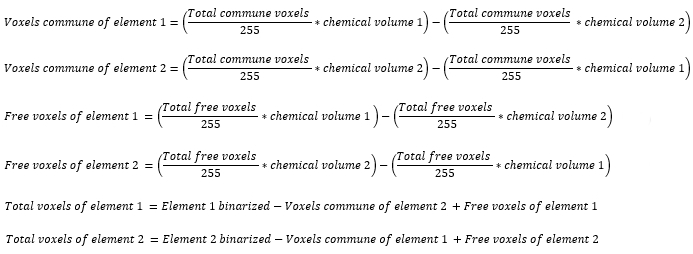
- To quantify the number of voxels that form the sample, import the segmented volumes into specialized surface rendering software, such as a 3D Slicer. Then, multiply the volume of a voxel in nm3 to obtain the volume of the sample in 3D.
- Using the Find Edges option, quantify the voxels forming the surface of the sample, and multiply with the voxel area in nm2 to obtain the surface of the sample.
- Calculate the specific surface area by dividing the surface of the sample by the mass of the sample.
NOTE: The mass of the sample can be estimated by using the theoretical density of the sample. In general, the specific surface area calculated by ET is 10 less than the specific surface calculated by dedicated methods such as N2 adsorption desorption. - To calculate the pore size distribution, use the binarized volume of the zero loss (the BF volume). The binary volume of the BF reconstruction is dilated using the 3D Toolkit/Morphological dilate 3D plugin until all the pores are covered and then eroded using the 3D Toolkit/Morphological erode 3D as many times as dilated. Then, the obtained volume is multiplied by the inverted volume of the binarized BF volume, to result in the pores distribution volume that can be visualized using a dedicated surface rendering software.
Access restricted. Please log in or start a trial to view this content.
Results
An example of the application of this protocol is shown in reference13. EFTEM tomography was used for analyzing titania alumina catalyst supports. To enhance the catalytic activity of the active phase of MoS2 nanoparticles, in applications like hydrodesulfurization (HDS), it is important that titania is preponderant at the support surface, and in contact with the active phase. It is known that titania has a smaller specific surface than alumina. The aim ...
Access restricted. Please log in or start a trial to view this content.
Discussion
The aim of this paper is to describe how to obtain 3D chemical maps using EFTEM tomography. This protocol is completely original and was developed by the authors.
EFTEM tomography as described here has several drawbacks: (i) Only samples that are electron beam resistant can be analyzed, due to the long exposure time needed for obtaining filtered images. (ii) EFTEM tomography is sensitive to the diffraction contrast. (iii) Many of the alignments were performed manually. To obtain the 3D chemica...
Access restricted. Please log in or start a trial to view this content.
Disclosures
The authors have nothing to disclose.
Acknowledgements
We are grateful to the French Ministry of Higher Education and Research, Conventions Industrielles de Formation par la Recherche (CIFRE) and IFP Energies Nouvelles for their financial support.
Access restricted. Please log in or start a trial to view this content.
Materials
| Name | Company | Catalog Number | Comments |
|---|---|---|---|
| JEOL 2100f | JEOL | Electron microscope | |
| Tridiem Gatan Imaging Filter (GIF) | Gatan | Post colum energy filter | |
| Digital micrograph | Gatan | Software | |
| Gatan EFTEM tomography plugin | Gatan | Dedicated software to record filtered tilt series for EFTEM tomograohy | |
| Tomoj | Imagej plugin http://www.cmib.fr/en/download/softwares/ | Free software developed by Currie Institute in Paris, France for electron tomography | |
| EFTEM-Tomoj | Imagej plugin http://www.cmib.fr/en/download/softwares/ | Free software developed by Currie Institute in Paris, France , for EFTEM imaging | |
| Imod | http://bio3d.colorado.edu/imod/ | Free software developed by University of Colorado, USA for electron tomography | |
| Imagej | https://imagej.nih.gov/ij/ | Free software developed by National Institute of Mental Health, Bethesda, Maryland, USA for images treatment | |
| Merge channels | https://imagej.net/Color_Image_Processing | Fonction in Imagej allowing to give different colors to volumes while they are overlapped | |
| 3D Slicer | https://www.slicer.org/ | Free software developed by a large consortium lead by Ron Kikinis , Harvard Medical School, Boston, MA, SUA | |
| Chimera | https://www.cgl.ucsf.edu/chimera/ | Free software developed by the Resource for Biocomputing, Visualization, and Informatics at the University of California, San Francisco,for data segmentation, cuatification and visualisation of 3D models | |
| silica alumina support of catalyst | IFPEN | sample prepared for eleboration of this protocol | |
| titania alumina support of catalyst | IFPEN | sample prepared for eleboration of this protocol | |
| alcohol | |||
| water | |||
| Au nanoparticles of 5 nm | BBI Solutions | ||
| Holey carbn film 200 mesh microscopy grid | Agar | ||
| EDX sepctrometer | Oxford Instruments |
References
- Frank, J. Electron Tomography - Methods for Three-Dimensional Visualization of Structures in the Cell. , Springer-Verlag. New York. (2006).
- Midgley, P. A., Dunin-Borkowski, R. E. Electron tomography and holography in materials science. Nat. Mater. 8, 271-280 (2009).
- Carenco, S. The core contribution of transmission electron microscopy to functional nanomaterials engineering. Nanoscale. 8 (3), 1260-1279 (2016).
- Radon, J. Uber die Bestimmung von Funktionen durch ihre Integralwerte langs gewisser Mannigfaltigkeiten. Akad. Wiss. 69, 262-277 (1917).
- Radermacher, M. Radon transform techniques for alignment and three-dimensional reconstruction from random projections. Scanning Microscopy. 11, 171-177 (1997).
- Roiban, L., Sorbier, L., Pichon, C., Pham-Huu, C., Drillon, M., Ersen, O. 3D-TEM investigation of the nanostructure of a δ-Al2O3 catalyst support decorated with Pd nanoparticles. Nanoscale. 4 (3), 946-954 (2012).
- Georgescu, D., Roiban, L., Ersen, O., Ihiawakrim, D., Baia, L., Simon, S. Insights on Ag doped porous TiO2 nanostructures: a comprehensive study of their structural and morphological characteristics. RSC Adv. 2 (12), 5358(2012).
- Shakeri, M., Roiban, L., Yazerski, V., Prieto, G., Gebbink, M. J. M. G., de Jongh, P. E., de Jong, K. P. Engineering and Sizing Nanoreactors To Confine Metal Complexes for Enhanced Catalytic Performance. ACS Catal. 4 (10), 3791-3796 (2014).
- Midgley, P. A., Weyland, M. 3D electron microscopy in the physical sciences: the development of Z-contrast and EFTEM tomography. Ultramicroscopy. 96 (3-4), 413-431 (2003).
- Ersen, O., Florea, I., Hirlimann, C., Pham-Huu, C. Exploring nanomaterials with 3D electron microscopy. Mater. Today. 18 (7), 395-408 (2015).
- Lepinay, K., Lorut, F., Pantel, R., Epicier, T. Chemical 3D tomography of 28nm high K metal gate transistor: STEM XEDS experimental method and results. Micron. 47, 43-49 (2013).
- Roiban, L., Sorbier, L., Pichon, C., Bayle-Guillemaud, P., Werckmann, J., Drillon, M., Ersen, O. Three-Dimensional Chemistry of Multiphase Nanomaterials by Energy-Filtered Transmission Electron Microscopy Tomography. Microsc. Microanal. 18 (05), 1118-1128 (2012).
- Roiban, L., Sorbier, L., Hirlimann, C., Ersen, O. 3 D Chemical Distribution of Titania-Alumina Catalyst Supports Prepared by the Swing-pH Method. ChemCatChem. 8 (9), 1651-1657 (2016).
- Egerton, R. F. Electron Energy-Loss Spectroscopy in the Electron Microscope. , Springer. (2011).
- Messaoudi, C., Aschman, N., Cunha, M., Oikawa, T., Sorzano, C. O. S., Marco, S. Three-Dimensional Chemical Mapping by EFTEM-TomoJ Including Improvement of SNR by PCA and ART Reconstruction of Volume by Noise Suppression. Microscopy and Microanalysis. 19 (6), 1669-1677 (2013).
- Pettersen, E. F., Goddard, T. D., Huang, C. C., Couch, G. S., Greenblatt, D. M., Meng, E. C., Ferrin, T. E. UCSF Chimera-A visualization system for exploratory research and analysis. Journal of Computational Chemistry. 25 (13), (2004).
- Roiban, L., Ersen, O., Hirlimann, C., Drillon, M., Chaumonnot, A., Lemaitre, L., Gay, A. S., Sorbier, S. Three-Dimensional Analytical Surface Quantification of Heterogeneous Silica-Alumina Catalyst Supports. ChemCatChem. 9 (18), 3503-3512 (2017).
- EFTEM-TomoJ. , Available from: http://www.cmib.fr/en/download/softwares/EFTEM-TomoJ.html (2018).
- Kremer, J. R., Mastronarde, D. N., McIntosh, J. R. Computer visualization of three-dimensional image data using IMOD. J Struct Biol. 116 (1), 71-76 (1996).
- The IMOD Home Page. , Available from: http://bio3d.colorado.edu/imod/ (2018).
- Landini, G. Align RGB planes. ImageJ. , Available from: https://ImageJ.net/Align_RGB_planes (2018).
- Messaoudi, C. TomoJ. , Available from: http://www.cmib.fr/en/download/softwares/TomoJ.html (2018).
- MessaoudiI, C., Boudier, T., Sorzano, C., Marco, S. TomoJ: tomography software for three-dimensional reconstruction in transmission electron microscopy. BMC Bioinf. 8 (1), 288(2007).
- Saxton, W. O., Baumeister, W., Hahn, M. Three-dimensional reconstruction of imperfect two-dimensional crystals. Ultramicroscopy. 13 (1-2), 57-70 (1984).
- Gatan, Inc. Quantum Energy Filters High Throughput Spectrometers. , Available from: http://www.gatan.com/products/tem-imaging-spectroscopy/gif-quantum-energy-filters (2018).
- Gatan, Inc. Direct Detection 16-Megapixel Camera. , Available from: http://www.gatan.com/products/tem-imaging-spectroscopy/k2-direct-detection-cameras (2018).
- Direct Electron, LP. DE-Series Cameras. , Available from: http://www.directelectron.com/products/de-series (2018).
Access restricted. Please log in or start a trial to view this content.
Reprints and Permissions
