The ability to monitor T cell responses in detail in vivo is important for the development of our understanding of the immune response. Here we describe the use of fluorescent target arrays (FTAs) in an in vivo T cell assay that assesses >250 parameters simultaneously by flow cytometry.
A subscription to JoVE is required to view this content. Sign in or start your free trial.
Method Article
The Use of Fluorescent Target Arrays for Assessment of T Cell Responses In vivo
In This Article
Summary
Abstract
The ability to monitor T cell responses in vivo is important for the development of our understanding of the immune response and the design of immunotherapies. Here we describe the use of fluorescent target array (FTA) technology, which utilizes vital dyes such as carboxyfluorescein succinimidyl ester (CFSE), violet laser excitable dyes (CellTrace Violet: CTV) and red laser excitable dyes (Cell Proliferation Dye eFluor 670: CPD) to combinatorially label mouse lymphocytes into >250 discernable fluorescent cell clusters. Cell clusters within these FTAs can be pulsed with major histocompatibility (MHC) class-I and MHC class-II binding peptides and thereby act as target cells for CD8+ and CD4+ T cells, respectively. These FTA cells remain viable and fully functional, and can therefore be administered into mice to allow assessment of CD8+ T cell-mediated killing of FTA target cells and CD4+ T cell-meditated help of FTA B cell target cells in real time in vivo by flow cytometry. Since >250 target cells can be assessed at once, the technique allows the monitoring of T cell responses against several antigen epitopes at several concentrations and in multiple replicates. As such, the technique can measure T cell responses at both a quantitative (e.g. the cumulative magnitude of the response) and a qualitative (e.g. functional avidity and epitope-cross reactivity of the response) level. Herein, we describe how these FTAs are constructed and give an example of how they can be applied to assess T cell responses induced by a recombinant pox virus vaccine.
Introduction
T cells play a central role in the adaptive immune response and are often targeted for manipulation in immunotherapy. CD4+ effector T cells respond to foreign antigen by secreting cytokines that regulate many aspects of immunity and can also directly help B cells to manufacture antibodies. CD8+ cytotoxic T cells (CTLs) can also respond to foreign antigen by secreting cytokines as well as playing a central role in directly killing cells expressing a foreign antigen. The fundamental interaction that initiates these T cell effector functions involves the interaction of the T cell receptor (TCR) with foreign peptides displayed on MHC molecules on the surface of cells. CD4+ T cells recognize peptides displayed on MHC class-II molecules on antigen presenting cells and CD8+ T cells recognize peptides displayed on MHC class-I molecules that are typically displayed on microbe infected cells.
In order to assess the role T cells play in an immune response, it is essential that their effector functions are measured by reliable and sensitive techniques. Common methods for T cell response assessment include; MHC class-I/II/peptide tetramer reactivity; cytokine production by ELISPOT and intracellular cytokine staining; and killing capacity by 51Cr-release assays. These assays, however, are typically performed ex vivo with in vitro stimulation, or provide limited insight into T cell function. Ideally, when measuring T cell responses it would be beneficial to assess them in situ, in vivo as they occur, with no manipulation of T cells so as to avoid changes in functional parameters that may occur through in vitro stimulation. Some of the most commonly used in vivo T cell functional assays are based on measuring CTL mediated killing of target cells pulsed with MHC class I-binding peptides, that are enumerated in vivo via their detection through fluorescent labeling with vital dyes such as CFSE. While these types of assays can monitor CTL mediated killing of targets when they happen in vivo, they have previously had a relatively limited capacity to assess killing of multiple targets presenting different concentrations and different types of peptide epitopes, which is required to allow qualitative parameters such as functional avidity and epitope variant cross-reactivity to be assessed. These assays also do not provide any information on CD4+ T cell mediated responses.
To overcome many of the limitations with current methods used to assess T cell responses, we have recently developed a multiplex assay based on fluorescent target arrays (FTAs), which allows the monitoring of T cell responses against >250 target cells simultaneously in one animal by flow cytometry 1,2. FTAs are comprised of lymphocytes labeled with several concentrations and combinations of vital dyes like CFSE, CTV and CPD allowing >250 cell clusters of unique fluorescence to be generated. Since these cells remain viable and fully functional, they can be injected into animals to allow monitoring of their interaction with effector T cells in vivo3. For example, the FTA cell clusters can be pulsed with MHC class-I-binding peptides to allow assessment of antigen-specific CTL mediated killing of target cells1. In addition, the FTA cell clusters can also be pulsed with MHC class-II-binding peptides, allowing assessment of antigen specific T helper cell (TH) activity by assessing activation (by assessment of activation markers such as CD69, CD44 and/or CD62L) of B cells within the FTA bearing cognate peptide2. Since more than 250 targets can be detected simultaneously, it is possible to measure CTL and TH responses against many target cell clusters pulsed with numerous peptides at different concentrations and the inclusion of many replicates. The FTA assay therefore provides an unprecedented level of T cell effector response assessment in vivo.
Here we describe in detail the construction of a FTA and show how they can be applied to assessing T cell responses in vivo. The procedure describes the construction of a FTA comprised of 252 discernable cell clusters through the use of three vital dyes, comprised of 6 repeats of 42 cell clusters pulsed with MHC class-I and II-binding peptides. The labeling of 42 cell clusters occurs in 10 ml conical bottomed tubes and it is helpful to lay these out in a tube rack as depicted in Table 1. This method can be adjusted for smaller numbers of discernable clusters as required by reducing the amount of labeling of each dye performed1.
We highlight the utility of the assay by showing how it can measure responses generated by recombinant pox -virus vaccination against multiple epitopes in a small cohort of mice. This shows how the FTA assay can be used to measure cumulative responses and functional avidity through, respectively, the use of area under curve (AUC) assessments and measurement of effective peptide concentration required to generate half maximal responses (EC50).
Access restricted. Please log in or start a trial to view this content.
Protocol
Note: Mice used under this protocol were handled according to the guidelines of the Australian National University Animal Experimentation Ethics Committee and mice were euthanized by cervical dislocation.
1. Dye and Peptide Preparation
- Dye preparation
Note: Dyes are prediluted at different concentrations to allow labeling of cells at discrete fluorescence intensities. CFSE is used at seven concentrations made through 3.5-fold serial dilutions, and CTV and CPD are used at six different concentrations made through 3.7-fold serial dilutions (see Tables 2-4). The stock concentrations of dyes listed in Tables 2-4 will be used to label target cells at the final dye concentrations listed in Tables 2-4. Dyes react upon exposure to aqueous solution. It is therefore important that vials be equilibrated to RT prior to opening to minimize exposure of dyes to condensation.- CFSE
Note: CFSE is purchased as carboxyfluorescein diacetate succinimidyl ester (CFDA, SE; MW 557.47), typically at 25 mg/vial.- Resuspend 25 mg of CFSE in 4.48 ml DMSO to obtain a 10 mM stock solution.
- Serially dilute CFSE: Add 35 μl of 10 mM CFSE stock into 87.5 μl of DMSO and repeat this with diluted stock solution to give each dye concentration in Table 3.
- CTV
Note: CTV is typically purchased in packs of 9 vials, each of which can be reconstituted with 10 μl of DMSO to generate a 10 mM solution of the dye.- Reconstitute and pool all 9 vials of CTV with 90 μl of DMSO to give a 10 mM solution.
- Serially dilute CTV: Add 11 μl of 10 mM CTV stock into 29.7 μl of DMSO and repeat this with diluted stock solution to give each dye concentration in Table 2.
- CPD
Note: CPD (MW 792.6) is typically purchased as 0.5 mg/vial.- Resuspend 0.5 mg of CPD in 63 ml of DMSO to get a 10 mM solution.
- Serially dilute CPD: Add 11 μl of 10 mM CPD stock into 29.7 μl of DMSO and repeat this with diluted stock solution to give each dye concentration in Table 4.
Note: Dye stocks can be stored at -20 °C for several months and can be thawed and refrozen several times without significant loss in function.
- CFSE
- Peptide preparation
Note: MHC class-I-binding peptides are generally used to pulse target cells at 6 different concentrations made using 10 fold dilutions from a starting concentration of 1 μM (Table 5). MHC class II-binding peptides are generally used to pulse target cells at 6 different concentrations made using 3 fold dilutions from a starting concentration of 400 μM (Table 5). Each peptide is made at 2x final concentration in PBS such that every peptide concentration has a minimum volume of 250 μl. Peptide stocks can be prepared prior to FTA construction and stored at -20 °C without significant loss in function.- Preparing stock MHC class-I-binding peptides
- Prepare the highest concentration of each peptide epitope to 2 μM stock solutions (2x 1 μM)
- Serially dilute MHC class-I-binding peptides: add 44.4 μl of 2 μM peptide stock solution into 400 μl of PBS. Repeat this with diluted stock solution to give each peptide concentration in Table 5.
- Preparing stock MHC class-II-binding peptides
- Prepare the highest concentration of each peptide epitope to 800 μM stock solutions (2x 400 μM).
- Serially dilute MHC class-II-binding peptides: add 150 μl of 800 μM peptide solution into 300 μl of PBS. Repeat this with diluted stock solution to give each peptide concentration in Table 5.
2. FTA Preparation
Note: The procedure below outlines the construction of a FTA comprised of cells pulsed with 7 different peptide epitopes at 6 different concentrations (i.e. 42 cell clusters) repeated 6 times to generate 252 discernable cell clusters. Within each repeat, a cell cluster not pulsed with any epitope (Nil), is included as a control. It is helpful for FTAs to have a CD45 allotype difference from host animals to allow their discrimination from recipient cells by antibody labeling at the time of analysis. Otherwise FTAs can be labeled with other dyes such as PKH-26 for this purpose (described in step 2.6). Typically, the FTA preparation procedure is carried out from start to finish during one sitting.
- Label 42, 10 ml conical bottomed plastic tubes 1-42 (as in Table 1 for example).
- Preparation of cells
- Isolate spleen and/or lymphnodes from mice. Prepare single cell suspension from tissues by mashing through a 70 μm pored sieve with a 5 ml syringe plunger and count cells using a hemocytometer.
- Resuspend lymphocytes at up to 200 x 106 cells/ml in 11.5 ml of Rochester Park Memorial Institute 1640 (RPMI, or equivalent) containing 5% fetal calf serum (FCS). Note: It is important to use a buffer with high amine content to minimize dye toxicity to cells3.
- CTV labeling
Note: Cells are initially labeled with 6 concentrations of CTV.- Thoroughly resuspend the cells by inverting the tube several times. Add 1.9 ml of cell suspension to 6 of the 10 ml tubes labeled 37-42, taking care not to wet the top half of the tubes.
- To label cells with CTV, remove the tube cap and lay the tube horizontally.
- Add 83 μl of PBS to the non wetted portion at the top of the tube, and to this add 17 μl of stock CTV (see Table 2 for which stock solution is assigned to which tube). Note: A non wetted tube is important to prevent cell suspension movement and premature mixing of the cell solution with the dye solution.
- Cap the tube and mix the cell suspension with the dye quickly and thoroughly by vortexing.
- Repeat steps 2.3.2-2.3.4 for the stock solutions of CTV in the designated tubes described in Table 2.
- Incubate cells for a minimum of 5 min at RT (20 °C).
- CFSE labeling
- After CTV labeling, add 5 ml of RPMI containing 5% FCS to each tube and thoroughly resuspend the cells by vortexing.
- From tube 37 transfer 1 ml of cell suspension to tubes 31, 25, 19, 13, 7, and 1.
- From tube 38 transfer 1 ml of cell suspension to tubes 32, 26, 20, 14, 8, and 2.
- From tube 39 transfer 1 ml of cell suspension to tubes 33, 27, 21, 15, 9, and 3.
- From tube 40 transfer 1 ml of cell suspension to tubes 34, 28, 22, 16, 10, and 4.
- From tube 41 transfer 1 ml of cell suspension to tubes 35, 29, 23, 17, 11, and 5.
- From tube 42 transfer 1 ml of cell suspension to tubes 36, 30, 24, 18, 12, and 6
Note: Take care not to wet the top half of the tubes during steps 2.4.1.1-2.4.1.6.
- To label cells with CFSE, remove the tube cap and lay the tube horizontally.
- Add 103 ml of PBS to the non wetted portion at the top of the tube, and to this add 7 ml of stock CFSE (see Table 3 for which stock solution is assigned to which tube).
- Cap the tube and mix the cell suspension with the dye quickly and thoroughly by vortexing.
- Do steps 2.4.2-2.4.4 for the stock solutions of CFSE in the designated tubes described in Table 3.
- Incubate cells for a minimum of 5 min at RT (20 °C).
- Wash cells: Dilute cell suspension with 9 ml of 20 °C RPMI containing 5% FCS, sediment by centrifugation at 300 x g for 10 min at 20 °C and remove supernatants by aspiration with a transfer pipette.
- After CTV labeling, add 5 ml of RPMI containing 5% FCS to each tube and thoroughly resuspend the cells by vortexing.
- Peptide pulsing and cell washing
Note: After cells have been labeled with CTV and CFSE, they are pulsed with MHC class-I and/or MHC class-II binding peptides (prepared in 1.2). One of the cell populations must also not be pulsed with peptide (e.g. Nil in Table 1) and used as a negative control for calculation of T cell responses.- Peptide pulsing
- Resuspend cells in a total volume of 250 μl of RPMI containing 5% FCS. Note: Typically 50 μl of cell suspension remains after aspiration of the supernatant at the end of step 2.4.7, therefore add 200 μl of medium to cell pellet.
- Add 250 μl of pre prepared peptide stocks (as in Table 5) to appropriately designated tubes (as in Table 1) and be sure to include a control tube of PBS added alone without peptide as a Nil control.
- Mix cell suspensions with a vortex. Note: It is critical that each peptide epitope and each peptide concentration is assigned to a single tube and this recorded clearly based on the expected fluorescence of the cells in this tube, since the fluorescence signature of this cluster will define this peptide (as in Table 1 for example).
- Incubate the cells at 37 °C for 1 hr.
- Cell washing
- Add 5 ml of ice cold (4 °C) RPMI containing 5% FCS to the cell suspension and resuspend cells by inverting tube. Carefully underlay the cell suspension with 3 ml of ice cold (4 °C) FCS.
- Sediment the cells by centrifugation at 300 x g for 10 min at 4 °C. Use slow acceleration and braking to ensure the interface of FCS and the cell suspension solution is maintained.
- Carefully aspirate off the RPMI and then the FCS with a transfer pipette, leaving the washed cell pellets undisturbed. Note: The use of a FCS underlay to wash cells helps to ensure as much peptide solution is removed from the cells as possible and thereby limiting exposure of cell populations to multiple free peptides when cells are pooled.
- Wash cells again: Resuspend the cell pellets in 10 ml of 4 °C RPMI containing 5% FCS. Sediment the cells by centrifugation at 300 x g for 10 min at 4 °C. Pour off supernatants.
- Pool all cell populations together into a single tube with a pipette using 6 ml of 4 °C RPMI containing 5% FCS. Sediment pooled cells by centrifugation at 300 x g for 10 min at 4 °C. Aspirate off supernatant with a transfer pipette.
- Peptide pulsing
- CPD Cell labeling
Note: At this point six intra assay replicates can be generated by labeling peptide pulsed cells with 6 different concentrations of CPD.- Add 11.4 ml of 20 °C RPMI containing 5% FCS to the pooled cell pellet and resuspend thoroughly using a pipette.
- Add 1.9 ml of cell suspension to 6, 10 ml tubes labeled A-F, taking care not to wet the top half of the tubes.
- To label cells with CPD, remove the tube cap and lay the tube horizontally.
- Add 92 μl of PBS to the non wetted portion at the top of the tube, and to this add stock CPD (see Table 4 for the quantity of stock solution assigned to each tube).
- Cap the tube and mix the cell suspension with the dye quickly and thoroughly by vortexing.
- Do steps 2.6.3-2.6.5 for the stock solutions of CPD in the designated tubes described in Table 4. Note: Unlike CFSE and CTV, the CPD labelling concentration is not precisely linearly related to the resulting fluorescence intensity of labelled cells, and so the labelling concentration used to obtain equidistant fluorescent peaks of several labelled populations has been determined empirically (see Table 4).
- Incubate cells for a minimum of 5 min at RT (20 °C).
- Wash cells twice: Resuspend cells to 10 ml with 20 °C RPMI containing 5% FCS. Sediment the cells by centrifugation at 300 x g for 10 min at 20 °C. Aspirate off supernatant with a transfer pipette. Repeat.
- Pool all cells together into a single tube using 8 ml 4 °C RPMI containing 5% FCS with a pipette. Sediment pooled cells by centrifugation at 300 x g for 10 min at 4 °C and aspirate off the supernatant with a transfer pipette.
- (Optional) PKH-26 Cell labeling
Note: If FTAs cannot be constructed with cells expressing a CD45 allotypic difference to host mice, they can be labeled with PKH-26 to allow their discrimination from recipient cells.- Add 2.9 ml of 20 °C PBS to the pooled cell pellet and resuspend thoroughly with a pipette.
- Add cell suspension to a non wetted 10 ml tube, taking care not to wet the top half of the tube.
- Remove the tube cap and lay the tube horizontally.
- Add 58 μl of diluent C (in the PKH-26 dye kit) to the non wetted portion at the top of the tube, and to this add 42 μl of 1 mM stock PKH-26.
- Cap the tube and mix cell solution with the dye thoroughly by vortexing.
- Incubate cells for a minimum of 10 min at RT (20 °C).
- Wash cells twice: Resuspend cells to 10 ml with 20 °C RPMI containing 5% FCS. Sediment the cells by centrifugation at 300 x g for 10 min at 20 °C. Aspirate off supernatant with a transfer pipette. Repeat.
- Injecting FTAs into host animals
Note: To measure T cell responses in vivo, FTAs are injected into animals that have an active immune response and left in situ for up to 24 hr . It is critical that the FTAs are also injected into a naïve animal as a negative control.- Count and resuspend cells at 2.5 x 10⁸ cells per ml in PBS. Inject 200 μl of cells intravenously into host mice, including a naïve animal as a control.
3. Flow Cytometry
- 18-24 hr after FTA injection harvest blood or spleen (or other tissues of interest) from host mice.
- Prepare single cell suspension from tissues by mashing through a 70 μm pored sieve with a 5 ml syringe plunger.
- Resuspend cells at up to 65 x 106 cells/ml in PBS containing 0.1% BSA.
- Dispense 100 μl aliquots of cell suspension into wells of a microtitre plate for antibody labeling.
- Label cells with fluorochrome labeled antibodies and fluorescent viability probes with spectrally compatible fluorescence to CFSE, CTV and CPD. Note: Antibodies to B cell markers such as B220 and activation markers such as CD69 are essential to measure B cell activation if using the FTA to measure TH cell responses2. Include an antibody to CD45.1 and/or CD45.2 if the FTAs and host mice have a CD45 allotypic difference.
- Add 100 μl of 2x stock solution of antibodies/viability dyes (in PBS containing 0.1% BSA) to 100 μl aliquots of cells, mix well and incubate on ice (4 °C) for 30 min.
- Wash cells: Sediment cells by centrifugation at 300 x g for 5 min at 4 °C and remove supernatant. Resuspend cells in 200 μl of PBS containing 0.1% BSA, sediment cells by centrifugation at 300 x g for 5 min at 4 °C and remove supernatant.
- Resuspend cells in a total volume of 400 μl of PBS containing 0.1% BSA, filter cells through a 70 μm mesh and analyze by flow cytometry in a flow cytometer capable of detecting the relevant fluorescent dyes and conjugates. Collect up to 3 x 10⁶ lymphocyte events in order to resolve each FTA cell cluster and gain enough cells for statistical analysis. Note: Ensure all the typical controls (such as single stained controls) for flow cytometry are employed. Typically, CFSE requires excitation from a blue laser source (typically at 488 nm) and detection with band pass filters centered over 520 nm; CTV requires excitation from a violet laser source (typically at 405 nm) and detection with band pass filters centered over 450 nm; and CPD requires excitation from a red laser source (typically at 633 nm or 640 nm) and detection with band pass filters centered over 670 nm.
4. Data Analysis
- Analyze flow cytometry data using standard flow cytometry software (see representative result for an example of the type of gating strategy employed).
- For % specific killing, calculate the number of cells in each FTA cell cluster pulsed with MHC class-I-binding peptides and the FTA clusters that were not peptide pulsed (“Nil”) and using the following formula to calculate % Specific Killing.
% Specific Killing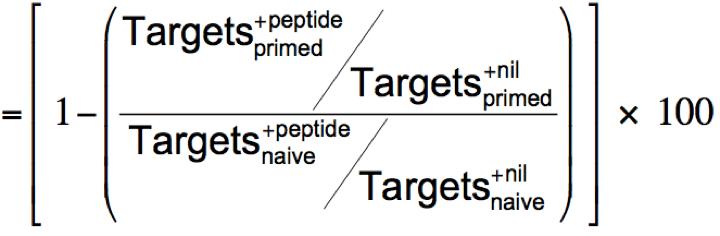
Note: In the above formula “primed” refers to targets from animals that are thought to have an immune response against the target peptides, “naïve” refers to targets from naïve animals, “peptide” refers to targets pulsed with peptides and “nil” refers to targets not pulsed with any peptides. - For B cell activation as a measure of TH activity, calculate the geometric mean fluorescence intensity (GMFI) of CD69 antibody fluorescence on FTA B cells pulsed with MHC class-II-binding peptides in “primed” animals and from this subtract the GMFI of CD69 expression on the corresponding FTA B cells in “naïve” animals to give a measure of TH activity.
- From the statistics generated in steps 4.2 and 4.3, use mathematical spreadsheet software such as GraphPad Prism to calculate other quantitative and qualitative parameters such as area under curve and EC50 (an in depth description of how these calculations are performed for AUC can be found at
http://graphpad.com/guides/prism/6/statistics/index.htm?stat_area_under_the_curve.htm, and for EC50: http://www.graphpad.com/guides/prism/6/curve-fitting/index.htm?reg_the_ec50.htm).
Access restricted. Please log in or start a trial to view this content.
Results
As an example of the use of the FTA assay, a BALB/c mouse was immunized with recombinant vaccinia virus (VV) expressing HIV-I epitopes (VV-HIV) and responses to the HIV-I CTL epitopes, Gag, Gag mut, Env and Pol, the VV CTL epitopes F2L and F2L mut, and the HIV-I TH cell epitope, Gag Th (as described in2) were assessed using a 252 parameter FTA assay (Figure 1B). Epitope variants of Gag (Gag mut) and F2L (F2L mut) are not expressed in the VV-HIV vector and therefore responses against...
Access restricted. Please log in or start a trial to view this content.
Discussion
The advantage of FTA-based assays is that they allow the discrimination of >250 viable and fully functional target cell populations from a single host animal by flow cytometry. This provides a level of complexity to in vivo flow cytometry based assays that has not been possible before. This is highlighted in the 2 animal experiments shown above, where responses to 7 distinct viral epitopes at 6 concentrations could be monitored in replicates of 6 simultaneously in a single animal allowing parameters such as ...
Access restricted. Please log in or start a trial to view this content.
Disclosures
The authors declare that they have no competing financial interests.
Acknowledgements
This work was supported by Project Grants #1010395 (BQ and CP) and #525431 (CR), and a Program Grant #455395 (CP) from the National Health and Medical Research Council of Australia, an Australian Centre for Hepatitis and HIV Virology EOI 2012 grant (CR and RJJ) and a grant from the Gordon and Gretel Bootes Foundation (BQ and CR). We wish to thank Harpreet Vohra and Michael Devoy for their excellent maintenance of the JCSMR FACS laboratory, the Australian Cancer Research Foundation Biomolecular Resource Facility, JCSMR, ANU, for peptide synthesis, and Dr. David Boyle, CSIRO Animal Health Laboratories, Geelong, Australia for providing the parent HIV vaccine stocks.
Access restricted. Please log in or start a trial to view this content.
Materials
| Name | Company | Catalog Number | Comments |
|---|---|---|---|
| RPMI | Sigma | R8758 | |
| Fetal calf serum | Serana | FCS-500 | |
| CTV | Invitrogen | C34557 | |
| CFDA, SE | Invitrogen | C1157 | |
| CPD | eBioscience | 65-0840-90 | |
| anti-B220 PerCp-Cy5.5 | eBioscience | 110730 | |
| anti-CD69 brilliant violet 605 | Biolegend | 104529 | |
| PKH-26 | Sigma | PKH26GL-1KT | |
| Vortex | Scientific Industries Inc | ||
| Centrifuge | Eppendorf | ||
| Flow cytometer (Fortessa or equivalent with blue, red and violet laser source) | BD Bioscience |
References
- Quah, B. J., Wijesundara, D. K., Ranasinghe, C., Parish, C. R. Fluorescent target array killing assay: A multiplex cytotoxic T-cell assay to measure detailed T-cell antigen specificity and avidity in vivo. Cytometry A. 81, 679-690 (2012).
- Quah, B. J., Wijesundara, D. K., Ranasinghe, C., Parish, C. R. Fluorescent target array T helper assay: a multiplex flow cytometry assay to measure antigen-specific CD4+ T cell-mediated B cell help in vivo. J Immunol Methods. 387, 181-190 (2013).
- Quah, B. J., Parish, C. R. New and improved methods for measuring lymphocyte proliferation in vitro and in vivo using CFSE-like fluorescent dyes. J Immunol Methods. 379, 1-14 (2012).
- Mata, M., Paterson, Y. Th1 T cell responses to HIV-1 Gag protein delivered by a Listeria monocytogenes vaccine are similar to those induced by endogenous listerial antigens. J Immunol. 163, 1449-1456 (1999).
- Earl, P. L., et al. Design and evaluation of multi-gene, multi-clade HIV-1 MVA vaccines. Vaccine. 27, 5885-5895 (2009).
- Wild, J., et al. Preclinical evaluation of the immunogenicity of C-type HIV-1-based DNA and NYVAC vaccines in the Balb/C mouse model. Viral Immunol. 22, 309-319 (2009).
- Takeshita, T., et al. Molecular analysis of the same HIV peptide functionally binding to both a class I and a class II MHC molecule. J Immunol. 154, 1973-1986 (1995).
- Krutzik, P. O., Nolan, G. P. Fluorescent cell barcoding in flow cytometry allows high-throughput drug screening and signaling profiling. Nature Methods. 3, 361-368 (2006).
- Gilbert, D. F., Wilson, J. C., Nink, V., Lynch, J. W., Osborne, G. W. Multiplexed labeling of viable cells for high-throughput analysis of glycine receptor function using flow cytometry. Cytometry A. 75, 440-449 (2009).
- Quah, B. J., Parish, C. R. The use of carboxyfluorescein diacetate succinimidyl ester (CFSE) to monitor lymphocyte proliferation. J Vis Exp. , (2010).
- Quah, B. J., Warren, H. S., Parish, C. R. Monitoring lymphocyte proliferation in vitro and in vivo with the intracellular fluorescent dye carboxyfluorescein diacetate succinimidyl ester. Nat Protoc. 2, 2049-2056 (2007).
- Durward, M., Harms, J., Splitter, G. Antigen specific killing assay using CFSE labeled target cells. J Vis Exp. , (2010).
- Hermans, I. F., et al. The VITAL assay: a versatile fluorometric technique for assessing CTL- and NKT-mediated cytotoxicity against multiple targets in vitro and in vivo. J Immunol Methods. 285, 25-40 (2004).
- Busch, D. H., Pamer, E. G. T cell affinity maturation by selective expansion during infection. J Exp Med. 189, 701-710 (1999).
- Savage, P. A., Boniface, J. J., Davis, M. M. A kinetic basis for T cell receptor repertoire selection during an immune response. Immunity. 10, 485-492 (1999).
- Wang, X. L., Altman, J. D. Caveats in the design of MHC class I tetramer/antigen-specific T lymphocytes dissociation assays. J Immunol Methods. 280, 25-35 (2003).
- von Essen, M. R., Kongsbak, M., Geisler, C. Mechanisms behind functional avidity maturation in T cells. Clin Dev Immunol. , (2012).
- Prussin, C., Metcalfe, D. D. Detection of intracytoplasmic cytokine using flow cytometry and directly conjugated anti-cytokine antibodies. J Immunol Methods. 188, 117-128 (1995).
- Foster, B., Prussin, C., Liu, F., Whitmire, J. K., Whitton, J. L. Detection of intracellular cytokines by flow cytometry. Curr Protoc Immunol. , (2007).
- Czerkinsky, C. C., Nilsson, L. A., Nygren, H., Ouchterlony, O., Tarkowski, A. A solid-phase enzyme-linked immunospot (ELISPOT) assay for enumeration of specific antibody-secreting cells. J Immunol Methods. 65, 109-121 (1983).
- Klinman, D. ELISPOT assay to detect cytokine-secreting murine and human cells. Curr Protoc Immunol. , (2008).
- Yerly, D., et al. Increased cytotoxic T-lymphocyte epitope variant cross-recognition and functional avidity are associated with hepatitis C virus clearance. J Virol. 82, 3147-3153 (2008).
Access restricted. Please log in or start a trial to view this content.
Reprints and Permissions
