Impairment in olfactory function is a common feature in many neurodegenerative disorders including Parkinson, Alzheimer, and Huntington diseases. In the present article, we describe a set of tests for assessing olfaction discrimination and detection in mice that can be used to measure olfactory abilities in mouse models of neurodegenerative diseases.
Method Article
Olfactory Assays for Mouse Models of Neurodegenerative Disease
In This Article
Summary
Abstract
In many neurodegenerative diseases and particularly in Parkinson’s disease, deficits in olfaction are reported to occur early in the disease process and may be a useful behavioral marker for early detection. Earlier detection in neurodegenerative disease is a major goal in the field because this is when neuroprotective therapies have the best potential to be effective. Therefore, in preclinical studies testing novel neuroprotective strategies in rodent models of neurodegenerative disease, olfactory assessment could be highly useful in determining therapeutic potential of compounds and translation to the clinic. In the present study we describe a battery of olfactory assays that are useful in measuring olfactory function in mice. The tests presented in this study were chosen because they measure olfaction abilities in mice related to food odors, social odors, and non-social odors. These tests have proven useful in characterizing novel genetic mouse models of Parkinson’s disease as well as in testing potential disease-modifying therapies.
Introduction
Olfactory dysfunction is linked to a number of neurodegenerative disorders including Parkinson’s disease (PD), Alzheimer’s disease, and Huntington’s disease1. In PD, olfactory impairments include deficits in odor identification, detection, and discrimination and are found in up to 70–95% of patients2-5. These deficits can precede the cardinal motor symptoms of PD by up to 4 years, indicating that olfactory dysfunction may signal the early stages of PD6-10. The early occurrence of olfactory deficits in PD has led to a keen interest in olfactory dysfunction and the underlying mechanisms involved. In preclinical studies in rodents, olfactory dysfunction could be a sensitive outcome measure to predict the therapeutic potential of novel therapeutic strategies.
Many tests have been designed and extensively used to characterize sensorimotor impairments in rodent models of PD and to test the therapeutic potential of novel treatments11-15. Even though olfactory deficits are well documented in PD, olfactory function has not been routinely measured in many models. This view is changing though with the discovery of genetic forms of PD and the more accepted notion that PD is a systemic disorder affecting more than just sensorimotor function. Currently, there are numerous studies in genetic mouse models of PD and other neurodegenerative disorders that now include analysis of olfaction in the characterization16-24. Given the growing interest of olfactory dysfunction in neurodegenerative disorders, we sought to assemble a battery of olfactory tests that can be used to characterize novel models of neurodegeneration as well as test potential disease-modifying therapies in preclinical studies. The tests described in the present study have been used in both characterization and preclinical studies18,25.
The tests highlighted in this study have been shown to be sensitive in detecting olfactory dysfunction in a frequently utilized alpha-synuclein overexpressing mouse model of Parkinson’s disease18. They include the buried pellet test26,27, an adapted version of the block test23,24,28,29, and the habituation/dishabituation test30. It is important to note that there are several adaptations of the tests described in this study that are sensitive measures of olfactory function in mice, the ones highlighted in this study are the tests our laboratory has the most experience with and routinely use.
Protocol
All steps of the protocol follow the animal care and use guidelines and regulations set by the IACUC of the University of Cincinnati.
1. General Considerations
- If possible, test mice during their active phase in the dark cycle. Typically, perform testing under low light and at least 1 hr into the dark cycle. However, if testing in the dark cycle is not feasible, perform all three tests during the light cycle. Keep in mind that sniffing times may decrease when mice are tested during their sleep cycle. NOTE: While the tests can be performed during the sleep cycle the mice may show less interest in the buried pellet, blocks, or scented cartridge.
- In order to reduce any effect of outside olfactory cues, wear a base pair of gloves at all times throughout each test and then place a clean pair of gloves over the base pair for each mouse and each trial. As a general rule, when in doubt, put on a clean set of gloves. Have a box of gloves readily available since they will be changed frequently. NOTE: We use nitrile gloves for all animal handling.
- Cleaning test materials and cages between subjects with a disinfectant/sterilizing agent is also an important step in this battery of tests in order to reduce the potential for spreading disease as well as remove undesired olfactory cues.
2. Buried Pellet Test
- At least two days before testing, record the weight of each mouse and then food restrict to 90% of body weight. Prior to testing and during food restriction, give each mouse 1-2 pieces of the pellets to be used during the test (e.g., a piece of sweetened cereal). Do not skip this step because mice are neophobic with food and may not search for the pellet during the test if they have not eaten the pellets previously.
- On all test days, habituate the mice for 1 hr prior to testing by placing their cage in the testing room with no water bottle or feeder bin. House them in their home cage with just a filter top lid.
- During habituation, fill a clean mouse cage ~3 cm high with clean bedding making certain the bedding is evenly distributed throughout the cage. Set a timer for 5 min.
- Following 1 hr of habituation, bury 1 sweetened cereal pellet 0.5 cm below the bedding so that it is not visible.
- Remove the test mouse from its home cage, place it in the center of the test cage, place the filter top lid on the cage and start the timer.
- Stop the timer when the mouse uncovers the pellet and begins eating it. Note the time to uncover the buried pellet.
- If the mouse does not find the pellet within 5 min, end the trial and note a score of 300 sec for that mouse. Move the pellet to the top of the bedding so the mouse has access to it, and allow the mouse to eat the pellet.
- Following the trial, return the mouse to its home cage.
- Empty the bedding from the test cage and clean the cage with animal room cleaning solution.
- Repeat steps 2.4 to 2.9 for each mouse, and change gloves before and after each mouse.
- After all mice are tested, give them just enough food to maintain them at 90% body weight.
- Perform testing on days 2-5 the same way as test day 1 with one exception; bury the pellet in a different spot in the cage for each trial.
- On testing day 6, perform the surface pellet trial.
- For the surface pellet trial, follow the same procedure for test day 1 but instead of burying the pellet under the bedding place it on top of the bedding. Record the time for the mouse to find and start eating the pellet.
3. Block Test
- Individually house mice in clean cages and place 5 blocks in the cage (labeled A-E), changing gloves before setting up each cage.
- Perform the test 24 hr later. Move test mice to the testing area, remove the water bottle and feeder bin, and place all 5 blocks from the cage along with a handful of bedding into a plastic bag labeled with the animal’s identification. Place the sealed plastic bag on top of the mouse’s home cage.
- Habituate the animals in their home cage without the water bottle, feeder bin, and blocks for 1 hr prior to testing.
- Change gloves between each cage so that the scents are not exchanged between animals/blocks.
- Line up the mouse cages beside each other on a table with at least 10 cm between each cage. Position a video camera so that the front of the cage (not the long side of the cage) is in clear view.
- Set the timer for 30 sec and label a card with the important experiment details (date, mouse ID, trial, etc.). Videotape the label for 2-3 sec.
- Remove blocks A-D from the plastic bag with that mouse’s identification and place them in the middle of the cage so that they are clearly visible on the video camera. Make sure there is ~1 cm of space between each of the blocks. Place the filter top back on the cage. Start the timer and videotape for 30 sec.
- After 30 sec, stop recording and remove the blocks from the cage and place them back into the plastic bag.
- Change gloves and then move on to the next mouse, repeating the same procedure used for the first trial. Do this for a total of 6 trials for each mouse making sure there is an inter-trial interval of ~5 min.
- On the 7th trial, follow the same procedure for the trials 1-6 except instead of placing block D from the mouse’s own cage add block E from another mouse’s cage so that the mouse is exposed to blocks A, B, and C from its own home cage and block E from another mouse’s cage. Note in the lab book whose block E each mouse is exposed to and alternate where block E is placed in each mouse’s cage (e.g., ABCE or AEBC). Take block E from a mouse of the same sex but not from an original cagemate. Videotape for 30 sec.
- Following the 7 trials, return animals to a new clean cage with their original cagemates. Clean blocks used in the test with mild detergent and water and allow to air dry for use in later tests.
4. Habituation/Dishabituation
- Perform the habituation/dishabituation test in a similar manner to the block test but instead of using blocks that have the odor of a mouse, use tissue cartridges holding cotton scented with different pairs of extracts.
- Follow steps 3.1-3.4 using a single, unscented tissue cartridge instead of the blocks.
- Habituate mice in the test room.
- Prepare the scented tissue cartridges in a separate room. Place a small cotton ball into a clean cartridge and then add 5 μl of extract (e.g., almond extract) into the cotton. Snap the cartridge top over the cotton and place in a dedicated box or bag labeled with that scent.
- Do the same procedure for a second scent (e.g., anise extract). Change gloves between handling different scents. Make sure the cotton ball is completely encased in the tissue cartridge. NOTE: Exposed fibers from the cotton ball may cause the animal to have interest in the cotton ball for nesting purposes rather than the scent itself.
- Then, follow steps 3.6-3.10 using one scented tissue cartridge for the first six trials, and the second scented tissue cartridge for the seventh trial.
5. Analysis of Videotapes
- For the block and habituation/dishabituation tests, have a rater blind to experimental condition measure the time spent sniffing each block, with sniffing defined as nasal contact with that block. If desired, measure other behaviors such as time to approach the novel block (E) during Trial 7 and total activity (the number of movements made along the length and width of the home cage) during each trial. Score the time spent sniffing and time to approach from the videotape using a stopwatch.
- Similarly, for the habituation/dishabituation test, have a rater blind to experimental condition measure the time spent sniffing the cartridge, time to approach the cartridge, and locomotor activity.
6. Statistics
- Analyze the buried pellet test using nonparametric statistics because the latency to find the pellet scores tend to show heterogeneity of variance. Average the latency to locate the pellet across days 3–5 and then compare between groups of mice using a Mann–Whitney U-test. Similarly, for the surface pellet part of the test, analyze latency to find the pellet using a Mann–Whitney U-test to compare genotypes.
- For the block test, analyze the data from Trial 7 (introduction of the novel-scented block). Typically, employ nonparametric analyses to account for heterogeneity of variance. In order to analyze differences in time spent sniffing the novel block as well as time to approach the blocks for different experimental groups, use the Mann–Whitney U-test. Use the Wilcoxon Signed Rank test to compare time spent sniffing the novel block to time spent sniffing the familiar blocks.
- For the habituation/dishabituation test, conduct parametric analyses on Trials 1, 6 and 7, similar to previous studies20. If mice exhibit little to no sniffing, use nonparametric analyses.
Results
The buried pellet, block, and habituation/dishabituation tests are all highly advantageous evaluations of olfaction in mice. Using these tests, we have found significant changes in olfaction in multiple genetic mouse models of Parkinson’s disease, including alpha-synuclein overexpressing (Thy1-aSyn)18 and Atp13a2 knockout mice. Both Thy1-aSyn and Atp13a2 knockout mice take longer to find the buried pellet than controls18. Figures 1-3 show data collected from wildtype and Atp13a2 knockout mice. In the buried pellet test, Atp13a2 knockout mice show increased latency to find the buried pellet compared to wildtype control mice (Figure 1). In the block test both wildtype and Atp13a2 knockout mice sniff the novel block from another mouse’s cage compared to blocks from their own home cage (Figure 2). In the habituation/dishabituation test wildtype mice show habituation to one odor and then increased sniffing when a novel odor is introduced (Figure 3).

Figure 1. Buried pellet test. Latency to find the pellet in wildtype (n = 10) and Atp13a2 KO (n = 14) at 20-27 m of age. * p < 0.05, Mann-Whitney U.
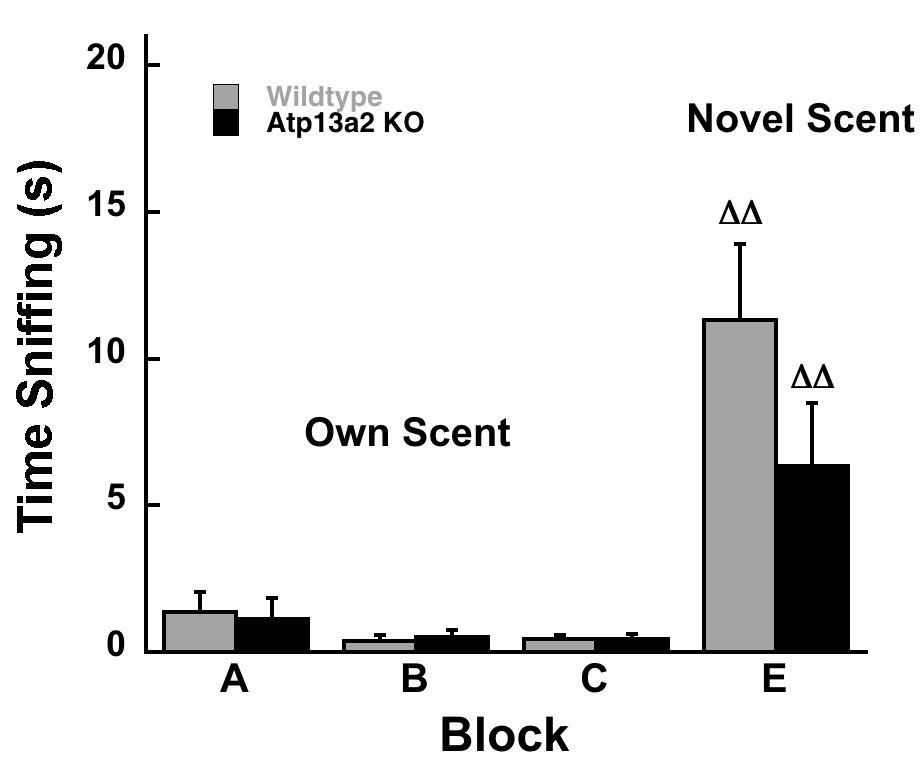
Figure 2. Block test. Time sniffing the novel block (E) in the block test in wildtype (n = 10) and Atp13a2 KO (n = 12) female mice at 20 - 27m of age. ΔΔ represents p < 0.01 compared to blocks A, B, and C from the same genotype. Mann-Whitney U.
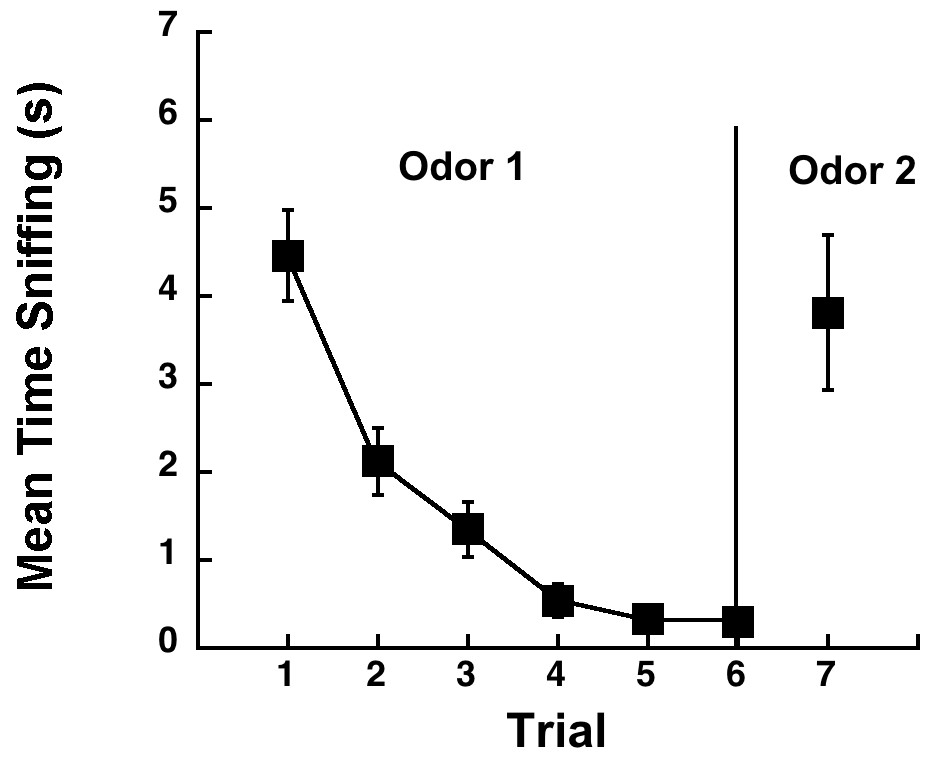
Figure 3. Habituation/dishabituation test. Mean time sniffing a scented cartridge in wildtype mice (age 9 m, n = 7) across 6 trials and the introduction of a cartridge with a novel scent on trial 7.
Discussion
Each of the tests described in this study measure different aspects of olfactory function in mice. The buried pellet test measures the food motivation aspect of olfaction, testing the ability of hungry (food restricted, not food deprived) mice to detect a palatable piece of sweetened cereal buried under bedding. The block test measures more of the social aspect of olfactory function, testing the ability of mice to discriminate between their own scent and that of a conspecific. The habituation/dishabituation test assesses the ability of the mouse to discriminate between familiar and novel, innocuous scents. Using multiple tests is important when characterizing a new model because anomalies in food motivation or fear could contribute to differences observed in mutant mice compared to controls. For example, if only the block test is performed and decreased sniffing of the block that has the odor of another mouse is observed, it is unclear whether there is an olfactory deficit or an enhanced fear response to the conspecific that may lead to avoidance of that block. When multiple tests are performed and deficits are observed in all tests, it strongly supports an interpretation of olfactory impairment. However, if differences are observed in only one test but not the others then there may be a more subtle olfactory impairment but it will be essential to rule out other explanations (i.e., enhanced fear or reduced food motivation). Additional important factors to keep in mind when testing olfactory function mice include the background strain and sex of the mice. Different genetic background strains (i.e., C57BL/6, DBA, etc.) can have profound effects on mouse behavior therefore, it is recommended to adapt each protocol in wildtype mice of the same background before performing the entire experiment. It is also recommended that male and female mice be tested separately from each other because the male olfactory system is highly sensitive to females in estrous and olfactory detection of a female in estrous could interfere with performance in all three tests.
Some steps are absolutely critical to follow when testing olfaction in mice. It is important to be cognizant of the odors the experimenter is introducing to the animals. Wearing gloves for the procedures is essential and frequent changing of gloves between animals is required. It is always a good practice for the experimenter not to wear cologne or perfume on olfaction testing days. While some parts of the procedure are inflexible, there are other parts that can be modified and adapted without reducing the validity or sensitivity of the test. For example, the number of habituation trials can be increased or decreased depending on the strain of mice being tested and how quickly they habituate to the stimuli. The major limitation of these tests is that they are all driven by some form of motivation, be it food or social, making it difficult to completely rule out anomalies in motivation as an explanation when an altered response observed. This can be minimized by analyzing additional parameters, such as activity during testing and time to approach stimuli.
Once mastered, the tests can be easily used in examining the phenotype of novel mouse models of neurodegenerative disease. In addition, the tests that have the highest power can be included in preclinical studies testing potential therapeutics (for an example see ref. 25).
Disclosures
We have no conflicts of interest.
Acknowledgements
This protocol follows any and all animal care and use guidelines and regulations set by IACUC at the University of Cincinnati. This work is funded by NIH/NINDS NS07722 and the Gardner Family Center for Parkinson’s Disease and Movement Disorders.
Materials
| Name | Company | Catalog Number | Comments |
|---|---|---|---|
| Cap'n Crunch | Quaker Oats | 30000065310 | |
| Wooden Blocks | Lara's Crafts | 10144 | |
| Almond Flavor Extract | Kroger | 011110664716 | |
| Anise Flavor Extract | Kroger | 011110615619 | |
| Banana Flavor Extract | Kroger | 011110669919 | |
| Coconut Flavor Extract | Kroger | 011110669889 | |
| Lemon Flavor Extract | Kroger | 011110669957 | |
| Orange Flavor Extract | Kroger | 0011110669964 | |
| Tissue Cartridges | Sigma-Aldrich | Z672122-500EA | Manufactured by Simport no: M490-2 |
| Cotton Balls | Kroger | 11110793119 | |
| Mouse Cages | Ancare | 19 x 29 x 12.7 cm | |
| Camcorder | Sony | HDR-HC9 | |
| MiniDV Tapes | Sony DVC premium | 27242523432 | 60 minute long play |
References
- Hawkes, C. Olfaction in neurodegenerative disorder. Adv. Otorhinolaryngol. 63, 133-151 (2006).
- Ward, C., Hess, W., Calne, D. Olfactory impairment in Parkinson's disease. Neurology. 33, 943-946 (1983).
- Doty, R., Stern, M., Pfeiffer, C., Gollomp, S., Hurtig, H. Bilateral olfactory dysfunction in early stage treated and untreated idiopathic Parkinson's disease. J. Neurol. Neurosurg. Psychiatry. 55, 138-142 (1992).
- Doty, R., Deems, D., Stellar, S. Olfactory dysfunction in parkinsonism: a general deficit unrelated to neurologic signs, disease stage, or disease duration. Neurology. 38, 1237-1244 (1988).
- Tissingh, G., et al. Loss of olfaction in de novo and treated Parkinson's disease: possible implications for early diagnosis. Movement Disorders. 16 (1), 41-46 (2001).
- Montgomery, E., Baker, K., Lyons, K., Koller, W. Abnormal performance on the PD test battery by asymptomatic first-degree relatives. Neurology. 52, 757-762 (1999).
- Berendse, H., et al. Subclinical dopaminergic dysfunction in asymptomatic Parkinson's disease patients' relatives with a decreased sense of smell. Ann. Neurol. 50 (1), 34-41 (2001).
- Ponsen, M., Stoffers, D., Booij, J., van Eck-Smit, B., Wolters, E., Berendse, H. Idiopathic hyposmia as a preclinical sign of Parkinson's disease. Ann. Neurol. 56, 173-181 (2004).
- Langston, J. The Parkinson's complex: parkinsonism is just the tip of the iceberg. Ann. Neurol. 59 (4), 591-596 (2006).
- Ross, G., et al. Association of olfactory dysfunction with risk for future Parkinson's disease. Ann. Neurol. 63, 167-173 (2008).
- Fleming, S., et al. Early and progressive sensorimotor anomalies in mice overexpressing wild-type human alpha-synuclein. J. Neurosci. 24, 9434-9440 (2004).
- Fleming, S., Ekhator, O., Ghisays, V. Assessment of sensorimotor function in mouse models of Parkinson's disease. J. Vis. Exp. , e50303(2013).
- Schallert, T., Tillerson, J. L. Intervention strategies for degeneration of DA neurons in parkinsonism: Optimizing behavioral assessment of outcome. Central Nervous System Diseases. , 131-151 (2000).
- Whishaw, I., O'Connor, W., Dunnett, S. The contributions of motor cortex, nigrostriatal dopamine and caudate-putamen to skilled forelimb use in the rat. Brain. 109 (5), 805-843 (1986).
- Schwarting, R., Huston, J. The unilateral 6-hydroxydopamine lesion model in behavioral brain research. Analysis of functional deficits, recovery and treatments. Prog Neurobiol. 49 (3), 215-266 (1996).
- Glasl, L., et al. Pink1-deficiency in mice impairs gait, olfaction and serotonergic innervation of the olfactory bulb. Experimental Neurology. 235, 214-227 (2012).
- Kim, Y., Lussier, S., Rane, A., Choi, S., Andersen, J. Inducible dopaminergic glutathione depletion in an α-synuclein transgenic mouse model results in age-related olfactory dysfunction. Neuroscience. 172, 379-386 (2011).
- Fleming, S., Tetreault, N., Mulligan, C., Huston, C., Masliah, E., Chesselet, M. Olfactory deficits in mice overexpressing human wildtype alpha-synuclein. The European Journal of Neuroscience. 28 (2), 247-256 (2008).
- Nuber, S., et al. A progressive dopaminergic phenotype associated with neurotoxic conversion of α-synuclein in BAC-transgenic rats. Brain. 136 (2), 412-432 (2013).
- Macknin, J., Higuchi, M., Lee, V., Trojanowski, J., Doty, R. Olfactory dysfunction occurs in transgenic mice overexpressing human tau protein. Brain Res. 1000, 174-178 (2004).
- Lazic, S., et al. Olfactory abnormalities in Huntington's disease: decreased plasticity in the primary olfactory cortex of R6/1 transgenic mice and reduced olfactory discrimination in patients. Brain Res. 1151, 219-226 (2007).
- Wesson, D., Wilson, D., Nixon, R. Should olfactory dysfunction be used as a biomarker of Alzheimer's disease? Expert Review of Neurotherapeutics. 10 (5), 633-635 (2010).
- Taylor, T., Caudle, W., Miller, G. VMAT2-deficient mice display nigral and extranigral pathology and motor and nonmotor symptoms of Parkinson's disease. Parkinsons Dis. 2011, 124-165 (2011).
- Tillerson, J., Caudle, W., Parent, J., Gong, C., Schallert, T., Miller, G. Olfactory discrimination deficits in mice lacking the dopamine transporter or the D2 dopamine receptor. Behav. Brain Res. 172, 97-105 (2006).
- Fleming, S., et al. A pilot trial of the microtubule-interacting peptide (NAP) in mice overexpressing alpha-synuclein shows improvement in motor function and reduction of alpha-synuclein inclusions. Mol. Cell. Neurosci. 4, 597-606 (2011).
- Crawley, J. What's Wrong with My Mouse? Behavioral Phenotyping of Transgenic and Knockout Mice. , Wiley-Liss. NY. (2000).
- Nathan, B., Yost, J., Litherland, M., Struble, R., Switzer, P. Olfactory function in apoE knockout mice. Behav. Brain Res. 150, 1-7 (2004).
- Spinetta, M. A simple and sensitive odor recognition test for rats and mice detects retrograde amnesia caused by ethanol or other drugs that interfere with memory consolidation. Society for Neuroscience. , Washington, D.C. (2005).
- Spinetta, M., et al. Alcohol-induced retrograde memory impairment in rats: prevention by caffeine. Psychopharmacology. 201 (3), 361-371 (2008).
- Bielsky, I., Hu, S., Szegda, K., Westphal, H., Young, L. Profound impairment in social recognition and reduction in anxiety-like behavior in vasopressin V1a receptor knockout mice. Neuropsychopharmacology. 29, 483-493 (2004).
Reprints and Permissions
