The transparent C. elegans intestine can serve as an "in vivo tissue chamber" for studying apicobasal membrane and lumen biogenesis at the single-cell and subcellular level during multicellular tubulogenesis. This protocol describes how to combine standard labeling, loss-of-function genetic/RNAi and microscopic approaches to dissect these processes on a molecular level.
Method Article
The C. elegans Intestine As a Model for Intercellular Lumen Morphogenesis and In Vivo Polarized Membrane Biogenesis at the Single-cell Level: Labeling by Antibody Staining, RNAi Loss-of-function Analysis and Imaging
In This Article
Summary
Abstract
Multicellular tubes, fundamental units of all internal organs, are composed of polarized epithelial or endothelial cells, with apical membranes lining the lumen and basolateral membranes contacting each other and/or the extracellular matrix. How this distinctive membrane asymmetry is established and maintained during organ morphogenesis is still an unresolved question of cell biology. This protocol describes the C. elegans intestine as a model for the analysis of polarized membrane biogenesis during tube morphogenesis, with emphasis on apical membrane and lumen biogenesis. The C. elegans twenty-cell single-layered intestinal epithelium is arranged into a simple bilaterally symmetrical tube, permitting analysis on a single-cell level. Membrane polarization occurs concomitantly with polarized cell division and migration during early embryogenesis, but de novo polarized membrane biogenesis continues throughout larval growth, when cells no longer proliferate and move. The latter setting allows one to separate subcellular changes that simultaneously mediate these different polarizing processes, difficult to distinguish in most polarity models. Apical-, basolateral membrane-, junctional-, cytoskeletal- and endomembrane components can be labeled and tracked throughout development by GFP fusion proteins, or assessed by in situ antibody staining. Together with the organism's genetic versatility, the C. elegans intestine thus provides a unique in vivo model for the visual, developmental, and molecular genetic analysis of polarized membrane and tube biogenesis. The specific methods (all standard) described here include how to: label intestinal subcellular components by antibody staining; analyze genes involved in polarized membrane biogenesis by loss-of-function studies adapted to the typically essential tubulogenesis genes; assess polarity defects during different developmental stages; interpret phenotypes by epifluorescence, differential interference contrast (DIC) and confocal microscopy; quantify visual defects. This protocol can be adapted to analyze any of the often highly conserved molecules involved in epithelial polarity, membrane biogenesis, tube and lumen morphogenesis.
Introduction
The generation of cellular and subcellular asymmetries, such as the formation of polarized membrane domains, is crucial for the morphogenesis and function of cells, tissues and organs1. Studies on polarized membrane biogenesis in epithelia remain a technical challenge, since directional changes in the allocation of subcellular components depend upon multiple consecutive and coincident extracellular and intracellular signals that are difficult to separate in most models and strongly depend on the model system. The model presented here - the single-layered Caenorhabditis elegans intestine - is a tissue of exquisite simplicity. Together with the single-cell C. elegans excretory canal (see accompanying paper on polarized membrane biogenesis in the C. elegans excretory canal)2, it provides several unique advantages for the identification and characterization of molecules required for polarized membrane biogenesis. The conservation of molecular polarity cues from yeast to man make this simple invertebrate organ an excellent "in vivo tissue chamber" to address questions on epithelial polarity that are of direct relevance to the human system, which is still far too complex to allow the visual dissection of these events at the single cell level in vivo.
Although multiple conserved polarity cues from (1) the extracelluar matrix, (2) the plasma membrane and its junctions, and (3) intracellular vesicular trafficking have been identified3, the underlying principles of their integration in the process of polarized epithelial membrane and tissue biogenesis is poorly understood4. The classical single-cell in vivo models (e.g.S. cerevisiae and the C. elegans zygote) have been instrumental in defining the principles of polarized cell division and anterior-posterior polarity and have identified critical membrane-associated polarity determinants (the small GTPases/CDC-42, the partitioning-defective PARs)5,6, but they depend upon unique symmetry breaking cues (bud scar, sperm entry) and lack junction-secured apicobasal membrane domains and, presumably, the corresponding intracellular apicobasal sorting machinery. Our current knowledge about the organization of polarized trafficking in epithelia, however, primarily relies on mammalian 2D monocultures7, which lack physiological extracellular and developmental cues that can change positions of membrane domains and directions of trafficking trajectories (a switch from 2D to 3D in vitro culture systems alone suffices to invert membrane polarity in MDCK (Madin-Darby canine kidney) cells)8. In vivo developmental studies on epithelial polarity in invertebrate model organisms were initially conducted in flat epithelia, for instance in the Drosophila melanogaster epidermis, where they identified the critical contribution of junction dynamics for polarized cell migration and cell sheet movement9, and of endocytic trafficking for polarity maintenance10. The 3D in vitro and in vivo analysis of lumen morphogenesis in tubular epithelia in MDCK cells and in the C. elegans intestine, respectively, have recently identified the requirement of intracellular trafficking for de novo (apical) domain and lumen biogenesis and positioning11,12,13. The thickness of tubular (versus flat) epithelial cells is an advantage for the 3D analysis of subcellular asymmetries since it permits a superior visual distinction of the apical-lumenal membrane, apico-lateral junctions, the lateral membrane, and the positions of intracellular organelles. To these visual advantages, the C. elegans model adds the in vivo setting, developmental axis, transparency, simplicity of body plan, invariant and defined cell lineage, analytical (genetic) and additional advantages described below.
C. elegans itself is a roundworm of tubular structure whose transparency and simple architecture make its likewise tubular internal organs directly accessible to the visual analysis of tube and lumen morphogenesis. The twenty cells of its intestine (21 or 22 cells on occasion)14 are derived from a single progenitor cell (E) and develop from a double-layered epithelium by one intercalation step into a bilaterally symmetrical tube of nine INT rings (four cells in the first ring; Figure 1 schematic)14,15,16. The intestine's lineage and tissue analysis, initially determined by Nomarski optics via nuclear identities17and subsequently by fluorescence microscopy via labeled membranes, has provided critical insights into its morphogenesis, in particular the cell-autonomous and cell-non-autonomous requirements for its directional cell divisions and movements (e.g., intercalation, right-left asymmetries, anterior and posterior tube rotation)14,18. Early endodermal cell specification and the gene regulatory network controlling the development of this clonal model organ are well characterized19,20. The focus here, however, is on the analysis of polarized membrane and lumen biogenesis in single tubular cells, and of the intracellular asymmetries of endomembranes, cytoskeletal structures and organelles that accompany this process. The analysis is facilitated by the simplicity of this tube, where all apical membranes (on the ultrastructural level distinguished by microvilli) face the lumen and all basal membranes face the outer tube surface, with lateral membranes contacting each other, separated from the apical membrane by junctions (Figure 1 schematic; see references (16,21) for the C. elegans-specific organization of tight and adherens junction components). Apical membrane biogenesis is thus coincident with lumen morphogenesis. Furthermore, the size of adult intestinal cells - the largest cells of this small animal (with exception of the excretory cell) - approximate the size of a mammalian cell, permitting the in vivo visual tracking of subcellular elements, e.g. vesicle trajectories, that is typically attempted in vitro in a culture dish.
For the purpose of this cellular and subcellular analysis, appropriate labeling is critical. Intestinal endo- or plasma-membrane domains, junctions, cytoskeletal structures, nuclei and other subcellular organelles can be visualized by labeling their specific molecular components. Many such components have been characterized and continue to be discovered (Table 1 gives a few examples and refers to resources). For instance, various molecules distinguishing the tubular and/or vesicular compartments of the intestinal endomembrane system, from the ER to the Golgi via post-Golgi vesicles to the plasma membrane, have been identified22. The specific proteins (as well as lipids and sugars) can either be labeled directly, or indirectly via binding proteins. This protocol focuses on in situ antibody staining of fixed specimens, one of two standard labeling techniques (see the accompanying paper on excretory canal tubulogenesis for a description of the other technique2 - in vivo labeling via fluorescent protein fusions - which is directly applicable to the intestine; Table 2 provides examples of intestine-specific promoters that can be used to drive expression of such fusion proteins to the intestine). Double- or multiple labeling with either approach, or with a combination of both plus additional chemical staining, allows greater in-depth visual resolution and the examination of spatial and temporal changes in co-localization and recruitment of specific molecules or of subcellular components (Figure 2). The fixation and staining procedures described in this protocol support preservation of green fluorescent protein (GFP) labeling during immunostaining procedures. For imaging, key points of the detection and characterization of tubulogenesis phenotypes via standard microscopic procedures (fluorescence dissecting and confocal microscopy) are described (Figure 3, 4). These can be extended to higher resolution imaging approaches, for instance superresolution microscopy and transmission electron microscopy (not described here).
A key strength of this system is the ability to analyze polarity in individual cells at different developmental stages, from embryogenesis through adulthood. For instance, apical membrane domain and lumen biogenesis can be tracked throughout development at the single-cell level via labeling with ERM-1, a highly conserved membrane-actin linker of the Ezrin-Radixin-Moesin family23,24. ERM-1 visualizes apical membrane biogenesis (1) during embryonic tube morphogenesis, when it occurs concomitantly with polarized cell division and migration (cells move apically around the lumen during intercalation)15; (2) during late embryonic and larval tube extension that proceeds in the absence of cell division or migration; and (3) in the adult intestine, where polarized membrane domains are maintained (Figure 1). In the expanding post-mitotic larval epithelium, de novo polarized membrane biogenesis can thus be separated from polarized tissue morphogenesis, which is not possible in most in vivo and in vitro epithelial polarity models, including those with single-cell resolution (e.g. the 3D MDCK cyst model8). With labeling for other components, this setting provides the opportunity (particularly at the L1 larval stage when cells have a higher cytoplasm/nucleus ratio) to distinguish those intracellular changes that are specific to polarized membrane biogenesis (e.g. the reorientation of trafficking trajectories) from those concomitantly required for polarized cell division and migration.
The genetic versatility of C. elegans is well known25and makes it a powerful model system for the molecular analysis of any biological question. A study on morphogenesis, for instance, can start with a wild-type strain, a transgenic strain where the structure of interest (e.g. a membrane) is labeled with a fluorescent marker, or with a loss- or gain-of-function mutant with a defect in this structure. A typical reverse genetic study may generate a mutant where the gene of interest is deleted in the germline (e.g. by a targeted deletion), modified by mutagenesis (typically producing point mutations with consequent loss, reduction, or gain in function of the gene), or where its transcript is reduced by RNAi. The ease of RNAi by feeding in C. elegans26 also lends itself to the design of targeted screens that examine a larger group of genes of interest. A genetic model organism's arguably greatest strength is the ability to conduct in vivo forward screens (e.g. mutagenesis, systematic or genome-wide RNAi screens) that permit an unbiased inquiry into the molecular cause for a phenotype of interest. For instance, an unbiased visual C. elegans RNAi tubulogenesis screen, starting with a transgenic animal with ERM-1-labeled apical membranes, discovered an intriguing reversible intestinal polarity conversion and ectopic lumen phenotype, used here as an example for this type of analysis. This screen identified the depletion of glycosphingolipids (GSLs; obligate membrane lipids, identified via their GLS-biosynthetic enzymes) and components of the vesicle coat clathrin and its AP-1 adaptor as the specific molecular defects causing this polarity conversion phenotype, thereby characterizing these trafficking molecules as in vivo cues for apical membrane polarity and lumen positioning12,13. When starting with a specific genetic mutation/morphogenesis phenotype, such screens (or single genetic/RNAi interaction experiments) can also examine functional interactions between two or multiple genes of interest (see accompanying paper on the excretory canal for an example of such an analysis)2. This protocol focuses on RNAi which, in addition to its ability to directly identify the gene whose loss causes the phenotype in forward screens, provides specific advantages for the analysis of morphogenesis. Since gene products directing morphogenesis often work in a dose-dependent fashion, RNAi is usually successful in generating a spectrum of phenotypes. The ability to generate informative partial-loss-of-function phenotypes also helps to address the problem that the majority of important tubulogenesis genes are essential and that their losses cause sterility and early embryonic lethality. This protocol includes conditional RNAi strategies to overcome this difficulty and suggests ways to optimize the generation of a broader spectrum of phenotypes, such as an allelic series produced by mutagenesis.
Protocol
1 . Labeling the C. elegans intestine
Note: See the accompanying paper by the authors on the analysis of excretory canal tubulogenesis2 for the construction of tissue specific fluorescent marker plasmids and the generation of transgenic animals, including discussions on transcriptional and translational fusion proteins (the latter required for the subcellular localization of a molecule of interest). These procedures can be adapted by using specific promoters to drive the molecule of interest to the intestine. See Table 1 for examples of molecules proven useful for visualizing C. elegans intestinal endo- and plasma membranes and their junctions, Table 2 for examples of promoters for driving expression to the intestine, and Table 3 for resources for more comprehensive collections of intestinal markers and promoters.
- Antibody staining of the C. elegans intestine27,28
- Fixation
- Take a clean glass slide and use poly-L-lysine to generate a thin film for worms to stick on. Place 30 µL 0.1-0.2% poly-L-lysine on the slide and place a second slide on the poly-L-lysine drop to make a "sandwich". Then rub the slides gently a few times to wet the entire surfaces of both and let them air dry for 30 min. Label the frosted side of the slides with pencil.
Note: 0.2% poly-L-lysine aliquots of 200 µL were made by dissolving the powder in dH2O; this can be stored at -20 °C. Use high molecular weight poly-L-lysine for improved sticking of the worms. The concentration of poly-L-lysine is also critical. Too low concentrations will not allow worms to stick but too high concentrations may generate fluorescence background signal. A too thick film may loosen up in its entirety. - Place a flat metal block firmly on the bottom of a container (e.g. a polystyrene container) filled with liquid nitrogen.
NOTE: One can use dry ice instead, but liquid nitrogen keeps a metal block more stable on the container bottom and chills well. - Collect worms either by washing them off their plates with M929 or pick different stage worms (either eggs, L1, L2, L3, or L4 larval stage worms) onto each slide. Typically, pick ~100 larvae and embryos or ~20 adults to each slide. Place 10 µL washed off worms onto the middle of the slide or pick eggs/worms into 10 µL M9 or 10 µL 1x PBS27 (phosphate buffered saline).
- Use a pipette to spread out large numbers of worms to avoid clumping.
Note: Mixed populations of washed off worms, due to crowding and different thickness of stages, do not stick well and are less effectively freeze-cracked (see below), therefore picking stage-specific worms (or synchronized populations) gives superior results. Larvae stick better than adults and more animals can be placed per slide. - Before picking worms onto slides, transfer them to a Nematode Growth Medium (NGM) plate29 without OP50 bacteria. Excess bacteria adherent to the worms can also interfere with sticking. Take care that worms do not dry out.
- Use a pipette to spread out large numbers of worms to avoid clumping.
- Gently place (drop) a 22 mm × 22 mm coverslip cross-ways on top of the collected worms such that its edges hang over on at least one side of the slide. Press straight down gently but firmly with one or two fingers on the coverslip. Avoid shearing that will damage tissue integrity.
- Immediately and gently transfer the slide to the metal block in liquid nitrogen and let it sit for about 5 min to freeze. Then "flick off" the coverslip in one swift move by using the overhanging edge.
Note: This step must be done decisively and while the slide is frozen to achieve "cracking" of the cuticle. Caution: Please follow the PPE (Personal Protection Equipment) guidelines when working with liquid nitrogen. - Immerse the freeze-cracked slides into a methanol-filled glass Coplin jar for 5 min at -20 °C. Then transfer to an acetone-filled glass Coplin jar for another 5 min at -20 °C.
Note: Methanol and acetone should be stored in -20 °C for at least 30 min before use. After fixation, slides can be stored at -20 °C. CAUTION: methanol and acetone are toxic. - Remove slides from jar and let them air dry at room temperature (RT) before use.
- Take a clean glass slide and use poly-L-lysine to generate a thin film for worms to stick on. Place 30 µL 0.1-0.2% poly-L-lysine on the slide and place a second slide on the poly-L-lysine drop to make a "sandwich". Then rub the slides gently a few times to wet the entire surfaces of both and let them air dry for 30 min. Label the frosted side of the slides with pencil.
- Staining
- Surround area of fixed worms with a thin layer of petroleum jelly on the slide. Draw a circle around this area on the underside of the slide to mark the spot.
Note: It is critical that the jelly circle remains intact throughout the staining procedure to prevent leakage of the staining solutions. - Prepare a "wet chamber" in a plastic bin with lid by placing wet paper towels into it. Place the slide onto a rack in this "wet chamber" to prevent the drying of the slides during staining.
Note: Slides should not be in contact with water or with each other. - Gently pipette approximately 50 µL 1x PBS into the jelly circle, enough to cover the area. Close the "wet chamber" with the lid. Incubate at RT for 5 min.
Note: To avoid losing worms at this step, do not pipette PBS directly onto the worms. Gently place pipette tip at the edge of the circle and allow fluid to smoothly disperse over the worms. - Tilt the slide and slowly aspirate the PBS with a pipette. Place the slide back flat onto the rack and add 50 µL (or the required amount to cover the spot) blocking solution carefully. Incubate this in the wet chamber at RT for 15 min. While waiting, dilute the primary antibodies in blocking solution (see Table of Materials for examples of primary antibodies and concentrations).
Note: Freshly prepare blocking solution using 1x PBS (10 mL), 10% tween (50 µL), and powdered milk (0.2 g). The amount of detergent and concentration of milk may vary depending on antibodies used and may need to be empirically determined. Aspiration of fluid from the slide is another step to easily lose worms. Check progress by examining the slide under the dissecting scope, but take care that the slide does not dry out. - Tilt the slide and aspirate away the blocking solution, using the same precautions as described above. Place slide back flat onto rack and slowly add 50 µL diluted primary antibody, using the same precautions. Close the "wet chamber" and incubate at 4 °C overnight or for shorter periods at RT.
Note: Incubation time may need to be empirically determined for a specific antibody. - Aspirate off the primary antibody solution as done for the other solutions. Then wash the slides with blocking solution for 10 min, 3 times, adding and removing the solution in the same fashion as described above.
- Add secondary (fluorescently-labeled) antibody diluted in blocking solution, incubate at RT for 1 h. See Table of Materials for examples of secondary antibodies and concentrations.
- Remove the secondary antibody and wash, as above, with blocking solution 2 times and, to clear off the blocking solution, with 1x PBS, for 10 min each.
- Aspirate away as much PBS as possible without permitting the specimen to dry out and carefully remove the jelly around the specimen.
- Add one drop mounting medium onto the specimen, and place a coverslip gently on top. Seal the edges of the coverslip with nail polish. Place slides in a dark slide box to preserve staining and store in 4 °C.
Note: Keep slides in the dark because of light sensitivity (fluorescence may fade with time) and prevent air exposure by keeping them sealed, for the same reason. Slides may be stored for extended periods of time at 4 °C or -20 °C.
- Surround area of fixed worms with a thin layer of petroleum jelly on the slide. Draw a circle around this area on the underside of the slide to mark the spot.
- Fixation
2. Interference with the function of essential tubulogenesis genes in the C. elegans intestine. Example: RNAi.
Note: C. elegans strains are cultured on OP50 bacteria seeded on NGM plates according to standard protocols29. For RNAi, C. elegans feed on HT115 RNAi bacteria on RNAi plates supplemented with 25 µg/mL carbenicillin and 2 mM IPTG (isopropyl beta-D-1-thiogalactopyranoside) for induction of the bacterial promoter that generates the double stranded RNA (dsRNA) from the introduced C. elegans gene. Antibiotics and IPTG concentration may vary according to RNAi clone/library and desired RNAi strength, resp. Specific RNAi clones can be obtained from commercially available genome-wide RNAi feeding libraries (see (26,30,31) for background on feeding RNAi in C. elegans and Table of Materials for materials/reagents and RNAi libraries).
- Standard RNAi by feeding26,31
- Take out RNAi library plate from -80 °C and put it on dry ice. Remove the sealing tape and use sterile pipette tip to transfer adherent bacteria of clone of interest to LB (Luria Broth) agar plates29 supplemented with 100 µg/mL ampicillin and 15 µg/mL tetracycline. Streak out bacteria onto agar plate. Seal the RNAi library plate with a new sealing tape. Grow the bacteria overnight at 37 °C.
Note: These agar plates can be stored at 4 °C for several weeks. New bacteria can be cultured directly from them to protect the original RNAi library. - Next day, inoculate RNAi bacteria from LB agar plate into 1 mL LB liquid medium29 containing 50 µg/mL ampicillin each and shake for 14 (8-18) h or overnight at 37 °C.
Note: For optimal results use fresh bacteria each time. See reference (30) for comparison of different culture conditions (e.g. timing of culture). - Next day, seed 200 µL per clone of the cultured RNAi bacteria on separate RNAi plates. Let the plates dry and leave at RT overnight for induction of the bacterial promoter.
- Transfer 4 - 6 L4-stage larvae onto each RNAi plate. Incubate the seeded RNAi plates at RT or 22 °C for 3-5 days.
Note: Pick L4 larvae first onto an NGM plate without bacteria to remove adherent OP50 that will interfere with RNAi, or serially transfer them to a new NGM plate without OP50 three times. Make sure strains are not contaminated, as contaminating bacteria - like OP50 preferred food for the worms - will also interfere with RNAi. Adjust temperature as needed: e.g. development accelerates with higher temperature; strains may be temperature sensitive. - For developmental studies, check phenotypes of the F1 progeny from day 2 onwards.
Note: It is critical to check animals frequently to avoid missing the appearance or progression of a phenotype (e.g. marker displacement) when assessing polarized membrane biogenesis during development. Enrichment of the F2 population for strong phenotypes (e.g. by picking parent hermaphrodites to a new RNAi plate on day 2 to select for the most strongly affected mid portion of their progeny) is rarely necessary, since a spectrum from mild to strong phenotypes is desirable.
- Take out RNAi library plate from -80 °C and put it on dry ice. Remove the sealing tape and use sterile pipette tip to transfer adherent bacteria of clone of interest to LB (Luria Broth) agar plates29 supplemented with 100 µg/mL ampicillin and 15 µg/mL tetracycline. Streak out bacteria onto agar plate. Seal the RNAi library plate with a new sealing tape. Grow the bacteria overnight at 37 °C.
- Conditional RNAi
NOTE: RNAi conditions can be modified to reduce severe, or increase mild effects, or to interfere stage-specifically; modifications are helpful for the full evaluation of phenotypic effects of the often lethal tubulogenesis genes.- Larval RNAi - evaluation of RNAi effects in the same generation (mild, stage-specific RNAi)
Note: To overcome sterility or embryonic lethality, or to disrupt gene function at a specific stage post embryogenesis, RNAi is induced in larvae, post embryonically. Either place untreated eggs (2.2.1.1), gravid adults (2.2.1.2) or synchronized L1 (or, if desired, later stage) larvae (2.2.1.3) on RNAi plates; evaluate the RNAi effects in the same generation, e.g. two days later and onwards, in larvae and/or adults.- Pick 30-50 gravid adults into one drop bleaching solution (a 1: 4 solution of 10 M NaOH and household sodium hypochlorite) placed to the edge of an RNAi plate. Let dry and allow L1s to hatch and move into the bacterial lawn.
Note: Bleaching solution, generally used for decontamination, will kill everything but embryos in their egg shells. Therefore, do not place the bleaching solution onto or close to the RNAi bacteria. - Pick or seed ~20 young gravid adults on RNAi plate and let them lay eggs for 2-3 h, or until there are around 300 eggs on the plate, then pick off the adults.
Note: This method may cause contamination of the RNAi bacteria by OP50. To reduce this risk, first transfer adults onto a NGM plate without bacteria to remove OP50 adherent to the worms. Take care that adults do not stay too long on RNAi plates to avoid RNAi effect on embryos. - Pick or place L1 stage worms directly on RNAi plates (see reference (29)-for synchronization protocols).
Note: One can use an abbreviated synchronization protocol (e.g. for a moderately large scale set-up) by washing worms from densely populated plates with M9 for several times until only eggs remain. After 2-3h hatching L1s can then be collected in M9 from these plates, cleaned by additional washes to remove bacteria (3x in M9), and seeded onto RNAi plates.
- Pick 30-50 gravid adults into one drop bleaching solution (a 1: 4 solution of 10 M NaOH and household sodium hypochlorite) placed to the edge of an RNAi plate. Let dry and allow L1s to hatch and move into the bacterial lawn.
- Dilution of RNAi bacteria with empty vector RNAi bacteria (mild RNAi)
Note: Reduction in the amount of dsRNA by diluting the amount of RNAi bacteria may suffice to induce milder effects and may also reduce embryonic lethality without abolishing all embryonic effects. Dilution of RNAi bacteria is also used for double RNAi experiments and to titrate conditions for genetic interaction experiments (e.g. to generate mild effects for the assessment of enhancement and strong effects for the assessment of suppression).- Grow up RNAi and empty vector HT115 RNAi bacteria in 1 mL LB medium with 50 µg/mL ampicillin, as done for standard RNAi conditions.
- Dilute the RNAi bacteria with empty vector RNAi bacteria to achieve a range of different concentrations, for example, of 5%, 15%, 30%, 50%, 70%. Mix the bacteria well by pipetting up and down. Pipette 200 µL mixed bacteria onto an RNAi plate.
- Pick 4-6 L4 larvae on each RNAi plate. Check the phenotype from day 2 onward.
- RNAi sensitive strains (strong RNAi)
- Use available RNAi-sensitive strains, for example, eri-1 (mg366), rrf-3 (pk1426) or eri-1 (mg366) lin-15B (n744) (the latter supersensitive), and follow standard RNAi procedures described in 2.131,32,33.
Note: RNAi sensitive strains (e.g. rrf-3and eri-1) may have lower brood sizes than wild-type animals and be sterile at 25 °C. They may also have a low background of own phenotypes, e.g. low penetrant embryonic lethality, which has to be taken into account when evaluating specific RNAi effects.
- Use available RNAi-sensitive strains, for example, eri-1 (mg366), rrf-3 (pk1426) or eri-1 (mg366) lin-15B (n744) (the latter supersensitive), and follow standard RNAi procedures described in 2.131,32,33.
- Larval RNAi - evaluation of RNAi effects in the same generation (mild, stage-specific RNAi)
3. In vivo imaging of the C. elegans intestine by fluorescence dissecting microscopy
- Before visualizing animals under the fluorescence light, check RNAi plates under bright light on any dissecting microscope. Assess (and potentially record) phenotypes visible under bright light that may affect the analysis, such as lethality, sterility (lower number of progeny), developmental (e.g. larval arrest) and other visible phenotypes that may help characterize the function of a gene involved in polarized membrane biogenesis and lumen morphogenesis.
Note: Only score plates that have sufficient progeny for evaluation (at least 50), otherwise try alternative RNAi conditions. For quantitative evaluation make sure that plates are not contaminated or grow OP50 (that interfere with RNAi). - To visualize animals under fluorescent light, remove the lid and place the RNAi plate directly under the dissecting fluorescence microscope.
Note: To detect subtle intestinal phenotypes one will need a dissecting microscope with a higher power stereo fluorescence attachment that allows for a sufficient range of magnification. This protocol describes the use of a scope with a 1.5 and 10 x objective and a zoom range from 3.5 to 45. - First find animals under bright light to focus. Next, examine animals under fluorescent light at low magnification (e.g. under the 1.5x objective), using the appropriate filter. Examine plate systematically from upper left to lower right to scan entire plate for phenotypes.
- Select animal of interest and change to 10x objective. Focus on the intestine and use zoom to assess tubulogenesis/lumen morphogenesis phenotype. See section 5 for scoring of phenotypes. First, take images at low magnification. Then switch to high magnification.
Note: Since healthy animals move fast, work swiftly, with one hand on computer mouse for image acquisition while focusing the microscope with the other hand. Slowing animals (e.g. by transient placement of the plates to 4 °C) may not be required when working with tubulogenesis phenotypes in mostly arrested embryos and early larvae. The images can be captured by a microscope-mounted CCD camera and image capture software.
4. Imaging the C. elegans intestine at higher resolution by laser scanning confocal microscopy 34,35
- Mounting and immobilization
- Use fingertip to thinly spread a small amount of grease or petroleum jelly in a circle on a glass slide (~6-8 mm in diameter).
Note: Thickness of grease circle is critical for mounting. For best imaging results, image only one or several larvae at a time and use an ultrathin grease circle with as little liquid as possible such that the animal is directly stuck between the glass slide and cover slip (if done perfectly, animal will be immobilized without anesthetic). Mounting of eggs and of older animals require a somewhat thicker circle to avoid destruction of sample when adding cover slip. - Add a drop of typically 3.5 µL 10 mM sodium azide solution into the middle of the circle and pick worms into it under the dissecting microscope.
Note: Prepare a 1 M sodium azide stock solution by dissolving 65.01 mg NaN3 in 1 ml dH2O; add 200 µL of this 1M solution into 20 mL M9 buffer. Pick worms swiftly into drop of sodium azide solution to avoid solution to dry out. Pick stages separately for optimal mounting, aiming at about 50 embryos per slide and about 20 larvae when examining larger populations. One can use M9 instead of sodium azide solution when picking embryos. If using sodium azide, animals must be imaged within 30 min to avoid tissue damage of this toxic chemical.
CAUTION: sodium azide is toxic. - Gently place a 22 mm × 22 mm coverslip on slide. Be careful not to crush the worms. Use mild pressure and check under dissecting microscope to make sure the worms are fixed well between slide and cover slip. Label the slide.
Note: The correct amount of pressure is critical to avoid damaging the specimen (too much pressure) and not fixing it well (too little pressure: animals float instead of sticking to the slide). Floating animals essentially preclude appropriate imaging.
- Use fingertip to thinly spread a small amount of grease or petroleum jelly in a circle on a glass slide (~6-8 mm in diameter).
- Imaging
- Place slide under the confocal microscope.Search for worms with 10x objective and focus.
Note: Use bright light to focus where possible to avoid photobleaching. - Change to 60x or 100x objective and focus on the intestine.
NOTE: The intestine can be easily identified under bright light by its lumen running through the middle of the animal, from the pharynx to the anus near the tip of the tail. Be careful when applying oil for the 60x or 100x oil objective. Mixing different types of oils may interfere with further imaging. Place small drop of oil onto slide when using an upright microscope or onto the objective when using an inverted scope, taking care not to contaminate other objectives or parts of the microscope. - Establish Kohler DIC/Nomarski illumination for the objective to be used for scanning36. Inspect animal under fluorescent light with appropriate channel to check labeling of the intestine and/or to check phenotype, in order to select suitable specimen for imaging. Work swiftly to avoid bleaching.
- Switch to laser scanning to restrict prospective image to the intestine by setting scanning boundaries at its dorsal and ventral side.
Note: Bracketing the intestine in this way is critical if fluorophore also labels structures outside the intestine. During this pilot scan, work with fast scanning conditions to avoid photobleaching. - Stop scanning to select scanning parameters for the experiment. Set 6-20 sections for intestinal scanning along the z axis, e.g. at 0.2 µm intervals, depending on inquiry, stage of animal and/or technical considerations. Set frame averaging per image depending on complexity of labeling and required resolution to reduce noise.
Note: Setting details vary depending on microscope and experiment. One may need to reduce the amount of sections to avoid bleaching if performing sequential scanning of three different fluorophores. Adjust number of frames to number of sections (should be lower than number of sections to avoid image distortion; also weigh in the increase in photobleaching). 4-6 frames are usually sufficient. - Go back to scanning with definitive (slow) laser scanning conditions and adjust: brightness (use minimum gain to reduce background); laser power (as high as required, as low as possible - increases photobleaching; usually minimum setting is adequate); pinhole (avoid opening if not required, to maintain resolution).
Note: Scanning conditions depend on specimen and need to be empirically determined at the beginning of the scanning session. Make sure that brightness does not exceed saturation (will limit ability to modify image subsequently by imaging software). When setting scanning conditions, also consider that identical conditions must be used for all imaging in experiments that compare experimental animals with controls. - Capture image series. Merge images into a single projection image.
Note: May have to save projection images and/or overlays separately depending on microscope. - When taking multi-channel images use sequential scanning to avoid bleed-through between channels (critical for co-localization studies).
Note: Image settings may need to be changed given increased photobleaching connected to longer scanning time. - Always acquire corresponding DIC/Nomarski images (sections) for landmarks and overall state of morphology of scanned animal.
- Place slide under the confocal microscope.Search for worms with 10x objective and focus.
5. Quantification of polarized membrane biogenesis defects in the C. elegans intestine
Note: Example: Basolateral displacement of apical ERM-1::GFP and ectopic lateral lumen formation induced by let-767and aps-1RNAi.
- Scoring phenotypes under the dissecting microscope (Figure 5 A, D, E)
- Define categories for scoring. Example: (i) wild-type (WT), (ii) basolateral displacement of ERM-1::GFP (polarity defect), and (iii) ectopic lumen formation (develops subsequent to basolateral displacement).
NOTE: A low magnification visual analysis lends itself to scoring numbers of animals with or without a specific phenotype. Here, we selected an example of three qualitatively different phenotypic categories that are at the same time indicative of a worsening of the polarity phenotype that is analyzed. However, a variety of different qualitative and quantitative phenotypes can be scored, such as lumen morphogenesis defects, absence/presence (or numbers) of GFP positive cytoplasmic vacuoles, lumen diameter and size or numbers of intralumenal cysts (see Figure 3 for examples). - Depending on magnitude of expected differences, score approximately 100 live worms on their agar plates under the dissecting microscope in a duplicate or triplicate set of experiments.
Note: One must score every animal that comes into view when scanning plates systematically, e.g. from upper left to lower right of the plate (make sure worms have populated plates evenly). - Repeat this for 3 independent sets of experiments. Generate bar graph and evaluate significance of results.
- Define categories for scoring. Example: (i) wild-type (WT), (ii) basolateral displacement of ERM-1::GFP (polarity defect), and (iii) ectopic lumen formation (develops subsequent to basolateral displacement).
- Scoring phenotypes under the confocal microscope (Figure 5 B)
- Define categories for scoring, e.g. number of ectopic lumens per animal
NOTE: A higher magnification visual analysis lends itself to scoring a quantifiable marker or phenotype per animal and allows scoring of subcellular markers that may not be discernible by dissecting microscopy. The present example of counting ectopic lumens per animal in a subset of worms of the same experiment previously evaluated by dissecting microscopy (5.1.1, category 3) refines the evaluation of the worsening polarity phenotype that is examined here. However, a variety of other phenotypes or parameters can be scored, e.g. number of vesicles, presence/absence or number of subcellular components that co-localize, fluorescence intensity (the latter quantified by ImageJ; see accompanying paper on the excretory canal)2. - Depending on magnitude of expected differences, quantify phenotypic marker (here, ectopic lumens) in approximately 20 animals in a duplicate or triplicate set of experiments under the confocal microscope.
- Repeat for 3 independent sets of experiments. Generate bar graphs and evaluate significance of results.
- Define categories for scoring, e.g. number of ectopic lumens per animal
Results
This protocol describes how to molecularly analyze and visualize polarized membrane biogenesis and lumen morphogenesis in the C. elegans intestine, at the single cell and subcellular level. The twenty-cell single-layered C. elegans intestine is formed by directed cell division and migration during mid embryogenesis. At this time, polarized membrane domains become established, yet de novo polarized membrane biogenesis continues in the mature but expanding epithelium throughout four larval stages until adulthood, allowing to focus the analysis on polarized membrane biogenesis (Figure 1A).
To visualize C. elegans cellular and subcellular components, two strategies are commonly used: immunofluorescence (detailed in this protocol, section 1; Figure 2, Figure 4D-F) and the expression of fluorescence fusion proteins (detailed in the accompanying paper on excretory canal polarized membrane biogenesis2; Figure 1B, Figure 2, Figure 4, Figure 5C). Double and multiple labeling, combining different labels of each or both methods, can resolve membrane asymmetries such as apical and basolateral membrane domains, and the relation of different subcellular components to each other (Figure 2, Figure 4D-E). The membrane-cytoskeleton linker ERM-1::GFP is shown here as an indicator of apical membrane biogenesis that coincides with lumen morphogenesis in this single-layered epithelium. By using this marker, an array of intestinal apical membrane/lumen biogenesis defects and their causative gene defects can be identified by loss-of-function studies, for instance by unbiased genome-wide screens using RNAi (RNAi approaches adopted to the generation of such phenotypes are described in section 2 of this protocol). Figure 3 and Figure 4 show examples of low-to-moderate magnification images of apical membrane/lumen biogenesis phenotypes acquired by a dissecting fluorescence microscope equipped with a high power objective; and of higher magnification images acquired by a confocal laser scanning microscope (these microscopic approaches are described in sections 3 and 4). As an example of quantifying polarized membrane biogenesis defects, the effects of RNAi with let-767 (encoding a steroid dehydrogenase/3-ketoacyl-CoA reductase) and aps-1 (encoding the sigma subunit of the clathrin AP-1 adaptor) on ERM-1::GFP localization and lumen positioning are shown in Figure 5.

Figure 1: Cellular and subcellular structure and morphogenesis of the wild-type C. elegans intestine. (A) Schematic of C. elegans intestinal development, cellular composition, and endo- and plasma membranes. The C. elegans intestine is generated clonally from the E blastomere born at the 8-cell stage. After four rounds of cell division, its 16 cells (E16 stage) form a radially symmetrical doubled-layered epithelium15. At this stage the cytoplasm of each cell polarizes, with nuclei moving to the future apical, and cytoplasmic components moving towards the opposite (future basal), membrane domains. In one intercalation step left and right ventral cells move (in parallel) into the dorsal cell layer to form the bilaterally symmetrical tube of 9 INT rings. Each cell faces and builds the lumen with its apical/lumenal membrane (green; structurally distinguished by specific membrane microdomains, microvilli) and contacts neighboring cells or the body cavity with its basolateral membranes (blue), except the first INT ring that is formed by four cells. Apical junctions (red) separate apical and basolateral membrane domains. After intercalation, de novo membrane biogenesis continues along with the growth of the intestine during late embryogenesis and the four larval stages into adulthood, where only minimal further growth occurs (phase of polarized membrane maintenance). The magnified single cell indicates the endomembrane system with ER and Golgi above the nucleus (N) and endosomal vesicles. (B) DIC/Nomarski and confocal overlap micrographs of the developing C. elegans intestine labeled with the apical membrane-cytoskeleton marker ERM-1::GFP. The intestine at the comma stage is outlined by a white line (ERM-1::GFP is already faintly expressed at the apical membrane at the beginning of intercalation but cannot be appreciated in this image). Animals here and below are shown with anterior (head) left, posterior (tail) right, dorsal up, ventral down. Scale bar: 5 µm. Please click here to view a larger version of this figure.
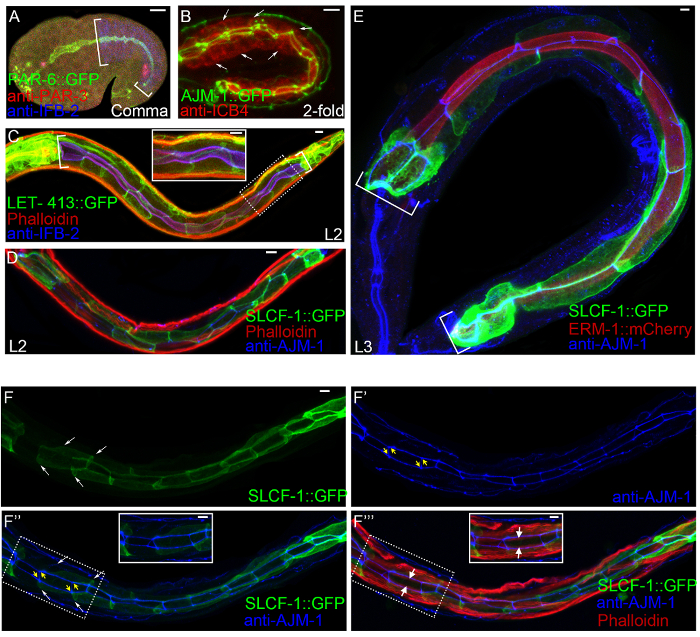
Figure 2: Examples of double and triple labeling of the developing wild-type C. elegans intestine using antibodies and fusion proteins. (A, B) Embryos. (A) Comma stage. PAR-6::GFP (green; component of the apical PAR polarity complex), anti-PAR-3 antibody (red/TRITC (tetramethyl rhodamine isothiocyanate); another component of the apical PAR polarity complex), and MH33 (blue/Cy5 (Cyanine5); anti-IFB-2/intermediate filament). PAR-6::GFP and the PAR-3 antibody label the apical membrane of the C. elegans intestine (bracketed). IFB-2, another apical marker at later stages, is panmembraneously localized at this early stage. PAR-6::GFP and anti-PAR-3 also label the pharynx (left); the intestinal lumen is indicated by their overlap with IFB-2 (turquoise) and the intestinal tube is outlined by blue anti-IFB-2 (right). (B) 2-fold stage. AJM-1::GFP (green; junction component), ICB4 antibody (red/Alexa, ICB4 detects an unknown membraneous intestinal antigen). AJM-1::GFP labels the apical junctions of the C. elegans intestine, visible as peri-lumenal ladder pattern (it also labels hypodermal junctions; not visible since image is focused on the intestine; see section 4, confocal imaging). ICB4 stains all membranes of the C. elegans intestine. Arrows point to basolateral membranes stained by anti-ICB4. (C, D) L2 larvae. (C) LET-413::GFP (green), phalloidin (red/Texas-red, a phallotoxin binding to F-actin) and MH33 (blue/Cyanine5, anti-IFB-2). LET-413/Scribble is a component of the basal polarity complex and localizes to basolateral membranes of the C. elegans intestine (bracketed). Phalloidin and the IFB-2 antibody label the apical submembraneous cytoskeleton of the C. elegans intestine (purple). Phalloidin also strongly stains body wall muscles, overwhelming the intestinal staining. Inset shows higher magnification of boxed area. (E) L3 larva. SLCF-1::GFP (green; integral membrane component/sugar transporter), ERM-1::mCherry (red) and MH27 antibody (blue/Cyanine5, anti-AJM-1). SLCF-1::GFP labels the basolateral membrane, while ERM-1::mCherry labels the apical membrane of the C. elegans intestine (bracketed); AJM-1 labels its apical junctions. (F-F''') L2 larva. (F,F') Single color images. SLCF-1::GFP (green) labels the basolateral membrane (lateral membranes indicated by thin white arrows). MH27 (blue/Cyanine5) labels apical junctions (short yellow arrows). (F'',F''') Overlay images with and without actin. Insets show higher magnification of boxed areas. Note clear distinction of apicolateral angle of intestinal cells by these different membrane/junction markers that appear superficially similar in single color images (F, F'). Thick white arrows in F'''point to the apical/lumenal actin cytoskeleton labeled by phalloidin (otherwise overwhelmed by muscle actin). All images are confocal projections (z-stacks of 0.2 µm), acquired by sequential scanning to avoid bleed-through between channels. Scale bars (for A-E, F-F''' and all insets): 5 µm. Please click here to view a larger version of this figure.

Figure 3: Examples of C. elegans intestinal polarized membrane and lumen morphogenesis defects at low-to-moderate magnification (dissecting fluorescence micrographs). All images are acquired by a dissecting fluorescent microscope equipped with a custom-made high-power stereo fluorescence attachment (Table of Materials). Different magnifications are shown. All phenotypes were obtained by RNAi with different genes in a strain labeled with ERM-1::GFP (localized at intestinal and excretory canal apical/lumenal membranes at embryonic and early larval stages, shown here). The intestinal lumen and polarity phenotypes are: (A, B) Wild type embryo (A) and larva (B); (C,D) basolateral displacement of ERM-1::GFP; intestinal cells are enlarged and appear bloated in this embryo (C, arrows point to single intestinal cells), but are of wild-type size and arrangement in these larvae (D, arrow points to lateral membranes between INT II and III); (E) widened and convoluted lumen in three embryos; (F) ERM-1::GFP broadening into lateral junction area (zigzag lumen) and into intestinal cytoplasm that contains GFP-negative vacuoles (arrows); (G) lumenal cysts inbetween intralumenal adhesions (arrows point to two cysts). (H) Cytoplasmic and basolateral ERM-1::GFP displacement with ectopic lumens (arrows); (I) ERM-1::GFP displacement to GFP-positive puncta (arrows) in the cytoplasm. Excretory canals and excretory canal phenotypes are not described here (canal is shown to the left, intestine to the right in all images). Scale bars: 10 µm. Please click here to view a larger version of this figure.
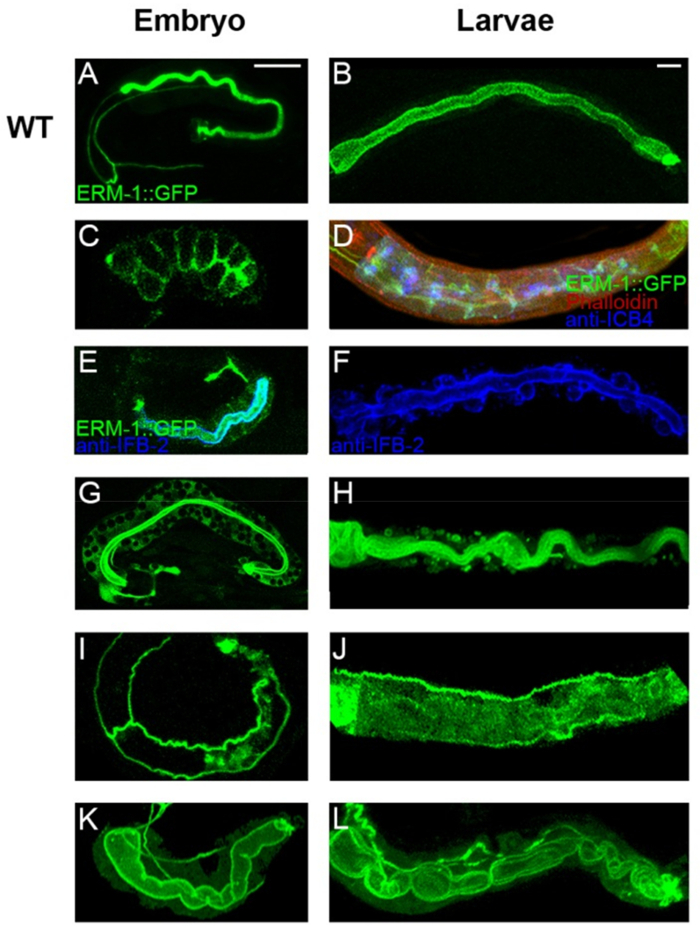
Figure 4: Examples of C. elegans intestinal polarized membrane and lumen morphogenesis defects at higher magnification (confocal images). (A, C, E, G, I, K) Embryos. (B, D, F, H, J, L) Larvae. All phenotypes were obtained by RNAi with different genes in a strain labeled with ERM-1::GFP (green in all images). Imaging is focused on the intestine. Images of embryos also show excretory canals (left side of image), including canal phenotypes (not described). (A, B) Wild type embryo (A) and larva (B). (C) Basolateral displacement of apical ERM-1::GFP (comma stage; late intercalation). (D) Polarity conversion: basolateral displacement of apical ERM-1::GFP and apical accumulation of basolateral ICB4, revealed by double labeling. F-actin (labeled by phalloidin-TRITC) outlines the animals by staining longitudinal muscle bundles (animal is triple labeled). (E) Basolateral displacement of ERM-1::GFP in late 3-fold embryo. The apical IFB-2 antibody (blue/Cyanine5) indicates intact lumen and peri-lumenal intermediate filaments. (F) Ectopic lumens labeled by anti-IFB-2 (blue/Cyanine5). (G) ERM-1::GFP negative vacuoles in intestinal cytoplasm. (H) ERM-1::GFP positive vacuoles in intestinal cytoplasm. (I, J) Absence of lumen in embryo and larvae, respectively. (K) Wide gut. (L) Cystic and convoluted gut. (A, D, H, I, J, K, L) are confocal projections. (B, C, E, F) are confocal sections. Brightness was increased in G to highlight cytoplasmic GFP-negative vacuoles. Scale bars: 10 µm (same for all embryos and larvae, respectively). Please click here to view a larger version of this figure.
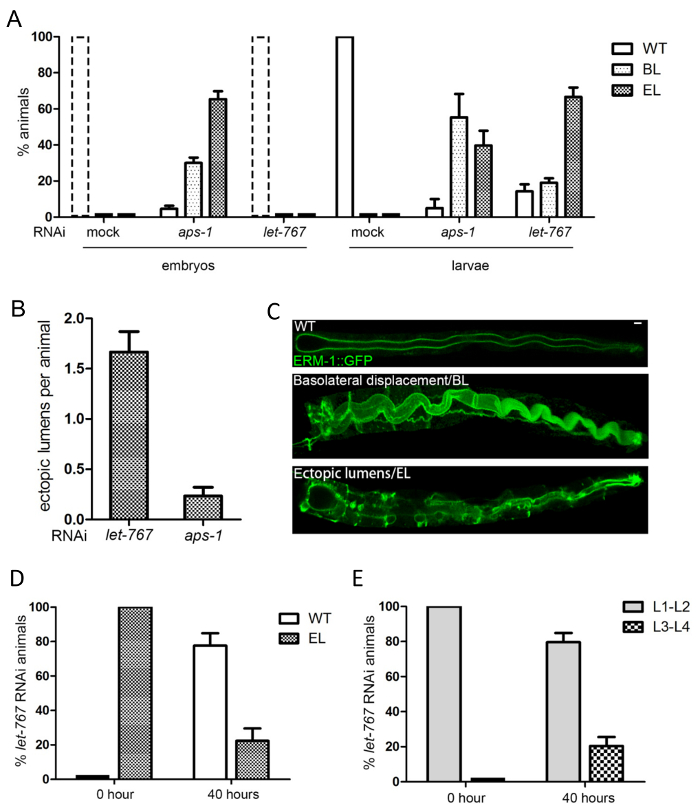
Figure 5: Intestinal polarity conversion and reversion: an example for the quantification of polarized membrane and lumen biogenesis defects. (A, B, C) let-767and aps-1RNAi both cause ERM-1::GFP basolateral displacement (BL) and ectopic lumen formation (EL), but at different developmental stages. (A) Quantification by dissecting microscope: counting of embryos (left) and larvae (right) with polarity phenotypes 2 days after seeding worms on RNAi plates. Note: all mock and let-767(RNAi) animals have hatched at this time (thus there are no embryos, which had, however, all wild-type polarity; broken line columns). aps-1RNAi induces polarity defects already in embryos, whereas let-767RNAi induces them in larvae. The higher percentage of ectopic lumens (vs basolateral displacement) in aps-1RNAi embryos versus larvae is due to arrest of embryos with ectopic lumens. (B) Quantification by confocal microscopy: counting of ectopic lumens per animal at the start of ectopic lumen development in larvae. let-767RNAi induces more ectopic lumens in larvae than aps-1RNAi (aps-1RNAi larvae are "escapers" that have not arrested as embryos). (C) Confocal images for wild-type larvae and larvae with ERM-1::GFP basolateral displacement (BL) and ectopic lumens (EL); scale bar: 5µm. (D, E) Polarity reversion in let-767RNAi animals (counting of animals with and without polarity defect [BL/EL] by dissecting microscope). 20 let-767(RNAi) animals with mild ectopic lumen phenotypes were transferred from an RNAi plate to an OP50 plate on day 4 and evaluated after 40 hours. (D) More than 50% larvae have reverted to wild-type polarity (ERM-1 at the apical membrane). (E) 20% of animals are growing up beyond the L1 larval stage (let-767(RNAi) results in L1 arrest). All data are shown as mean +/- SEM, n = 3. Please click here to view a larger version of this figure.
| Table 1: Examples of markers for the C. elegans larval and adult intestinal membrane system1. | ||||
| Protein name | Subcellular localization | Protein structure/Function | Commercially available C. elegans specific antibodies (DSHB2) | Examples of strains available at the CGC |
| OPT-2/PEPT-1 | apical transmembrane protein | oligopeptide transporter | KWN246 (pha-1(e2123) III, rnyEx133[opt-2(aa1-412):: GFP) + pha-1(+)]) | |
| AQP-4 | apical transmembrane protein | water channel | ||
| ERM-1 | apical brushborder | membrane–cytoskeleton linker | ERM1 | |
| ACT-5 | apical brushborder | cytoplasmic actin | (3) | |
| IFB-2 | apical brushborder | intermediate filament component | MH33 | |
| EPS-8 | apical brushborder | human-epidermal-growth-factor-receptor-kinase-substrate-8 ortholog | ||
| PAR-6 | apical membrane | apical polarity complex component | ||
| SLCF-1 | basolateral transmembrane protein | monocarboxylate transporter | ||
| AQP-1 | basolateral transmembrane protein | water channel | ||
| LET-413 | basolateral membrane | Scribble homologue, adaptor and polarity determinant | LET413 | |
| HMP-1 | apical junction (CCC4) | α-catenin, cadherin-catenin complex component | FT1609 (unc-119(ed3) III; xnIs528[hmp-1p::hmp-1:: GFP + unc-119(+)]) | |
| HMR-1 | apical junction (CCC) | E-cadherin, cadherin-catenin complex component | HMR1 | |
| AJM-1 | apical junction (DAC5) | junction integrity molecule, DLG-1/AJM-1complex component | MH27 | SU159 (jcEx44 [ajm-1::GFP + rol-6(su1006)]) |
| DLG-1 | apical junction (DAC) | Discs-large homologue, MAGUK protein, DLG-1/AJM-1complex component | DLG1 | |
| RAB-11 | endosomal vesicles | trafficking6 | RT311 (unc-119(ed3)III; pwIs69 [vha6p::gfp::rab-11, Cbunc-119(+)]) | |
| RAB-5 | endosomal vesicles | trafficking | RT327 (unc-119(ed3)III; pwIs72[pvha6::gfp::rab-5, Cbunc-119(+)]) | |
| RAB-7 | endosomal vesicles | trafficking | RT476 (unc-119(ed3)III; pwIs170[vha6p::gfp::rab-7, Cbunc-119(+)]) | |
| RAB-10 | endosomal vesicles | trafficking | RT525 (unc-119(ed3)III; pwIs206[pvha6::gfp::rab-10 Cbunc-119(+)) | |
| MANS | Golgi | α-mannosidase II | RT1315 (unc-119(ed3)III; pwIs503[pvha6::mans::gfp Cbunc-119(+)]) | |
| 1Examples are selected from resources listed in Table3. | ||||
| 2Developmental Studies Hybridoma Bank. | ||||
| 3Antibodies against vertebrate actin cross-react. | ||||
| 4CCC: cadherin-catenin complex; localizes to the apical part of the apical junction; corresponding to adherens junction (AJ). | ||||
| 5DAC: DLG-1/AJM-1complex; localizes to the basal part of the apical junction; corresponding to tight junction (TJ). | ||||
| 6For additional vesicle-associated molecules expressed in the intestine see ref(22). | ||||
| Note: not all molecules have been tested as fusion proteins under their own promoters or by antibodies. | ||||
| Table 2: Examples of C. elegans intestine-specific promoters and time of expression1. | |||
| Promoters | Expression stage | ||
| elt-2 | expression begins during the 2 E cell stage and persists into adulthood | ||
| vha-6 | expression begins in the late embryo and persists into adulthood | ||
| ges-1 | expression begins at approximately the 4E cell stage and persists into adulthood | ||
| end-1 | expression begins after 1E cell stage and declines during later embryogenesis | ||
| 1Examples are selected from resources listed in Table 3. | |||
| Table 3: Resources to find C. elegans intestine-specific molecules, labeling reagents/strains and antibodies. | |||
| 1. Caenorhabditis Genetics Center (CGC)42 for available reagents and strains | |||
| 2. Wormbase43 for information about intestine-specific molecules, strains and antibodies | |||
| 3. Information about intestine-specific molecules20,44 | |||
| 4. Transgeneome website45 for translational GFP fusion constructs | |||
| 5. C. elegans expression pattern46 for transcriptional GFP fusion constructs | |||
| 6. National BioResource Project (NBRP)::C.elegans47 for information on intestine-specific promoters | |||
| 7. Developmental Studies Hybridoma Bank (DSHB)48 for C. elegans antibodies | |||
| 8. For secondary antibodies and dyes see reference27,28 |
Discussion
This protocol describes how to combine standard loss-of-function genetic/RNAi and imaging (labeling and microscopic) approaches to take advantage of the C. elegans intestinal epithelium as a model for the visual and molecular dissection of in vivo polarized membrane and lumen biogenesis.
Labeling
This protocol focuses on antibody staining. In situ labeling by antibodies is a highly specific alternative approach to labeling by fluorescent fusion proteins (described in the accompanying paper on excretory canal membrane biogenesis)2. Although antibody staining does not allow live imaging, it may provide confirmation for the localization of a protein of interest (neither labeling method is without fail). Moreover, questions regarding morphogenesis and/or the subcellular localization of a protein can often be assessed in fixed animals. Immunostaining is useful for double and multiple labeling and it can be combined with labeling by fluorescent fusion proteins if these can be preserved through the required fixation and permeabilization procedures. The here outlined protocol typically permits this (Figure 2). In situ labeling of fixed animals by antibodies or chemical stains may also provide advantages for superresolution microscopic techniques such as STORM (stochastic optical reconstruction microscopy). Immunofluorescence detects the endogenous antigen, and can be adapted, for instance, to distinguish specific posttranslational protein modifications. It can produce fast results if antibodies are available, once in situ staining techniques - not as straightforward in C. elegans specimens as in cell culture - have been established.
The generation of a new antibody (not described here) is, however, time-consuming. Unfortunately, the selection of commercially available C. elegans primary antibodies remains rather small, and not all are able to detect the antigen in situ (see Table 1 for examples of antibodies demonstrated to detect intestinal antigens in situ, and Table 3 for additional resources). Most antibodies generated against vertebrate antigens will not cross-react with their C. elegans homologs. The selection of secondary antibodies must take into account the species of the first antibody (discussed in general immunofluorescence protocols27,28). Large selections are commercially available with continuously improving fluorescent dyes (e.g. Alexa-Fluor dyes). For optimized staining, dyes can be selected for their ability to match the microscope used for imaging, e.g. the laser of the confocal microscope, or, if super resolution microscopy is also planned, for their ability to "blink"37. Directly labeled primary antibodies or chemical stains (e.g. fluorescently labeled phalloidin) are also available and are particularly useful for double staining.
The difficulty for in situ antibody staining in C. elegans is the impermeability of the embryo's egg shell and the larval/adult cuticle that both require chemical and/or mechanical disruption to allow access of the antibody to the tissue. Although complex liquid antibody staining protocols have been developed to overcome this problem27,28, most include collagenase for permeabilization, which tends to damage the target tissue. In contrast, the freeze-crack method described here is a simple way to open the worm's cuticles or eggshells. It is performed directly on the glass slide where the specimens are collected (and where the rest of the staining is also performed), and works particularly well for eggs and larvae that stick best to glass slides (i.e. the stages predominantly examined in tubulogenesis studies). It also does not interfere with the preservation of fluorophore-labeled fusion proteins. The technique requires some manual dexterity, as the correct pressure on the coverslip (before flicking) and the avoidance of shear pressure are critical for preserving the specimen (as is gentle handling and pipetting during the entire staining procedure).
Fixation conditions may need to be empirically determined and adjusted for the structure/antigen that is to be stained (discussed in27). Milder (e.g. formaldehyde-based) fixation techniques may better preserve antigenicity, although this must be balanced with the need to maintain tissue morphology, critical for the analysis of morphogenesis. Milder fixation conditions also help to preserve fluorescent fusion proteins in double labeling experiments. Similarly, the amount of blocking agent (e.g. milk or bovine serum albumin/BSA) and detergent in the wash solution requires empirical adjustment to balance background with specific staining. Details on general aspects of immunofluorescence techniques, e.g. discussion of different staining techniques, design of appropriate controls, and tips for optimizing these procedures for worm intestines (e.g. minimizing intestinal autofluorescence) can be found in general and C. elegans specific immunofluorescence protocols, as referenced throughout.
Interference with gene function and evaluation of tubulogenesis phenotypes
This protocol highlights specific RNAi approaches that are useful when evaluating genes with early, essential and ubiquitous functions, whose partial (rather than complete) loss is most informative, as is the case for most tubulogenesis genes (our genome-wide screen on ERM-1::GFP-labeled intestines suggested that interference with such genes causes >90% of all informative tubulogenesis phenotypes in this particular setting12). The many advantages that C. elegans offers for genetic manipulations (e.g. its short generation time) and the different approaches to perturb gene function by forward (starting with the function/phenotype) and reverse (starting with the gene) genetic approaches are discussed in the general C. elegans literature31,38. The availability of commercially available genome-wide RNAi feeding libraries also allows one to use this reverse genetic technique as a forward genetic screening tool (see Table of Materials for resources). The specific advantages of RNAi for the analysis of tubulogenesis include its ability: to generate a range of phenotypes equivalent to a mutant allelic series (this usually works well for dose-dependent morphogenesis genes); to remove maternal RNAs (typically involved in early morphogenesis/tubulogenesis); to stage-specifically interfere (useful for evaluating effects on polarized membrane biogenesis during postmitotic larval growth).
Details on general aspects of RNAi procedures are discussed in refs (26,31). Key for the analysis of lethal tubulogenesis phenotypes is the ability to modulate RNAi conditions to increase the spectrum of phenotypes. Informative tubulogenesis phenotypes can usually be generated in a wild-type background without the need for intestine-specific RNAi strains39. However, such strains are available if this fails and can also be used to distinguish cell-autonomous from non-autonomous effects. Different approaches for modulating the strength of RNAi have been reported, e.g. the titration of IPTG concentrations for induction of dsRNA, an approach that may produce the most reproducible results30. However, quantitatively exact titration may not be necessary when aiming at generating a spectrum of different phenotypes. Overall, the success of this analysis is not so much dependent on maximizing the RNAi effect as it is on determining RNAi conditions that generate an informative spectrum of phenotypes (which may often be the result of suboptimal (e.g. milder) RNAi conditions).
For the visual assessment of tubulogenesis phenotypes induced by RNAi it is important to determine the optimal window for phenotypic evaluation. It is best to start evaluating the plates early (e.g. two days after picking the animals to their RNAi plates under standard RNAi conditions) and to follow them long enough for possible late effects. A developmental time course of a worsening polarity defect, for example, should cover 3 - 7 days in typically arrested larvae. Conditions for the analysis of polarized membrane biogenesis in postmitotic non-dividing cells of the larval intestine can be further improved when using mutants or RNAi animals with slowed growth (as, for instance, let-767(RNAi) or mutant animals12, Figure 5). Any time course has to be aborted if F2 animals appear (can remove L4s in experiments where most but not all animals arrest as larvae). Every experiment requires the concomitant evaluation of appropriate positive and negative controls (e.g. bacterial RNAi clones that induce a defined tubulogenesis phenotype and empty vector or scrambled RNAi clones, respectively). Another requirement for evaluation is a sufficient brood size (at least 50). If not met, other (e.g. conditional) RNAi conditions can be tried. Finally, some particularly interesting tubulogenesis phenotypes occur at low penetrance, thus a sufficient number of animals must be evaluated.
Microscopy
Low-to-moderate magnification dissecting fluorescent microscopy and high magnification confocal microscopy, the two standard imaging procedures described here, are typically sufficient to characterize the basic aspects of a tube or lumen phenotype in the C.elegans intestine and can also be used to visually screen larger sets of animals in forward screens. Dissecting fluorescence microscopy permits: in vivo imaging of animals on their plates (however, live animals, transiently immobilized by anesthetics, can also be recovered from mounts after confocal or DIC imaging); screening large sets of animals; tracking developmental events (e.g. the displacement and replacement of a polarized marker during membrane expansion); tracking of specific expression patterns (some patterns and asymmetries are better distinguished at lower magnification); selecting and picking fluorescent worms suitable for further analysis (e.g. confocal microscopy) or for maintenance of extrachromosomal transgenes. Visualization at high magnification by confocal microscopy permits to characterize the phenotype at the single cell and subcellular level. This protocol describes imaging with a laser scanning confocal microscope that offers the best confocality over alternatives such as a spinning disc confocal microscope. A spinning disc confocal microscope is, however, the microscope of choice for dynamic and time-lapse studies since it induces less phototoxicity (see refs (34,35) for further discussion of low and high magnification microscopy in C. elegans). Novel as well as conventional microscopic techniques offer additional advantages and permit imaging at higher resolution into the nanoscale range (e.g. transmission electron and super-resolution microscopy; discussed in37,40).
When imaging C. elegans intestines under a confocal microscope, mounting and immobilization is critical. Among different chemicals for immobilization, sodium azide - although toxic - works most reliably if scanning is done immediately. Levamisole, although not toxic, produces hypercontraction that sometimes interferes with the evaluation of morphogenesis phenotypes. Some anesthetics may interfere with membrane-associated fluorescent proteins and can produce artifacts that may look like polarity defects. C. elegans is a thick specimen and thus 3D analysis (sectioning) is essential to take advantage of the specific strength of the tubular intestinal epithelium that allows excellent visualization of apical junctions and the lateral membrane (not easily accessible in flat epithelia). Confocal settings must be adjusted for every slide and objective to obtain good quality images, including parameters like bracketing, averaging, laser power, gain, pinhole and brightness. One particular problem of intestinal imaging is this organ's content of green/yellow autofluorescent granules (lysosome related organelles (LROs)) that may interfere with the interpretation of results, particularly when assessing displacement of GFP-labeled endo- and plasma-membrane associated components. This problem is well recognized in the field and can be tackled by different approaches (depending on microscope), including DAPI exclusion, spectral fingerprinting, and empirical scanner settings13,41.
Disclosures
The authors declare that they have no competing financial interests.
Acknowledgements
We thank Mario de Bono (MRC Laboratory of Molecular Biology, Cambridge, UK), Kenneth J. Kemphues (Cornell University, Ithaca, USA), Michel Labouesse (Institut de Biologie Paris Seine, Université Pierre et Marie Curie, Paris, France), Grégoire Michaux (Université deRennes 1, Rennes, France) and the CGC, funded by NIH Office of Research Infrastructure Programs (P40 OD010440), for strains and antibodies. This work was supported by grants NIH GM078653, MGH IS 224570 and SAA 223809 to V.G.
Materials
| Name | Company | Catalog Number | Comments |
|---|---|---|---|
| Antibody staining | |||
| poly-L-lysine | Sigma | P5899 | |
| Methanol | Fisher Scientific | A452-4 | |
| Acetone | Fisher Scientific | A949SK-4 | |
| Tween | Fisher Scientific | 50-213-612 | |
| Permount | Fisher Scientific | SP15-100 | |
| Powdered milk | Sigma | MT409-1BTL | |
| Primary antibodies | |||
| MH27 (mouse) | Concentration: 1:20 Resources: Developmental Studies Hybridoma Bank. | ||
| MH33 (mouse) | Concentration: 1:10 Resources: Developmental Studies Hybridoma Bank. | ||
| anti-ICB4 (rabbit) | Concentration: 1:5 Resources: A gift from Mario de Bono (Medical Research Council, England) | ||
| anti-PAR-3 (rabbit) | Concentration: 1:50 Resources: A gift from Kenneth J. Kemphues (Cornell University) | ||
| Secondary antibodies | |||
| Alexa Floor 568 (anti-rabbit) | ABCam | AB175471 | Concentration: 1:200 |
| Cy5 (anti-mouse) | Life technologies | A10524 | Concentration: 1:200 |
| TRITC (anti-rabbit) | Invitrogen | T2769 | Concentration: 1:200 |
| FITC (anti-mouse) | Sigma | F9006 | Concentration: 1:100 |
| Labeled chemicals | |||
| Texas Red-Phalloidin | Concentration: 1:100 Resources: Molecular Probes-T7471 | ||
| Materials | |||
| Vacuum Grease Silicone | Beckman | 335148 | |
| Microscope slides | Fisher Scientific | 4448 | |
| Microscope coverslips (22x22-1) | Fisher Scientific | 12-542-B | |
| C. elegans related | see reference29 for standard C. elegans culture and maintenance procedures. | ||
| LB Medium and plates | see reference29 for protocols. | ||
| Tryptone | Acros Organics | 611845000 | |
| Yeast Extract | BD Biosciences | 212750 | |
| NaCl | Sigma | S7653 | |
| Bacto Agar | BD Biosciences | 214040 | |
| Ampicillin | Sigma | A0116 | |
| Tetracycline | Fisher Scientific | BP912 | |
| M9 Medium | see reference29 for protocols. | ||
| NaCl | Sigma | S7653 | |
| KH2PO4 | Sigma | P0662 | |
| Na2HPO4 | Sigma | S7907 | |
| MgSO4 | Sigma | M2773 | |
| NGM plates | see reference29 for protocols. | ||
| NaCl | Sigma | S7653 | |
| Peptone | BD Biosciences | 211677 | |
| Tryptone | Acros Organics | 611845000 | |
| Bacto Agar | BD Biosciences | 214040 | |
| MgSO4 | Sigma | M2773 | |
| CaCl2 | Sigma | C3881 | |
| Cholesterol | Sigma | C8667 | |
| K2HPO4 | Sigma | P3786 | |
| KH2PO4 | Sigma | P0662 | |
| RNAi plates | see reference30 for protocols. | ||
| NaCl | Sigma | S7653 | |
| Peptone | BD Biosciences | 211677 | |
| Tryptone | Acros Organics | 611845000 | |
| Bacto Agar | BD Biosciences | 214040 | |
| MgSO4 | Sigma | M2773 | |
| CaCl2 | Sigma | C3881 | |
| Cholesterol | Sigma | C8667 | |
| K2HPO4 | Sigma | P3786 | |
| KH2PO4 | Sigma | P0662 | |
| IPTG | US Biological | I8500 | |
| Carbenicillin | Fisher Scientific | BP2648 | |
| NaOH | Fisher Scientific | SS266-1 | |
| Sodium hypochlorite | Fisher Scientific | 50371500 | |
| Bacteria | |||
| OP50 bacteria | CGC | ||
| HT115 bacteria | CGC | ||
| Genome-wide RNAi libraries Ahringer genome-wide RNAi feeding library (ref 30,49,50) | Source BioScience | ||
| C. elegans ORF-RNAi feeding library (ref51) | Source BioScience | ||
| Imaging related | |||
| Sodium azide | Fisher Scientific | BP9221-500 | |
| Equipment | |||
| dissecting microscope | Nikon | SMZ-U | |
| dissecting microscope equipped with a high-power stereo fluorescence attachment (Kramer Scientific), CCD camera with Q capture software and X-Cite fluorescent lamp (Photonic Solutions) | Olympus | SZX12 | |
| Laser-scanning confocal microscope | Leica Microsystem | TCS SL | |
| laser-scanning confocal mounted on an ECLIPSE Ti-E inverted microscope | Nikon | C2 |
References
- Bryant, D. M., Mostov, K. E. From cells to organs: building polarized tissue. Nat. Rev. Mol. Cell Biol. 9 (11), 887-901 (2008).
- Zhang, N., Membreno, E., Raj, S., Zhang, H., Khan, L. A., Gobel, V. The C. elegans excretory canal as a model for intracellular lumen morphogenesis and in vivo polarized membrane biogenesis in a single cell. JoVE. , (2017).
- Rodriguez-Boulan, E., Macara, I. G. Organization and execution of the epithelial polarity programme. Nat. Rev. Mol. Cell Biol. 15 (4), 225-242 (2014).
- Mellman, I., Nelson, W. J. Coordinated protein sorting, targeting and distribution in polarized cells. Nat. Rev. Mol. Cell Biol. 9 (11), 833-845 (2008).
- Nelson, W. J. Adaptation of core mechanisms to generate cell polarity. Nature. 422, 766-774 (2003).
- Goldstein, B., Macara, I. G. The PAR Proteins: Fundamental Players in Animal Cell Polarization. Dev. Cell. 13 (5), 609-622 (2007).
- Rodriguez-Boulan, E., Kreitzer, G., Musch, A. Organization of vesicular trafficking in epithelia. Nat. Rev. Mol. Cell Biol. 6 (3), 233-247 (2005).
- Zegers, M. M., O'Brien, L. E., Yu, W., Datta, A., Mostov, K. E. Epithelial polarity and tubulogenesis in vitro. Trends Cell Biol. 13 (4), 169-176 (2003).
- Tepass, U. The apical polarity protein network in Drosophila epithelial cells: regulation of polarity, junctions, morphogenesis, cell growth, and survival. Annu. Rev. Cell Dev. Biol. 28, 655-685 (2012).
- Shivas, J. M., Morrison, H. A., Bilder, D., Skop, A. R. Polarity and endocytosis: reciprocal regulation. Trends Cell Biol. 20 (8), 445-452 (2010).
- Bryant, D. M. A molecular network for de novo generation of the apical surface and lumen. Nat. Cell Biol. 12 (11), 1035-1045 (2010).
- Zhang, H. Apicobasal domain identities of expanding tubular membranes depend on glycosphingolipid biosynthesis. Nat. Cell Biol. 13 (10), 1189-1201 (2011).
- Zhang, H. Clathrin and AP-1 regulate apical polarity and lumen formation during C. elegans tubulogenesis. Development. 139 (11), 2071-2083 (2012).
- Asan, A., Raiders, S. A., Priess, J. R. Morphogenesis of the C. elegans Intestine Involves Axon Guidance Genes. PLoS Genet. 12 (4), e1005950(2016).
- Leung, B., Hermann, G. J., Priess, J. R. Organogenesis of the Caenorhabditis elegans intestine. Dev. Biol. 216 (1), 114-134 (1999).
- Altun, Z. F., Hall, D. H. Alimentary system, intestine. WormAtlas. , (2009).
- Sulston, J. E., Horvitz, H. R. Post-embryonic cell lineages of the nematode, Caenorhabditis elegans. Dev. Biol. 56 (1), 110-156 (1977).
- Rasmussen, J. P., English, K., Tenlen, J. R., Priess, J. R. Notch signaling and morphogenesis of single-cell tubes in the C. elegans digestive tract. Dev. Cell. 14 (4), 559-569 (2008).
- Maduro, M. F. Gut development in C. elegans. Seminars in cell & developmental biology. , (2017).
- McGhee, J. D. The Caenorhabditis elegans intestine. Wiley Interdiscip. Rev. Dev. Biol. 2 (3), 347-367 (2013).
- Pásti, G., Labouesse, M. Epithelial junctions, cytoskeleton, and polarity. WormBook. , The C. elegans Research Community. WormBook: http://www.wormbook.org. (2014).
- Sato, K., et al. C. elegans as a model for membrane traffic. WormBook. , The C. elegans Research Community. WormBook: http://www.wormbook.org. (2014).
- Gobel, V., Barrett, P. L., Hall, D. H., Fleming, J. T. Lumen morphogenesis in C. elegans requires the membrane-cytoskeleton linker erm-1. Dev. Cell. 6 (6), 865-873 (2004).
- Fehon, R. G., McClatchey, A. I., Bretscher, A. Organizing the cell cortex: the role of ERM proteins. Nat. Rev. Mol. Cell Biol. 11 (4), 276-287 (2010).
- Brenner, S. The genetics of Caenorhabditis elegans. Genetics. 77, 71-94 (1974).
- Timmons, L., Court, D. L., Fire, A. Ingestion of bacterially expressed dsRNAs can produce specific and potent genetic interference in Caenorhabditis elegans. Gene. 263 (1-2), 103-112 (2001).
- Shakes, D. C., Miller, D. M. 3rd, Nonet, M. L. Immunofluorescence microscopy. Methods Cell Biol. 107, 35-66 (2012).
- JS, D. uerr Immunohistochemistry. WormBook. , The C. elegans Research Community. WormBook: http://www.wormbook.org. (2006).
- T, S. tiernagle Maintenance of C. elegans. WormBook. , The C. elegans Research Community. WormBook: http://www.wormbook.org. (2006).
- Kamath, R. S., Martinezcampos, M., Zipperlen, P., Fraser, A. G., Ahringer, J. Effectiveness of specific RNA-mediated interference through ingested double-stranded RNA in Caenorhabditis elegans. Genome Biol. 2 (1), RESEARCH0002(2001).
- Ahringer, J. Reverse genetics. WormBook. , The C. elegans Research Community. WormBook: http://www.wormbook.org. (2006).
- Simmer, F. Loss of the Putative RNA-Directed RNA Polymerase RRF-3 Makes C. elegans Hypersensitive to RNAi. Curr. Biol. 12 (15), 1317-1319 (2002).
- Kennedy, S., Wang, D., Ruvkun, G. A conserved siRNA-degrading RNase negatively regulates RNA interference in C. elegans. Nature. 427 (6975), 645-649 (2004).
- Shaham, S. Methods in Cell Biology. WormBook. , The C. elegans Research Community. WormBook: http://www.wormbook.org. (2006).
- Maddox, A. S., Maddox, P. S. High-resolution imaging of cellular processes in Caenorhabditis elegans. Methods Cell Biol. 107, 1-34 (2012).
- Netherlands, S. Nomarski Differential Interference Contrast Microscopy. , Springer. Netherlands. (2008).
- Bates, M., Jones, S. A., Zhuang, X. Stochastic optical reconstruction microscopy (STORM): a method for superresolution fluorescence imaging. Cold Spring Harb. Protoc. 6, 498-520 (2013).
- Jorgensen, E. M., Mango, S. E. The art and design of genetic screens: caenorhabditis elegans. Nat. Rev. Genet. 3, 356-369 (2002).
- Lee, Y. U., Son, M., Kim, J., Shim, Y. H., Kawasaki, I. CDC-25.2, a C. elegans ortholog of cdc25, is essential for the progression of intestinal divisions. Cell Cycle. 15 (5), 654-666 (2016).
- Hall, D. H., Hartwieg, E., Nguyen, K. Modern electron microscopy methods for C. elegans. Methods Cell Biol. 107, 93-149 (2012).
- Shi, A., Grant, B. D. In vivo analysis of recycling endosomes in Caenorhabditis elegans. Methods Cell Biol. 130, 181-198 (2015).
- Caenorhabditis Genetics Center (CGC). , http://cbs.umn.edu/cgc/home (2017).
- Wormbase. , http://www.wormbase.org/ (2017).
- McGhee, J. The C. elegans intestine. WormBook. , The C. elegans Research Community. WormBook: http://www.wormbook.org. (2007).
- Transgeneome website. , https://transgeneome.mpi-cbg.de/transgeneomics/index.html (2017).
- C. elegans expression pattern. , http://gfpworm.org/ (2017).
- National BioResource Project (NBRP)::C. elegans. , https://shigen.nig.ac.jp/c.elegans/ (2017).
- Developmental Studies Hybridoma Bank (DSHB). , http://dshb.biology.uiowa.edu (2017).
- Kamath, R. Genome-wide RNAi screening in Caenorhabditis elegans. Methods. 30 (4), 313-321 (2003).
- Kamath, R. S. Systematic functional analysis of the Caenorhabditis elegans genome using RNAi. Nature. 421 (6920), 231-237 (2003).
- Rual, J. F. Toward improving Caenorhabditis elegans phenome mapping with an ORFeome-based RNAi library. Genome Res. 14 (10B), 2162-2168 (2004).
Reprints and Permissions
