This protocol describes the dissection of neonatal dmp1-topaz mouse calvaria and isolation of osteocytes expressing the green fluorescent protein through cell digestion and fractionation, in addition to osteocyte preparation for fluorescence activated cell sorting (FACS).
Method Article
Obtaining Primary Osteocytes Through Murine Calvarial Fractionation of GFP-Expressing Osteocytes
In This Article
Summary
Abstract
The osteocyte, once thought to be a passive resident of the bone given the backstage function of sensing mechanical loading, is now brought to the spotlight and has been shown to have multiple major functions like actively modifying the extracellular matrix and forming an endocrine organ with the lacunocanalicular system that encloses it sending messages to distant sites. Owing to the methods that made it possible to test the osteocyte in vitro from isolating primary osteocytes to osteocyte-like cell lines, osteocytes are now experiencing a resounding interest and a surge of knowledge on structure and function. Many aspects of the osteocyte biology and interaction with other molecular components are yet to be discovered. In this protocol, we describe in detail the efficient isolation of primary osteocytes from dmp1-topaz neonatal mouse calvaria, which express the green fluorescent protein in osteocytes, through cell fractionation and subsequently acquiring cultures of primary osteocytes by FACS.
Introduction
Osteocytes are terminally differentiated cells from osteoblastic progenitors that became embedded in their secreted matrix1. They are the most abundant and longest-living cells among bone cell populations. They reside within lacunae and have a characteristic stellate morphology with dendrites that extend through channels called canaliculi forming an extensive network of communication and metabolic exchange with their surrounding environment and the bone surface2. Osteocytes choreograph both osteoblasts and osteoclasts roles in bone remodeling, they are the primary mechanosensory cells conferring adaptation to mechanical loading3, are involved in phosphate homeostasis4 and bone matrix mineralization5, and together with the lacunocanalicular system, they act as an endocrine organ signaling distant tissues6.
Osteocytes are situated within a mineralized matrix, which limits accessibility and renders their isolation challenging, thus hindering in vitro investigation. One of the first isolation methods described isolated osteocytes from chicken calvaria using an osteocyte-specific monoclonal antibody (OB7.3)7 which was later known to be the avian variant of PHEX (PHosphate-regulating gene with homology to Endopeptidases on the X chromosome)8. Other researchers used sequential digestion of rat9 or mouse10 long bones to obtain osteocyte-rich fractions in which osteocyte purity was reported to be around 70%9. Limitations of this procedure include the sub-optimal purity of cultures contaminated with other cell types besides osteocytes and that osteocytes could be potentially overgrown by other cells in culture since osteocytes have lost the ability to divide. These challenges restrict the usability of long term cultures.
To overcome these limitations, different osteocyte cell lines were developed. The MLO-Y4 cell line11 and the MLO-A5 cell line12 are notably the most widely studied cell lines which are useful for the study of the early stage osteocytes; however, they are less useful for studying mature osteocyte signaling as they express low levels of sclerostin and FGF2313, both of which are mature osteocyte markers. Other cell lines including IDG-SW314 and Ocy45415, express high levels of sclerostin and FGF23 and are useful in studying the late osteocyte stage. Cell lines prove to be useful research tools; nevertheless, they do not come without limitations as they do not fully represent the biology of the primary cell. Different cell lines represent different developmental stages of the osteocyte maturity spectrum, and cell lines fail to represent the heterogeneity of primary osteocytes16,17.
To obtain pure cultures of primary osteocytes, researchers took advantage of the cre mouse model in which the 8-kb dmp1 promoter is used to drive green fluorescent protein (GFP) expression in osteocytes18,19. Dual transgenic mice (pOB-Col 2.3- GFP-cyan and DMP1-GFP-topaz) by Paic et al.19 and dmp1-topaz transgenic mice by Nakashima et al.20 have been used to obtain osteocyte populations. In which they employed sequential digestion and FACS of osteocytes expressing GFP to acquire cultures of primary osteocytes19,20. The direction of cre in the 10-kb dmp1 reporter mouse Ai9, which activates the tdTomato protein, was shown to be present in osteocytes, osteoblasts, muscles, and cells within the bone marrow. The 8-kb dmp1 promoter had the same expression pattern, but only a proportion of osteoblasts and bone marrow cells expressed the protein, which indicates that the 8-kb dmp1 promoter is more specific21. Despite this, results obtained using the 8-kb dmp1 promoter should be interpreted with caution, and gene expression profiles should be routinely carried out using osteocyte vs. osteoblast-specific markers to ensure that the population obtained is of high enough purity.
Osteoclast markers OSCAR and Dcstamp were found in hematopoietic non-depleted vs. depleted osteocyte populations, this finding led the authors to conclude that digests obtained from fractionation of 8-kb dmp1-topaz neonatal calvaria and GFP sorting are contaminated with hematopoietic cells. Contamination with hematopoietic cells could have been mitigated by tightening the GFP sort gate since GFP-positive hematopoietic cells had a reasonably lower GFP intensity than GFP-positive mesenchymal cells (osteocytes)22.
The methods for studying osteocytes in vitro have contributed to the recent wealth of information on osteocyte biology. However, osteocyte isolation remains a labor-intensive and lengthy procedure with low cell yields. The described method of bone digestion using collagenase and EDTA often up to fraction 823, takes several hours in which osteocyte viability is taxed. Researchers have reported using fractions (2‒5) for cell sorting20, and have shown that the expression profile of genes associated with osteocytes versus those of osteoblasts confirms the success of isolating pure osteocyte populations20. In this article, we describe the process of obtaining fractions (2‒5), and we compare the yield of osteocytes from each fraction starting with fraction 1 through 8 to determine the return of osteocytes in each fraction. We also describe the dissection of newborn dmp1-topaz mouse calvaria and calvarial digestion using collagenase and ethylenediaminetetraacetic acid (EDTA), as well as, preparation of cells for FACS.
Protocol
All animal procedures and animal care were performed in accordance with Tohoku University rules and regulations.
1. Dissection of newborn dmp1-topaz mouse calvaria
- For this protocol, use 6‒7 day old pups of C57BL/6-Tg(Dmp1-Topaz)1Ikal/J mice. Euthanize mice with 5% isoflurane inhalation and then transfer the pups into 70% ethanol.
- Transfer the euthanized pup into a non-treated culture dish.
- Using scissors and tweezers, grab the skin at the base of the skull and make an incision.
- Using the first incision as a starting point, cut on both lateral sides of the skull in front of the ears, remove the skin, and expose the calvaria.
- Hold the head from the nasal bridge and cut the calvaria along the lambdoid suture. Cut along the lateral edges of the parietal bones and extend it to include the frontal part.
- Separate the calvaria from the underlying brain tissue.
NOTE: To ensure a clean bony calvaria with minimal soft tissue attachment do not cut deep into the bone; for reference, one should be able to see the shadow of the scissors beneath the bone. - Transfer the calvaria into phosphate-buffered saline (PBS, pH 7.4 throughout the protocol). Make sure the concave part is facing upwards.
2. Fractionation of newborn mouse calvaria
- Transfer up to 5 calvariae to a 50 mL conical tube containing 5 mL of 2 mg/mL collagenase solution. Use fresh collagenase solution prepared just before use.
- To prepare a fresh collagenase solution, add collagenase powder to isolation buffer (70 mM NaCl, 10 mM NaHCO3, 60 mM sorbitol, 3 mM K2HPO4, 1 mM CaCl2, 1 mg/mL bovine serum albumin (BSA), 5 mg/mL glucose and 25 mM HEPES) at 2 mg/mL. Dissolve the collagenase powder on a magnetic stirrer.
- Run the collagenase solution through a 0.22 μm sterile filter unit into a 50 mL tube and keep it on ice throughout the protocol.
- Incubate the calvaria at 37 °C for 20 min on a shaker at 300 rpm to obtain fraction 1.
- Discard the digest of fraction 1, wash the calvaria with 5 mL of phosphate buffered saline (PBS) and discard the wash.
- Incubate the calvaria in 5 mL of 5 mM ethylenediaminetetraacetic acid (EDTA) containing 1 mg/mL BSA in PBS, PH 7.4 at 37 °C for 15 min on a shaker at 300 rpm.
- Collect the digest in a 50 mL conical tube. Wash the calvaria with 5 mL of PBS and add the wash solution to the digest.
NOTE: At each point of collecting the digest and washing, pipette the bones in their solution to detach the cells from the bone and to prevent doublets and cell aggregates. - To obtain fraction 2, centrifuge the digest at 300 x g at 4 °C for 5 min. Discard the supernatant, re-suspend the pellet in 8 mL of α-Minimum Essential Medium (MEM) containing 10% fetal bovine serum (FBS), 100 IU/mL penicillin G, and 100 μg/mL streptomycin. Seed on a 10 cm culture dish. Incubate fraction 2 at 37 °C under 5% CO2.
- Incubate the calvaria in 5 mL of collagenase solution at 37 °C for 20 min on a shaker at 300 rpm.
- To collect fraction 3, repeat steps 2.5‒2.6. Incubate fraction 3 at 37 °C under 5% CO2.
NOTE: At this point, the bones will become smaller, and they will be reduced to fragments. To ensure that no bones get accidentally aspirated into the digests, which leads to cell loss in the process, use a small tip pipette for collecting the digests (1000‒200 μL pipette tips). - Incubate the calvaria in 5 mL of collagenase solution at 37 °C for 20 min on a shaker at 300 rpm.
- To collect fraction 4, repeat steps 2.5‒2.6. Incubate fraction 4 at 37 °C under 5% CO2.
- Incubate the calvaria in 5 mL of 5 mM EDTA containing 1 mg/mL BSA in PBS (pH 7.4) at 37 °C for 15 min on a shaker at 300 rpm.
- To collect fraction 5, repeat steps 2.5‒2.6. Incubate fraction 5 at 37 °C under 5% CO2. Osteocytes can be prepared for sorting on the same day or cultured up to 24 h before sorting.
3. Preparation of osteocytes for fluorescence activated cell sorting
- Aspirate the medium of each cell fraction and wash gently with 10 mL of PBS twice.
- Add 5 mL of 0.5% Trypsin-EDTA in PBS and incubate the cells for 5 min at 37 °C. Add 5 mL of 10% FBS α-MEM and pipette to detach the cells gently. Combine the cells in each fraction by sifting through a 40 μm cell strainer into a 50 mL conical centrifuge tube.
- Wash the cells with 10 mL of PBS and collect by sifting through a 40 μm cell strainer into a 50 mL conical centrifuge tube. Centrifuge the cells at 300 x g at 4 °C for 5 min.
- Aspirate the supernatant and add 10% FBS α-MEM to the pellet. Adjust cell concentration to approximately 1 x 10⁷ cells/mL.
- Filter the cells in a 35 μm nylon mesh capped tube. The cells are now ready for FACS.
- For this protocol, use a 100 μm size nozzle. The collection fluid should consist of 10% FBS α-MEM. Keep the sample being sorted on agitation and at 4 °C throughout the sort if possible.
- Prior to the sort, optimize gating to remove artifacts and cells by adjusting the side scatter (SSC) area and forward scatter (FSC) area. Eliminate doublets by adjusting SSC-width vs SSC-Height and FSC-area vs FSC-width. GFP-negative osteocytes should be used as a control to adjust the parameters of the sort instrument.
- After cell collection is complete, centrifuge the cells at 300 x g at 4 °C for 10 min. Wash cells with PBS. Centrifuge the cells at 300 x g at 4 °C for 5 min.
- Re-suspend the cells and adjust the number as desired using 10% FBS α-MEM.
Results
The purpose of this protocol is to demonstrate the process of obtaining cultures of primary osteocytes from dmp1-topaz neonatal mouse calvaria through a fractionation process using collagenase to degrade the collagen matrix and EDTA for calcium chelation, after which cells are prepared for FACS to separate osteocytes from other cell populations.
Methods for obtaining primary osteocytes from neonatal mouse calvaria often describe the use of fractions (1‒8) for sorting23. To test the efficiency of this method, we compared the yield of osteocytes obtained from one dmp1-topaz mouse calvaria, starting from fractions 1 through 8. Fractions 1‒8 were sorted separately to determine the percentage and yield of osteocytes from each fraction. After the sort, we cultured osteocytes for 24 h on a 96-well plate to compare the density of the seeded cells. The density of osteocytes in fractions 2‒5 is shown to be higher than that of fraction 1, and osteocyte density starts to decrease remarkably in fractions 6, 7, and 8 (Figure 1A).
Although the percentage of osteocyte obtained among all fractions is not statistically significant (Figure 1B), the density of osteocytes differs dramatically. Researchers20 have reported the use of fractions 2‒5 for isolating osteocytes via FACS, and we show in Figure 1 that using fractions 2‒5 optimizes the process for obtaining osteocytes and decreases the time of the sort.
Figure 2 shows the number of cells and gating strategy practiced to isolate GFP-positive from GFP-negative cells in which cells obtained through fractionation of GFP-negative mouse calvaria were used as control. Osteocytes obtained through this method were analyzed for gene expression of Dmp1 and SOST, which are known osteocytes markers. Dmp1 and SOST mRNA expressions are higher in osteocytes when compared to pre-sort fraction 2, which is known as a high osteoblast fraction (Figure 3A). Figure 3B shows the morphology of a GFP-positive osteocyte retaining a stellate shape with dendrites extending from the cell body cultured for 24 h on a plastic culture dish post sort.
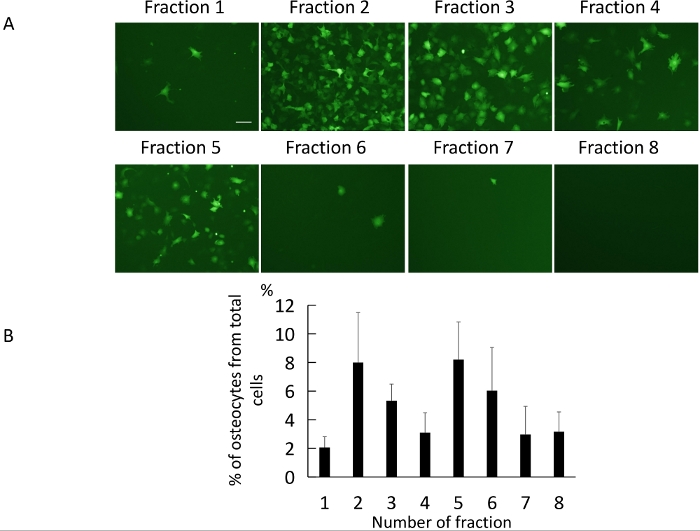
Figure 1: Efficiency of osteocyte fractionation. (A) Microscopic images of the density of osteocytes from fractions 1‒8 seeded on a 96-well plate captured after 24 h of the sort. Fractions 2‒5 have a higher cell density than fractions 1, and 6‒8. Scale bar = 100 µm. (B) Percentage of osteocytes obtained from fractions 1‒8 as measured by the flow cytometer software. Results are derived from three separate representative experiments. Data are presented as a mean ± standard deviation. Please click here to view a larger version of this figure.
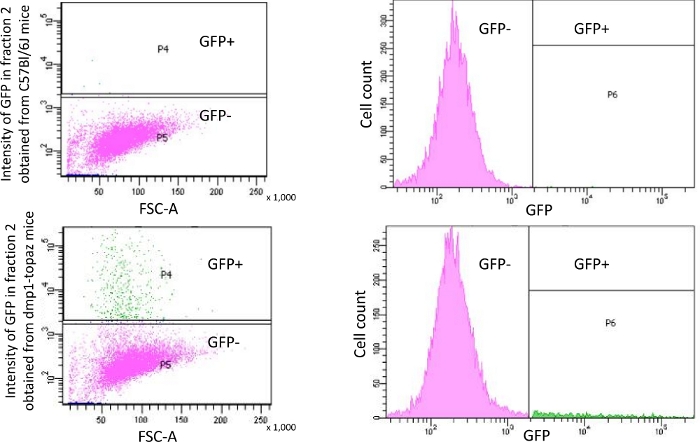
Figure 2: Isolation of GFP-positive osteocytes via fluorescence activated cell sorting. The upper panel represents cells isolated from GFP-negative C57Bl/6J littermate calvaria as GFP threshold control. The lower panel represents the number of cells and gating control practiced to isolate GFP-positive osteocytes from GFP-negative cells in fraction 2 obtained from dmp1-topaz mouse calvaria. Please click here to view a larger version of this figure.
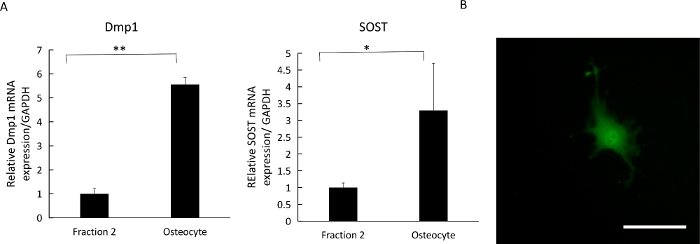
Figure 3: Osteocyte characterization post sort. (A) Relative mRNA expression of Dmp1 and SOST of fraction 2 cells cultured for 24 h and osteocytes cultured for 24 h post sort. Data are presented as a mean ± standard deviation. Statistical differences were detected by using Student’s t-test: * p < 0.05, **p < 0.01. (B) Microscopic image of an osteocyte retaining dendrites extending outwards from the cell body cultured for 24 h post sort. Scale bar = 50 µm. Please click here to view a larger version of this figure.
Discussion
The first isolated osteocyte was from a chicken calvaria7 isolated by using (OB7.3) or the aviant variant of PHEX; however, this method is limited by the availability of workable antibodies, as osteocyte-specific antibodies that are also specie-specific have to be manufactured. Researchers used a different modification of the sequential enzymatic process to obtain osteocytes from mouse and rat long bones; the reported purity of these cultures were set at about 70%9. The development of the cre mouse model allowed for engineering osteocytes, which express GFP on their surface. This mouse model, along with FACS, was used to obtain pure cultures of primary osteocytes20.
We omit the use of fractions 1 and fractions 6‒8 as little amounts of osteocytes come off in these fractions. Using fractions 2‒5 give the best possible yield of osteocytes over the shortest processing time; this limits the handling time of osteocytes and works towards preventing cell death or a possible alteration in cell signaling as a result of the stress the cell is subjected to during fractionation. We also culture osteocytes for 24 h pre-sort, which by default, excludes non-adherent suspension cells (hematopoietic cells) during sort preparation. This minimizes contamination by hematopoietic cells expressing GFP22. The workflow provided in this protocol takes advantage of previously published methods23 and shortens the time of the sort allowing for an efficient and quick osteocyte recovery with minimal contamination.
Critical steps in the protocol include obtaining a clean bony calvaria and trimming soft tissue from the brain or connective tissue attached to the bone to limit the contamination of adherent cells (fibroblast and neural cells). Also, pipetting the cells during steps that include obtaining and washing the digests is crucial, since cell aggregates and doublets are read as waste during sorting and will contribute to a low yield of osteocytes.
Osteocytes can be sorted without prior culture. However, this means that a higher number of cells have to be sorted, increasing the time of the sort and increasing the chance of hematopoietic contamination. This can be mitigated by applying hematopoietic cell depletion pre-sort. However, this is taxing and not recommended for routine and batch laboratory analysis22. Trouble may arise while sorting due to the presence of large cell aggregates and doublets clogging fluid flow of the sort machine. In our protocol, this has not been an issue, but this can be solved by reducing the FBS content of the sort buffer (less than 10%).
This protocol does not come without limitations. This method utilizes mouse osteocytes, which do not entirely resemble human osteocytes. This restricts extending the results obtained by studying murine osteocytes to meaningful clinical outcomes. Protocols for isolation of human osteocytes have been described24, and researchers are encouraged to use the cell species that best serves their goals. As with other protocols, the quantities of osteocytes obtained using this protocol are limited, and a large number of mice are required for large scale analysis, however, by decreasing the time needed for preparing and sorting osteocytes, higher quantities of cells can be acquired in a single time frame.
Osteocytes obtained through this process can be used for further culture and co-culture, gene expression analysis, downstream analysis of substrate activation/ inhibition, molecular probing, and staining applications. Primary cells can also be used to construct a 3D osteocyte matrix model resembling the native osteocytic environment for the study of mechanotransduction and mechanosensing.
Disclosures
The authors have nothing to disclose.
Acknowledgements
This work was supported in part by a JSPS KAKENHI grant from the Japan Society for the Promotion of Science (No. 19K10397 to H.K. and No. 18K09862 to I.M.).
Materials
| Name | Company | Catalog Number | Comments |
|---|---|---|---|
| BD FACSDiva software | BD Biosciences | Data aquisition and analysis | |
| BD Falcon Tube | BD Biosciences | 352235 | 12 x 75 mm Tube with Cell Strainer Cap, 35 μm nylon mesh. |
| Bovine serum albumin (BSA) | Sigma-Aldrich, MO, USA | ||
| Collagenase | Wako, Osaka, Japan | 034-22363 | 0.2% (w/v), crude collagenase mix sourced from C. histolyticum. |
| EDTA | Dojindo, Kumamoto, Japan | 5mM EDTA prepared with 0.1% BSA | |
| FACSAriaTM II | BD Biosciences | ||
| Fetal bovine serum (FBS) | Biowest, Nuaillé, France | ||
| Isolation buffer | 70mM NaCl, 10mM NaHCO, 60mM sorbitol, 3mM K2HPO4, 1mM CaCl2, 0.1% (w/v) BSA, 0.5% (w/v) glucose and 25 mM HEPES | ||
| Millex Sterile Filter Unit | Merck Millipore, Ireland | SLGV033RS | 0.22μm |
| Nylon cell strainer | FALCON, NY, USA | 40μm | |
| Trypsin-EDTA | Life Technologies, NY, USA | 0.5% x10. diluted to x1 in PBS | |
| α-MEM | Wako, Osaka, Japan | Containing 10% fetal bovine serum, 100 IU/ml penicillin G, and 100 μg/ml streptomycin |
References
- Manolagas, S. C. Birth and death of bone cells: basic regulatory mechanisms and implications for the pathogenesis and treatment of osteoporosis. Endocrine Reviews. 21 (2), 115-137 (2000).
- Bonewald, L. F. Osteocytes as Dynamic Multifunctional Cells. Annals of the New York Academy of Sciences. 1116 (1), 281-290 (2007).
- Bonewald, L. F. Mechanosensation and Transduction in Osteocytes. BoneKEy osteovision. 3 (10), 7-15 (2006).
- Feng, J. Q., et al. Loss of DMP1 causes rickets and osteomalacia and identifies a role for osteocytes in mineral metabolism. Nature Genetics. 38 (11), 1310-1315 (2006).
- Lane, N. E., et al. Glucocorticoid-Treated Mice Have Localized Changes in Trabecular Bone Material Properties and Osteocyte Lacunar Size That Are Not Observed in Placebo-Treated or Estrogen-Deficient Mice. Journal of Bone and Mineral Research. 21 (3), 466-476 (2005).
- Dallas, S. L., Prideaux, M., Bonewald, L. F. The Osteocyte: An Endocrine Cell ... and More. Endocrine Reviews. 34 (5), 658-690 (2013).
- van der Plas, A., Nijweide, P. J. Isolation and purification of osteocytes. Journal of bone and mineral research : the official journal of the American Society for Bone and Mineral Research. 7 (4), 389-396 (1992).
- Westbroek, I., De Rooij, K. E., Nijweide, P. J. Osteocyte-specific monoclonal antibody MAb OB7.3 is directed against Phex protein. Journal of bone and mineral research : the official journal of the American Society for Bone and Mineral Research. 17 (5), 845-853 (2002).
- Gu, G., Nars, M., Hentunen, T. A., Metsikkö, K., Väänänen, H. K. Isolated primary osteocytes express functional gap junctions in vitro. Cell and Tissue Research. 323 (2), 263-271 (2006).
- Kramer, I., et al. Osteocyte Wnt/β-Catenin Signaling Is Required for Normal Bone Homeostasis. Molecular and Cellular Biology. 30 (12), 3071-3085 (2010).
- Kato, Y., Windle, J. J., Koop, B. A., Mundy, G. R., Bonewald, L. F. Establishment of an Osteocyte-like Cell Line, MLO-Y4. Journal of Bone and Mineral Research. 12 (12), 2014-2023 (1997).
- Kato, Y., et al. Establishment of an osteoid preosteocyte-like cell MLO-A5 that spontaneously mineralizes in culture. Journal of bone and mineral research : the official journal of the American Society for Bone and Mineral Research. 16 (9), 1622-1633 (2001).
- Zhang, C., Bakker, A. D., Klein-Nulend, J., Bravenboer, N. Studies on Osteocytes in Their 3D Native Matrix Versus 2D In Vitro Models. Current Osteoporosis Reports. 17 (4), 207-216 (2019).
- Woo, S. M., Rosser, J., Dusevich, V., Kalajzic, I., Bonewald, L. F. Cell line IDG-SW3 replicates osteoblast-to-late-osteocyte differentiation in vitro and accelerates bone formation in vivo. Journal of bone and mineral research : the official journal of the American Society for Bone and Mineral Research. 26 (11), 2634-2646 (2011).
- Spatz, J. M., et al. The Wnt Inhibitor Sclerostin Is Up-regulated by Mechanical Unloading in Osteocytes in Vitro. The Journal of biological chemistry. 290 (27), 16744-16758 (2015).
- Gillet, J. P., Varma, S., Gottesman, M. M. The clinical relevance of cancer cell lines. Journal of the National Cancer Institute. 105 (7), 452-458 (2013).
- Sandberg, R., Ernberg, I. Assessment of tumor characteristic gene expression in cell lines using a tissue similarity index (TSI). Proceedings of the National Academy of Sciences of the United States of America. 102 (6), 2052-2057 (2005).
- Kalajzic, I., et al. Dentin matrix protein 1 expression during osteoblastic differentiation, generation of an osteocyte GFP-transgene. Bone. 35 (1), 74-82 (2004).
- Paic, F., et al. Identification of differentially expressed genes between osteoblasts and osteocytes. Bone. 45 (4), 682-692 (2009).
- Nakashima, T., et al. Evidence for osteocyte regulation of bone homeostasis through RANKL expression. Nature Medicine. 17 (10), 1231-1234 (2011).
- Kalajzic, I., et al. In vitro and in vivo approaches to study osteocyte biology. Bone. 54 (2), 296-306 (2013).
- Chia, L. Y., Walsh, N. C., Martin, T. J., Sims, N. A. Isolation and gene expression of haematopoietic-cell-free preparations of highly purified murine osteocytes. Bone. 72, 34-42 (2015).
- Halleux, C., Kramer, I., Allard, C., Kneissel, M. Bone Research Protocols. Helfrich, M. H., Ralston, S. H. , Humana Press. 55-66 (2012).
- Bernhardt, A., Wolf, S., Weiser, E., Vater, C., Gelinsky, M. An improved method to isolate primary human osteocytes from bone. Biomedizinische Technik (Berlin). 65 (1), 107-111 (2020).
Reprints and Permissions
