We report the application of quantitative chromosome conformation capture followed by high-throughput sequencing in embryoid bodies generated from embryonic stem cells. This technique allows to identify and quantitate the contacts between putative enhancers and promoter regions of a given gene during embryonic stem cell differentiation.
Method Article
Identification of Enhancer-Promoter Contacts in Embryoid Bodies by Quantitative Chromosome Conformation Capture (4C)
In This Article
Summary
Abstract
During mammalian development, cell fates are determined through the establishment of regulatory networks that define the specificity, timing, and spatial patterns of gene expression. Embryoid bodies (EBs) derived from pluripotent stem cells have been a popular model to study the differentiation of the main three germ layers and to define regulatory circuits during cell fate specification. Although it is well-known that tissue-specific enhancers play an important role in these networks by interacting with promoters, assigning them to their relevant target genes still remains challenging. To make this possible, quantitative approaches are needed to study enhancer-promoter contacts and their dynamics during development. Here, we adapted a 4C method to define enhancers and their contacts with cognate promoters in the EB differentiation model. The method uses frequently cutting restriction enzymes, sonication, and a nested-ligation-mediated PCR protocol compatible with commercial DNA library preparation kits. Subsequently, the 4C libraries are subjected to high-throughput sequencing and analyzed bioinformatically, allowing detection and quantification of all sequences that have contacts with a chosen promoter. The resulting sequencing data can also be used to gain information about the dynamics of enhancer-promoter contacts during differentiation. The technique described for the EB differentiation model is easy to implement.
Introduction
In mice, the inner cell mass (ICM) of 3.5-day-old embryos contains embryonic pluripotent stem cells. The ICM further develops into the epiblast at day 4.5, generating ectoderm, mesoderm, and endoderm cells, the main three germ layers in the embryo. Although pluripotent cells in the ICM exist only transiently in vivo, they can be captured in culture by the establishment of mouse embryonic stem cells (mESCs)1,2,3. The mESCs remain in an undifferentiated state and proliferate indefinitely, yet upon intrinsic and extrinsic stimuli they are also capable of exiting the pluripotency state and generating cells of the three developmental germ layers2,4. Interestingly, when cultured in suspension in small droplets, mESCs form three-dimensional aggregates (i.e., EBs) that differentiate into all three germ layers5. The EB formation assay is an important tool to study the early lineage specification process.
During lineage specification, cells of each germ layer acquire a specific gene expression program4. The precise spatiotemporal expression of genes is regulated by diverse cis-regulatory elements, including core promoters, enhancers, silencers, and insulators6,7,8,9. Enhancers, regulatory DNA segments typically spanning a few hundred base pairs, coordinate tissue-specific gene expression8. Enhancers are activated or silenced by binding of transcription factors and cofactors that regulate local chromatin structure8,10. Commonly used techniques to identify putative enhancers are genome-wide chromatin immunoprecipitation followed by sequencing (ChIP-seq) and the assay for transposase-accessible chromatin using sequencing (ATAC-seq) techniques. Thus, active enhancers are characterized by specific active histone marks and by increased local DNA accessibility11,12,13,14. In addition, developmental enhancers are believed to require physical interaction with their cognate promoter8,9. Indeed, it has been shown that enhancer variants and deletions that disrupt enhancer-promoter contacts can lead to developmental malformations15. Therefore, there is a need for novel techniques that provide additional information for the identification of functional enhancers that control developmental gene expression.
Since the development of the chromosome conformation capture (3C) technique16, the mapping of chromosomal contacts has been intensively used to assess physical distance between regulatory elements. Importantly, high-throughput variants of 3C techniques have recently been developed, providing different strategies for fixation, digestion, ligation, and recovery of contacts between chromatin fragments17. Among them, in situ Hi-C has become a popular technique allowing the sequencing of 3C ligation products genome-wide18. However, the high sequencing costs required to reach a resolution suitable for the analysis of enhancer-promoter contacts makes this technique impractical for the study of specific loci. Therefore, alternative methods were developed to analyze targeted loci at higher resolution19,20,21,22. One of these methods, namely 4C, known as a one versus all strategy, allows detection of all sequences that contact a site selected as viewpoint. However, a disadvantage of the standard 4C technique is the inverse PCR required, which amplifies differently sized fragments, favoring small products and biasing quantification after high-throughput sequencing. Recently, UMI-4C, a new variant of the 4C technique using unique molecular identifiers (UMI) has been developed for quantitative and targeted chromosomal contact profiling that circumvents this problem23. This approach uses frequent cutters, sonication, and a nested-ligation-mediated PCR protocol, thereby involving amplification of DNA fragments with relatively uniform length distribution. This homogeneity reduces biases in the amplification process of PCR preferences for shorter sequences and allows efficient recovery and accurate counting of spatially connected molecules/fragments.
Here we describe a protocol that adapts the UMI-4C technique to identify and quantify chromatin contacts between promoters and enhancers of lineage instructive transcription factors during EB differentiation.
Protocol
1. Embryoid body generation from mouse embryonic stem cells
- Prepare mESC serum-free culture medium: DMEM/F12 and neurobasal medium mixed at a ratio of 1:1. The culture medium is supplemented with MEM non-essential amino acids solution (1x), sodium pyruvate (1 mM), L-glutamine (2 mM), penicillin-streptomycin (100 U/mL), beta-mercaptoethanol (50 µM), N2 and B27 supplements (1x), PD0325901 (1 µM), CHIR99021 (3 µM), and leukemia inhibitory factor (LIF) (1,000 U/mL).
- Prepare EB differentiation medium: DMEM supplemented with 10% fetal bovine serum (FBS), MEM non-essential amino acids (1x), sodium pyruvate (1 mM), L-glutamine (2 mM), penicillin-streptomycin (100 U/mL), beta-mercaptoethanol (50 µM).
- Culture mESCs on 10 cm plastic dishes precoated with 0.1% (w/v) gelatin in mESC culture serum-free medium.
- When mESCs reach 60% confluency, remove culture medium and wash gently 1x with 2 mL of sterilized PBS.
- Remove PBS completely and add 2 mL of cell detachment medium. Incubate the culture dish at 37 °C for 5 min.
- Inactivate the reaction by adding 8 mL of EB differentiation medium into the dish.
- Dissociate mESC colonies by pipetting up and down 15-20 times to obtain a single-cell suspension.
- Centrifuge the cells at 300 x g at room temperature (RT) for 5 min and carefully remove the supernatant.
- Count cells (e.g., using a hemocytometer).
- Resuspend the cell pellet with EB differentiation medium and adjust the concentration to 2 x 10⁴ cells/mL.
- Invert the lid of a 15 cm culture dish and use a 200 µL multichannel pipette to deposit 20 µL drops of resuspended cells (~400 cells/drop) on the lid.
- Invert the lid carefully onto the bottom chamber and incubate the dish with hanging drops at 37 °C with 5% CO2 and 95% humidity for 3 days.
- Collect the EBs by washing the lid gently with 10 mL of PBS and transfer the EB-containing suspension to a 50 mL plastic tube.
- Place the tube at RT for 30 min, so that the EBs will sink to the bottom by gravity. Carefully remove the supernatant.
- Resuspend the EBs gently with 10 mL of fresh EB differentiation medium and transfer to a 10 cm bacteriological Petri dish.
- Check EB formation 3-6 days later using an inverted microscope. The EBs generated should be round and homogeneous in size.
- Incubate the cultures at 37 °C with 5% CO2 and 95% humidity. EBs will continue to differentiate into the three germ layers and can be collected at various timepoints for analysis.
2. Dissociation of EBs
- Collect the EBs from two to three 10 cm dishes into a 50 mL plastic tube. Centrifuge the EBs at 300 x g at RT for 5 min, then carefully remove the supernatant.
- Resuspend the EBs with 10 mL of PBS. Centrifuge EBs at 300 x g at RT for 3 min and remove the supernatant.
- Add 2 mL of trypsin-EDTA (0.25%) to the pellet and incubate the tube at 37 °C for 15 min. Pipette up and down every 3 min to obtain a single-cell suspension.
- Add 8 mL of EB differentiation medium to stop the trypsin reaction. Check EB dissociation under the microscope and count the cells.
3. Fixation
- Resuspend the cells in fresh EB culture medium at 1 x 10⁶ cells/mL. For a 50 mL tube, use a maximum of 4.5 x 10⁷ cells in 45 mL of medium.
- Add paraformaldehyde from a 37% stock (not older than 6 months) to a 1% final concentration.
CAUTION: Follow appropriate health and safety regulations while handling paraformaldehyde because it is a hazardous chemical. - Incubate for 10 min at RT under rotation.
- Quench the formaldehyde by adding glycine to a final concentration of 0.125 M.
- Incubate for 5 min at RT under rotation.
- Transfer the fixed cells to ice and keep cold at 4 °C from now on.
- Pellet the cells at 300 x g for 5 min in a refrigerated centrifuge.
- Discard the supernatant and resuspend the pellet in cold PBS (1 mL for 5 x 10⁶ cells), then transfer to 1.5 mL safe-lock tubes.
- Pellet the cells at 300 x g for 5 min at 4 °C, discard the supernatant, and snap-freeze the pellets in liquid nitrogen. Store at -80 °C or proceed with the protocol below.
4. Cell lysis and restriction enzyme digest
- Gently resuspend the cell pellet in 0.25 mL of freshly prepared ice-cold lysis buffer (10 mM Tris-HCl pH = 8.0, 10 mM NaCl, 0.2% Igepal CA630, and 1x protease inhibitors) per 2-5 x 10⁶ cells. To prepare 5 mL of lysis buffer, see Table 1.
- Incubate the cells for 15 min on ice.
- Centrifuge at 1,000 x g for 5 min at 4 °C. Discard the supernatant and keep the pellet, which contains the nuclei.
- Wash the pelleted nuclei with 500 µL of cold lysis buffer.
- Gently resuspend the pellet in a 1.5 mL tube with 50 µL of 0.5% SDS in 1x buffer 2, then incubate the tube in a heating block at 62 °C for 10 min.
- Remove the tubes from the heating block and add 170 µL of digestion buffer containing 25 µL of 10% triton X-100 to quench the SDS. Mix well by pipetting, avoiding excessive foaming.
- Incubate at 37 °C for 15 min.
- Add 25 µL of digestion buffer, mix by inverting, and take 8 µL as an undigested control. Keep the undigested control sample at -20 °C. Add 100 U MboI restriction enzyme (4 µL of a 25 U/µL stock) to the remaining nuclei and digest the chromatin for 2 h at 37 °C under rotation. Add another aliquot of 100 U of MboI and incubate for an additional 2 h.
- Add another 100 U of MboI and incubate under rotation overnight at 37 °C.
- The next day, add another 100 U of MboI and incubate for 3 h at 37 °C under rotation.
- Take 8 µL as a digested control sample. De-crosslink digested control samples and the undigested control samples from step 4.8 by adding 80 µL of TE buffer (10 mM Tris pH = 8, 1 mM EDTA) and 10 µL of proteinase K (10 mg/mL). Incubate at 65 °C for 1 h.
- Run 20 µL aliquots on a 0.6% gel to check digestion efficiency. Successful digestions show mostly fragments in the 3.0-0.5 kb range.
5. Proximity ligation and crosslink reversal
- Incubate the MboI-digested samples at 65 °C in a heating block for 20 min to inactivate MboI, then cool to RT.
- Centrifuge the tubes for 5 min at 1,000 x g at RT, remove the supernatant, and dissolve the pellet in 200 µL of fresh ligase buffer.
- Add 1,000 µL of the ligation master mix to each sample. To prepare 1,000 µL of the ligation master mix, see Table 2.
- Mix by inverting and incubate at RT overnight with slow rotation (9 rpm).
- Eliminate RNA and protein residues by adding 100 µL of proteinase K (10 mg/mL) and 10 µL of RNase A (10 mg/mL). Incubate samples at 55 °C for 45-60 min.
- Continue incubating samples at 65 °C for an additional 4 h.
6. DNA shearing and size selection
- Cool tubes to RT.
- Centrifuge for 5 min at 1,000 x g at 4 °C.
- Split the sample into three 400 µL aliquots in 2 mL tubes and add 2 µL of glycogen (20 mg/m), 40 µL of sodium acetate (3 M, pH = 5.2), and 2.5x volumes (1 mL) of 100% ethanol to each tube. Mix by inverting and incubate at -80 °C for 45-60 min.
- Centrifuge at 16,000 x g at 4 °C for 25 min. Keep the tubes on ice after spinning and carefully remove the supernatant by pipetting.
- Wash the DNA pellets by resuspending in 800 µL of 70% ethanol. Centrifuge at 16,000 x g at 4 °C for 5 min.
- Remove the supernatant and perform the wash once more with 800 µL of 70% ethanol.
- Dissolve the pellet in 130 µL of 1x Tris buffer (10 mM Tris-HCl, pH = 8) and incubate at 37 °C for 15 min to fully dissolve the DNA. If necessary, use pipetting to resuspend any precipitate.
- Measure the DNA yield; 2.5-5 µg of chromatin can be expected for 1 x 10⁶ cells. Check the ligation by running ± 200 ng of the 3C product on a 0.6% agarose gel. Successful ligations mostly show DNA fragments > 3 kb. Store the samples at -20 °C.
- Dilute a sample in a 0.65 mL tube suitable for sonication to 10 ng/µL in 100 µL of 1x Tris buffer volume (1 µg per tube). The standard amount used for library preparation is 3 µg, so perform the sonication in three separate tubes if necessary.
- Shear DNA to a size of 150-700 bp (average = 400-500 bp) using the following parameters on the sonicator: Cycles: 6-8 of 20 s on -60 s off. This should make the DNA suitable for high-throughput sequencing library preparation using Illumina sequencers.
- Transfer the sheared DNA to a normal new safe-lock tube. Pool multiple sonications from the same sample.
- Warm a bottle of DNA purification beads at RT. From now on, use low binding tips.
- Add 1.8x volumes of beads to the DNA tube and resuspend gently.
- Incubate at RT for 5 min.
- Collect the beads with a magnetic rack. Wash the beads 2x with 1 mL of freshly prepared 80% ethanol while keeping the tubes in the magnetic rack.
NOTE: Remove all ethanol, including residual droplets. - Air-dry the beads briefly (2-3 min) at RT.
NOTE: Do not dry beads longer than 5 min. This will decrease the DNA yield. - Resuspend the beads with 90 µL of 1x Tris buffer (10 mM Tris-HCl, pH = 8) to elute the DNA.
- Measure the DNA yield and analyze a 5 µL aliquot on a 1.5% gel. There should be very little loss compared to the presonication yield.
7. Library preparation for sequencing
- Add 15 µL of master mix from the library preparation kit. To repair the ends of sheared DNA, combine 10 µL of 10x end repair reaction buffer and 5 µL of end repair enzyme mix.
- Incubate at RT for 30 min.
- Add 1.1x volume of DNA purification beads and resuspend gently.
- Incubate at RT for 5 min.
- Collect the beads with a magnetic rack. Wash the beads twice with 1 mL of freshly prepared 80% ethanol while keeping the tubes in the magnetic rack. Remove ethanol.
- Air-dry the beads for 2-3 min at RT. Resuspend the beads with 42 µL of 1x Tris buffer (10 mM Tris-HCl, pH = 8) to elute the DNA.
- Add 8 µL of dA-tailing master mix to each sample. To prepare the dA-tailing master mix, combine 5 µL of 10x dA-tailing reaction buffer and 3 µL of Klenow fragment exo minus.
- Incubate at 37 °C for 30 min.
- Add 2 µL calf intestinal alkaline phosphatase (CIP) to dephosphorylate DNA.
- Incubate for 30 min at 37 °C, then 60 min at 50 °C.
- Add 1.1x volumes of DNA purification beads and resuspend gently.
- Incubate at RT for 5 min.
- Collect the beads with a magnetic rack. Wash the beads 2x with 1 mL of freshly prepared 80% ethanol while keeping the tubes in the magnetic rack.
- Air-dry the beads briefly (2-3 min) at RT. Resuspend beads with 35 µL of 1x Tris buffer (10 mM Tris-HCl, pH = 8) to elute the DNA.
- Perform the adapter ligation reaction. Use reduced adapter/ligase concentrations as mentioned in Table 3.
- Incubate at 20 °C for 15 min.
- Add 3 µL of the mixture of uracil DNA glycosylase and DNA glycosylase lyase endonuclease VII (e.g., USER) enzyme, mix by pipetting, and incubate at 37 °C for 15 min.
- Increase the volume to 100 µL with water, boil 5 min at 96 °C, then keep samples on ice.
- Add 1.1x volumes of DNA purification beads and resuspend gently.
- Incubate at RT for 5 min.
- Collect the beads with a magnetic rack. Wash the beads 2x with 1 mL of freshly prepared 80% ethanol while keeping the tubes in the magnetic rack.
- Air-dry the beads for 2-3 min at RT. Resuspend the beads with 50 µL of 1x Tris buffer (10 mM Tris-HCl, pH = 8) to elute the DNA.
8. 4C chromatin interaction library amplification and purification
- Amplify the 4C library using 10 µL of library to carry out the first PCR. The PCR setup and program can be found in the Table 4.
- Perform nested PCR. The nested PCR setup and program can be found in the Table 5.
- Pool PCR products for each library and purify with a 1.1x DNA purification beads.
- Measure DNA yield and analyze a 5 µL aliquot on a 1.5% gel.
- Adjust the library concentration and sequence the library. If indexed, the libraries can be pooled prior to sequencing.
Results
Six days after the induction of ESC differentiation in the hanging drops, we obtained a homogenous population of EBs that were used for further analyses (Figure 1). We adapted the UMI-4C method23 to quantify specific chromatin interaction at promoters of lineage specific genes in EBs24. A schematic overview of the protocol with representative quality control gels at different steps is shown in Figure 2A. The first quality control was carried out to determine the efficiency of the MboI restriction enzyme digestion. Efficient digestion showed a fragment size of less than 3 kbp (Figure 2B). Of note, mESC and EB chromatin digestion was difficult and sometimes residual undigested chromatin persisted. The second quality control was carried out after ligation to verify that most of the fragments were now > 3 kbp (Figure 2B). Then, chromatin fragments obtained after sonication were analyzed by gel electrophoresis. Fragment sizes of 400-500 bp were expected (Figure 2B).
After dephosphorylation and single-end adapter ligation, two rounds of PCR were performed to amplify the targets of interest. A nested approach was used to design a set of two primers for each locus. This helped improve specificity. Each target was amplified separately with two different primer pairs to optimize PCR conditions (i.e., primer pairs A and B for the Pou5f1 locus and primer pairs C and D for the T locus, respectively) and resulted in a DNA smear around 400 bp (Figure 2C). Alternatively, multiplex PCR was performed to amplify targets A and C simultaneously (Figure 2D) and resulted in a similar fragment size after purification (Figure 2D). Primers used for 4C library preparation (loci of Pou5f1 and T) can be found in Table 6.
For data analysis, raw sequencing reads were first aligned against the refence mm10 mouse genome, were all duplicated, and low quality (< 20) reads were removed. For each bait, the information on each restriction fragment was obtained by computing the number of read fragments, and a raw contact profile was obtained. Next, the region of interest was defined as all restriction fragments with 2 kbp and 250 kbp distance to the bait. The size of each restriction fragment was increased by aggregating the adjacent restriction fragments sequentially to smoothen the profiles until a threshold of 5% of the total number of raw contacts was reached in the region of interest. To ensure that the replicates were integrated, and conditions were compared, we included both slopes and random intercepts on the restriction fragment level. The average profile per condition and the fold change between them were plotted as shown in Figure 3. During EB differentiation, the contacts between the enhancers and the promoter of the pluripotency gene Pou5f1 decreased, while enhancer-promoter contacts of mesendoderm lineage instructive transcription factor T increased (Figure 3), providing functional insights about these developmental enhancers.
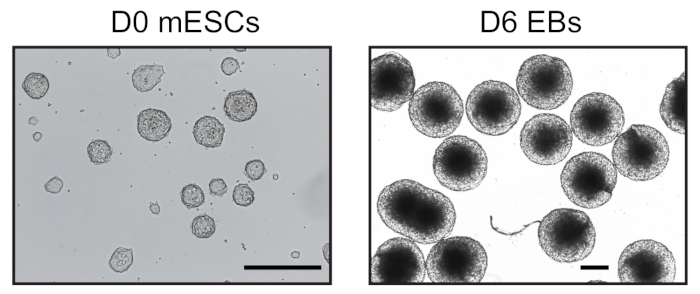
Figure 1: Representative images of mESC and derived embryoid bodies. Day 0 mESC cultured in serum-free conditions (left) and homogenous day 6 EBs (right) observed by an inverted microscope. Scale Bar = 500 μm. Please click here to view a larger version of this figure.
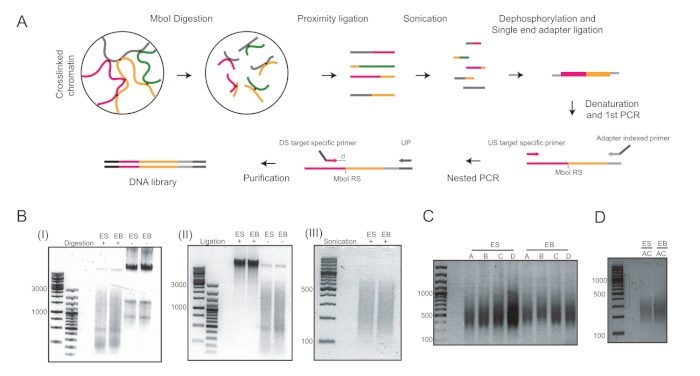
Figure 2: 4C workflow and representative images of the main steps of the protocol. (A) Schematic workflow of the quantitative 4C. RS = restriction site; US = upstream; DS = downstream; UP = universal primer; D = the distance between RS and DS should ideally be 5-15 bp. (B) Examples of MboI-digested chromatin (I), in-nuclei ligated chromatin (II), and sonicated chromatin (III). The numbers on the left indicate the DNA sizes determined by the DNA ladder run for each sample. (C) Examples of PCR amplification at the two loci: Pou5f1 (primers A and B) and T (primer C and D). (D) Examples of multiplex PCR amplification at Pou5f1 and T loci using primers A and C. ES = embryonic stem cells; EB = embryoid bodies. Please click here to view a larger version of this figure.
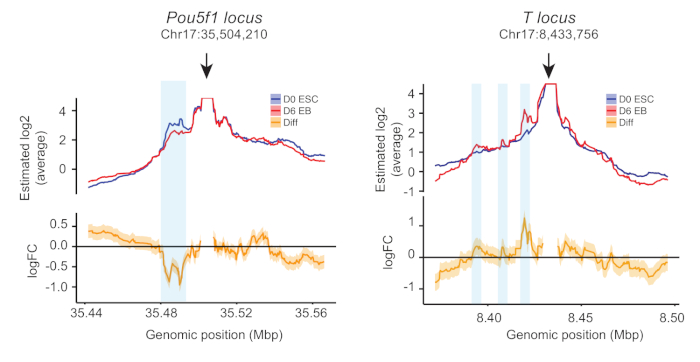
Figure 3: Examples of 4C profiles. Quantitative 4C profiles for baits located on the Pou5f1 and T gene promoters assayed in mESCs and Day 6 EBS. The top panel shows plots of average contacts generated from two independent biological replicates; the bottom panel shows the average contact fold change of Day 6 EBs versus mESCs (average of the two replicates). Light blue boxes indicate the location of enhancers with dynamic changes during differentiation. Figure adapted from Tian et al.24. Please click here to view a larger version of this figure.
| For 5mL | |
| 1M Tris-HCl, pH8.0 | 50 µL |
| 5M NaCl | 10 µL |
| 10% Igepal CA630 | 100 µL |
| 50x Roche complete protease inhibitors | 100 µL |
| MilliQ Water | 4.74 mL |
Table 1: Lysis buffer.
| For 1000µL | |
| MilliQ Water | 869 µL |
| 10X NEB T4 DNA Ligase Buffer | 120 µL |
| 20mg/mL Bovine Serum Albumin | 6 µL |
| 2000 U/µL T4 DNA Ligase | 5 µL |
Table 2: Ligation master mix preparation.
| For 15 µL | |
| 5X Quick Ligation Reaction Buffer | 10 µL |
| NEBNext Adaptor | 3 µL |
| Quick T4 DNA ligase | 2 µL |
Table 3: Adapter ligation reaction.
| PCR setup | |
| Adaptor ligated library-on-deads | 10 µL |
| PCR grade water | 20.25 µL |
| 10 µM Target specific primer | 3.75 µL |
| 10 µM NEB Index primer | 3.75 µL |
| Herculase II 5X buffer | 10 µL |
| 10 Mm dNTPs | 1.25 µL |
| Herculase II polymerase | 1 µL |
| Total volume | 50 µL |
| PCR program | |
| Step 1: 98 °C - 2 min | |
| Step 2: 98 °C - 20s | |
| Step 3: 65 °C - 30s | |
| Step 4: 72 °C - 45s | |
| Step 5: go to step 2 to make a total of 15-18 cycles | |
| Step 6: 72 °C - 3 min | |
| Step 7: 4 °C – hold |
Table 4: 4C chromatin interaction library amplification, first PCR.
| Nested PCR setup | |
| DNA fragment from the first PCR | 10 µL |
| PCR grade water | 20.25 µL |
| 10 µM specific primer+P5 Illumina primer | 3.75 µL |
| 10 µM P7 Illumina primer | 3.75 µL |
| Herculase II 5X buffer | 10 µL |
| 10 Mm dNTPs | 1.25 µL |
| Herculase II polymerase | 1 µL |
| Total volume | 50 µL |
| Nested PCR program | |
| Step 1: 98 °C - 2 min | |
| Step 2: 98 °C - 20s | |
| Step 3: 65 °C - 30s | |
| Step 4: 72 °C - 45s | |
| Step 5: go to step 2 to make a total of 15-18 cycles | |
| Step 6: 72 °C - 3 min | |
| Step 7: 4 °C – hold |
Table 5: 4C chromatin interaction library amplification, nested PCR.
| Name | Sequence (5'-3') |
| DS-Oct4-A | AATGATACGGCGACCACCGAGATCTACACTCTTTCCCTACACGACG CTCTTCCGATCTTCTTGCAAAGATAACTAAGCACCAGGCCAG |
| US-Oct4-A | TCTCTTGCAAAGATAACTAAGCACCAGGCC |
| DS-Oct4-B | AATGATACGGCGACCACCGAGATCTACACTCTTTCCCTACACGACG CTCTTCCGATCTGTGATGGGTCAGCAGGGCTGGAGCCGGGCT |
| US-Oct4-B | ACCAGGTGGGGGTGATGGGTCAGCAGGGCT |
| DS-T-C | AATGATACGGCGACCACCGAGATCTACACTCTTTCCCTACACGACG CTCTTCCGATCTCCTGGGTCCCTGCACATTCGCCAAAGGAGC |
| US-T-C | GATTACACCTGGGTCCCTGCACATTCGCCAA |
| DS-T-D | AATGATACGGCGACCACCGAGATCTACACTCTTTCCCTACACGACG CTCTTCCGATCTGGCTTTGGAGAGGTCAAGGAGACCCGGGAG |
| US-T-D | GCTGAGGCTTTGGAGAGGTCAAGGAGACC |
| UP-4C | CAAGCAGAAGACGGCATACGA |
| Adap-i1 | CAAGCAGAAGACGGCATACGAGATCGTGATGTGACTGGAGTTCAGA CGTGTGCTCTTCCGATC |
| Adap-i2 | CAAGCAGAAGACGGCATACGAGATACATCGGTGACTGGAGTTCAGA CGTGTGCTCTTCCGATC |
| Adap-i3 | CAAGCAGAAGACGGCATACGAGATGCCTAAGTGACTGGAGTTCAGA CGTGTGCTCTTCCGATC |
| Adap-i4 | CAAGCAGAAGACGGCATACGAGATTGGTCAGTGACTGGAGTTCAGA CGTGTGCTCTTCCGATC |
Table 6: Primers used for 4C library preparation.
Discussion
The hanging drop culture method does not need additional growth factors or cytokines and reproducibly generates homogeneous populations of EBs from a predetermined number of mESCs5. Here we describe a protocol of quantitative 4C adapted from the UMI-4C approach to quantify enhancer-promoter contact of lineage specific transcription factors in the EB differentiation model. We identified chromatin regions that contact promoters of Pou5f1 and T genes in a dynamic fashion during EB differentiation. Pou5f1 was downregulated during EB differentiation and the contact frequency between the Pou5f1 promoter and its distal enhancer decreased. Conversely, T was upregulated during EB differentiation and we identified three enhancers for which contact frequencies with their promoter are decreased (Figure 3). To confirm the identification, a chromatin immunoprecipitation (ChIP) assay of active histone mark H3K27ac can be performed24, as this histone mark has been shown to be associated with enhancer activation and enhancers lose this mark during their inactivation11.
A standard 4C technique has been extensively used to survey the chromatin contact profile of specific genomic sites25. However, this approach is difficult to interpret quantitatively even after extensive normalization26,27,28 because of the biases introduced by the heterogeneity of PCR fragment size and the impossibility to distinguish PCR duplicates. Our quantitative 4C method is largely identical to the UMI-4C technique that allows the quantification of single molecules using sonication and a nested-ligation-mediated PCR step to bypass the limitation of the classic 4C approach23. However, unlike the UMI-4C that uses unique molecular identifiers, our quantitative 4C protocol allows the quantification of single molecules based on the specific DNA break produced by the sonication step. It makes our protocol compatible with commercial DNA library preparation kits, obviating the need of primers with unique molecular identifiers.
Our protocol involves several key steps that should be considered. As in the classical 4C method28, critical factors of our protocol are the efficiency of the digestion and the ligation during the preparation of the 3C molecules. Low digestion/ligation efficiencies can dramatically decrease the complexity of interaction with a fragment of interest, resulting in a reduced resolution. As previously described23, another critical step of the protocol is the design of the primers for the library amplification. The second PCR reaction primers should be located 5-15 nt from the interrogated restriction site. In a 75 nt sequencing read, this allows for at least 40 nt left of the capture length for mapping. The primer used in the first PCR reaction should be designed upstream of the second primer with no overlap and both should be specific enough to ensure efficient DNA amplification. For multiplexing, primers should be designed independently, aiming for a melting temperature (Tm) of 60-65 °C. Moreover, as for other 3C techniques, the resolution of the quantitative 4C method is determined by the restriction enzyme used in the protocol25. This protocol uses a restriction enzyme with a 4 bp recognition site, MboI. The maximum resolution with this enzyme is around 500 bp, but this is highly locus dependent and rarely achieved. Another limitation is that interactions that occur between elements located in the same restriction fragment are not detectable. In addition, interactions occurring at a distance of one restriction site cannot be distinguished from the undigested background. The use of a fill-in step prior to ligation might allow the detection of these interactions.
Quantitative 4C is ideally suited to interrogate chromatin contacts of targeted loci. However, the specific PCR amplification step limits the number of loci that can be investigated simultaneously. A way to increase the number of targeted loci is to multiplex the PCR steps to simultaneously amplify several targets, but this requires compatibility of the primers used and testing each primer pair prior to implementation. If global changes of chromatin architecture at promoters are desired, genome-wide approaches such as Hi-C, PC Hi-C, or HiChIP would be more appropriate29,30,31.
Disclosures
The authors have nothing to disclose.
Acknowledgements
We would like to thank F. Le Dily, R. Stadhouders and members of the Graf laboratory for their advice and discussions. G.S. was supported by a Marie Sklodowska-Curie fellowship (H2020-MSCA-IF-2016, miRStem), T.V.T by a Juan de la Cierva postdoctoral fellowship (MINECO, FJCI-2014-22946). This work was supported by the European Research Council under the 7th Framework Programme FP7 (ERC Synergy Grant 4D-Genome, grant agreement 609989 to T.G.), the Spanish Ministry of Economy, Industry and Competitiveness (MEIC) to the EMBL partnership, Centro de Excelencia Severo Ochoa 2013-2017 and CERCA Program Generalitat de Catalunya.
Materials
| Name | Company | Catalog Number | Comments |
|---|---|---|---|
| 0.1% EmbryoMax gelatin | EMD Millipore | ES-006-B | Cell culture |
| 0.25% Trypsin-EDTA | 25200072 | ||
| AMPure XP | Beckman Coulter | 10136224 | 4C/DNA purification |
| B27 supplement | Gibco | 17504044 | Cell culture |
| Beta-mercaptoethanol | Gibco | 31350010 | Cell culture |
| Bioruptor Pico | Diagencode | B01060010 | 4C/sonication |
| BSA | NEB | B9000S | 4C |
| CHIR99021 | Selleck Chemicals | S1263 | Cell culture |
| CIP | NEB | M0212 | 4C |
| cOmplete Protease Inhibitor Cocktail | Roche | 4693116001 | 4C |
| DMEM/F12 medium | Gibco | 11320033 | Cell culture |
| dNTP | NEB | N0447S | 4C |
| ESGRO Leukaemia Inhibitory Factor (LIF) | EMD Millipore | ESG1107 | Cell culture |
| Formaldehyde solution (37%) | Sigma | 252549-25ML | 4C |
| Glycin | Sigma | GE17-1323-01 | 4C |
| Glycogen | ThermoFischer | R0551 | 4C |
| Herculase II Fusion DNA polymerase | Agilent | 600675 | 4C |
| IGEPAL CA-630 | Sigma | I3021-50ML | 4C |
| Knockout DMEM | 10829018 | ||
| L-glutamine | Gibco | 25030081 | Cell culture |
| MboI | NEB | R0147M | 4C |
| MEM non-essential amino acids | Gibco | 11140050 | Cell culture |
| N2 supplement | Gibco | A1370701 | Cell culture |
| NEBNext DNA Library prep | NEB | E6040 | 4C |
| NEBuffer 2.1 | NEB | B7202S | 4C/digestion |
| Neurobasal medium | Gibco | 21103049 | Cell culture |
| PD0325901 | Selleck Chemicals | S1036 | Cell culture |
| Penicillin Streptomycin | Gibco | 15140122 | Cell culture |
| Proteinase K | NEB | P8107S | 4C |
| Qubit 4 Fluorometer | ThermoFischer | Q33238 | 4C |
| Qubit dsDNA HS Assay Kit | ThermoFischer | Q32851 | 4C |
| RNase A | ThermoFischer | EN0531 | 4C |
| Sodium pyruvate solution | Gibco | 11360070 | Cell culture |
| StemPro Accutase Cell Dissociation Reagent | Gibco | A1110501 | Cell culture |
| T4 DNA Ligase Reaction Buffer | NEB | B0202S | 4C |
| T4 DNA Ligase Reaction Buffer | NEB | M0202M | 4C |
References
- Evans, M. J., Kaufman, M. H. Establishment in culture of pluripotential cells from mouse embryos. Nature. 292 (5819), 154-156 (1981).
- Martello, G., Smith, A. The nature of embryonic stem cells. Annual Review Cell and Developmental Biology. 30, 647-675 (2014).
- Martin, G. R. Isolation of a pluripotent cell line from early mouse embryos cultured in medium conditioned by teratocarcinoma stem cells. Proceedings of the National Academy of Science U. S. A. 78 (12), 7634-7638 (1981).
- Loh, K. M., Lim, B., Ang, L. T. Ex uno plures: molecular designs for embryonic pluripotency. Physiological Reviews. 95 (1), 245-295 (2015).
- Sheridan, S. D., Surampudi, V., Rao, R. R. Analysis of embryoid bodies derived from human induced pluripotent stem cells as a means to assess pluripotency. Stem Cells International. 2012, 738910(2012).
- Gaszner, M., Felsenfeld, G. Insulators: exploiting transcriptional and epigenetic mechanisms. Nature Reviews in Genetics. 7 (9), 703-713 (2006).
- Lenhard, B., Sandelin, A., Carninci, P. Metazoan promoters: emerging characteristics and insights into transcriptional regulation. Nature Reviews in Genetics. 13 (4), 233-245 (2012).
- Long, H. K., Prescott, S. L., Wysocka, J. Ever-Changing Landscapes: Transcriptional Enhancers in Development and Evolution. Cell. 167 (5), 1170-1187 (2016).
- Schoenfelder, S., Fraser, P. Long-range enhancer-promoter contacts in gene expression control. Nature Reviews in Genetics. 20 (8), 437-455 (2019).
- Spitz, F., Furlong, E. E. Transcription factors: from enhancer binding to developmental control. Nature Reviews in Genetics. 13 (9), 613-626 (2012).
- Creyghton, M. P., et al. Histone H3K27ac separates active from poised enhancers and predicts developmental state. Proceedings of the National Academy of Sciences U. S. A. 107 (50), 21931-21936 (2010).
- Heintzman, N. D., et al. Histone modifications at human enhancers reflect global cell-type-specific gene expression. Nature. 459 (7243), 108-112 (2009).
- Klemm, S. L., Shipony, Z., Greenleaf, W. J. Chromatin accessibility and the regulatory epigenome. Nature Reviews in Genetics. 20 (4), 207-220 (2019).
- Rada-Iglesias, A., et al. A unique chromatin signature uncovers early developmental enhancers in humans. Nature. 470 (7333), 279-283 (2011).
- Lettice, L. A., et al. Development of five digits is controlled by a bipartite long-range cis-regulator. Development. 141 (8), 1715-1725 (2014).
- Dekker, J., Rippe, K., Dekker, M., Kleckner, N. Capturing chromosome conformation. Science. 295 (5558), 1306-1311 (2002).
- de Wit, E., de Laat, W. A decade of 3C technologies: insights into nuclear organization. Genes and Development. 26 (1), 11-24 (2012).
- Lieberman-Aiden, E., et al. Comprehensive mapping of long-range interactions reveals folding principles of the human genome. Science. 326 (5950), 289-293 (2009).
- Simonis, M., et al. Nuclear organization of active and inactive chromatin domains uncovered by chromosome conformation capture-on-chip (4C). Nature Genetics. 38 (11), 1348-1354 (2006).
- Splinter, E., de Wit, E., van de Werken, H. J., Klous, P., de Laat, W. Determining long-range chromatin interactions for selected genomic sites using 4C-seq technology: from fixation to computation. Methods. 58 (3), 221-230 (2012).
- Stadhouders, R., et al. Multiplexed chromosome conformation capture sequencing for rapid genome-scale high-resolution detection of long-range chromatin interactions. Nature Protocols. 8 (3), 509-524 (2013).
- van de Werken, H. J., et al. Robust 4C-seq data analysis to screen for regulatory DNA interactions. Nature Methods. 9 (10), 969-972 (2012).
- Schwartzman, O., et al. UMI-4C for quantitative and targeted chromosomal contact profiling. Nature Methods. 13 (8), 685-691 (2016).
- Tian, T. V., et al. Whsc1 links pluripotency exit with mesendoderm specification. Nature Cell Biology. 21 (7), 824-834 (2019).
- Chen, H., et al. Dynamic interplay between enhancer-promoter topology and gene activity. Nature Genetics. 50 (9), 1296-1303 (2018).
- Apostolou, E., et al. Genome-wide chromatin interactions of the Nanog locus in pluripotency, differentiation, and reprogramming. Cell Stem Cell. 12 (6), 699-712 (2013).
- de Wit, E., et al. The pluripotent genome in three dimensions is shaped around pluripotency factors. Nature. 501 (7466), 227-231 (2013).
- Krijger, P. H. L., Geeven, G., Bianchi, V., Hilvering, C. R. E., de Laat, W. 4C-seq from beginning to end: A detailed protocol for sample preparation and data analysis. Methods. , (2019).
- Mumbach, M. R., et al. HiChIP: efficient and sensitive analysis of protein-directed genome architecture. Nature Methods. 13 (11), 919-922 (2016).
- Rao, S. S., et al. A 3D map of the human genome at kilobase resolution reveals principles of chromatin looping. Cell. 159 (7), 1665-1680 (2014).
- Schoenfelder, S., Javierre, B. M., Furlan-Magaril, M., Wingett, S. W., Fraser, P. Promoter Capture Hi-C: High-resolution, Genome-wide Profiling of Promoter Interactions. Journal of Visualized Experiments. (136), e57320(2018).
Reprints and Permissions
