A plasma-induced polymerization procedure is described for the surface-initiated polymerization on polymer membranes. Further postmodification of the grafted polymer with photochromic substances is presented with a protocol of conducting permeability measurements of light-responsive membranes.
A subscription to JoVE is required to view this content. Sign in or start your free trial.
Method Article
Preparation of Light-responsive Membranes by a Combined Surface Grafting and Postmodification Process
In This Article
Summary
Abstract
In order to modify the surface tension of commercial available track-edged polymer membranes, a procedure of surface-initiated polymerization is presented. The polymerization from the membrane surface is induced by plasma treatment of the membrane, followed by reacting the membrane surface with a methanolic solution of 2-hydroxyethyl methacrylate (HEMA). Special attention is given to the process parameters for the plasma treatment prior to the polymerization on the surface. For example, the influence of the plasma-treatment on different types of membranes (e.g. polyester, polycarbonate, polyvinylidene fluoride) is studied. Furthermore, the time-dependent stability of the surface-grafted membranes is shown by contact angle measurements. When grafting poly(2-hydroxyethyl methacrylate) (PHEMA) in this way, the surface can be further modified by esterification of the alcohol moiety of the polymer with a carboxylic acid function of the desired substance. These reactions can therefore be used for the functionalization of the membrane surface. For example, the surface tension of the membrane can be changed or a desired functionality as the presented light-responsiveness can be inserted. This is demonstrated by reacting PHEMA with a carboxylic acid functionalized spirobenzopyran unit which leads to a light-responsive membrane. The choice of solvent plays a major role in the postmodification step and is discussed in more detail in this paper. The permeability measurements of such functionalized membranes are performed using a Franz cell with an external light source. By changing the wavelength of the light from the visible to the UV-range, a change of permeability of aqueous caffeine solutions is observed.
Introduction
Plasma modification of materials has become an important process in many industrial fields. Cleaning of surfaces and functionalization of surfaces without changing the bulk property of the material has made the plasma treatment an essential process in surface science1-8.
Plasma treatment of polymers results in homolytic bond cleavage. This leads to an edging of the polymeric material and to the formation of radical rich surfaces. By using plasma containing oxygen molecules, the surface becomes oxygen rich and thus more hydrophilic9-11. However, the hydrophilicity of the surfaces is not stable over time12. In order to enhance the long-term stability, the plasma treated surface can be chemically modified after or during the plasma process13-15. This treatment is normally performed by adding a reactive monomer species into the gas phase during the plasma process; these monomers then polymerize from the created radicals of the polymer surface. If the chemical treatment is performed with a nonvolatile monomer, the polymer grafting has to take place after the plasma modification. In order to perform a controlled grafting after the radicals are formed on the surface, a plasma setup is described, which allows the plasma-initiated surface-induced polymerization from the surface in solution under controlled conditions12,16.
The presentation focuses on the modification of track-edged polymer membranes12,17. By modifying the surface tension of these membranes, the permeability rate can be varied12. This clean and fast process allows the creation of very thin layers (<5 nm), which cover the entire membrane surface without changing the bulk property of the polymer membrane. Due to the edging during the plasma process, the pore diameters of the track-edged membranes augment slightly12. The edging rate is depending on the polymer and has a linear behavior.
When using monomers with reactive functional groups, the grafted polymers can be further functionalized. This is demonstrated by the postmodification of a PHEMA-grafted membrane with a carboxylic acid functionalized spiropyran. This results in a photochromic surface, since spiropyran is known to transform into a merocyanine species when irradiated with UV-light. The spiropyran form can be reestablished by irradiating the merocyanine form with visible light (Figure 1)18,19. Since the merocyanine form is more polar than the spiropyran state, the surface tension of the coating can be triggered with light20. The change in surface tension influences the permeability resistance of the membrane towards aqueous solutions. The set-up how to perform the permeability tests of these light-responsive membranes will be shown and the significant change in permeability resistance (decrease in permeability resistance by 97%) is demonstrated. Such a membrane can be integrated in a drug delivery setup or in smart sensing systems.
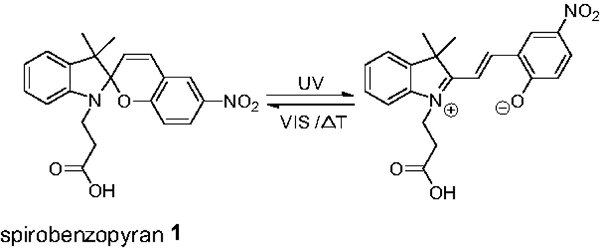
Figure 1. Photoisomerization of spirobenzopyran compound 1.
Access restricted. Please log in or start a trial to view this content.
Protocol
1. Plasma-initiated Polymerization
- Preparing of monomer solution.
- Dissolve HEMA (100 ml; 0.718 mol) in 200 ml water and wash 3x with hexane (100 ml) in a separating funnel. Saturate the aqueous phase with sodium chloride and extract the HEMA with diethyl ether (50 ml). Dry the organic phase over MgSO4 and remove the solvent in vacuo (100 mbar, 40 °C). Distill the HEMA under reduced pressure (15 mbar; 99 °C).
- Prepare a 0.62 M methanolic solution of the inhibitor-free HEMA produced in Section 1.1.1. Pour 30 ml of the solution into a one-necked flask and eliminate oxygen by bubbling Ar through the solution for 1 hr.
- Surface-induced polymerization.
- Position two polycarbonate membranes next to each other into the plasma chamber (Figure 2). Place the shiny side of the membrane pointing towards the gas phase.
- Connect the plasma chamber to a high vacuum (20 mbar) for 5 min. Close the valve to the vacuum and open the other valve, which is connected to argon and oxygen gas and purge the chamber with this mixture for 2 hr with 15 sccm argon and 2.5 sccm oxygen.
- Initiate the plasma and reduce the power to the desired power (for polycarbonate membrane: 12 W) and treat the membranes for 4 min with the plasma. Connect the monomer solution with the chamber by opening the corresponding valve. Switch off the plasma and evacuate the chamber.
- Connect the monomer solution with the chamber by opening the corresponding valve and pour the solution into the chamber. Ensure that the membranes are covered with the monomer solution. Open the valve connected to the argon and store the reaction mixture for 12 hr at 20 °C (conditioned room).
- Remove the monomer solution. Wash the membranes with methanol in an ultrasonic bath for 5 min. Repeat the washing procedure with water.
- Dry the membrane in vacuo over molecular sieves for 2 hr.
2. Postmodification of Coated Membranes
- Prepare a solution of spirobenzopyran 1 (Figure 1) (100 mg; 0.27 mmol), N,N-dicyclohexylcarbodiimide (DCC) (55 mg; 0.27 mmol) and dimethyl aminopyridine (DMAP) (33 mg, 0.27 mmol) in tert-butylmetylether (TBME) (12 ml).
- Place a protecting stirrer bar and a protecting grid into a round-bottom flask. Dry the flask and flood the flask with argon.
- Pour the solution into the flask, followed by the coated membrane.
- Stir gently at room temperature for 12 hr.
- Remove the solution and wash the membrane with tert-butylmetylether in an ultrasonic bath for 5 min. Repeat the washing procedure with ethanol and water.
- Dry the membrane in vacuo over molecular sieves for 2 hr.
3. Surface Tension Measurements
- Fix the membrane with a standard tape on a metal O-ring. Position a drop of nanopure water (3.3 μl) on that part of the membrane surface, which is not in contact with the O-ring. Measure the contact angle (CA) at 5 different spots of the membrane.
- For testing the long term stability of the samples, measure the contact angles at three different spots of the membranes after 0, 1, 2, 3, 7, 14, and 21 days.
4. Permeability Tests of the Photochromic Membranes
- Fill the receptor chamber of the Franz diffusion cell with water (12 ml).
- Fix the membrane in a Franz diffusion cell. Ensure that the membrane is in contact with the water of the receptor chamber. Fill the donor chamber (the chamber on top of the membrane) with an aqueous caffeine solution (20 mM; 3.0 ml). Irradiate the membrane from the top of the donor chamber with white-light (Figure 3). Collect samples (200 μl) from the receptor cell; for track-edged polycarbonate membranes with a pore diameter of 200 nm, collect samples every 10 min.
- Repeat the experiment as described in step 4.2. but irradiate the membrane with UV-light (366 nm, 80 W/m2) during the entire permeability test.
- Determination of the caffeine concentrations of the collected samples.
- Plot a calibration curve with 15 different caffeine concentrations (between 0.05 mg/ml and 1.5 mM/L) using a UV/Vis spectrometer. Calibrate at 293 nm.
- Determine the concentration of each of the collected samples using the calibration curve.
- Plot the determined concentration vs. the time of the collected samples. Make a linear fit through the points and determine Δc from the slope.
Access restricted. Please log in or start a trial to view this content.
Results
The etch rate can be followed by weighing the membrane after different periods of time. As can be seen from Figure 4, the etch rate follows for polyester, polyvinylidene fluoride, and polycarbonate membranes a linear etch rate, which can be determined from the slope of the linear correlation of the etch time versus mass loss. As shown in Figure 4, the polycarbonate membranes show the lowest etch rate of all the three polymer membranes. One consequence of the etching is the chang...
Access restricted. Please log in or start a trial to view this content.
Discussion
The plasma process produces a purple gas, which is caused by ionized argon. An orange color would indicate the presence of undesired nitrogen from a leak. The plasma process does not only form radicals on the surface but also etches the membrane7,12. Too much etching can change the pore diameter significantly, which would influence the permeability of the membrane. The controlled reaction conditions of the presented setup allow enhancing the reproducibility of the plasma-initiated grafting process. Nevertheles...
Access restricted. Please log in or start a trial to view this content.
Disclosures
The authors have nothing to disclose.
Acknowledgements
This work was financially supported by Swiss National Science Foundation (NRP 62 – Smart Materials). Also acknowledged is the support of B. Hanselmann, K. Kehl, U. Schütz and B. Leuthold.
Access restricted. Please log in or start a trial to view this content.
Materials
| Name | Company | Catalog Number | Comments |
|---|---|---|---|
| 2-Hydroxyethyl methacrylate, 97% | Sigma-Aldrich | 128635 | |
| Hexane 99% | Biosolve | ||
| Magnesium sulfate (MgSO4, anhydrous) | Sigma-Aldrich | M7506 | |
| Methanol, 99% | Sigma-Aldrich | 14262 | dried over molecular sieves |
| N,N-Dicylcohexylcarbodiimide, 99% | Sigma-Aldrich | D8002 | |
| Dimethyl aminopyridine, 99% | Sigma-Aldrich | 107700 | |
| Tert-butylmethylether, 98% | Fluka | 306975 | |
| Polycarbonate membrane | Whatman | Nanopore Track Etched (TE) (1.0 μm, 0.2 μm, 0.1 μm, 50 nm, 30 nm, and 15 nm pore diameter; 47 mm or 25 mm membrane diameter) | |
| Caffeine (reagent plus) | Sigma-Aldrich | C0750 | |
| Franz diffusion cell (12 ml) | SES-Analysesysteme | 6C010015 | 15 mm unjacheted Franz Cell, 12 ml Receptor volume, Flat ground, clear glass, stirbar and clamp |
| UV-Lamp | UV irradiation (366 nm, 15 W/m2) | ||
| White light lamp | White light irradiation (500 W bulb) | ||
| UV/Vis spectrophotometer | Varian 50Bio/50MPR | ||
| Polyester membranes | Sterlitech | PET0225100 | Polyester Membrane Filters, 0.2 μm pore diameter, 25 mm diameter |
| Polyvinylidene fluoride membranes | Millipore | PVDF Membranes Durapore (0.22 μm pore diameter; 47 mm membrane diameter) | |
| Argon (99.9995%) | Alphagaz | ||
| Dressler Cesar RF Power Generator | Plasma chamber setup | ||
| MKS Multi Gas Controller 647C | Plasma chamber setup | ||
| MKS Mass-Flow controllers | Plasma chamber setup | ||
| Vacuubrand RE 2.5 rotary vane vacuum pump | Plasma chamber setup | ||
| Contact angle measurement device | Krüss | G10 | |
| Balances | Mettler Toledo | AB204-S and Mettler ME30 |
References
- d'Agostino, R. Basic Approaches to Plasma Production and Control. , Wiley-VCH Verlag GmbH & Co. KGaA. (2008).
- Liston, E. M., Martinu, L., Wertheimer, M. R. Plasma surface modification of polymers for improved adhesion: a critical review. J. Adh. Sci. Technol. 7 (10), 1091-1127 (1993).
- Siow, K. S., Britcher, L., Kumar, S., Griesser, H. J. Plasma Methods for the Generation of Chemically Reactive Surfaces for Biomolecule Immobilization and Cell Colonization - A Review. Process. Polymers. 3 (6-7), 392-418 (2006).
- Hossain, M. M., Hegemann, D., Herrmann, A. S., Chabrecek, P. Contact angle determination on plasma-treated poly(ethylene terephthalate) fabrics and foils. Appl. Polymer Sci. 102 (2), 1452-1458 (2006).
- Guimond, S., Hanselmann, B., Amberg, M., Hegemann, D. Plasma functionalization of textiles: Specifics and possibilities. Pure Appl. Chem. 82 (6), 1239-1245 (2010).
- Lymberopoulos, D. P., Economou, D. J. Modeling and simulation of glow discharge plasma reactors. Journal of Vacuum Sci. Technol. A Vacuum Surf. Films. 12 (4), 1229-1236 (1994).
- Hegemann, D., Brunner, H., Oehr, C. Plasma treatment of polymers for surface and adhesion improvement. Nuclear Instr. Methods Phys. Res. B Interact. Atoms. 208 (0), 281-286 (2003).
- Øiseth, S. K., Krozer, A., Kasemo, B., Lausmaa, J. Surface modification of spin-coated high-density polyethylene films by argon and oxygen glow discharge plasma treatments. Appl. Surf. Sci. 202 (1-2), 92-103 (2002).
- Choi, W. -K., Koh, S. -K., Jung, H. -J. Surface chemical reaction between polycarbonate and kilo-electron-volt energy Ar[sup + ] ion in oxygen environment. J. Vacuum Sci. Technol. A Vacuum Surf. Films. 14 (4), 2366-2371 (1996).
- Kitova, S., Minchev, M., Danev, G. RF plasma treatment of polycarbonate substrates. Optoelectron. Adv. Mater. 7 (5), 2607-2612 (2005).
- Friedrich, J. F., Mix, R., Schulze, R. D., Meyer-Plath, A., Joshi, R., Wettmarshausen, S. New plasma techniques for polymer surface modification with monotype functional groups. Plasma Process. Polymers. 5 (5), 407-423 (2008).
- Baumann, L., et al. Tuning the resistance of polycarbonate membranes by plasma-induced graft surface modification. Appl. Surf. Sci. 268, 450-457 (2013).
- Hegemann, D., Hossain, M. M., Balazs, D. J. Nanostructured plasma coatings to obtain multifunctional textile surfaces. Prog. Org. Coatings. 58 (2-3), 237-240 (2007).
- Gengenbach, T., Vasic, Z., Li, S., Chatelier, R., Griesser, H. Contributions of restructuring and oxidation to the aging of the surface of plasma polymers containing heteroatoms. Plasmas Polymers. 2 (2), 91-114 (1997).
- Gengenbach, T. R., Chatelier, R. C., Griesser, H. J. Characterization of the Ageing of Plasma-deposited Polymer Films: Global Analysis of X-ray Photoelectron Spectroscopy Data. Interface Anal. 24 (4), 271-281 (1996).
- Hirotsu, T., Nakajima, S. Water ethanol permseparation by pervaporation throught the plasma graft copolymeric membranes of acrylic acid and acrylamide. Appl. Polymer Sci. 36 (1), 177-189 (1988).
- Baumann, L., de Courten, D., Wolf, M., Rossi, R. M., Scherer, L. J. Light-Responsive Caffeine Transfer through Porous Polycarbonate. Appl. Mater. Interf. 5 (13), 5894-5897 (2013).
- Minkin, V. I. Photo-, thermo-, solvato-, and electrochromic spiroheterocyclic compounds. Chem. Rev. 104 (5), 2751-2776 (2004).
- Berkovic, G., Krongauz, V., Weiss, V. Spiropyrans and spirooxazines for memories and switches. Chem. Rev. 100 (5), 1741-1753 (2000).
- Vlassiouk, I., Park, C. -D., Vail, S. A., Gust, D., Smirnov, S. Control of Nanopore Wetting by a Photochromic Spiropyran: A Light-Controlled Valve and Electrical Switch. Lett. 6 (5), 1013-1017 (2006).
- Baumann, L., et al. Development of light-responsive porous polycarbonate membranes for controlled caffeine delivery. RSC Adv. 3 (45), 23317-23326 (2013).
- Nicoletta, F. P., Cupelli, D., Formoso, P., De Filpo, G., Colella, V., Gugliuzza, A. Light Responsive Polymer Membranes: A Review. Membranes. 2 (1), 134-197 (2012).
Access restricted. Please log in or start a trial to view this content.
Reprints and Permissions
