Here we describe a procedure allowing a detailed analysis of the phosphorylation-dependent activation of the IRF3 transcription factor. This is achieved through the combination of a high resolution SDS-PAGE and a native-PAGE coupled to immunoblots using multiple phosphospecific antibodies.
A subscription to JoVE is required to view this content. Sign in or start your free trial.
Method Article
A High Resolution Method to Monitor Phosphorylation-dependent Activation of IRF3
* These authors contributed equally
In This Article
Summary
Abstract
The IRF3 transcription factor is critical for the first line of defense against pathogens mainly through interferon β and antiviral gene expression. A detailed analysis of IRF3 activation is essential to understand how pathogens induce or evade the innate antiviral response. Distinct activated forms of IRF3 can be distinguished based on their phosphorylation and monomer vs dimer status. In vivo discrimination between the different activated species of IRF3 can be achieved through the separation of IRF3 phosphorylated forms based on their mobility shifts on SDS-PAGE. Additionally, the levels of IRF3 monomer and dimer can be monitored using non-denaturing electrophoresis. Here, we detail a procedure to reach the highest resolution to gain the most information regarding IRF3 activation status. This is achieved through the combination of a high resolution SDS-PAGE and a native-PAGE coupled to immunoblots using multiple total and phosphospecific antibodies. This experimental strategy constitutes an affordable and sensitive approach to acquire all the necessary information for a complete analysis of the phosphorylation-mediated activation of IRF3.
Introduction
The ubiquitously and constitutively expressed transcription factor Interferon (IFN) Regulatory Factor 3 (IRF3) is critical for the first line of defense against pathogens mainly through the induction of IFNβ, but also through the induction of the chemokine (C-C motif) ligand 5 (CCL5) and several antiviral proteins including IFN-induced protein with tetratricopeptide repeats IFIT1/2/31-3. IRF3 activation has been reported following infection with numerous viruses, or exposure to polyinosinic-polycytidylic acid (poly I:C) or lipopolysaccharide (LPS)4. Importantly, most studied viruses have evolved mechanisms to evade the IRF3-mediated response, and thereby escape the host innate immune defense5. Thus, monitoring IRF3 activation is of great importance to understand the molecular mechanisms of the innate antiviral host defense, but also to identify the strategy used by viruses to counteract this response.
Many published reports however provide only a limited analysis of IRF3 activation performed by the monitoring of IRF3-target gene induction (IFNB1 and IFIT1) and/or luciferase reporter gene assay coupled to low resolution sodium dodecyl sulfate polyacrylamide gel electrophoresis(SDS-PAGE) analysis of IRF3. However, numerous biochemical studies, analysis of the behavior of various IRF3 mutants and elucidation of IRF3 crystal structure 6-11 have contributed to establish that IRF3 is subjected to a complex set of sequential post-translational modifications by phosphorylation at multiple sites. The set of phosphorylation involved in IRF3 activation appears to be dependent on the stimulus and most likely on the cell type. In uninfected cells, IRF3 coexists as non-phosphorylated and hypophosphorylated species containing phosphoresidues, including Thr135 and Ser173, in the 1-198 aa N-terminal region6,12-14. Accumulation of this hypophosphorylated form of IRF3 is induced by stress inducers, growth factors and DNA-damaging agents6. Phosphorylation of Ser/Thr residues at the C-terminal region of IRF3 containing the transactivation domain is triggered following activation by viruses, poly I:C or LPS in a cell-type dependent manner15-17. C-terminal phosphorylation of IRF3 involves no less than 7 distinct phosphoacceptor sites organized in two main clusters, Ser385/Ser386 and Ser396/Ser398/Ser402/Thr404/Ser405, that each contribute to IRF3 activation through dimerization, nuclear accumulation, association with the CREB-binding protein (CBP)/p300 coactivators, DNA binding to IFN sensitive response element (ISRE) consensus sequences and transactivation of target genes9,10,17-19. Phosphorylation of Thr390 is also thought to contribute to virus-induced IRF3 activation20. Mass spectrometry analyses of IRF3 have demonstrated that Ser386, Thr390, Ser396 and Ser402 residues are directly phosphorylated by the inhibitor of κB kinase ε (IKKε)/ TANK-binding kinase 1 (TBK1) kinases9,10. Phosphorylation at the C-terminal residues is also required for termination of IRF3 activation through polyubiquitination and proteasome-mediated degradation10. This process is also dependent on the phosphorylation at Ser339, which is necessary for the recruitment of the propyl isomerase Pin110,11. IRF3 species containing at least phospho-Ser339/386/396 residues are considered hyperphosphorylated forms. The exact sequence and function of each site remains a matter of discussion 10,21. It is now clear that activated IRF3 does not represent a homogeneous state, but that different activated species exhibiting distinct phosphorylation or dimerization characteristics exist 10,22.
To provide a complete understanding of IRF3 activation in response to specific pathogens, it is thus necessary to characterize which of the activated species are induced. Induction of IRF3 target genes, IFNB1 and IFIT1, has proven to provide a reliable read-out for IRF3 activation. However, monitoring expression of these genes does not distinguish between different activation states of IRF3. A comprehensive analysis of IRF3 activation states in a particular setting relies on the detailed characterization of its phosphorylation and dimerization status10. Unphosphorylated (form I), hypophosphorylated (form II) and hyperphosphorylated (forms III and IV) IRF3 forms6,18,23 can be successfully resolved by reduced mobility in high-resolution SDS-PAGE analysis. Monomeric and dimeric IRF3 species can be efficiently identified by native-PAGE analysis. These approaches are greatly improved when used in combination with phosphospecific antibodies directed against distinct IRF3 phosphoacceptor sites.
Standard protocols allow a poor resolution of proteins that does not permit efficient separation of distinct IRF3 phosphorylated forms. Here, we describe in detail a procedure to achieve the highest resolution to monitor the induction of distinct virus-activated IRF3 species using SDS-PAGE coupled to native-PAGE in combination with immunoblot using total and phosphospecific antibodies. In vivo discrimination between the different activated forms of IRF3 is performed based on their mobility shifts observed on SDS-PAGE. Additionally, IRF3 monomer and dimer can be distinguished by non-denaturing electrophoresis. The combination of these two complementary techniques with immunoblot proves to be an affordable and sensitive approach to acquire all the necessary information for a complete analysis of phosphorylation-mediated activation of IRF3.
Access restricted. Please log in or start a trial to view this content.
Protocol
NOTE: The protocol is described here using A549 cells infected with Sendai virus (SeV). However, the protocol for SDS-PAGE and native PAGE also works with all human and murine cell types tested so far, particularly myeloid cells stimulated with various IRF3-activating stimuli 9,15,19,24,25.
1. Infection of A549 Cells
- Maintain A549 cells in culture in a 15 cm plate at 37 °C/5% CO2 in 20 ml F12K/Ham medium containing 10% heat-inactivated fetal bovine serum (HI-FBS) and 1% L-glutamine (complete F12K/Ham medium).
NOTE: All the solutions used for cell culture and treatments must be sterile. - At 24 hr before the infection, aspirate the medium and wash the cells with 10 ml of distilled phosphate buffered saline (D-PBS) at RT.
- Add 1 ml of 0.25% trypsin-EDTA solution to each plate to cover the cells and incubate at 37 °C for 3 min.
- Stop the incubation as soon as the cells start to detach from the plate by softly tapping the plate with one hand. Inactivate the trypsin by adding 10 ml of pre-heated complete F12K/Ham medium per plate and transfer the cells to a 15 ml conical tube.
- Centrifuge at 350 x g for 3 min at RT. Remove the supernatant and resuspend the cell pellet in 8 ml of complete F12K/Ham medium to obtain a homogeneous single cell suspension.
- Count the cells using a hemocytometer. Seed the cells at a density of 1 x 10⁶ cells per 60 mm plate in 4 ml of pre-heated complete F12K/Ham medium. Incubate for 20 - 24 hr at 37 °C/5% CO2. After 20 - 24 hr, the cells form a 90% confluent monolayer (this corresponds to 1.5 x 10⁶ cells).
- Remove the medium and wash the cells with 2 ml of serum-free F12K/Ham medium (SFM). Add 2 ml of fresh SFM per 60 mm plate.
- Thaw an aliquot of Sendai virus (SeV) (stored aliquoted at -80 °C) on ice and vortex briefly.
- Dilute the virus in pre-heated SFM to obtain 60 HAU/100 µl. Mix by pipetting up and down softly and add 100 µl of diluted virus per plate to perform the infection at 40 HAU/106 cells. Do not add virus in the non-infected control plate.
- Incubate the cells in the incubator at 37 °C/5% CO2. Agitate the plates by hand 3 or 4 times, or using an automatic orbital or rocking shaker placed directly in the incubator, during the first hour of infection.
- At 2 hr post-infection, add 2 ml of F12K/Ham medium containing 20% HI-FBS to obtain a final concentration of 10% HI-FBS.
- Incubate the cells in the incubator at 37 °C/5% CO2 for an additional 1, 4 and 7 hr to reach total infection times of 3, 6, and 9 hr, respectively. At each of these time points, proceed to step 2.1.
2. Preparation of Whole Cell Extracts (WCE)
- Remove the infection medium. Harvest the cells by scraping in 1 ml of ice-cold D-PBS and transfer the cell suspension to a pre-chilled 1.5 ml centrifuge tube.
- Pellet the cells by centrifugation at 16,000 x g at 4 °C for 20 sec and carefully decant all traces of D-PBS.
NOTE: At this step, the cell pellet can be directly subjected to protein extraction or flash-frozen in liquid nitrogen or dry ice/ethanol bath and stored at -80 °C until lysis. - Prepare the lysis buffer containing 50 mM HEPES pH 7.4, 150 mM NaCl, 5 mM EDTA, 10% glycerol and 1% Nonidet P-40 in deionized water (ddH2O). Extemporarily add protease (1 µg/ml leupeptin and 2 µg/ml aprotinin) and phosphatase inhibitors (5 mM sodium fluoride, 1 mM activated sodium orthovanadate, 2 mM p-nitrophenyl phosphate and 10 mM β-glycerophosphate pH 7.5).
NOTE: The lysis buffer without inhibitors can be stored at 4 °C. A specific protocol for the activation of sodium orthovanadate is described in the Table of Specific Reagents/Equipment. - Resuspend the cell pellet in 70 µl of lysis buffer. Typically the lysate concentration will be around 2 µg/µl.
- Incubate on ice for 20 min. Flash-freeze the lysate by incubation in a liquid nitrogen bath for 15 sec. Thaw the lysate at RT until it is completely melted and vortex for 10 sec. Repeat the freeze/thaw/vortex cycle 3 times.
- Alternatively, perform the freezing step in an ethanol/dry ice bath for 1 min.
- Centrifuge at 16,000 x g at 4 °C for 20 min. Transfer the supernatant (corresponding to the WCE) to a new pre-chilled 1.5 ml centrifuge tube. Keep the WCE on ice at all times.
- Quantify proteins using any protein quantification procedure compatible with the lysis buffer such as Bradford-based protein assay26.
3. Resolution of WCE by High Resolution SDS-PAGE
- Prepare three denaturing electrophoresis gels.
- For the detection of IRF3 forms, pour two gels of a minimum of 16 cm length with a separation gel composed of 7.5% acrylamide/bis-acrylamide (37.5:1), 375 mM Tris-HCl pH 8.8 (RT), 0.1% sodium dodecyl sulfate (SDS), 1% ammonium persulfate and 0.1% TEMED in ddH2O and a stacking gel composed of 4% acrylamide, 62.5 mM Tris-HCl pH 6.8 (RT), 0.05% SDS, 1% ammonium persulfate and 0.1% TEMED in ddH2O.
Caution! Acrylamide, TEMED and SDS are toxic and/or irritant. Wear protective gloves and manipulate under a fume hood. - For the detection of SeV proteins, pour one gel of a minimum of 8.5 cm length with characteristics similar to the gel described in 3.1.1, except that the separation gel contains 12% acrylamide.
- For the detection of IRF3 forms, pour two gels of a minimum of 16 cm length with a separation gel composed of 7.5% acrylamide/bis-acrylamide (37.5:1), 375 mM Tris-HCl pH 8.8 (RT), 0.1% sodium dodecyl sulfate (SDS), 1% ammonium persulfate and 0.1% TEMED in ddH2O and a stacking gel composed of 4% acrylamide, 62.5 mM Tris-HCl pH 6.8 (RT), 0.05% SDS, 1% ammonium persulfate and 0.1% TEMED in ddH2O.
- Denature the WCE obtained in step 2.6 by adding 1:4 (v/v) 5x loading buffer (125 mM Tris-HCl pH 6.8 (RT), 10% SDS, 20% (p/v) glycerol, 0.0005% bromophenol blue and 25% β-mercaptoethanol in ddH2O) followed by heating at 100 °C for 10 min. Quick spin the tubes to bring down the condensation that forms in the cap.
Caution! β-mercaptoethanol is toxic by inhalation. Wear protective gloves and manipulate under a fume hood. - Mount the gels in the migration apparatus. Fill the upper and lower chambers with running buffer containing 25 mM Tris-Base, 0.1% SDS and 192 mM glycine in distilled water (dH2O).
- Load 14 µl of molecular weight standard in one well of each 16 cm gel and 7 µl of molecular weight standard in one well of the 8.5 cm gel. Load 30 µg of denatured WCE (prepared as described in step 3.2) per well of the two gels prepared in step 3.1.1 for IRF3 forms detection. Load 8 - 10 µg of denatured WCE (prepared as described in step 3.2) per well on the gel prepared in step 3.1.2 for SeV analysis.
- Run the gels at 30 mA constant current until the migration front reaches the bottom of the gel.
NOTE: Migration typically lasts approximately 3 hr for a 16 cm gel and 45 min for an 8.5 cm gel. - Proceed to the transfer onto nitrocellulose membranes (step 5).
4. Analysis of IRF3 Dimerization by Native-PAGE
NOTE: This method was originally described by the group of Dr. T. Fujita27.
- Prepare the upper (-) and lower (+) chamber electrophoresis buffers. The upper chamber buffer consists of 25 mM Tris-HCl pH 8.4 (RT), 192 mM glycine and 1% sodium deoxycholate (DOC) in ddH2O. The lower chamber buffer contains 25 mM Tris-HCl pH 8.4 (RT) and 192 mM glycine in ddH2O.
NOTE: The upper and lower chamber electrophoresis buffers can be stored at 4 °C until use. However, make sure that they are pre-warmed to RT before performing the electrophoresis. - Pour a non-denaturing resolving gel of a minimum of 8.5 cm length containing 7.5% acrylamide/bis-acrylamide (37.5:1), 375 mM Tris-HCl pH 8.8 (RT), 1% ammonium persulfate and 0.1% TEMED in ddH2O.
- Pre-run the gel at 40 mA constant current for 30 min on ice. Press the running apparatus into the ice approximately to the level of the lower chamber electrophoresis buffer. It is important that the gel is not in the ice.
- During pre-run, mix WCE kept on ice with 2x native-PAGE loading buffer 1:1 (v/v) containing 125 mM Tris-HCl pH 6.8 (RT), 30% glycerol and 0.1% bromophenol blue in ddH2O.
- Load 8 - 10 µg WCE (prepared as described in step 4.4) immediately at the end of the pre-run.
- Run the gel at 25 mA constant current on ice, as described above for the pre-run, until the migration front reaches the bottom of the gel (approximately 40 min).
5. Immunoblot Analysis of IRF3 Species
- Prepare the transfer buffer containing 25 mM Tris-Base and 192 mM glycine in ddH2O. Refrigerate the transfer buffer at 4 °C before use.
- Wet three pieces of nitrocellulose membrane cut to a size slightly larger than the gels in a plastic/glass box containing the transfer buffer. Indicate the orientation of the membrane by cutting one corner. The transfer buffer can be reused 3 times. Store the buffer at 4 °C between uses.
- Uncast the gels (SDS-PAGE and native-PAGE) and cut one corner of each gel for proper orientation.
- For native-PAGE, incubate the gel at RT with gentle agitation for at least 30 min in the SDS-PAGE running buffer to remove the DOC before transferring to the transfer buffer.
- Incubate the gels (SDS-PAGE and native-PAGE) in the transfer buffer for 5 - 10 min.
- Mount a transfer sandwich per gel in a transfer cassette with the membrane towards the positive electrode (foam pad/filter paper/membrane/gel/filter paper/foam pad). Be careful to remove all the bubbles in between the layers of the sandwich.
- Perform the transfer as recommended by the manufacturer for the transfer apparatus used.
NOTE: Perform all incubations and washes in the next steps on a rocking or orbital shaking platform. - At the end of the transfer time, incubate the membranes for 15 min in the fixation solution containing 7% acetic acid, 40% ethanol and 3% glycerol in ddH2O. Wash the membranes 3x 5 min in PBS (137 mM NaCl, 2.7 mM KCl, 10.2 mM Na2HPO4 and 1.8 mM KH2PO4 in dH2O).
Caution! Acetic acid is toxic, irritant and flammable. Wear protective gloves and manipulate under the fume hood.
NOTE: The fixation solution can be reused multiple times. - For the native-PAGE membrane proceed directly to step 5.11.
- Rinse the three SDS-PAGE membranes quickly in dH2O before incubating them for 1 min in red ponceau solution containing 6.57 mM red ponceau and 1% acetic acid in ddH2O.
NOTE: The red ponceau solution can be reused several times. - Rinse the membranes in dH2O until the background is white enough to see the protein bands stained in red. Note the markers with a pencil and cut the excess membrane around the proteins. Destain the membranes by incubation for 5 min in PBS under agitation.
- Incubate the membranes for 1 hr at RT or O/N at 4 °C in the blocking solution (PBS containing 0.05% Tween 20 and 5% non-fat dry milk (PBS-T-milk). Wash the membranes 3x 5 min in PBS-T.
NOTE: The PBS-T wash is optional and only strictly required when applying antibodies diluted in PBS-T containing 5% bovine serum albumin (PBS-T-BSA) (Figure 1 and Table 1) in the next step. - Incubate the four membranes (from SDS-PAGE and native-PAGE) with the primary antibodies according to the sequential order detailed in Figure 1 and Table 1. Perform 5x 5 min washes in PBS-T.
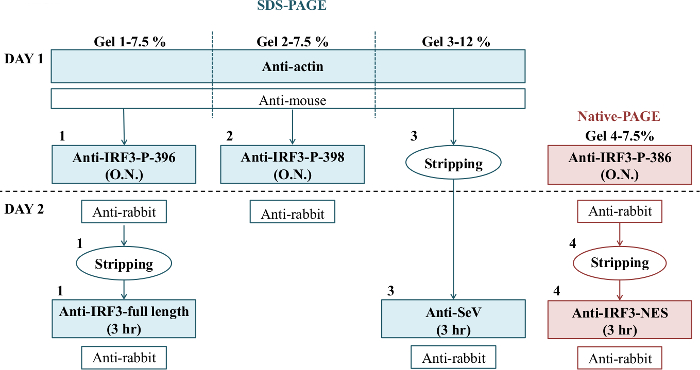
Figure 1. Sequence of Immunoblot Analyses. The schematic describes the individual SDS-PAGE and native-PAGE gels required to detect the various IRF3 phosphorylated and monomeric/dimeric forms. The specific order of antibodies applied to the membrane resulting from each gel in the immunoblot procedure is described. Note that the anti-actin antibodies are used first to ensure equal loading of the samples before applying any other specific antibodies. The alternate sequence, with anti-actin antibodies being applied after the anti-phospho-IRF3 antibodies, also works. Stripping is used between anti-actin and anti-SeV antibodies, or between anti-phospho-IRF3 and anti-IRF3 antibodies because of overlapping size of the signals. Please click here to view a larger version of this figure.
| Primary antibodies | Dilution | Dilution buffer | Incubation | Secondary antibodies | Comments |
| Anti-Actin | 1/10,000 | PBS-T-BSA | 15 min at RT | Anti-mouse | Use after SDS-PAGE Diluted antibodyies can be reused several times if stored at 4 °C in the presence of 0.02 % Sodium Azide. |
| Anti-IRF3-P-Ser386 | 1/200 | PBS-T-BSA | O/N at 4 °C | Anti-rabbit | Use after Native-PAGE. It is not recommended to reuse the diluted antibody |
| Anti-IRF3-P-Ser396 | 1/10,000 | PBS-T-BSA | O/N at 4 °C | Anti-rabbit | Use after SDS-PAGE. It is not recommended to reuse the diluted antibody Anti-IRF3-P-396 is also available from Cell Signaling. Optimal dilution was defined as 1/1,000 for this antibody, but may vary between lots. |
| Anti-IRF3-P-Ser398 | 1/10,000 | PBS-T-BSA | O/N at 4 °C | Anti-rabbit | Use after SDS-PAGE. It is not recommended to reuse the diluted antibody |
| Anti-IRF3 full length | 1/7,500 | PBS-T-milk | 3 hr at RT | Anti-rabbit | Use after SDS-PAGE. Anti-IRF3 full length antibody can be used after native-PAGE, but it is less sensitive to detect the monomer. Diluted antibodies can be reused several times if stored at 4 °C in the presence of 0.02 % Sodium Azide. |
| Anti-IRF3-NES | 0.5 μg/ml | PBS-T-milk | 3 hr at RT | Anti-rabbit | Use after Native-PAGE. Diluted antibodyies can be reused several times if stored at 4 °C in the presence of 0.02 % Sodium Azide. |
| Anti-SeV | 1/14,000 | PBS-T-BSA | 3 hr at RT | Anti-rabbit | Use after SDS-PAGE. Diluted antibodyies can be reused several times if stored at 4 °C in the presence of 0.02 % Sodium Azide. |
| NOTE: Dilution and buffer used for HRP-coupled secondary antibodies need to be optimized as it varies from one company to the other. | |||||
Table 1. Specifications of Antibodies used in the Immunoblotting Procedure.
- Incubate the membranes with the horseradish peroxidase (HRP)-conjugated secondary antibodies as detailed in Figure 1 and Table 1. Wash the membranes 5x 5 min in PBS-T, followed by 2x 5 min in PBS to fully remove traces of Tween.
- Incubate the membranes for 1 min in a volume of enhanced chemiluminescence reagent sufficient to fully cover the membranes. Dry the membranes using filter paper.
- Place the membranes in a luminescent image analyzer to visualize the immunoreactive bands.
- Alternatively, perform the detection of immunoreactive bands using sensitive X-Ray films.
- Wash the membranes 3x 5 min in PBS.
NOTE: At this step the membranes can be kept dry. However, if further stripping is required, it is better to perform the stripping before drying the membrane. Membranes can also be stored for short-term in PBS. - For the membranes that do not require stripping between incubation with antibodies (see Figure 1) proceed directly to step 5.20.
- When stripping is required between antibodies (see Figure 1), incubate the membranes in pre-warmed stripping solution containing 2% SDS, 62.5 mM Tris-HCl pH 6.8 (RT) and 0.7% β-mercaptoethanol in ddH2O at 50 °C for 20 min under regular agitation. Wash the membranes 3x 5 min in PBS.
NOTE: Agitation during the stripping procedure is key. Stripping can be performed in a hybridization oven. Alternatively, stripping can be performed using membranes sealed in plastic bags and immersed in a water bath. In this case, it is important to agitate the membranes 4 - 5 times during the incubation. - Incubate the membranes for 1 hr at RT or O/N at 4 °C in PBS-T-milk.
- Repeat steps 5.12 to 5.16 according to Figure 1.
Access restricted. Please log in or start a trial to view this content.
Results
Figure 2 shows a typical immunoblot image of IRF3 detected with IRF3 total antibodies and IRF3-phosphospecific antibodies against Ser396 and Ser398 after resolution of WCE by high-resolution SDS-PAGE. In unstimulated A549 cells, IRF3 is detected as two bands at 50 and 53 kDa on the SDS-PAGE corresponding to the non-phosphorylated (form I) and the hypophosphorylated (form II) species of IRF3. Exposure of A549 cells to SeV for 3 - 9 hr results in a time-dependent shift to s...
Access restricted. Please log in or start a trial to view this content.
Discussion
The protocol we describe here consists of a combination of high-resolution SDS-PAGE and native-PAGE coupled to the use of several phosphospecific antibodies to distinguish the monomeric/dimeric and phosphoforms I-IV of IRF3. Appropriate detection of these IRF3 species is essential to fully characterize IRF3 activation in a specific setting. For instance, LPS stimulation of activated macrophages leads to the formation of dimeric, Ser396/398 phosphorylated IRF3 that exhibits a hypophosphorylated (form II), but not hyperpho...
Access restricted. Please log in or start a trial to view this content.
Disclosures
The authors declare that they have no competing financial interests.
Acknowledgements
The authors thank previous and current members of the laboratory for development of the protocols. The work was supported by funding from the Canadian Institutes of Health Research (CIHR) [grant # MOP-130527] and from the Natural Sciences and Engineering Research Council of Canada [NSERC-355306-2012]. NG is recipient of a Tier II Canada Research Chair. AR holds a studentship from the training program of the Respiratory Health Research Network from the Fonds de la recherche du Québec-Santé (FRQS).
Access restricted. Please log in or start a trial to view this content.
Materials
| Name | Company | Catalog Number | Comments |
|---|---|---|---|
| F12/Ham | Life Technologies | 11765-054 | Warm in a 37 °C bath before use. |
| Fetal bovine serum | Life Technologies | 12483-020 | |
| L-glutamine | Life Technologies | 25030-081 | |
| D-PBS | Life Technologies | 14190-144 | For cell culture. |
| Trypsin/EDTA 0.25% | Life Technologies | 25200-072 | |
| Sendai virus Cantell Strain | Charles River Laboratories | 600503 | |
| Hepes | Bioshop | HEP001 | |
| Sodium chloride (NaCl) | Bioshop | SOD001.5 | |
| EDTA | Bioshop | EDT001 | |
| Glycerol | Bioshop | GLY001.1 | Cut the extreminity of the tip and pipet slowly as it is very thick. |
| IGEPAL CA-630 | Sigma-Aldrich | I7771 | Registred trademark corresponding to Octylphenoxy poly(ethyleneoxy)ethanol (Nonidet P-40) detergent |
| Leupeptin | Bioshop | LEU001 | |
| Aprotinin | Bioshop | APR600.25 | |
| Sodium fluoride | Sigma-Aldrich | 201154 | |
| Sodium orthovanadate | MP Biomedicals | 159664 | Activation of sodium orthovanadate 0.2 M : 1) Ajust the pH to 10.0 using either 1 N NaOH or 1 N HCl. The starting pH of the sodium orthotovanadate solution may vary with lots of chemical. 2) The solution is yellow at pH 10.0. 3) Boil until colorless. 4) Cool to RT. 5) Reajust the pH to 10.0 and repat steps 3-4 until the solution remains colorless and stabilizes at 10.0. Store the activated sodium orthovanadate aliquots at -20 °C. |
| p-nitrophenyl phosphate disodium salt hexahydrate | Sigma-Aldrich | P1585 | |
| Beta-Glycerophosphate | Sigma-Aldrich | G6376 | |
| Bio-Rad Protein Assay Reagent | Bio-Rad | 500-0006 | Cytotoxic |
| Acrylamide/Bis-Acrylamide (37.5 : 1) 40% | Bioshop | ACR005 | Cytotoxic |
| Tris-Base | Bioshop | DEO701 | |
| Hydrochloric acid (HCl) | LabChem | LC15320-4 | Work under fume hood. Toxic and irritant. |
| Sodium dodecyl sulfate (SDS) | Bioshop | SDS001.1 | Irritant. |
| Amonium persulfate | Sigma-Aldrich | A3678 | |
| TEMED | Invitrogen | 15524-010 | Toxic and irritant. |
| Bromophenol blue | Fisher Scientific | B392-5 | |
| Beta-mercaptoethanol | Sigma-Aldrich | M6250 | Work under fume hood. Toxic to the nervous system, mucous membranes. May be toxic to upper respiratory tract, eyes, central nervous system. |
| Glycine | Bioshop | GLN001.5 | |
| Sodium deoxycholate | Sigma-Aldrich | D6750 | |
| Sodium hydroxide (NaOH) | Bioshop | SHY700 | Irritant. |
| Nitrocellulose membrane (0.45 mm) | Bio-Rad | 162-0115 | |
| Acetic acid glacial | Bioshop | ACE222.4 | Work under fume hood. Toxic, irritant and flammable. |
| Red ponceau | Sigma-Aldrich | P3504 | |
| Potassium chloride (KCl) | Sigma-Aldrich | P3911 | For PBS composition for immunoblot. |
| Na2HPO4 | Bioshop | SPD307.5 | For PBS composition for immunoblot. |
| KH2PO4 | Sigma-Aldrich | P0662 | For PBS composition for immunoblot. |
| Bovine serum albumin | Sigma-Aldrich | A7906 | For PBS-T-BSA composition for immunoblot. |
| Non-fat dry milk | Carnation | ||
| Poly sorbate 20 (Tween) | MP Biomedicals | 103168 | Cut the extreminity of the tip and pipet slowly as it is very thick. |
| Anti-IRF-3-P-Ser386 | IBL-America | 18783 | Store aliquoted at -20 oC. Avoid freeze/thaw. |
| Anti-IRF-3-P-Ser396 | Home made19 | Store aliquoted at -80 oC. Avoid freeze/thaw. | |
| Phospho-IRF-3 (Ser396) (4D4G) | Cell Signaling Technology | 4947s | Store at -20 oC. |
| Anti-IRF-3-P-Ser398 | Home made15 | Store aliquoted at -80 oC. Avoid freeze/thaw. | |
| Anti-IRF-3-full length | Actif motif | 39033 | Store aliquoted at -80 oC. Avoid freeze/thaw. |
| Anti-IRF3-NES | IBL-America | 18781 | Store aliquoted at -20 oC. |
| Western Lightning Chemiluminescence Reagent Plus | Perkin-Elmer Life Sciences | NEL104001EA | |
| LAS4000mini CCD camera apparatus | GE healthcare | ||
| SDS-PAGE Molecular Weight Standards, Broad Range | Bio-Rad | 161-0317 | Store aliquoted at -20 oC. |
References
- Juang, Y. T., et al. Primary activation of interferon A and interferon B gene transcription by interferon regulatory factory-3. Proc Natl Acad Sci U S A. 95 (17), 9837-9842 (1998).
- Lin, R., Hiscott, J. A role for casein kinase II phosphorylation in the regulation of IRF-1 transcriptional activity. Mol Cell Biochem. 191 (1-2), 169-180 (1999).
- Grandvaux, N., et al. Transcriptional profiling of interferon regulatory factor 3 target genes: direct involvement in the regulation of interferon-stimulated genes. J Virol. 76 (11), 5532-5539 (2002).
- Thompson, M. R., Kaminski, J. J., Kurt-Jones, E. A., Fitzgerald, K. A. Pattern recognition receptors and the innate immune response to viral infection. Viruses. 3 (6), 920-940 (2011).
- Grandvaux, N., tenOever, B. R., Servant, M. J., Hiscott, J. The interferon antiviral response: from viral invasion to evasion. Curr Opin Infect Dis. 15 (3), 259-267 (2002).
- Servant, M. J., et al. Identification of Distinct Signaling Pathways Leading to the Phosphorylation of Interferon Regulatory Factor 3. J Biol Chem. 276 (1), 355-363 (2001).
- Qin, B. Y., et al. Crystal structure of IRF-3 reveals mechanism of autoinhibition and virus-induced phosphoactivation. Nat Struct Biol. 10 (11), 913-921 (2003).
- Takahasi, K., et al. X-ray crystal structure of IRF-3 and its functional implications. Nat Struct Biol. 10 (11), 922-927 (2003).
- Mori, M., et al. Identification of Ser-386 of interferon regulatory factor 3 as critical target for inducible phosphorylation that determines activation. J Biol Chem. 279 (11), 9698-9702 (2004).
- Clement, J. F., et al. Phosphorylation of IRF-3 on Ser 339 generates a hyperactive form of IRF-3 through regulation of dimerization and CBP association. J Virol. 82 (8), 3984-3996 (2008).
- Saitoh, T., et al. Negative regulation of interferon-regulatory factor 3-dependent innate antiviral response by the prolyl isomerase Pin1. Nat Immunol. 7 (6), 598-605 (2006).
- Wathelet, M. G., et al. Virus infection induces the assembly of coordinately activated transcription factors on the IFN-beta enhancer in vivo. Mol Cell. 1 (4), 507-518 (1998).
- Karpova, A. Y., Trost, M., Murray, J. M., Cantley, L. C., Howley, P. M. Interferon regulatory factor-3 is an in vivo target of DNA-PK. Proc Natl Acad Sci U S A. 99 (5), 2818-2823 (2002).
- Zhang, B., et al. The TAK1-JNK cascade is required for IRF3 function in the innate immune response. Cell Res. 19 (4), 412-428 (2009).
- Solis, M., et al. Involvement of TBK1 and IKKepsilon in lipopolysaccharide-induced activation of the interferon response in primary human macrophages. Eur J Immunol. 37 (2), 528-539 (2007).
- Soucy-Faulkner, A., et al. Requirement of NOX2 and reactive oxygen species for efficient RIG-I-mediated antiviral response through regulation of MAVS expression. PLoS Pathog. 6 (6), e1000930(2010).
- Lin, R., Heylbroeck, C., Pitha, P. M., Hiscott, J. Virus-dependent phosphorylation of the IRF-3 transcription factor regulates nuclear translocation, transactivation potential, and proteasome-mediated degradation. Mol Cell Biol. 18 (5), 2986-2996 (1998).
- Yoneyama, M., et al. Direct triggering of the type I interferon system by virus infection: activation of a transcription factor complex containing IRF-3 and CBP/p300. EMBO J. 17 (4), 1087-1095 (1998).
- Servant, M. J., et al. Identification of the minimal phosphoacceptor site required for in vivo activation of interferon regulatory factor 3 in response to virus and double-stranded RNA. J Biol Chem. 278 (11), 9441-9447 (2003).
- Bergstroem, B., et al. Identification of a novel in vivo virus-targeted phosphorylation site in interferon regulatory factor-3 (IRF3). J Biol Chem. 285 (32), 24904-24914 (2010).
- Takahasi, K., et al. Ser386 phosphorylation of transcription factor IRF-3 induces dimerization and association with CBP/p300 without overall conformational change. Genes Cells. 15 (8), 901-910 (2010).
- Noyce, R. S., Collins, S. E., Mossman, K. L. Differential modification of interferon regulatory factor 3 following virus particle entry. J Virol. 83 (9), 4013-4022 (2009).
- McCoy, C. E., Carpenter, S., Palsson-McDermott, E. M., Gearing, L. J., O'Neill, L. A. Glucocorticoids inhibit IRF3 phosphorylation in response to Toll-like receptor-3 and -4 by targeting TBK1 activation. J Biol Chem. 283 (21), 14277-14285 (2008).
- Oliere, S., et al. HTLV-1 evades type I interferon antiviral signaling by inducing the suppressor of cytokine signaling 1 (SOCS1). PLoS Pathog. 6 (11), e1001177(2010).
- Kato, H., et al. Cell type-specific involvement of RIG-I in antiviral response. Immunity. 23 (1), 19-28 (2005).
- Bradford, M. M. A rapid and sensitive method for the quantitation of microgram quantities of protein utilizing the principle of protein-dye binding. Anal Biochem. 72, 248-254 (1976).
- Iwamura, T., et al. Induction of IRF-3/-7 kinase and NF-kappaB in response to double-stranded RNA and virus infection: common and unique pathways. Genes Cells. 6 (4), 375-388 (2001).
- tenOever, B. R., Servant, M. J., Grandvaux, N., Lin, R., Hiscott, J. Recognition of the measles virus nucleocapsid as a mechanism of IRF-3 activation. J Virol. 76 (8), 3659-3669 (2002).
- Bibeau-Poirier, A., et al. Involvement of the I{kappa}B Kinase (IKK)-Related Kinases Tank-Binding Kinase 1/IKKi and Cullin-Based Ubiquitin Ligases in IFN Regulatory Factor-3 Degradation. J Immunol. 177 (8), 5059-5067 (2006).
- Grandvaux, N., et al. Sustained Activation of Interferon Regulatory Factor 3 during Infection by Paramyxoviruses Requires MDA5. J Innate Immun. 6 (5), 650-662 (2014).
Access restricted. Please log in or start a trial to view this content.
Reprints and Permissions
