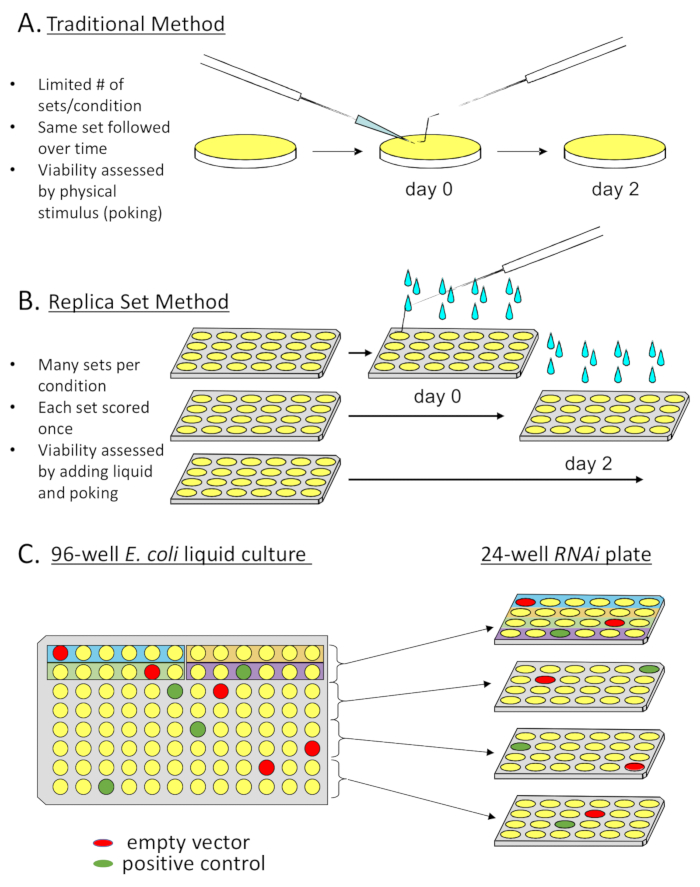
The following protocol is an excerpt from Cornwell et al, The Replica Set Method: A High-throughput Approach to Quantitatively Measure Caenorhabditis elegans Lifespan, J. Vis. Exp. (2018).
1. Preventing progeny production by the addition of 5-Fluoro-2'-deoxyuridine (FUdR)
- Grow animals until L4 stage at 20 °C. Check to see whether synchronized animals have developed to L4 approximately 40 h after seeding (step 2.1.7).
NOTE: C. elegans developmental time will vary at different temperatures and growth rates of mutant animals for which rates have not been characterized must be empirically tested.
- Add 160 µL of 50x FUdR to each 6 cm plate with L4 animals.
NOTE: It is critical to add FUdR at the L4 stage. For convenience, make 1,000x stocks of FUdR by dissolving 1 g FUdR into 10 mL ultrapure H2O. Filter-sterilize stock FUdR with a 0.2 µm filter and a 10 cc syringe. Aliquot ~1 mL of stock into sterile 1.5 mL tubes. Freeze and store at -20 °C.
- Inspect plates for the presence of male C. elegans. Remove all males.
NOTE: Lifespan is typically measured for hermaphrodites and not males. Hermaphrodites that mate live shorter than unmated animals, even in the presence of FUdR. Males are smaller and thinner than hermaphrodites and can be easily identified by a distinctive hooked tail.
- Put box back into the zip-lock bag. Return to 20 °C incubator.
2. Scoring viability
- Score viability daily by gently touching the animal on the head with a platinum wire or eyelash. Score animals that fail to move as dead and remove them from the plate (Figure 1A). Record the number observed dead for each condition for every observation time point.
NOTE: To reduce the risk of scoring bias, the experimenter must remain blind to experimental conditions and similarly must not reference the results from previous time points during scoring.
- Censor animals that rupture, die from other obvious development defects, or crawl up on the side of the dish: remove these animals and record the number at each observed time point for consideration in the statistical analysis. Additionally, if males are found, remove them and record the number observed.
- Repeat from step 2.1 daily until no animals remain alive.
NOTE: Should the lawn of E. coli diminish significantly or fungus begins to grow upon the plate, transfer all remaining animals to a fresh plate with the appropriate RNAi and FUdR.